
Nigeria receives more than $22 billion a year in personal remittances; however, much of the country's diaspora wealth remains outside formal domestic investment channels.
A private gateway planned for October says it can connect identity, banking and vetted opportunities.
Its real test will be transparent governance, investor protection and evidence that capital reaches productive assets.
Diaspora Money Meets Nigeria's Trust Test
Nigeria is approaching a consequential experiment in diaspora finance. The Nigeria Diaspora Investment Gateway (NDIG), a private-sector initiative chaired by productivity consultant Dr Sam Ikoku, says it will launch on 1 October 2026 as a single entry point linking Nigerians abroad to investment products, professional networks, verification services and public institutions.
The opportunity is unusually large.
- The World Bank's personal-remittances series reports about $22.8 billion received by Nigeria in 2025, up from $22.1 billion in 2024.
- By comparison, the Bank's net foreign-direct-investment series totals approximately $15.3 billion across the seven years from 2019 through 2025.
One year's remittance flow is therefore larger than several years of net FDI combined.
But scale is not the same as investability.
- Remittances pay school fees, rent, food and medical bills; that household function is development finance in its own right.
- The policy challenge is to create voluntary, protected routes through which savers can allocate part of their wealth to long-term assets without weakening family welfare or replacing due diligence with patriotism.
Remittance Scale Has Outrun Investment Channels
Ikoku's central argument is that Nigeria no longer lacks every component of a diaspora-investment system.
In his 26 August article, he points to remote identification, dedicated non-resident accounts, sovereign securities, housing finance and legal protections as a trust layer that can be connected.
He describes NDIG as the door rather than the bank, regulator or payment processor.
That distinction matters.
- The CBN and NIBSS launched the Non-Resident Bank Verification Number platform on 13 May 2025, allowing eligible Nigerians abroad to obtain a BVN remotely.
- The CBN had already introduced the Non-Resident Nigerian Ordinary Account and Non-Resident Nigerian Investment Account on 10 January 2025 to support remittances, fund management and investment in naira and foreign currencies.
These reforms reduce access friction; however, they do not erase currency, project, counterparty or policy risk.
- A digital identity proves who an investor is; it does not prove that a project is bankable.
- A dedicated account makes transactions easier; it does not guarantee returns.
The next layer must therefore convert access into informed choice, traceable custody and enforceable rights.
New Rails Connect Identity, Accounts and Assets
The investment menu is widening.
- Nigeria's $300 million, five-year Diaspora Bond issued in 2017 was redeemed at maturity in June 2022.
- The DMO's 2024 domestic US-dollar bond programme was sized at $2 billion; Series 1 targeted up to $500 million, carried a 9.75 per cent coupon and allowed diaspora participation from a $10,000 minimum subscription.
Housing has also acquired an institutional route.
- FMBN launched its NHF Diaspora Mortgage Loan in London on 7 August 2026. Eligible contributors may access up to N100 million at 9% a year for a maximum ten-year tenor, subject to affordability and other requirements.
- NIPC also confirms that Nigeria's investment laws protect repatriation of capital, dividends and profits after applicable taxes, although sector rules and the statutory negative list still apply.
NDIG says its planned platform will curate opportunities, vet private businesses, verify counterparties, support permits, connect professionals and provide a policy and compliance hub.
It also says investor money will move through regulated banks, capital-market operators and public institutions rather than sit with the gateway.
- That architecture could reduce informal brokerage, but only if every link is independently verifiable.
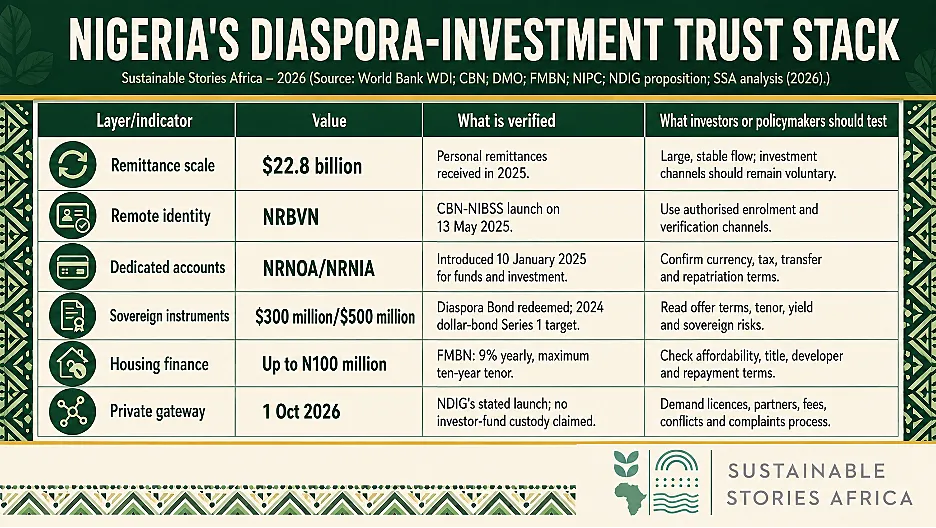
Editorial verification note: NDIG is a private initiative scheduled to launch on 1 October 2026. Its proposed services, partnerships and opportunity-vetting claims should be independently confirmed before publication or investment.
Patient Capital Could Finance Productive National Growth
A trusted system could broaden what diaspora participation means.
- Instead of a binary choice between sending money for consumption and keeping savings offshore, households could build diversified portfolios that include sovereign debt, mortgages, regulated funds, private credit, infrastructure and equity.
- Even a modest, voluntary allocation of annual flows would create a meaningful pool of long-term capital.
Product design must reflect a financially diverse diaspora.
- A professional in Toronto, a nurse in London and a contract worker in the Gulf will not share the same income cycle, risk tolerance or need for liquidity.
- Low minimum subscriptions, recurring contributions, plain-language risk summaries and transparent foreign-exchange costs would widen access without pretending every product fits every saver.
- Providers should also distinguish emergency family transfers from investable savings, so mobilisation targets do not create pressure to divert money from essential household needs.
The development prize is not simply foreign exchange.
- Well-designed products could finance housing supply, renewable energy, logistics, health facilities and growth-stage businesses while producing market-rate returns.
- Project-level disclosure could also improve capital discipline: sponsors would need to show permits, land title, revenue models, procurement, safeguards, milestones and use of proceeds before asking citizens abroad to carry risk.
The alternative is familiar.
- When formal options are difficult to find or poorly explained, savings move through unregulated intermediaries, speculative property deals or offshore platforms.
- Trust lost through one failed scheme can contaminate an entire market.
The gateway's value will therefore be measured less by registrations than by verified transactions, repeat investors, complaints resolved and projects completed.
Trust Requires Disclosure, Protection and Performance
Before launch, NDIG should publish its legal status, ownership, advisory-board mandate, partner institutions, fee schedule, conflict-of-interest rules, data-protection controls and precise limits of responsibility.
- Each opportunity should identify the regulated issuer or sponsor, custodian, receiving account, applicable licence, risk rating, exit terms and grievance route.
- Marketing language such as 'vetted' must be backed by a disclosed methodology and named accountable parties.
Regulators and public institutions should provide confirmation channels so investors can verify products and counterparties directly.
- SEC registration, DMO offer documents, FMBN eligibility and NIPC protections should be linked at source.
- A public warning list, standardised project disclosures and coordinated complaint handling would make fraud harder and reduce the burden on individual investors.
Product sponsors should report financial and development performance together.
- Useful metrics include capital mobilised, share invested in productive assets, jobs supported, housing units completed, local procurement, climate impact, defaults, fees, complaints and distributions to investors.
- Independent audits and periodic portfolio updates are essential if the platform wants to claim institutional credibility.
Diaspora investors must also resist the idea that affection for country substitutes for risk analysis.
- They should verify licences, read offering documents, understand naira and dollar exposure, test property title, diversify holdings and use regulated advice.
- Nigeria can welcome patriotic capital; however, the strongest signal of respect is to give it the same disclosure and protection expected by any professional investor.
Path Forward – From Gateway Promise to Investable Proof
Nigeria now has several credible rails for remote identity, accounts, sovereign securities and housing finance.
The immediate priority is to connect them without confusing institutional access with investment assurance.
NDIG can earn trust by publishing governance, custody, fees, vetting and performance data before mobilisation begins.
Regulators, issuers and investors should make independent verification routine, protect household remittances and open voluntary routes to productive capital.