China has built the world's largest electricity system and an unmatched fleet of wind, solar, batteries and transmission. The next phase is less visible and more difficult.
Episode 303 of Energy Unplugged argues that flexibility, inter-provincial trade and market design must now catch up with construction, a warning for African systems expanding renewables today.
China's Clean-Power Success Creates Integration Pressure
For more than a decade, China's energy transition could be measured in factories built, gigawatts installed and transmission corridors completed. That construction story remains extraordinary.
However, the country's central challenge is shifting from adding equipment to coordinating a power system whose rules, prices and provincial interests were not designed for such a large share of variable generation.
That was the focus of the 44-minute Energy Unplugged episode published on 25 August 2026. Aurora Energy Research's APAC research head Lara Panjkov and China market lead Zelin Chen joined Anders Hove, Senior Research Fellow at the Oxford Institute for Energy Studies, to examine market reform, grid flexibility, storage, coal and the balance between central direction and provincial decision-making.
Their question extends beyond China.
- African countries need far more generation and grid investment, but they can still avoid designing tomorrow's congestion into today's renewable boom.
- China's experience shows that installed capacity is only the beginning; reliable, affordable electricity depends on dispatch, trade, demand response and incentives that value flexibility.
A Vast System Reaches Its Limits
Chen opened with the scale of the system:
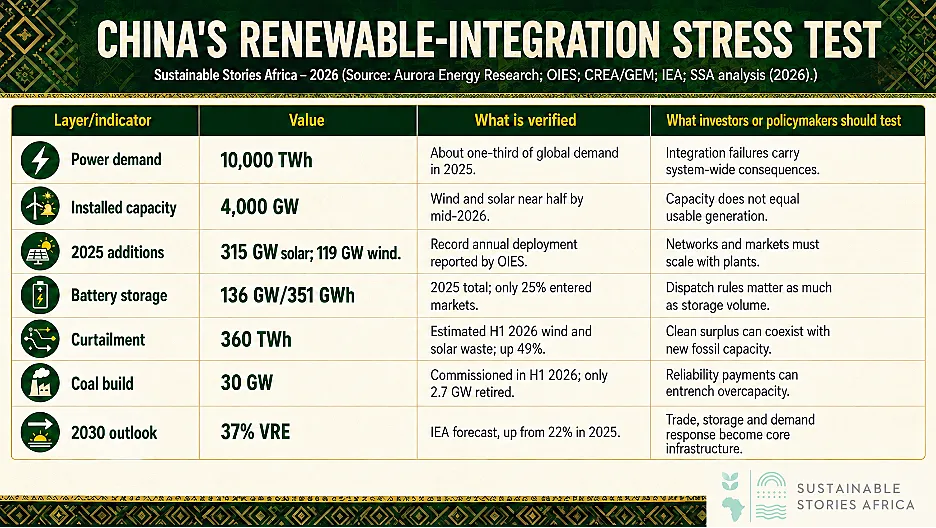
- Chinese power demand reached about 10,000 terawatt-hours in 2025, close to one-third of global demand, while installed capacity approached 4,000 gigawatts by mid-2026.
- Wind and solar were nearing half of total installed capacity.
Those figures describe a clean-technology superpower; however, they also magnify every coordination failure.
Hove calls the present stage a 'messy midgame'. The major pieces, including provincial spot markets, new renewable auctions, capacity payments, storage, long-distance grids and green certificates, are on the board.
However, the system remains fragmented by technology and province, so a new mechanism can solve one problem while worsening another.
The physical symptoms are familiar across changing power systems: transmission bottlenecks, renewable overproduction at certain hours, price volatility, weak incentives for flexible demand and generators protected by administrative contracts.
China's difference is scale. When surplus cannot move, or demand cannot shift, the wasted electricity can be measured in hundreds of terawatt-hours.
Markets Lag Behind the Building Boom
China's renewable buildout continues to outpace the market mechanisms needed to absorb it.
- Hove's April 2026 OIES paper shows solar capacity reaching 1,202 GW after 315 GW of additions in 2025
- Wind hit a record 640 GW following 119 GW of new installations.
- Battery storage grew to 136 GW/351 GWh.
However, State Grid data shows only 25% of that capacity participated in market transactions, evidence that assets are multiplying faster than the rules governing their use.
Document 136, effective June 2025, restructured renewable pricing by shifting provinces toward contract-for-difference wind and solar auctions, typically covering 80% of a project's output while exposing the rest to wholesale prices.
This should deepen trading and lower support costs, though low auction prices and thin spot markets risk undermining project economics.
The starkest signal is curtailment.
- CREA and Global Energy Monitor estimate China curtailed 360 TWh of wind and solar in H1 2026, up 49% year-on-year and equivalent to all incremental electricity demand over that period.
Meanwhile, 30 GW of coal capacity came online against just 2.7 GW retired.
- This estimate far exceeds China's official curtailment rate (9.2% for solar, 8.5% for wind in January – February 2026), exposing a governance gap: inconsistent definitions of available generation obscure whether losses stem from technical constraints or contractual and grid barriers.
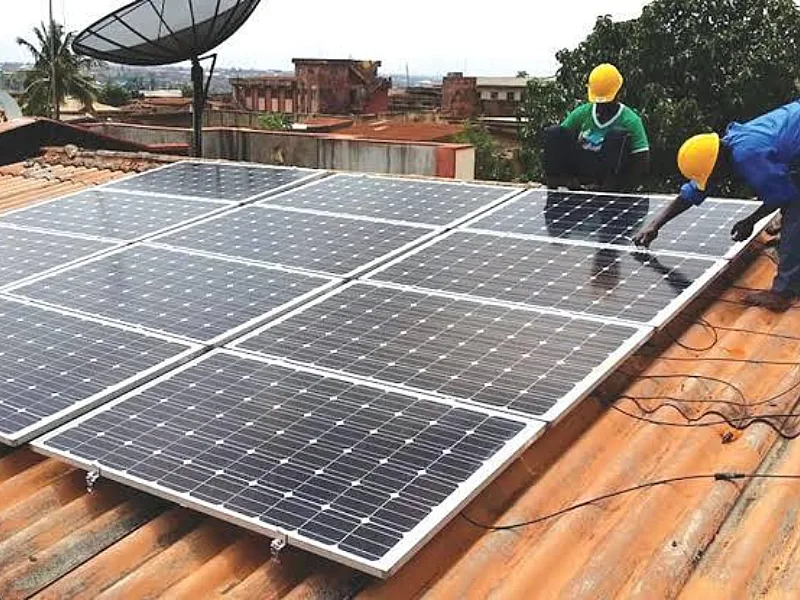
Africa lens: China's integration problem emerges after immense overbuilding. African markets should not copy that pathway; they should coordinate new capacity with networks, regional trade, affordability and flexible resources suited to local supply gaps.
Flexibility Can Turn Surplus Into Security
China's build-out still creates an enormous decarbonisation opportunity.
- The IEA expects low-emissions sources to meet all additional Chinese electricity demand from 2026 to 2030.
- It forecasts the variable-renewable share of generation rising from 22% in 2025 to 37% in 2030, with total renewables approaching half of generation.
Capturing that value requires a system that can move power across provincial borders, store it, shift industrial and digital demand, and reward fast response.
More frequent spot trading, better alignment between short- and long-term contracts, technology-neutral adequacy payments and transparent curtailment data would help operators choose the least-cost flexibility option rather than defaulting to protected local assets.
The payoff is broader than emissions.
- Efficient integration reduces fuel exposure, limits stranded assets and protects commercial and industrial users from avoidable system charges.
- It can also make electrification more credible for transport, buildings and heavy industry.
Cheap panels do not create cheap power if networks, contracts and dispatch keep the electricity from reaching useful demand.
Reform Must Reward Flexibility Across Borders
China's priority is turning its national power market from aspirational to operational.
- Provincial spot markets need deeper liquidity and shorter settlement cycles, while inter-provincial transmission should respond to real-time surplus and scarcity rather than fixed schedules.
- Capacity payments should purchase measurable reliability from coal, gas, storage, demand response and interconnection on comparable terms.
- Renewable policy needs consistency too: auction prices should stay competitive without becoming uneconomic, and green certificates, carbon markets and renewable obligations should reinforce rather than duplicate each other.
African policymakers should adapt this lesson, not replicate the system.
- Most African markets face inadequate supply and weak grids rather than Chinese-style overcapacity; however, procurement can pair new solar and wind with transmission, storage and demand-response plans from the outset.
- Regional power pools can function as reliability infrastructure through transparent wheeling rules and bankable cross-border contracts.
Timing matters:
- The IEA projects solar PV will supply about 28% (55 TWh) of Africa's additional electricity from 2026 – 2030.
Rewarding delivered, dispatchable power, rather than just new megawatts, can prevent early congestion.
Path Forward – Capacity Must Become Reliable, Affordable Electricity
China's next transition milestone is not another capacity record. It is a power market that moves, stores and prices clean electricity when and where customers need it.
For Africa, the lesson is to design flexibility early: align generation with grids, regional trade, storage and responsive demand.
Success should be measured in reliable, affordable delivered power - not installed megawatts alone.