Africa’s energy challenge is no longer only about money. The AESTAP Status Report 2025 argues that technical assistance, better data, stronger regulators, bankable plans and digital utilities are becoming the machinery that turns reform into investment.
With Mission 300 targeting electricity and clean cooking access for 300 million Africans by 2030, the report asks a sharper question: can African markets build the institutions fast enough to unlock capital, reliability and inclusive growth?
Technical Assistance Moves To Energy Centre
Africa’s energy transition is entering a more practical phase. The headline is not only solar plants, transmission lines or billion-dollar commitments.
It is the quieter work of regulation, utility reform, data systems, policy design and project preparation, the technical assistance that makes large-scale investment possible.
The African Development Bank’s AESTAP Status Report 2025 places that work at the centre of Africa’s power sector future.
Through the Africa Energy Sector Technical Assistance Program, the Bank is positioning upstream support as a bridge between political ambition and bankable delivery.
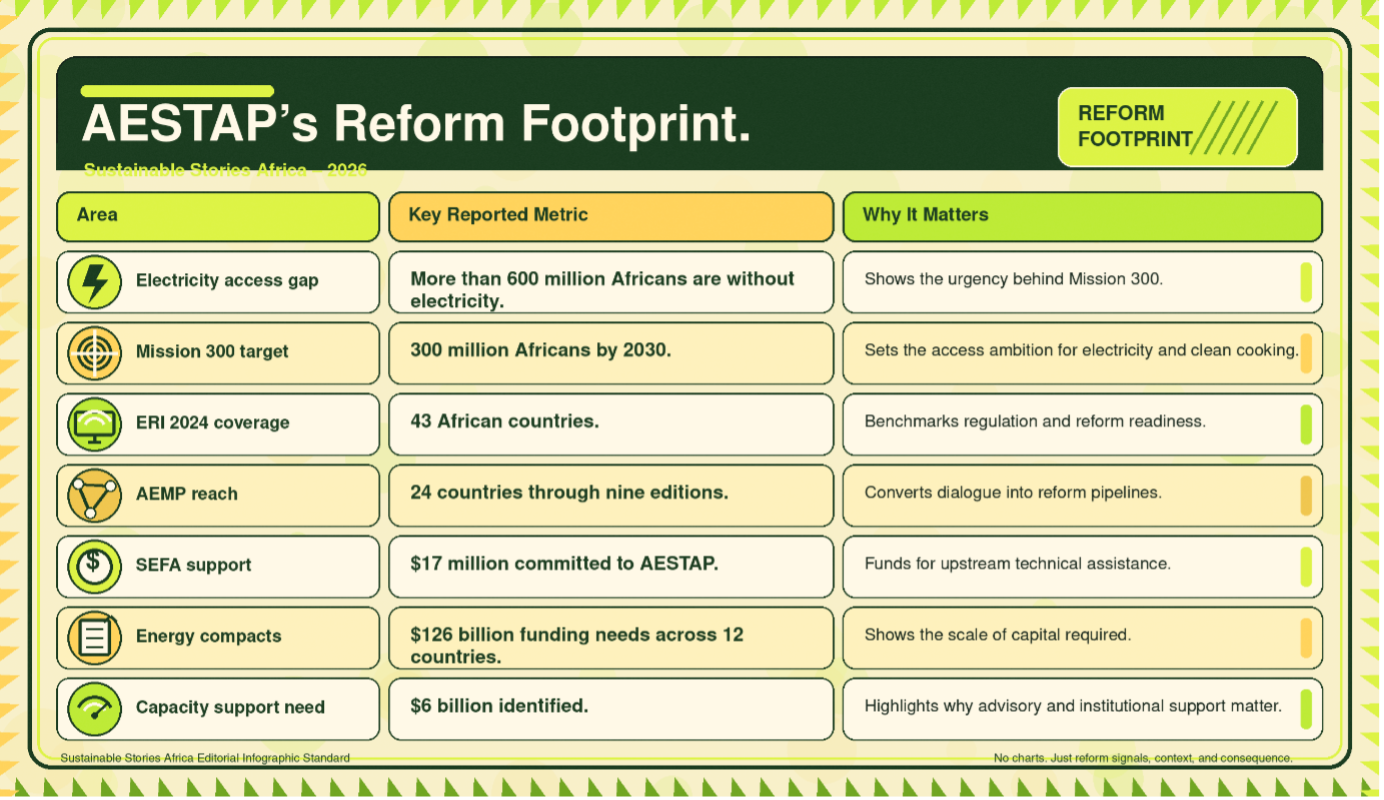
The stakes are immediate. More than 600 million Africans still lack electricity, while many utilities remain financially weak, regulators are under-resourced, and markets are fragmented.
For households, this means darkness, diesel, unsafe cooking and lost productivity. For investors, it means risk. For governments, it means that energy access targets cannot be reached by finance alone.
Africa’s Energy Gap Demands Reform Now
AfDB Vice President Kevin Kariuki’s message is clear: technical assistance is the foundation for stronger private-sector engagement in Africa’s energy sector, because capital follows clarity.
That is the gap AESTAP is designed to close. The programme helps governments, regulators, utilities and regional institutions address upstream barriers that slow investment, including weak policy alignment, uncertain tariffs, poor data, fragile utility governance and limited market coordination.
Its four pillars cover data, knowledge and policy dialogue; power-sector policy, regulation and planning; sustainable utility transformation; and regional integration and power markets.
The report shows AESTAP moving from a support function to a strategic enabler, backing regulatory indexes, policy dialogues, digital systems, Mission 300 energy compacts and regional reforms.
In effect, technical assistance is becoming invisible infrastructure, shaping credible tariffs, bankable projects, reliable utilities and confident private investment.
Evidence Shows Reform Is Becoming Bankable
The Electricity Regulatory Index 2024 gives AESTAP a clear reform signal. The ERI assesses electricity regulation in 43 African countries, measuring governance, substance and outcomes. Since 2018, it has become a diagnostic tool for reform.
In Kenya, Egypt and Togo, the report links ERI participation to stronger regulation, stakeholder engagement, tariff methodologies and transparent decisions. For investors, predictability matters because it lowers uncertainty and supports long-term capital commitments.
AESTAP has also helped policy dialogue become national reform. In Nigeria, the 8th Africa Energy Market Place supported the National Integrated Electricity Policy and implementation of the 2023 Electricity Act.
Signed on May 5, 2025, the policy advances decentralisation by giving states authority to regulate electricity, improving accountability, investment and access for more than 90 million unserved Nigerians.
In Tanzania, the 9th Africa Energy Market Place informed the Energy Compact, January 2025 Presidential Energy Summit agenda and 2024–2034 National Renewable Energy Strategy.
Better Systems Can Lower Investment Risk
AESTAP’s greatest contribution may be its ability to reduce investment risk before projects reach financial close.
For investors, risk extends beyond resource potential to the credibility of tariffs, regulatory independence, utility data quality and transparent procurement systems.
The report shows how technical assistance can translate into bankable energy projects.
- In Togo, the Sokodé Solar Project has secured €26.5 million in AfDB support for the country’s first privately financed solar PV plant.
The project is expected to deliver 42 MWac, generate 87 GWh of renewable electricity annually, benefit more than 700,000 people and avoid 13,600 tonnes of emissions each year.
- In Mozambique, the $43.6 million Namaacha-Boane Transmission Line will evacuate up to 120 MW of clean energy and strengthen regional power trade.
- Egypt’s 1.1 GW Suez Wind Power Project is expected to generate 4,111 GWh annually, power over one million households, and offset 1.71 million tonnes of CO₂, demonstrating how strong institutions enable energy transition at scale.
Digital Utilities Can Strengthen Public Trust
Digital transformation is emerging as a core pillar of power-sector reform. Through AESTAP, the AfDB is supporting energy-sector Database Management Systems (DBMS) in Liberia, Uganda, Ghana, Tanzania and Nigeria.
Liberia launched its regulatory DBMS in March 2025, while similar initiatives are advancing across the continent.
The significance is straightforward: effective energy reform depends on reliable data.
- Regulators need data to set tariffs and monitor utilities
- Utilities need it to manage losses and service delivery
- Governments require it for planning, and investors depend on it to assess market risk.
In markets where energy information remains fragmented or outdated, digital regulatory platforms can improve transparency, accountability and investment confidence.
Better data also supports better public services by enabling performance monitoring and evidence-based decision-making.
Ultimately, trust is at the centre of reform. Transparent data and credible institutions help build public confidence in difficult but necessary changes, including tariff adjustments, market restructuring and greater private-sector participation.
Regional Power Trade Needs Shared Rules
The report highlights regional integration as a critical solution to Africa’s energy challenge.
While some countries have surplus resources and renewable potential, others face supply shortages, making cross-border cooperation essential for reliability, affordability and energy security.
Through AESTAP, regulatory harmonisation efforts are advancing across COMESA, ECOWAS, ECCAS and SADC.
In COMESA, a $1.5 million technical assistance programme has supported harmonised regulations, utility performance monitoring, tariff and cost-reflectivity assessments, and a centralised energy information system.
Though relatively small in value, these reforms can significantly reduce investor risk, strengthen regional power pools and enable countries to share excess capacity while avoiding costly generation investments.
The importance of this work is growing as Mission 300 moves into implementation.
Backed by the Dar es Salaam Declaration, technical assistance remains central to electrification, institutional reform and private-sector mobilisation, alongside a planned $48 billion AfDB–World Bank electrification effort.
Delivery Now Depends On Institutional Ownership
The next phase of Africa’s energy transition will depend on execution.
At the Mission 300 Summit in Dar es Salaam, 12 African countries presented national energy compacts with a combined funding requirement of $126 billion, while a further 20 countries are preparing their own plans.
AESTAP’s focus is now shifting toward delivery. Over the next 12 to 24 months, the programme will support Compact Delivery and Monitoring Units, reform implementation, integrated resource planning, database systems, regional power integration and the removal of key investment bottlenecks.
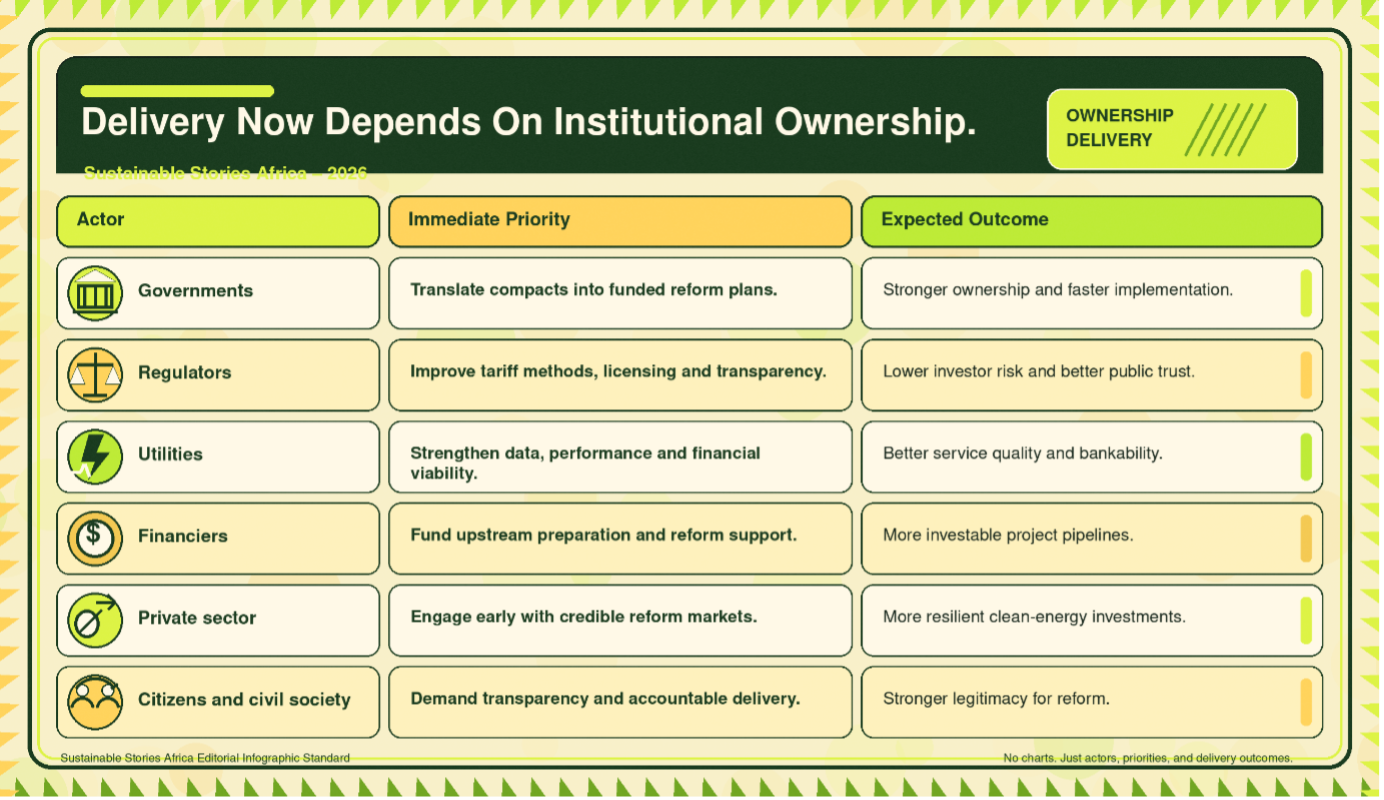
The opportunity is significant. Effective technical assistance can help translate energy compacts into electricity connections, stronger utilities, expanded renewable energy, cleaner cooking solutions and deeper regional power trade.
The cost of delay is equally high. Without stronger institutions and faster reforms, ambitious projects may continue to stall, financing costs could remain elevated, and millions of Africans may remain reliant on unreliable electricity and unsafe cooking fuels.
Path Forward – Build Rules That Deliver
AESTAP’s message is that Africa’s energy future will be built through both capital and capacity.
Finance matters, but rules, data, institutions and delivery systems will determine whether that finance becomes reliable power.
The priority now is disciplined implementation: fund technical assistance, strengthen regulators, digitalise utilities, support compacts and align national reforms with regional markets.
If Africa gets this right, Mission 300 can become more than a target. It can become measurable progress.