
Academic freedom erodes systematically, not overnight. The Academic Freedom Index 2026 Update pinpoints the mechanism: institutional autonomy, universities' capacity to self-govern free from political, corporate, or ideological interference, as the gateway protecting or destroying all other academic freedoms.
Drawing on 2,357 country experts and over one million data points, AFI 2026 confirms a near-perfect correlation (r=0.91) between autonomy and research/teaching freedom.
For Africa, where governance faces political interference and funding dependency, this finding offers both diagnosis and roadmap.
Autonomy First. Everything Else Follows.
The 2026 edition of the Academic Freedom Index makes a deliberate analytical choice: it centres its narrative on institutional autonomy, not because individual freedoms matter less, but because the data reveals that institutional autonomy is the primary lever through which individual freedoms are protected or undermined.
This is not a theoretical argument; it is empirically confirmed across 179 countries, over 25 years of data.
The relationship is logical once stated: a scholar who works in a university that can hire and fire on merit, set its own research agenda, determine its own curriculum, and reject politically motivated funding conditions is meaningfully freer than one who works in an institution where politicians control appointments, government agencies determine research priorities, and university leadership must satisfy non-academic power before academic excellence.
The 0.91 Correlation That Changes Everything
The AFI 2026 report presents a striking empirical finding. Plotting institutional autonomy (x-axis) against freedom to research and teach (y-axis) across 179 countries, averaged over the 2000 – 2025 period, reveals a Pearson correlation coefficient of r=0.91, statistically significant at the 0.001 level.
This is an extraordinarily high correlation for any cross-national governance study.
It means that institutional autonomy accounts for approximately 83% of the variance in freedom to research and teach across all 179 countries in the dataset.
In practical terms, knowing how autonomous a country's universities are tells you, with high reliability, how free its scholars are to pursue knowledge without political interference.
The report draws an explicit conclusion: "Institutional autonomy is positively associated with individual dimensions of academic freedom and suggests that more autonomous higher education institutions provide more robust safeguards for individual academics' freedom.
When institutional autonomy is undermined, higher education institutions and individual scholars become more exposed to external pressures, ranging from economic constraints to political and ideological restrictions."
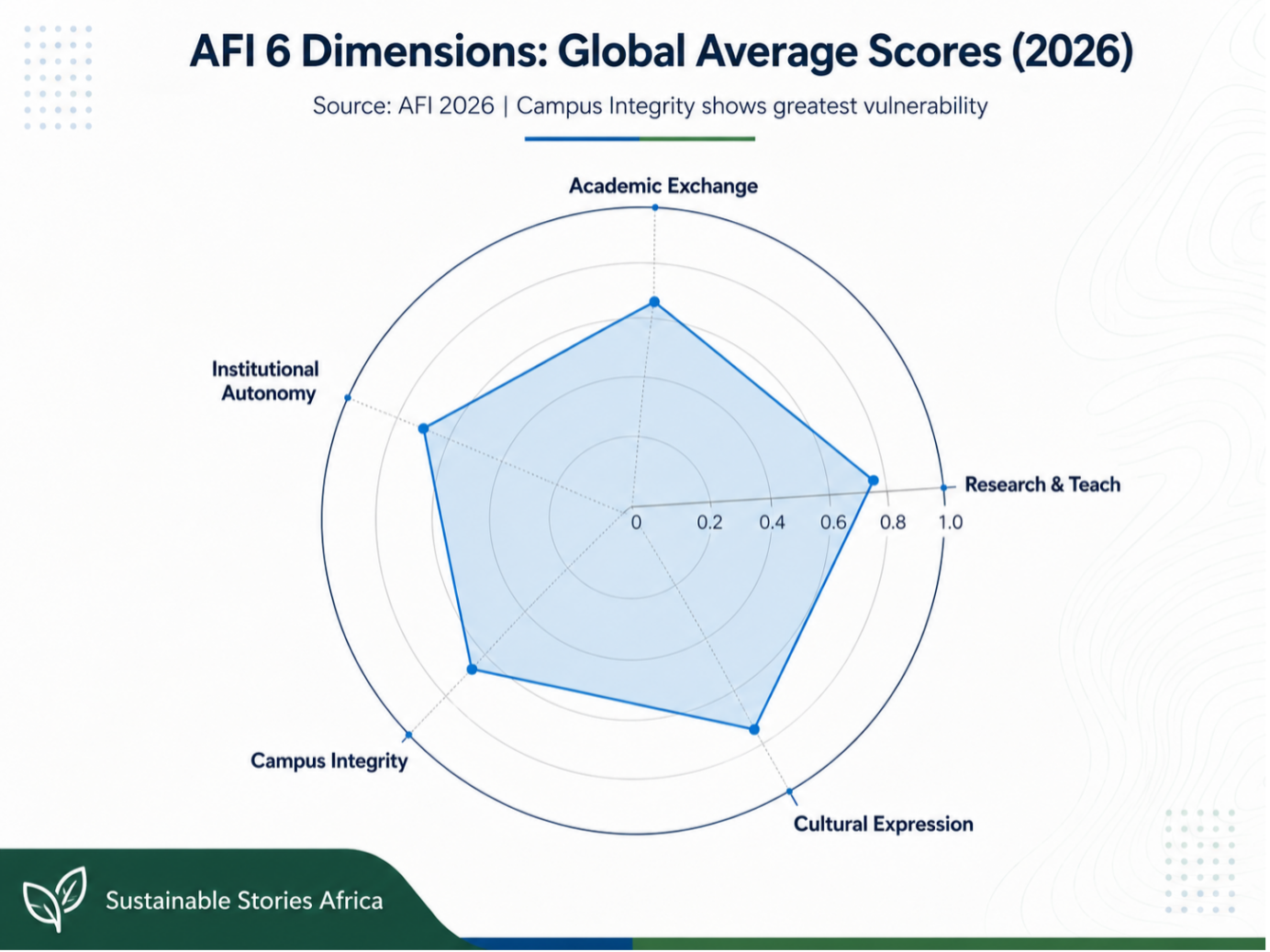
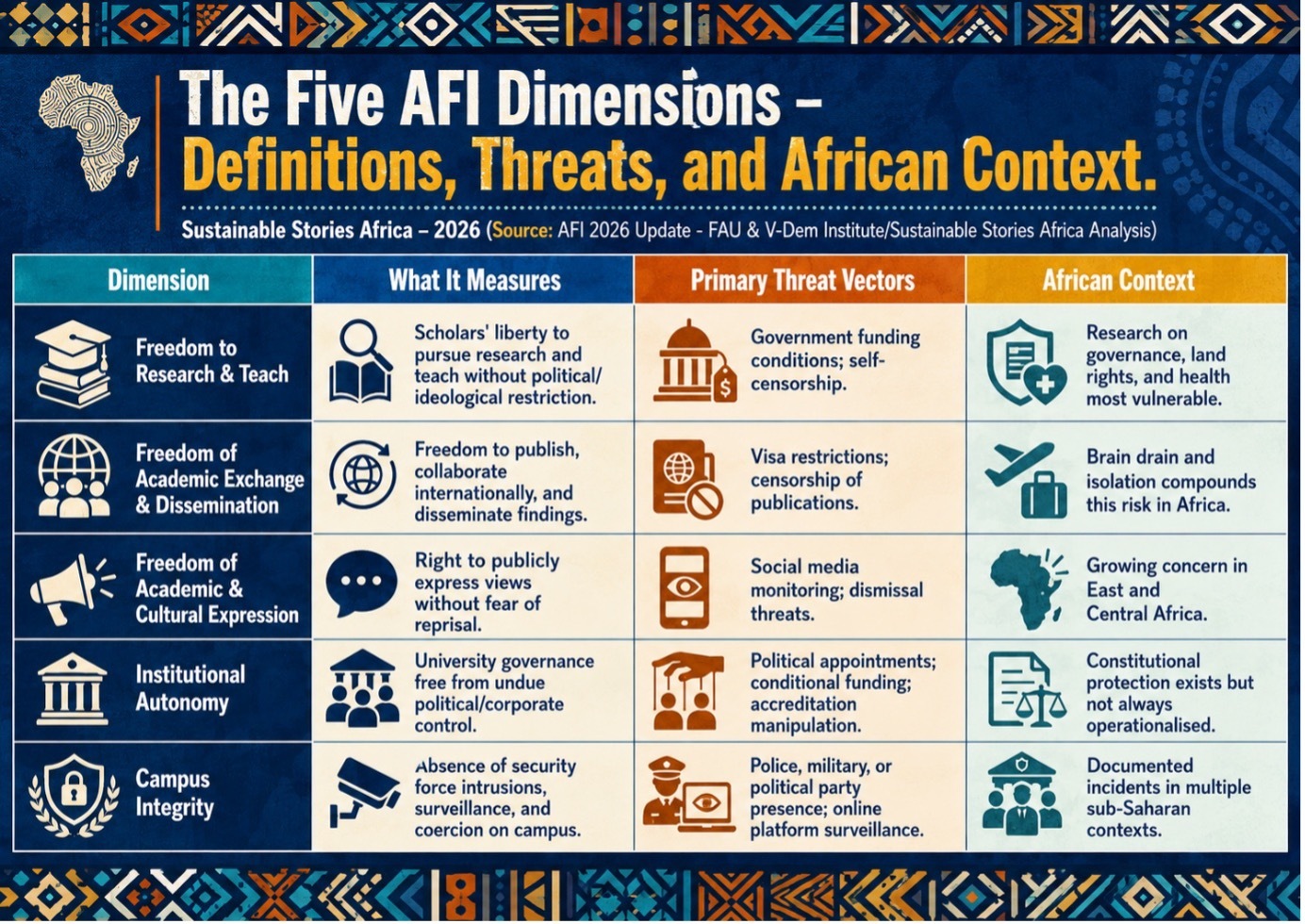
Five Dimensions, One System – How the AFI Measures Academic Freedom
The AFI 2026 measures academic freedom across five indicators, forming an integrated system in which each dimension both reinforces and depends upon the others:
Between 2015 and 2025, every one of these five dimensions deteriorated in more countries than it improved.
However, institutional autonomy proved the most resilient; 43 countries saw substantial declines, compared to 51 for research freedom and campus integrity.
This relative resilience is significant: institutional frameworks, once built and legally protected, show greater resistance to erosion than individual-level freedoms.
This can be curtailed by a single executive decision, a change in government funding policy, or a climate of political intimidation.
The Countries That Got It Right – Lessons From AFI Improvers
The AFI 2026 report identifies 9 countries that registered substantial improvements in overall academic freedom between 2015 and 2025.
While the majority of notable improvers are in Asia or Central America (Bahrain, Laos, Maldives, Uzbekistan, Panama), two Sub-Saharan African countries appear as positive cases for institutional autonomy: The Gambia and the Democratic Republic of Congo.
These are not wealthy countries. They are not countries with historically strong institutions. What they share is a deliberate post-transition commitment to rebuilding university independence as part of broader democratic reforms.
- In The Gambia's case, the post-Jammeh transition explicitly addressed higher education governance as part of institutional reconstruction.
- In the DRC, amid continued fragility, specific improvements in how universities relate to the state have been recorded by expert coders.
The lesson for Africa is powerful: academic freedom improvement is not reserved for rich democracies.
It is available to any government with the political will to protect it. Constitutional codification enshrined in law with enforcement mechanisms is the most durable protection available.
As of 2022, constitutional protections for university autonomy are widespread in Latin America, Central Asia, and parts of Europe, a model African constitutions can emulate and strengthen.
Building the Institutional Architecture That Protects Academic Freedom
The AFI 2026 data points to five actionable institutional design principles that African universities and governments should adopt:
Constitutionalise university autonomy;
- Formal legal protection is more durable than ministerial goodwill.
- Constitutional provisions for university self-governance, with enforcement mechanisms, should be a policy priority for African constitutional review processes.
Diversify university funding
- Universities that depend exclusively on government funding are more vulnerable to political pressure.
- Building endowments, research grants, philanthropic partnerships, and competitive international funding reduces the leverage of any single political actor over institutional independence.
Establish independent governing boards
- Boards composed of academics, independent professionals, and civil society representatives, not government appointees, are a structural safeguard for institutional autonomy.
Build regional academic freedom solidarity
- African universities should establish continental mechanisms for monitoring, reporting, and responding to academic freedom violations, analogous to Scholars at Risk at the global level, but rooted in the African context and values.
Embed academic freedom in accreditation standards
- African accreditation bodies should include institutional autonomy indicators in their quality assurance frameworks, creating a market incentive for universities to protect rather than erode their independence.
Path Forward – Autonomy Is Not a Luxury
The AFI 2026 data end the debate that should never have been opened: institutional autonomy is not an indulgence of wealthy democracies or a luxury of stable governance environments.
It is the primary mechanism through which knowledge is kept honest, scholarship is kept fearless, and universities fulfil their fundamental social contract, to seek truth and educate free minds.
Africa's universities are the continent's most important long-term development assets. Their autonomy must be treated as a strategic imperative, not an administrative afterthought. The data says so. Now it is time for policy to follow.