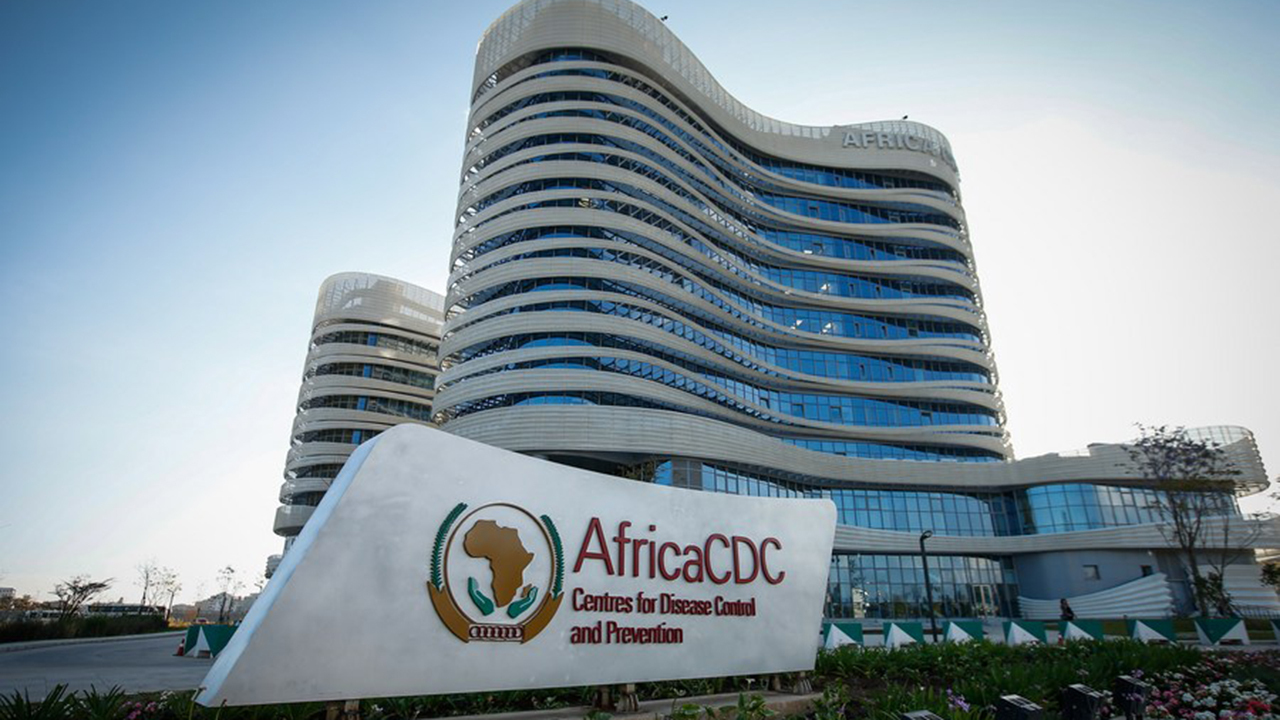
Africa CDC says health research and development could become one of the continent’s strongest economic bets, adding $668 billion to GDP over 20 years if governments meet the African Union’s 1% R&D target and reserve 15% for health.
The question is no longer whether health innovation matters.
It is whether African governments, investors and regulators can build the market infrastructure that turns science into jobs, exports and resilience.
Health Research Becomes Africa’s Growth Test
Africa CDC is making a direct economic case for a new kind of health sovereignty: invest in African health research and development, or keep paying the price through import dependence, lost talent, weak manufacturing capacity and avoidable vulnerability to disease shocks.
In its May 2026 report, Investing in Health R&D: Africa’s Next Economic Growth Frontier, Africa CDC, with Global Health Ecosystems and the AU-EU Health Partnership, argues that health R&D is no longer only a public health priority.
It is industrial policy, jobs policy, fiscal policy and resilience policy.
The report lands at a tense moment. Aid budgets are tightening, African health systems remain exposed to external supply chains, and governments are under pressure to deliver growth with limited fiscal space.
The evidence suggests that building laboratories, trial platforms, data systems, manufacturing capability and commercialisation pathways could become one of Africa’s most powerful development bets.
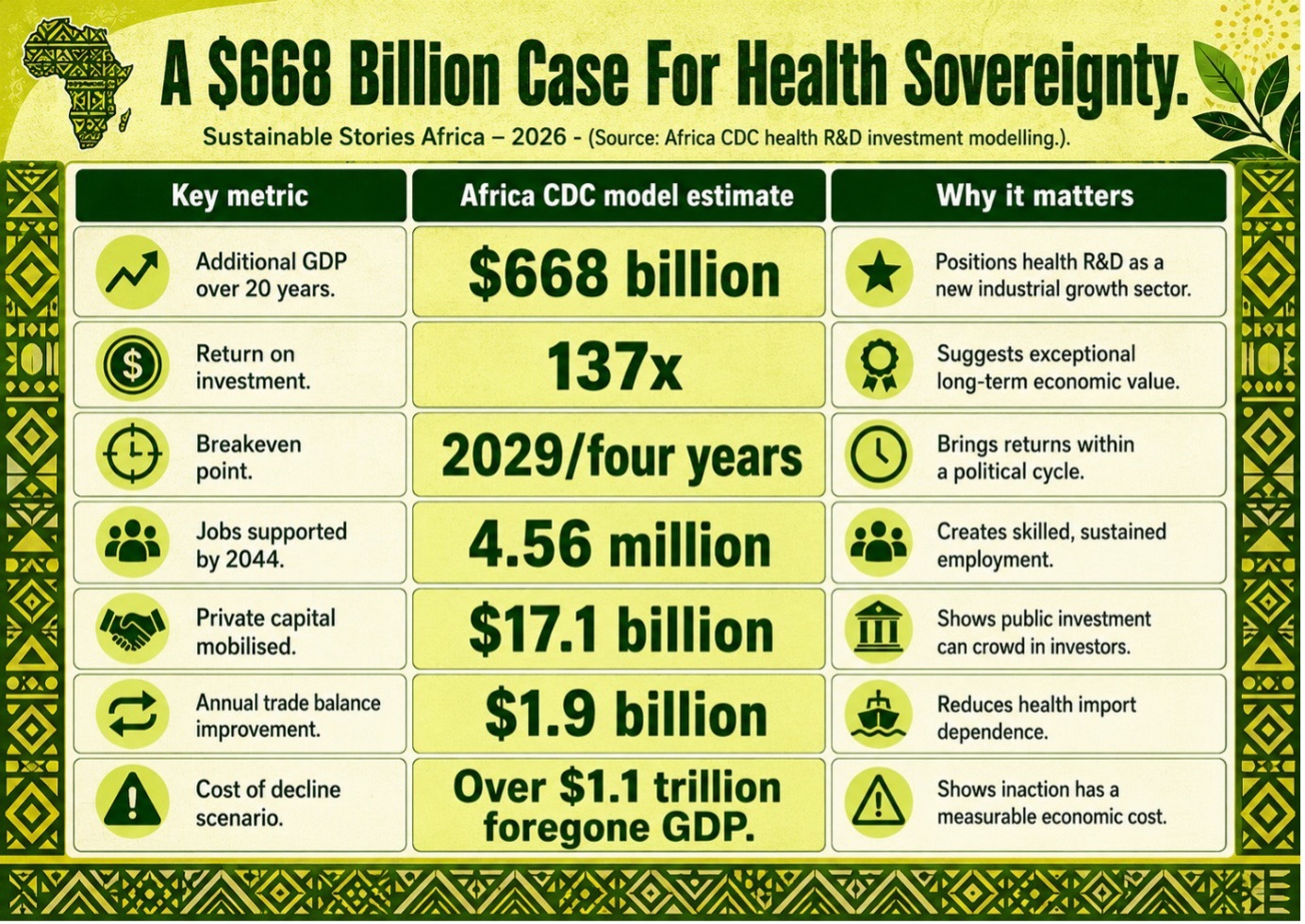
A $668 Billion Case For Health Sovereignty
The headline number is striking: if Africa reaches the African Union’s target of investing 1% of GDP in research and development, with 15% of that committed to health R&D, the continent could generate $668 billion in additional GDP over 20 years.
Africa CDC’s model estimates a 137-times economic return and a breakeven point within four years, meaning returns begin within a single political cycle.
That matters because Africa is still treated too often as a consumer of health innovation rather than a producer. The continent carries an estimated 25% of the world’s disease burden; however, it remains underrepresented in the global research systems that design, test and manufacture medicines, diagnostics and vaccines.
In 2023, only 819 of 20,825 clinical trials initiated globally were conducted in African countries.
- For policymakers, the report reframes health spending as productive capital.
- For investors, it presents health R&D as an investable growth frontier.
- For citizens, it connects high-level financing decisions to tangible outcomes: better diagnostics, stronger local manufacturing, skilled jobs, faster outbreak response and reduced exposure to global supply disruptions.
The Numbers Behind Africa’s R&D Gap
Africa's research and development deficit carries both scientific and economic consequences.
The continent holds approximately 19% of the global population; however, it accounts for just 1.1% of worldwide R&D investment.
Nearly two decades after the African Union called on member states to commit at least 1% of GDP to R&D, the continental average remains at 0.45%, less than a third of the global average of 1.7%.
This gap determines which diseases receive attention, where intellectual property is held, and where high-value research careers and commercial spillovers are created.
Africa largely imports finished products while its scientists operate within systems designed outside local realities. The urgency is compounded by a weakening donor landscape, including aid from DAC member countries, which fell 23.1% in real terms in 2025, representing a $40.3 billion decline.
That shift elevates the case for domestic resource mobilisation and blended finance.
Modelling across five channels, including GDP growth, employment, private investment, trade balance and researcher retention, confirms that public R&D spending builds the knowledge capital underpinning long-term industrial and economic transformation.
What A Working Health Innovation Market Unlocks
Africa's health innovation potential is no longer theoretical.
South Africa's Afrigen mRNA technology transfer programme, Egypt's pharmaceutical self-sufficiency trajectory and Rwanda's BioNTech mRNA facility each demonstrate that frontier health innovation is achievable when public institutions, technical partners and capital align.
Rwanda's facility is particularly instructive as a blended-finance model: BioNTech's $150 million investment in Kigali anchored a project that drew over $500 million in public, concessional and private commitments, illustrating how strategic public de-risking can unlock private capital at scale.
However, the report identifies a persistent structural gap: the "missing middle" between research and investable products.
Weak commercialisation pathways, fragmented regulation, limited capacity for technology transfer, and underdeveloped exit routes constrain progress.
As Sarah Ngamau of Moremi Fund, Kuramo Capital, observes, investors fund systems, not science in isolation.
A vaccine candidate or diagnostic tool only becomes an economic sector through clinical trial networks, harmonised regulation, patient capital and visible exit pathways.
That is Africa's real infrastructure challenge.
Who Must Move, And What Changes
- Governments must enshrine the AU's 1% GDP R&D target in national budgets, with a protected minimum of 15% allocated to health R&D, alongside tax incentives, advance purchase commitments and procurement reform to shape markets actively.
- Regulators must evolve from fragmented approval systems into market-building institutions. Under AfCFTA-linked frameworks and the African Medicines Agency agenda, a product approved in one country should not face prohibitive reapproval across neighbouring markets.
- Universities and research institutes must broaden their definition of success beyond publications. Technology transfer offices, researcher IP participation, royalty sharing and spin-off support are essential bridges between discovery and commercial application.
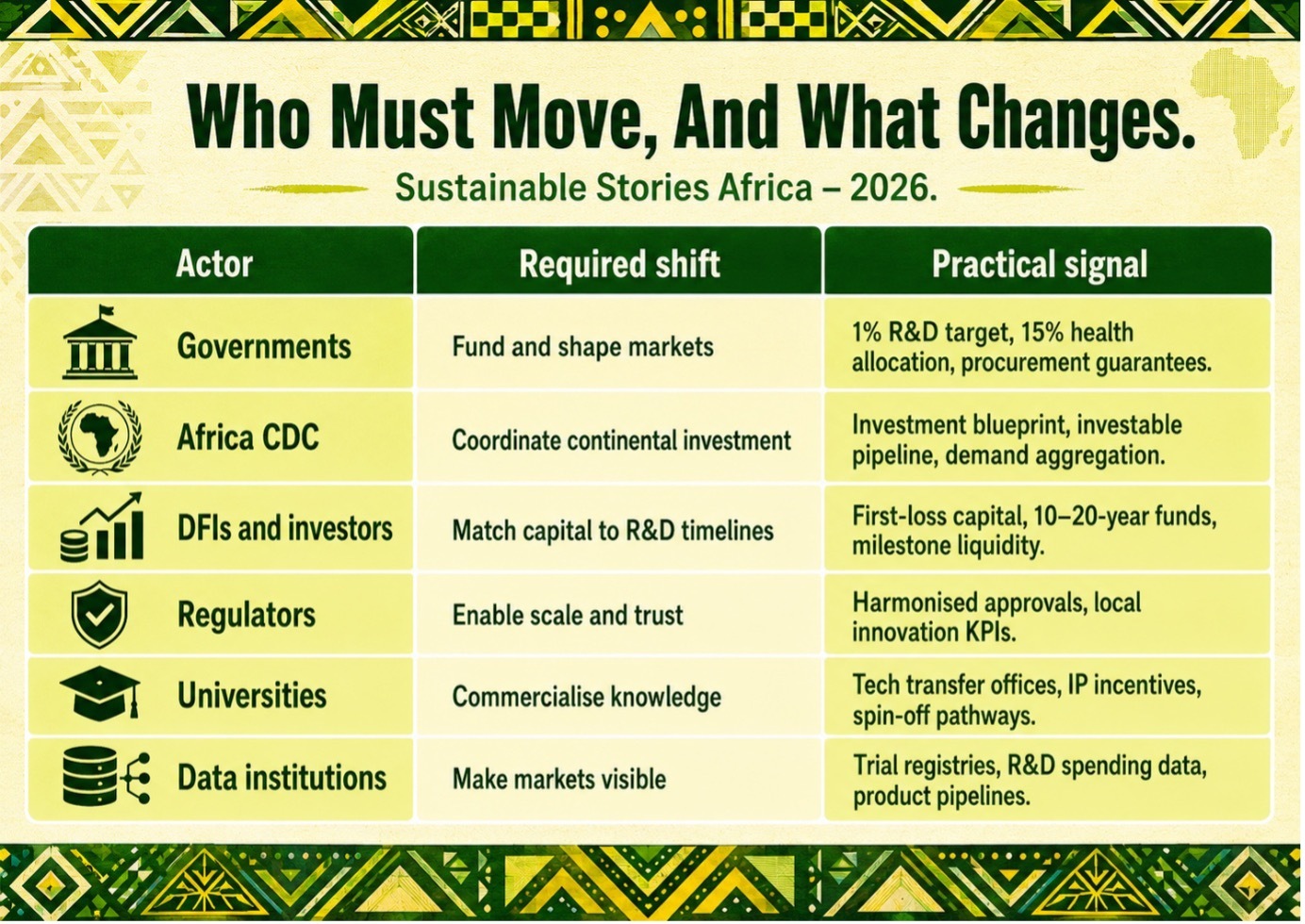
- Investors must align capital structures with R&D timelines. Blended finance vehicles with genuine risk-sharing, longer fund lives, milestone-based liquidity and credible exit infrastructure, including M&A facilitation, are necessary to attract and sustain health innovation investment.
Path Forward – Build The System, Then Scale Investment
Africa CDC’s message is pragmatic: Africa already has scientific talent, disease-relevant research questions, market demand and early proof points.
What is missing is the coordinated system that converts these assets into investable health industries.
The path forward is clear: fund R&D, harmonise regulation, build data systems, de-risk private capital and create commercialisation pathways.
Properly done, health R&D can become a foundation for African health sovereignty, industrial resilience, skilled employment and inclusive growth.