The world has a new financing pact; however, developing economies are entering 2026 with tighter budgets, costlier debt and falling aid.
The Financing for Sustainable Development Report 2026 says the SDG financing gap now exceeds $4 trillion annually, making the Sevilla Commitment an urgent test of whether global finance can still deliver for people, climate and growth.
Global Development Finance Enters Harder Terrain
The global development finance agenda has entered a decisive year. The United Nations-backed Financing for Sustainable Development Report 2026 warns that the world is trying to implement the Sevilla Commitment even as developing countries face a deep financing squeeze, weaker investment flows and rising climate-related fiscal pressure.
For African economies, the stakes are immediate. The report’s numbers translate into delayed roads, underfunded schools, fragile health systems, slower clean-energy deployment and limited fiscal room to protect households from food, climate and price shocks.
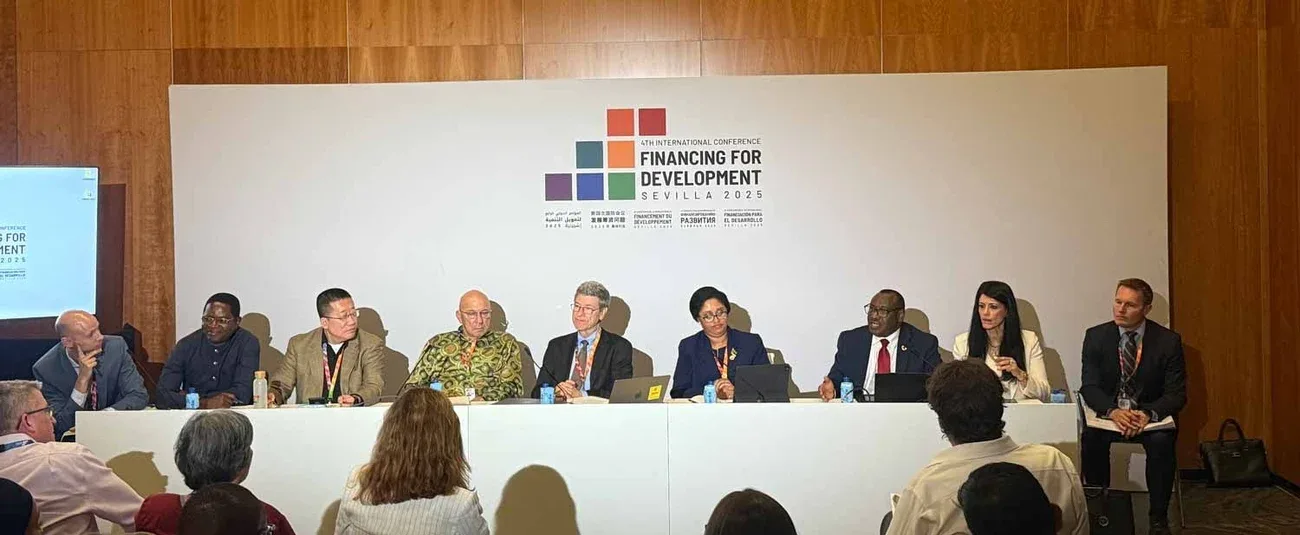
The Sevilla Commitment, adopted at the Fourth International Conference on Financing for Development in 2025, offers a renewed framework around investment, debt and reform of the international financial architecture.
However, its first real test is whether pledges can translate to affordable capital, stronger tax systems, better risk-sharing and measurable development impact.
A $4 Trillion Gap Meets Reality
The most important number in the report is also the most sobering: the annual financing and investment gap for achieving the Sustainable Development Goals has risen to more than $4 trillion.
That gap is not an abstract global estimate. It is the missing classroom in a rural community, the unelectrified health centre, the unfunded irrigation system, the stalled rail corridor, and the climate adaptation project that remains on paper.
The report frames 2026 as the first comprehensive assessment since the adoption of the Sevilla Commitment.
It finds that while global growth has shown resilience, many developing countries remain exposed to high borrowing costs, elevated debt service, low tax revenue, declining official development assistance and subdued investment flows.
That combination matters deeply for African markets. When debt service rises, and concessional finance falls, governments face a brutal trade-off: pay creditors, subsidise fuel and food, build infrastructure, fund schools, strengthen health systems, or invest in climate resilience.
In practice, the choice is often not between development and debt, but between today’s survival and tomorrow’s productivity.
UN Secretary-General António Guterres, in the report’s foreword, describes financing for development as “more than an economic imperative,” framing it as a pathway for countries to thrive, trade and prosper together.
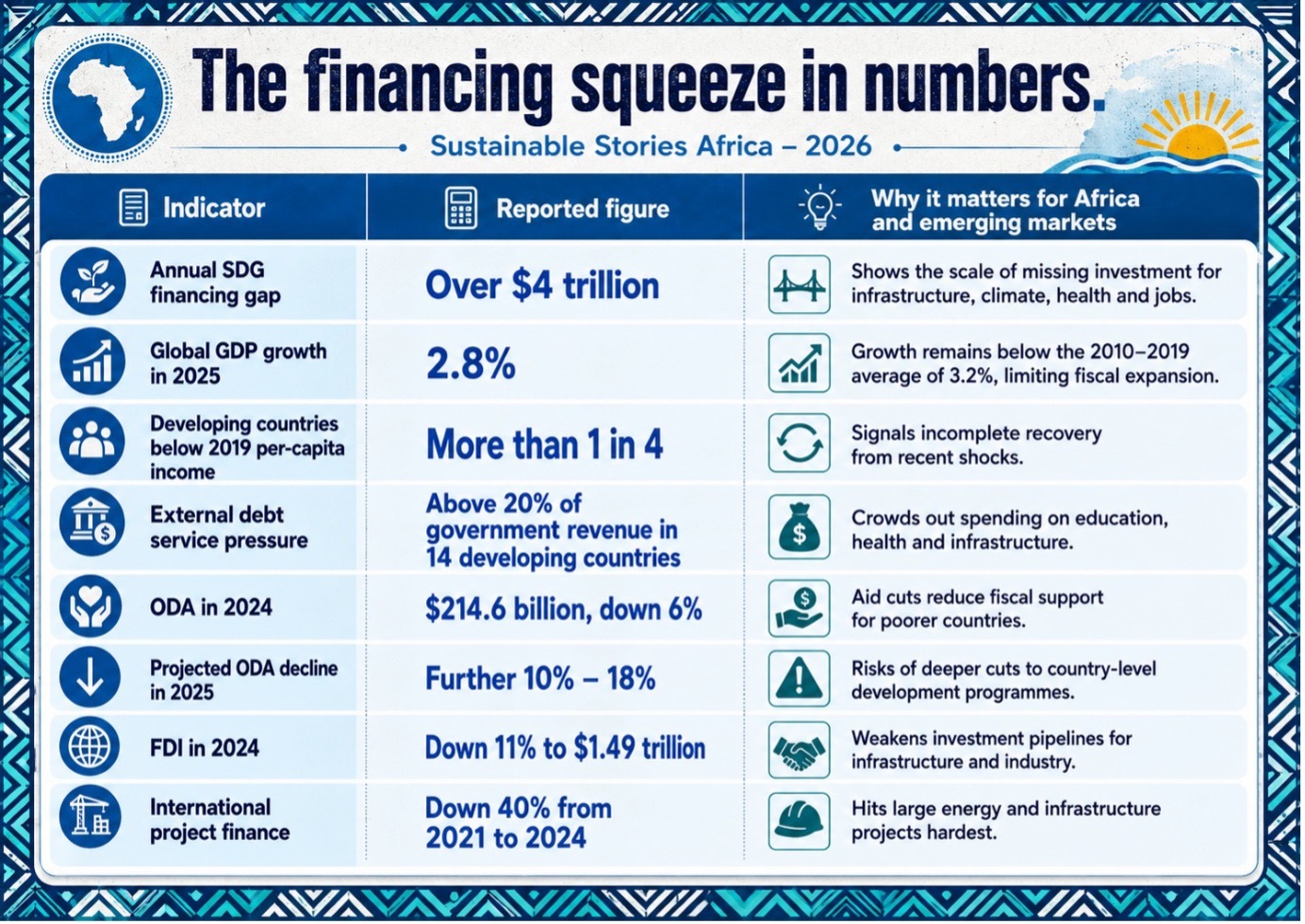
Numbers Show A Widening Financing Squeeze
The financing crisis has several layers. First, debt has become more expensive.
- The report says debt service on external debt reached 20-year highs in developing countries and small island developing states in 2024, while average coupon rates on hard-currency bonds for least developed and other low-income countries rose to 8.4% in 2025, from 6.1% in 2024.
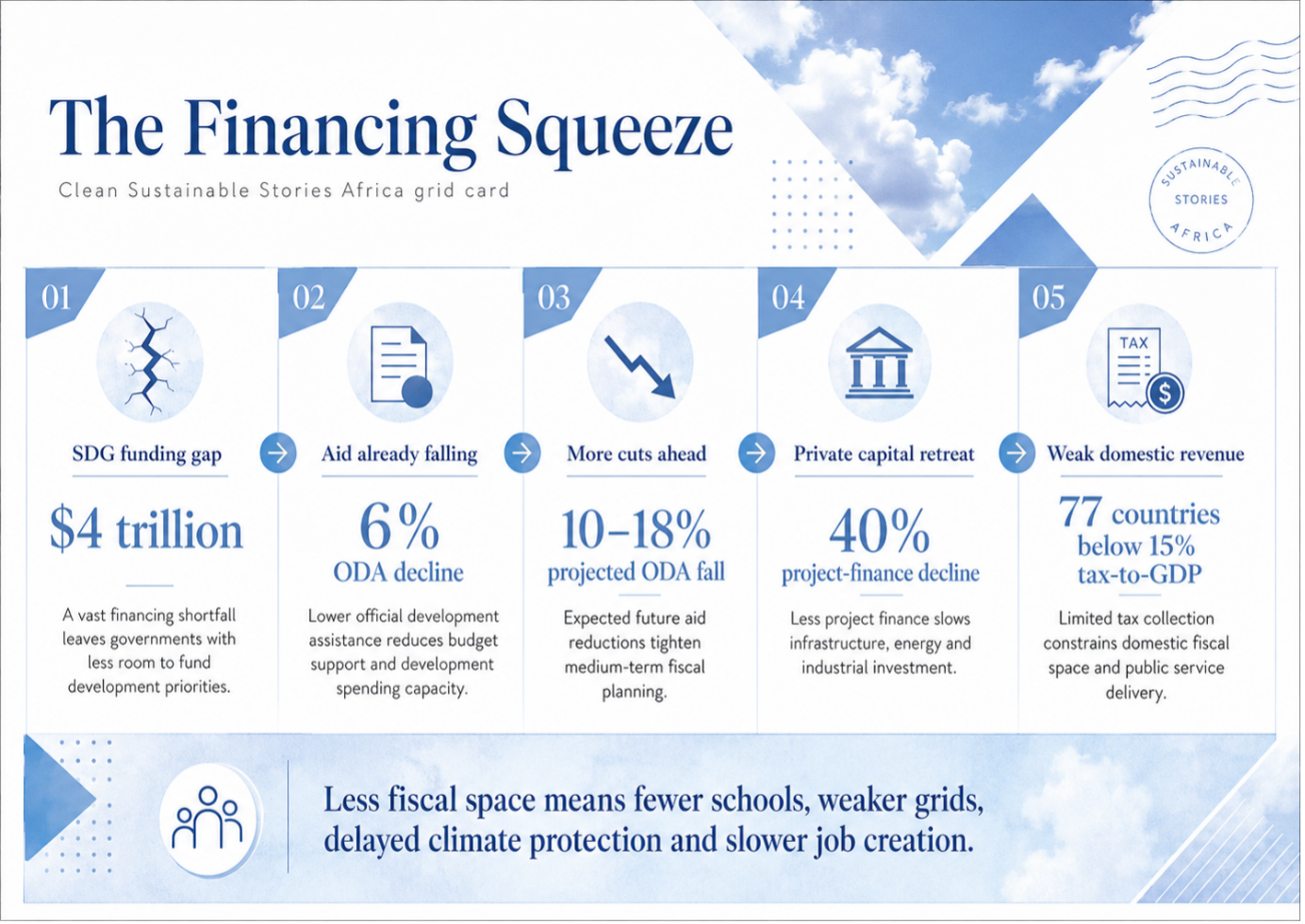
- Domestic revenue mobilisation across developing economies remains structurally weak, limiting fiscal resilience at a critical moment. Tax revenues rose only marginally from 13% to 14% of GDP between 2000 and 2024, while 77 developing countries still fall below the 15% tax-to-GDP threshold set by the Sevilla Commitment, compared to a median of 24% in developed economies.
- Compounding this, aid is contracting precisely when it is most needed. Official development assistance fell 6% in 2024 to $214.6 billion and is projected to decline a further 10% – 18% in 2025. Least developed countries face steeper losses, with bilateral ODA to LDCs forecast to decline by 13% – 25% following a 3% decline in 2024.
- Investment flows are equally concerning. FDI fell 11% in 2024 to $1.49 trillion, while international project finance, critical for infrastructure and energy, declined by 40% between 2021 and 2024, and weakened further in early 2025.
The cumulative picture is stark: developing nations are being asked to finance development, climate resilience and industrial transformation with shrinking budgets and less predictable external support.
Trade offers some relief. South-South merchandise trade grew fourfold between 2005 and 2024, and the African Continental Free Trade Area, ratified by 49 countries, holds strategic potential for deepening regional integration.
Impact Finance Can Rebuild Development Momentum
The Sevilla Commitment is a reform agenda, not merely a funding appeal. Its framework encompasses 280 actions supported by 130 voluntary initiatives under the Sevilla Platform for Action, targeting structural shifts including tripling multilateral development bank lending, doubling support for countries pursuing a 15% tax-to-GDP ratio, improving private investment mobilisation and strengthening developing countries' voice in global financial institutions.
For African policymakers, the practical imperative is integration.
- The report calls for coherent national investment strategies that align development plans, climate policy, industrial strategy, tax reform, debt management and local capital market development into a single, actionable pipeline.
On private capital, progress is uneven.
- Blended finance grew from $32 billion in 2015 to $75 billion in 2024; however, the volumes mobilised in middle-income countries were four times higher than in least developed countries, landlocked economies and small island states combined, precisely the contexts where finance is most urgently needed.
This gap matters for Africa. The continent's priority financing needs, early-stage grid infrastructure, climate adaptation, rural logistics, water systems and green industrialisation, are exactly the sectors markets routinely avoid.
The report's core message is clear: leverage ratios are insufficient.
- Every public dollar must be measured by development impact, not simply by its ability to crowd in private capital.
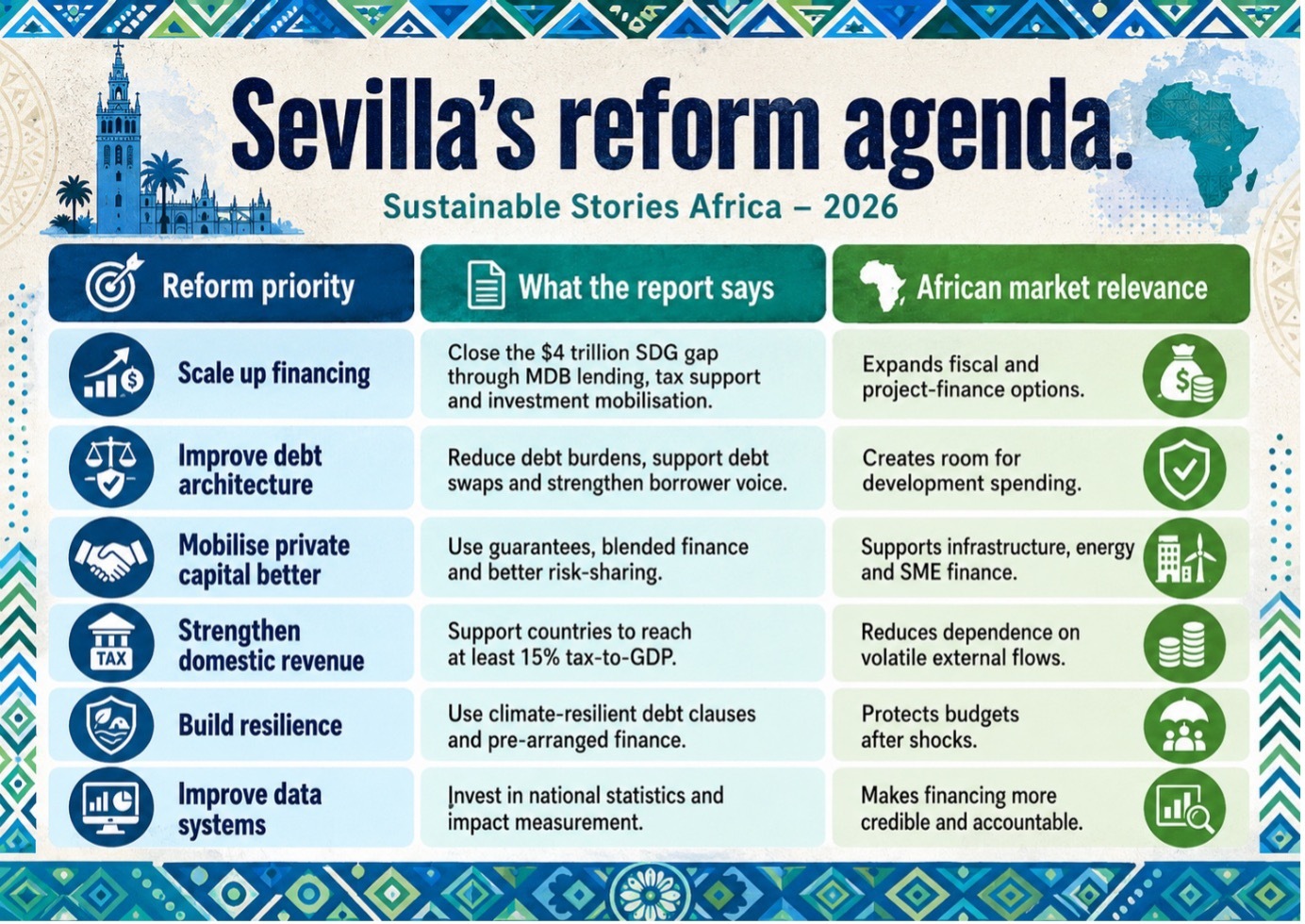
What Governments And Financiers Must Do
The report’s action agenda begins with domestic credibility. African governments need stronger revenue systems, transparent budgets, better debt data and bankable project pipelines.
The Sevilla Commitment includes actions to strengthen tax systems, transparency, budget accountability, integrated national financing frameworks, natural resource taxation and digital revenue systems.
However, domestic reform cannot carry the burden alone. The international system must reduce the cost of capital for countries investing in public goods.
The report points to risk-sharing instruments, local-currency financing, stronger development banks, more effective guarantees and better recognition of how credit enhancements reduce risk.
Debt reform is especially urgent. The report notes growing attention to debt pause clauses, including climate-resilient debt clauses.
It says that half of the surveyed bilateral creditor countries and five of the seven surveyed international financial institutions offer such clauses. 69% of surveyed borrower countries in sub-Saharan Africa have not yet included them in debt contracts.
Development finance institutions also need a sharper strategy for Africa. From 2013 to 2023, only 6.1% of MDB and development finance institution private-sector investments were committed to LDCs.
That underlines a core weakness in the current model: the countries most in need of patient risk capital often receive the least.
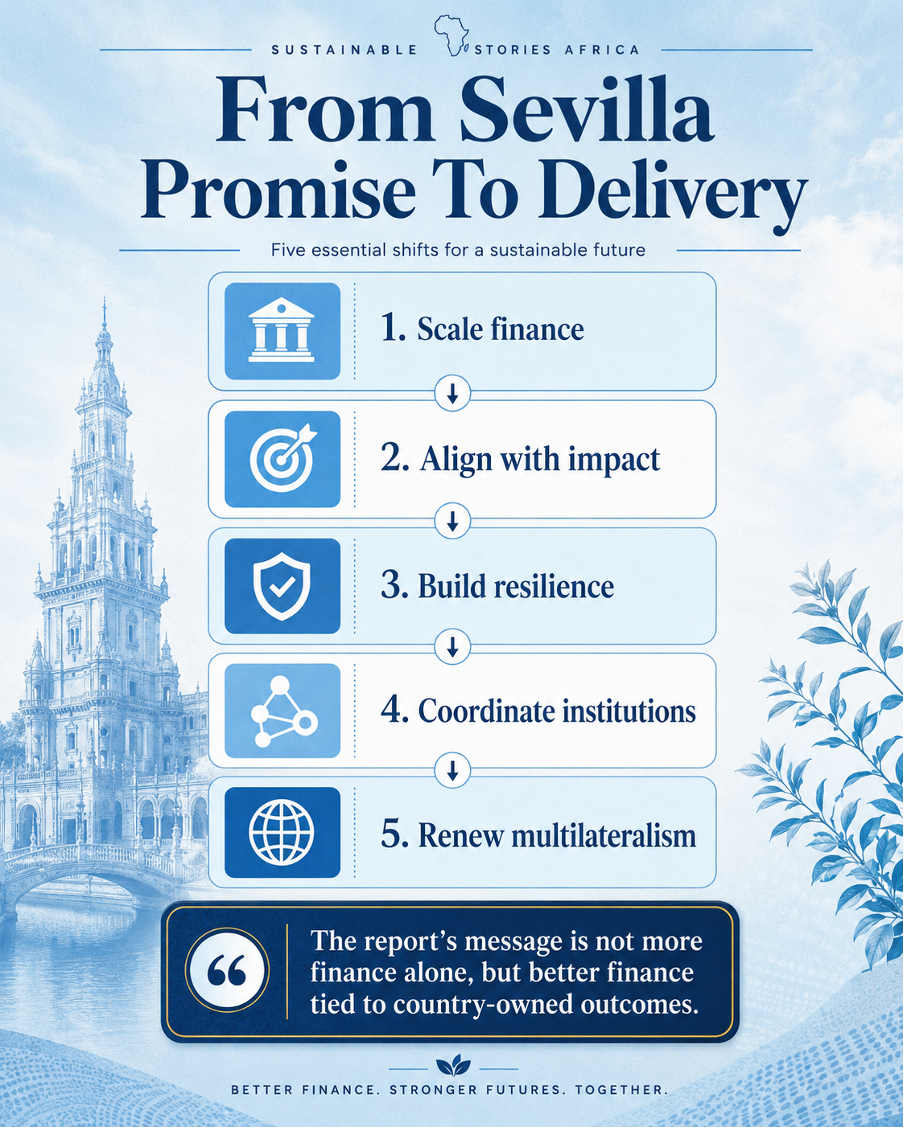
Path Forward – Turn Sevilla Commitments Into Measurable Delivery
The path forward is execution. Sevilla provides countries and institutions with a framework; 2026 must prove whether it can unlock affordable finance, reduce debt pressure, strengthen tax systems and direct capital into jobs, resilience and climate-smart growth.
For Africa, success will depend on country-owned plans, credible data, fairer risk-sharing, stronger regional trade and a development finance system that measures impact where people actually live.
The promise is clear: finance must move faster than the crises it is meant to solve.