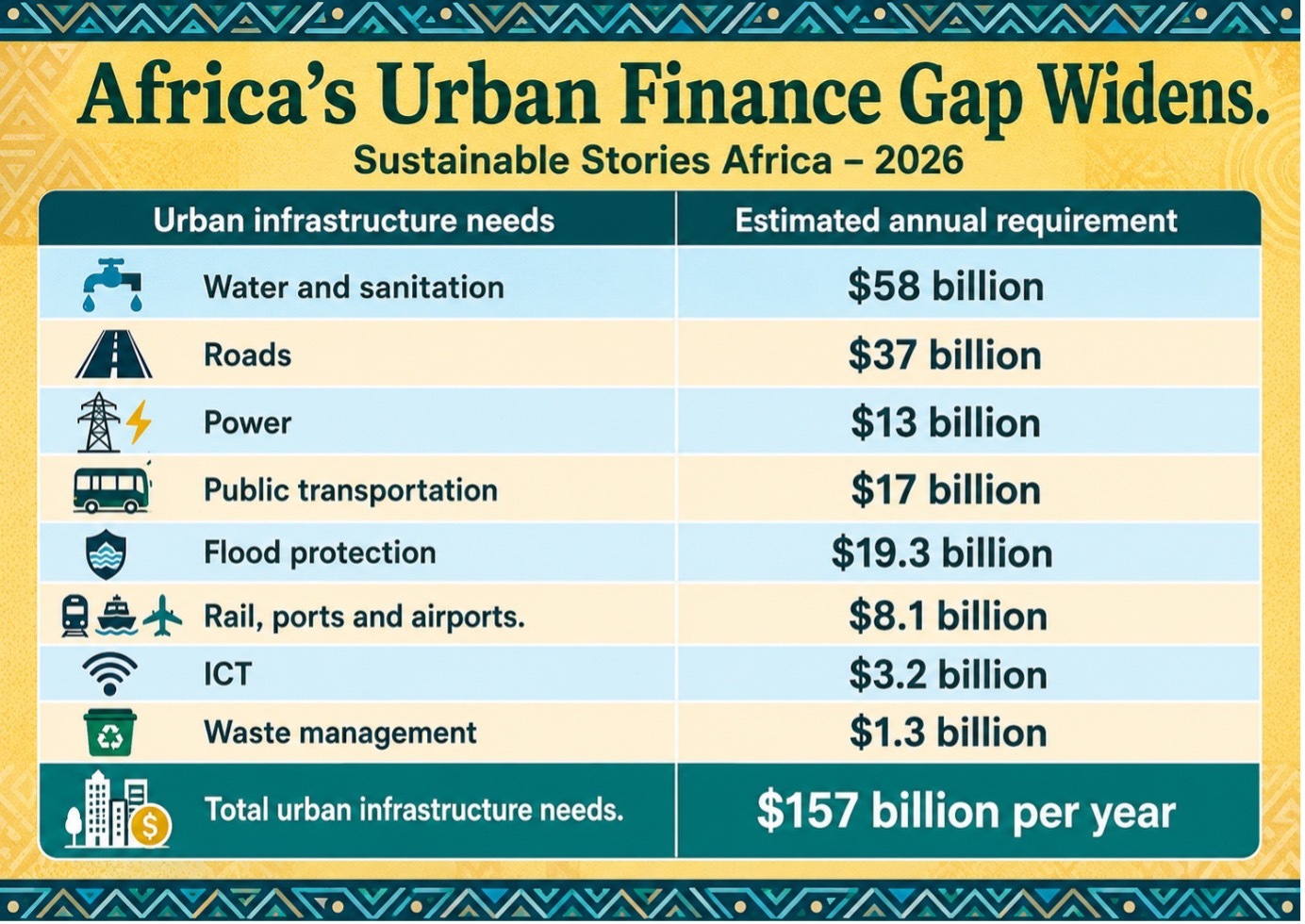
African cities need an estimated $157 billion a year for infrastructure, yet many local governments cannot borrow, collect limited revenue and depend heavily on national transfers.
The question is no longer whether Africa is urbanising. It is whether finance, fiscal policy and governance can turn that urban growth into productive, climate-resilient cities.
Cities Need Finance Before Crisis
Africa’s cities are becoming the continent’s decisive development arena, but their fiscal systems remain too weak to finance the infrastructure needed for a fast-growing urban population.
A June 2025 Urban2063 policy brief by Anton Cartwright, published by the African Centre for Cities at the University of Cape Town, argues that African cities face deep infrastructure deficits despite being central to growth, climate resilience and Agenda 2063’s vision of modern urban settlements.
The warning is stark: without stronger municipal finance, better national transfers and more affordable investment, Africa’s cities could become sites of social, ecological and fiscal instability rather than engines of productivity, jobs and sustainable development.
Africa’s Urban Finance Gap Widens
Africa’s cities require an estimated $157 billion annually in urban infrastructure investment, equivalent to 5.34% of regional GDP, according to the Urban2063 policy brief.
However, total infrastructure spending across Africa was estimated at $62 billion in 2018, leaving a gap that highlights unreliable power, poor drainage, unsafe roads, weak sanitation and underfunded public transport.
The brief frames this as an issue central to the G20 and the African Union. Urbanisation is one of the defining forces of the 21st century; however, the G20’s major objectives, including inclusive growth, employment, inequality reduction, critical minerals, financial reform, artificial intelligence and food security, often treat cities as background rather than operating systems for development.
That omission matters because roughly 900 million people are expected to live in African cities by 2035. If urban finance fails, the consequences will not remain local.
Congestion, informal settlements, weak infrastructure, pollution, energy poverty and climate exposure will deepen systemic risks for national economies and global markets.
Weak City Budgets Limit Development
Africa's urban infrastructure funding crisis is rooted in deep structural fiscal constraints. Sub-national governments across the continent spent just $155 per capita in 2020 after purchasing power parity adjustments, approximately 40 times less than their counterparts in Europe and North America.
Most African cities collect minimal own-source revenue, have limited influence over national infrastructure allocations and frequently lack the legal standing to access development finance directly.
This forces heavy dependence on national governments and state-owned enterprises whose investment priorities often misalign with urban service needs.
The consequences are tangible and daily. Inadequate water systems raise household costs as well as time, health and dignity.
Poor road infrastructure lengthens and endangers commutes. Weak solid waste management elevates the risks of flooding and disease, while insufficient public transport erodes urban productivity.
The energy gap captures the scale most starkly. Of the 746 million people globally without reliable electricity, 600 million are in Africa.
Meeting SDG7 targets requires an estimated $200 billion annually between 2026 and 2030; however, the continent received only $110 billion in 2024.
Urban electricity alone requires an estimated $30 billion annually, a gap that demands urgent attention from governments, financiers and development partners.
Risk Perceptions Raise Capital Costs
Despite hosting approximately one-fifth of the world's population, Africa attracted only 3.5% of global foreign direct investment, just $45 billion in 2022, and holds less than 3% of global investment stock.
The cost of available capital compounds this challenge further, with African countries paying on average five times more than the International Bank for Reconstruction and Development, with borrowing costs estimated at 2.9 percentage points above what macroeconomic fundamentals and credit ratings should justify.
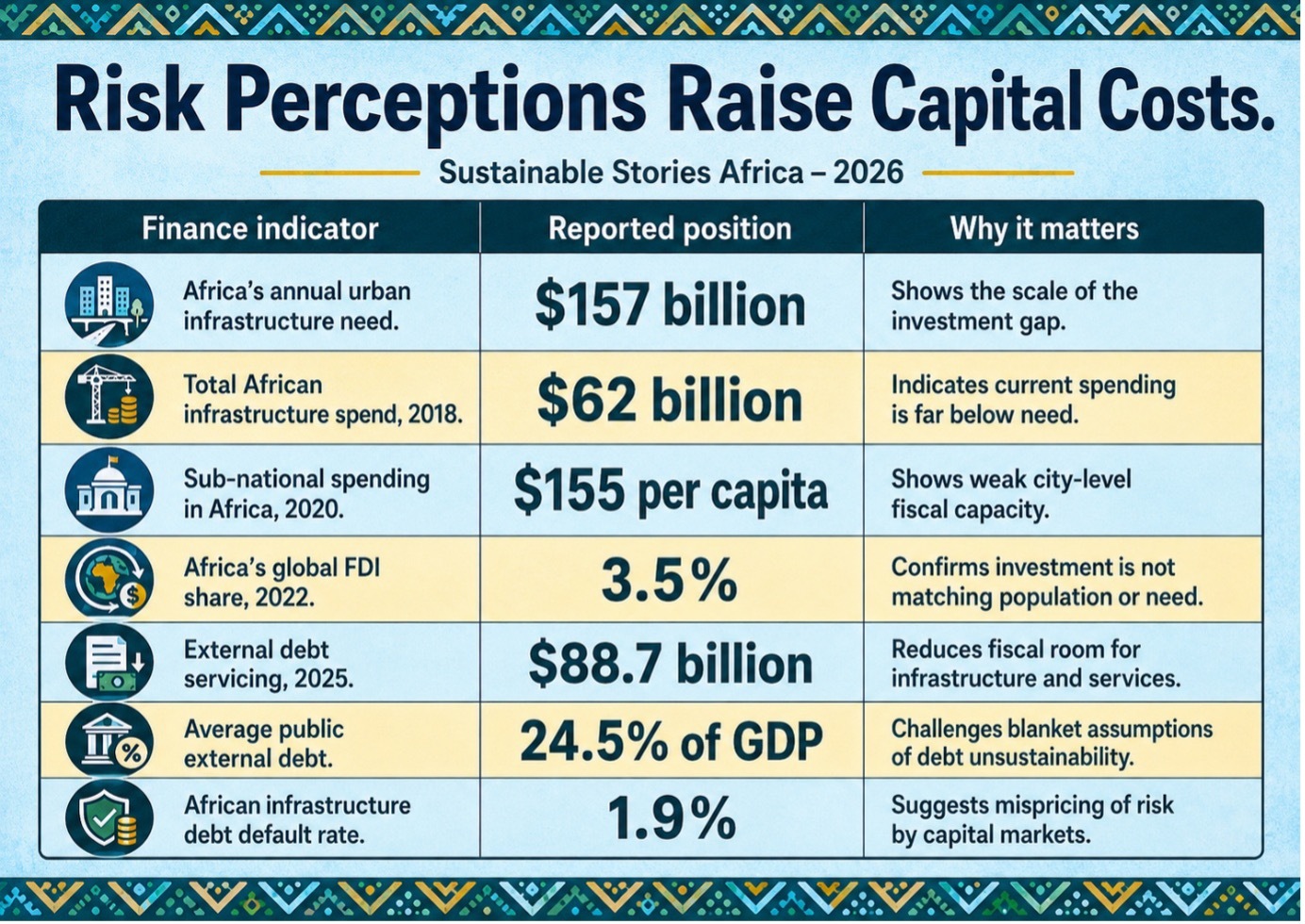
This premium reflects a striking contradiction. Africa is consistently priced as high-risk. However, cumulative infrastructure debt default rates from 2009 to 2020 stood at just 1.9%, significantly lower than Western Europe and Asia at 4.6%, North America at 6.6%, and Latin America at 10.1%.
The fiscal consequences are severe. African countries are projected to spend $88.7 billion on external debt servicing in 2025. In 2024, debt servicing consumed 13.6% of public spending, more than double the 6.3% allocated to healthcare and approaching the 14.7% directed to education.
The development cost is direct and measurable: resources that could finance drainage, water systems, transport, electricity and sanitation are instead absorbed by debt repayment obligations.
Urban Investment Can Save Lives
The case for investing in African urban infrastructure is both humanitarian and economic.
Closing the infrastructure gap would directly reduce the consequences of unsafe sanitation, unreliable water, household air pollution from wood and charcoal burning, congested roads and fragmented waste systems.
Reliable power reduces business dependence on costly diesel, functional public transport lowers commuting costs, improved flood protection shields markets and schools, and better waste systems reduce public health emergencies and unplanned municipal expenditures.
Climate finance presents a potential but currently insufficient pathway. African countries estimate they require $250 billion to $280 billion annually to implement their Nationally Determined Contributions.
However, the Green Climate Fund had committed only $16.7 billion and disbursed $5.6 billion by April 2025, a significant gap that confirms climate finance alone cannot resolve Africa's structural financing constraints.
The more compelling opportunity lies in repositioning African urban infrastructure within the emerging global resilience economy.
World Bank estimates project a $5.2 trillion annual climate-resilient investment after 2030, with McKinsey placing the figure at $9 trillion.
African cities, characterised by low-carbon development needs and substantial infrastructure deficits, are well positioned to compete for this future capital rather than remaining dependent solely on concessional finance.
Reform Finance at the City Level
Addressing Africa's urban infrastructure financing gap requires action across fiscal, institutional and financial dimensions.
On fiscal devolution, African sub-national governments collected just 4.9% of total government tax revenue in 2020, compared to a global average of 14.5%. Property tax and land value capture remain significantly underutilised.
National governments must establish transparent, predictable transfer systems enabling long-term infrastructure planning, while avoiding unfunded mandates that assign cities responsibilities without corresponding revenue or institutional capacity.
Cities must simultaneously invest in digitally enabled revenue systems that cover land records, billing, valuation and transparent expenditure tracking. Visible, reliable and fairly priced services build resident trust and improve revenue collection.
Multilateral Development Banks hold $1.8 trillion in assets, and face calls to deploy callable capital more effectively.
The priority, however, is directing finance toward urban infrastructure that demonstrably improves productivity, climate resilience and debt serviceability.
Domestic finance channels, including pension funds, approximately 25 sovereign wealth funds and remittances estimated at $83.3 billion or 2.6% of Africa's GDP, remain underdeveloped as local-currency investment sources.
Critically, maintenance must be embedded within financing models. Effective maintenance can reduce the life-cycle costs of transport, water and sanitation infrastructure by over 50%.
Addis Ababa's light rail system, built for $475 million, now faces a $60 million maintenance deficit and carries only a fraction of projected passengers, a cautionary reminder that building assets without sustainable operating finance ultimately undermines infrastructure value.
Path Forward – Put Cities At Finance Centre
Africa’s urban finance challenge is not only a funding gap. It is a governance, data, risk, pricing and fiscal design problem that requires stronger city revenues, predictable national transfers and MDB lending aligned with urban productivity.
The priority is clear: make African cities investable without making them unaffordable. That means financing water, power, transport, sanitation and resilience as core ESG infrastructure, rather than optional urban upgrades.