African startups raised $3.5 billion in 2025, a 65% jump from 2024's $2.13 billion; however, the money flowed differently, toward energy, debt, and mature companies rather than early-stage fintech bets.
The question now is whether this marks durable recovery or a temporary spike driven by a handful of megadeals, and what it means for founders, investors, and policymakers betting on the continent's next growth wave.
Capital Returns, Unevenly
African startup funding staged a sharp comeback in 2025, rising to approximately $3.5 billion across 275 rounds, a 65% increase in value and a 27% jump in deal count from 2024's $2.13 billion and 217 rounds.
However, beneath the headline growth lies a story of concentration: fewer countries, fewer sectors, and fewer founder profiles captured a disproportionate share of the gains.
Kenya displaced South Africa and Nigeria as the top-funded market in 2025, pulling in $1.06 billion largely on the back of energy megadeals, compared with South Africa's 2024 lead of $748 million.
This shift signals that investors are increasingly rewarding infrastructure-heavy, revenue-predictable business models over the consumer fintech plays that once defined African venture capital.
For ESG watchers and development finance institutions, the numbers matter because they reveal where capital is flowing toward climate resilience and energy access, and where it continues to bypass women-led ventures and early-stage innovators.
A Rebound Built on Bigger Bets
The headlines alone tell a story of resilience:
African startups raised $3.5 billion in 2025, up from $2.13 billion in 2024, even as the number of startups funded rose only from 208 to 256.
That imbalance, fewer new entrants but far more capital, points to a market rewarding scale and maturity, not experimentation.
Optasia's $345 million IPO became 2025's single largest transaction, eclipsing 2024's top deal, Cassava Technologies' $310 million raise, and signalling investor appetite for exits and public-market validation rather than pure early-stage risk.
Fintech retained its crown as the most-funded sector, with $1.4 billion. However, the energy sector surged to a close second at $835 million, nearly triple its 2024 tally of $377 million, driven by distributed solar and grid-scale infrastructure plays concentrated in Kenya.
Debt financing nearly tripled in dollar terms, rising from $540 million in 2024 to roughly $1.45 billion in 2025, or 41% of total capital, reflecting a structural pivot toward asset-backed and revenue-secured lending in energy and fintech.
Nigeria, once the continent's undisputed funding leader, saw its share fall to $314 million in 2025 from $617 million in 2024, a sign of persistent macroeconomic caution weighing on investor confidence despite the country's large market.
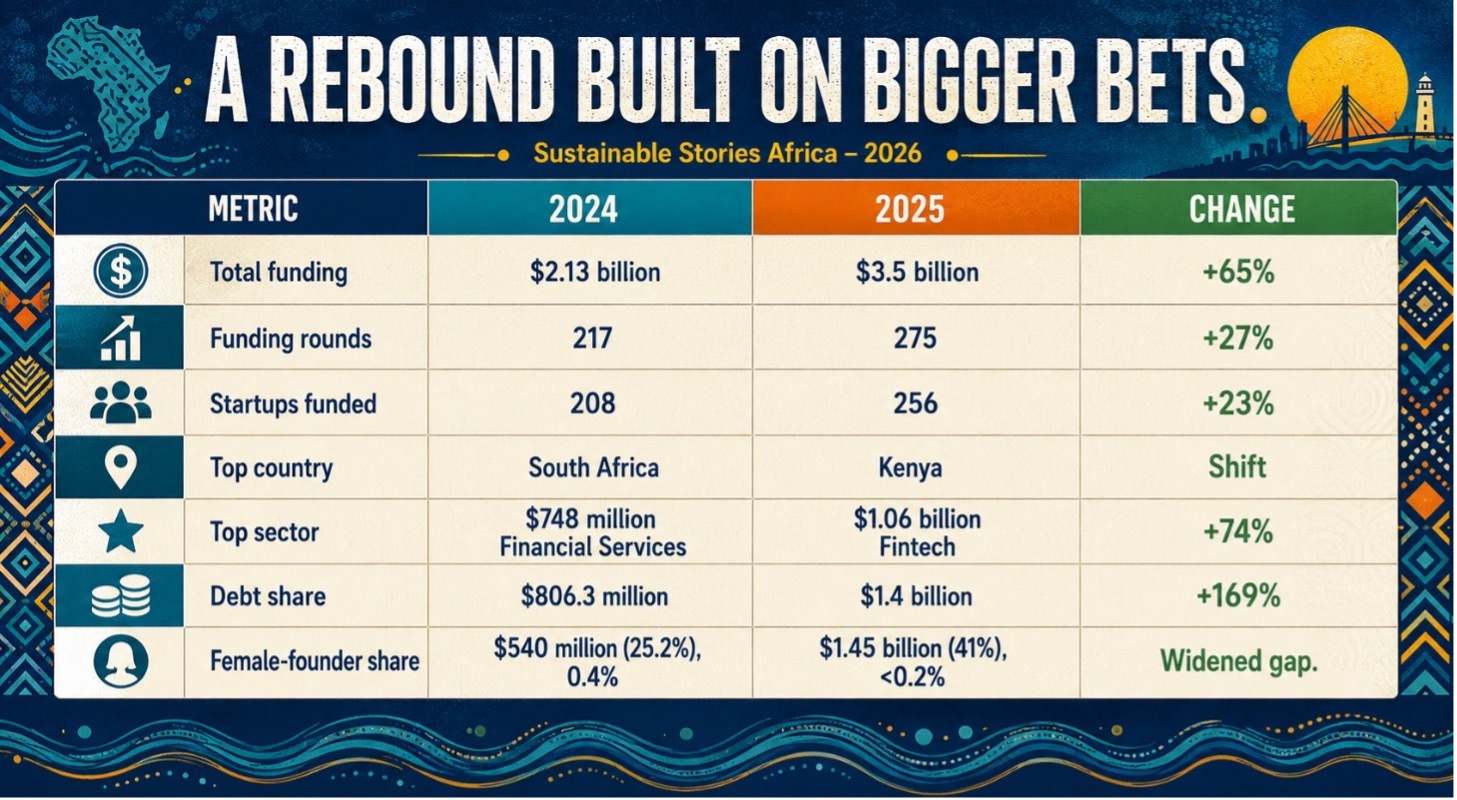
Founder demographics remain the starkest counterpoint to this growth story. All-male teams captured 96.3% of 2024's total funding, and while 2025 data show male-led startups accounting for a still-dominant 93.9% of capital, all-female founders saw their share shrink further to under 0.2%, down from an already thin 0.4%.
Two-founder teams continued to dominate deal flow in both years, taking 57% of 2024 capital and $1.8 billion of 2025's total across 142 deals.
What Gains Mean for Africa's Ecosystem
If this capital shift toward energy and infrastructure holds, it could accelerate electrification, climate resilience, and digital financial inclusion across markets that badly need both.
Kenya's energy-driven surge, anchored by distributed solar and grid infrastructure investments totalling $546 million, offers a template for how patient, infrastructure-oriented capital can support climate adaptation goals central to ESG mandates.
The rise of debt and structured financing also signals a maturing ecosystem less dependent on speculative equity rounds, which could mean steadier access to capital for startups with proven revenue models.
However, if the gender funding gap continues to widen rather than narrow, the sector risks entrenching inequality even as overall capital expands, undermining inclusive growth narratives that donors and impact investors increasingly demand.
Where Stakeholders Must Move Next
Investors and development finance institutions need to deliberately rebalance portfolios toward female-led and early-stage ventures, given that funding for women-led startups has fallen for two consecutive years despite record overall capital.
Governments in Nigeria and other markets experiencing funding declines should address the macroeconomic volatility, currency instability, and regulatory unpredictability that investors cite as reasons for caution.
Venture funds like Renew Capital and Launch Africa, the most active dealmakers in 2024, alongside emerging players backing 2025's debt and securitisation deals, should expand local co-investment structures that reduce dependence on a handful of mega-transactions.
Policymakers should also prioritise frameworks that support structured, asset-backed lending in energy and agritech, sectors where debt financing already outpaces equity and where predictable cash flows can unlock further institutional capital.
Path Forward – Building On A Fragile Rebound
The path forward for African startup funding hinges on converting 2025's headline recovery into broader, more inclusive momentum rather than a repeat of concentrated megadeals.
That means diversifying beyond Kenya, South Africa, Egypt, and Nigeria, and closing the persistent gender financing gap.
Stakeholders across the continent's innovation ecosystem, investors, regulators, and founders alike, must treat 2025's numbers as a floor to build on, not a ceiling to celebrate, ensuring that infrastructure gains translate into equitable, long-term ecosystem resilience.