Africa holds more than a quarter of the world’s known critical mineral reserves, placing the continent near the centre of the global race for energy transition, AI and advanced manufacturing inputs.
However, McKinsey’s June 2026 analysis warns that geology alone will not create prosperity.
Infrastructure gaps, weak project execution and limited technology adoption could blunt Africa’s advantage unless governments, investors and mining companies move faster.
Africa’s Minerals Moment Demands Strategic Discipline
Africa’s mining story is entering a decisive phase. Critical minerals such as copper, lithium, cobalt, manganese, graphite, tantalum and rare earth elements now sit at the heart of the world’s energy transition, artificial intelligence infrastructure, defence supply chains and advanced manufacturing.
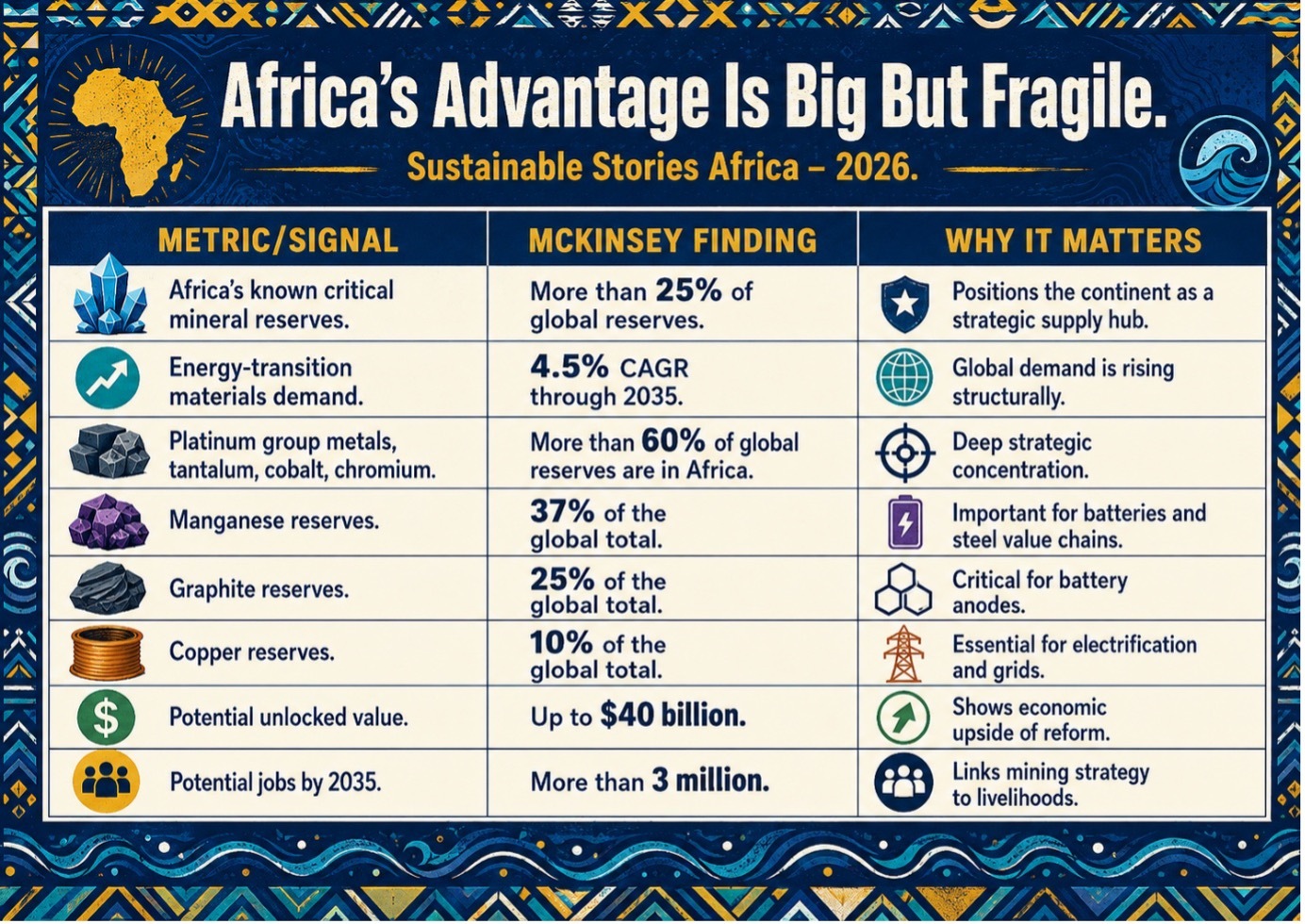
A June 2026 McKinsey analysis argues that Africa has a central role because it holds more than a quarter of the world’s known critical mineral reserves, including high-grade deposits across several strategic commodities.
However, the same report warns that structural weaknesses in infrastructure, logistics, financing, operations and governance continue to erode the continent’s geological advantage.
The stakes are not abstract. McKinsey estimates that three strategic moves - mining clusters, stronger project execution and technology innovation - could unlock up to $40 billion in incremental value, increase Africa’s GDP by 4%, and create more than three million jobs by 2035.
The World Needs Africa’s Minerals Now
The next industrial era may run on African bedrock. Critical minerals, essential for batteries, grids, EVs, AI infrastructure, and defence systems, are now strategic assets.
McKinsey's Global Materials Perspective 2025 projects 4.5% CAGR demand growth for energy-transition materials through 2035, even as supply constraints persist for rare earths, nickel, and manganese.
Africa's position is powerful. The continent holds over 60% of global reserves of platinum group metals, tantalum, cobalt, and chromium, plus 37% of manganese, 25% of graphite, and 10% of copper, concentrations that place Africa at the centre of global transition strategies.
However, opportunity brings pressure. Global powers want secure supply chains; African governments demand local value addition; communities ask whether mining will deliver jobs or repeat extractive patterns.
The real question isn't whether Africa has the minerals; it's whether it can convert them into inclusive industrial value chains.
Africa's mineral endowment is often high-grade, acting as a natural hedge against logistics costs.
Guinea's Simandou iron ore (65% content) could cut ironmaking emissions by 5% compared with 62% ore.
This ESG opportunity pairs lower emissions intensity with local jobs, transport corridors, and regional industrialisation
However, Africa is not fully capturing this advantage.
Why Geology Has Not Delivered Leadership
The constraint isn't only underground; it's what happens above ground.
Africa's exploration spending averages $1.2 billion annually, trailing Australia's $2.0 billion and Canada's $2.2 billion, despite its vast landmass.
The financing gap is sharper still: less than 10% of Africa's $9 billion critical-minerals pipeline has secured financing, per McKinsey MineSpans data, leaving viable midtier deposits undeveloped.
Infrastructure compounds the problem. Nearly 40% of key mineral producers are landlocked, and unreliable power and grids further disrupt production.
The human story sits within these numbers: delayed jobs due to unreliable power, lost revenue from inefficient rail, community resistance due to poor consultation, and eroded investor confidence from regulatory gaps.
Africa's mining challenge, then, is not geology; it is execution.
Clusters Could Change Mining Economics
McKinsey's first major recommendation is clustering: grouping geographically close mining operations to share infrastructure, power, water, processing, skills development, and logistics, replacing isolated mines and diesel generators with shared renewable power, ports, and mining universities.
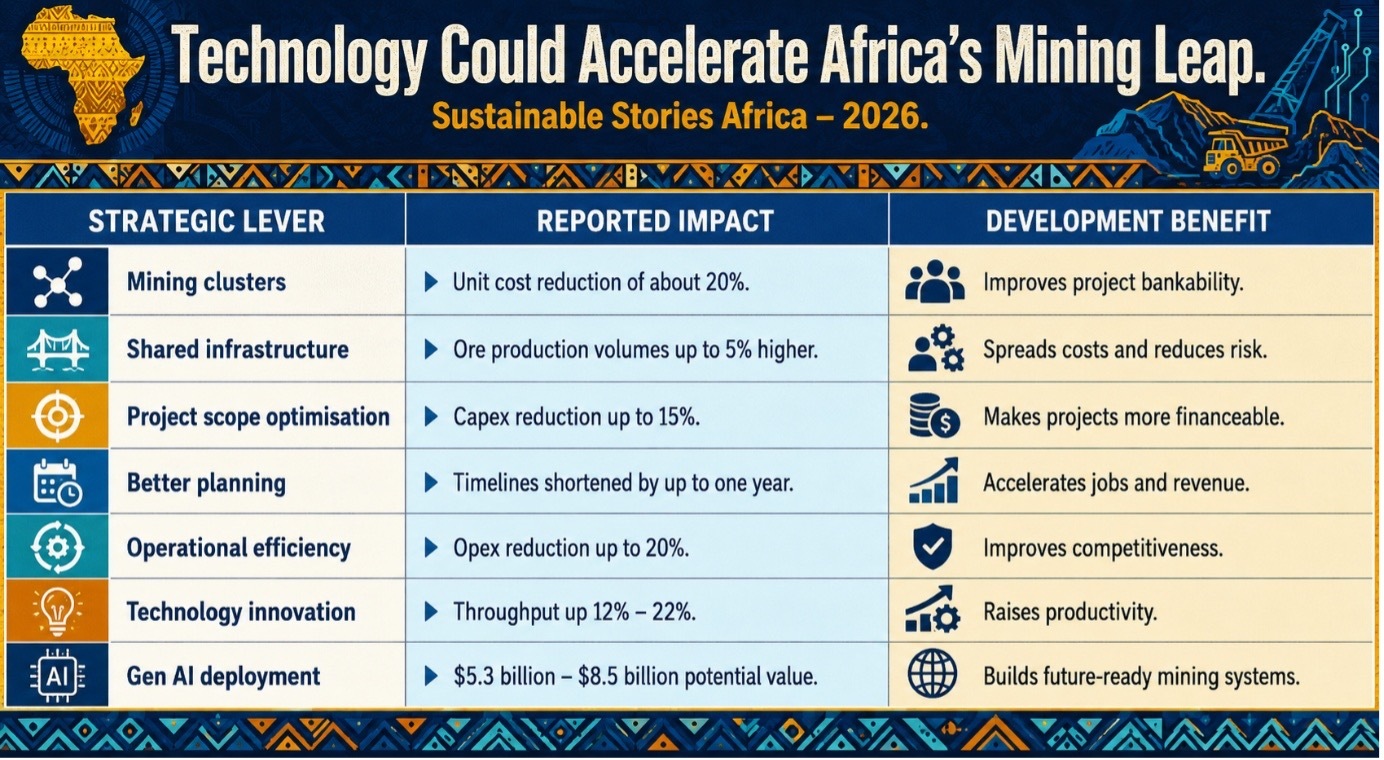
The potential impact is significant. Integrated investments could improve ore production by up to 5% and cut unit costs by roughly 20%.
- Four southern African critical-mineral clusters could unlock $15 – $20 billion in revenue and create 1.85 million jobs
- West African bauxite and iron ore clusters could add $17 billion and 1.3 million jobs across Guinea, Liberia, and Sierra Leone.
- The Lobito Corridor, linking DRC and Zambia to Angola's Atlantic port, exemplifies infrastructure-led clustering.
- South Africa's Badirammogo Water User Association shows how coordinated bulk water planning can serve industrial and community needs alike.
Clusters, done well, can create ESG platforms to coordinate biodiversity, water efficiency, and governance.
Operational Discipline Can Unlock Cash Flow
Africa also needs stronger capital-project execution and operational excellence.
McKinsey estimates that optimising project scope can reduce capital expenditure by up to 15%. Better planning can shorten timelines by up to one year.
Improved life-cycle cash-flow management can reduce operating expenditure by up to 20%, while enhanced mineral recovery can produce a 5% revenue uplift.
These improvements matter because many African projects face high capital costs, permitting delays, financing risk and infrastructure uncertainty.
A project that opens one year earlier can capture revenue sooner, build investor confidence and accelerate local employment.
- The Kamoa-Kakula Copper Complex in the DRC is presented as an example of delivery discipline.
McKinsey notes that the project exceeded production targets in phase one, then scaled through repeatable expansion modules, while reliable lower-carbon hydro-generation helped derisk operations.
For policymakers and investors, the message is clear: Africa does not only need more mining projects. It needs better-designed, better-sequenced and better-executed projects.
Technology Could Accelerate Africa’s Mining Leap
Technology may be the fastest lever available.
- McKinsey MineLens data suggest innovation can boost throughput by 12% – 22% and cut operating expenditure by 8% – 13%.
- At-scale generative AI deployment could add $5.3 – $8.5 billion in economic value across exploration, safety, and environmental monitoring.
- AI is already improving discovery: machine learning on geological datasets could raise exploration hit rates by 15% – 30%.
- KoBold Metals secured $537 million to develop an AI-identified copper deposit in Zambia, while AI-enabled drilling rigs could cut costs per metre by 15% – 30%.
The productivity gap underscores the stakes: sub-Saharan African haul trucks and shovels lag global availability and utilisation benchmarks, with longer repair times, meaning technology could raise output faster than infrastructure fixes alone.
Africa Needs A New Resource Bargain
The opportunity is not simply to export more minerals. It is to negotiate a new resource bargain.
- Governments need to create enabling policy environments that support special economic zones, fast-track approvals, transparent permitting, environmental safeguards, community benefit-sharing and cross-border infrastructure coordination.
- Investors need to finance not just mines, but rail, power, water, ports, processing and skills ecosystems.
- Mining companies must move beyond extraction-led models toward shared infrastructure, local procurement, responsible community engagement and credible decarbonisation strategies.
- Development finance institutions can help derisk early-stage projects, especially where transport corridors and renewable power assets serve both mines and communities.
- Citizens and communities must also be treated as stakeholders, not obstacles.
Mining that does not improve local livelihoods, protect water sources, manage land impacts and build trust will struggle to maintain its social licence.
Africa’s minerals can power the world. But the greater test is whether they can also power African industrialisation.
Path Forward – Build Mining Ecosystems Now
Africa’s priority is to convert geological advantage into investable ecosystems. That means clusters, shared infrastructure, stronger project execution, digital mining systems and transparent governance.
The next decade will reward countries that move from mineral possession to mineral strategy.
Governments, investors and mining companies should align around value addition, community benefit, cleaner power and skills development, so Africa’s bedrock becomes a foundation for sustainable prosperity.