Africa’s next growth story may depend less on what it produces and more on how easily people, goods, services, money and skills move across borders.
A May 2026 report argues that without better mobility and connectivity, AfCFTA ambitions, youth employment, industrialisation and climate-resilient infrastructure will remain constrained.
Africa Must Move Faster To Grow
Africa’s development challenge is increasingly a movement challenge. A continent of more than 30 million square kilometres and 1.3 billion people cannot fully trade, industrialise, employ its youth or build climate-resilient economies if its people, goods, services and payments remain trapped behind fragmented borders and outdated infrastructure.
That is the central message of Africa on the Move: Boosting Mobility and Connectivity, a May 2026 report released by the Africa Forward Summit co-hosted by Kenya and France in Nairobi.
The report argues that both “soft” mobility, visas, customs, payments, qualification recognition and regulatory systems, and “hard” connectivity, roads, railways, ports, aviation and digital infrastructure must improve if Africa is to realise the promise of continental integration.
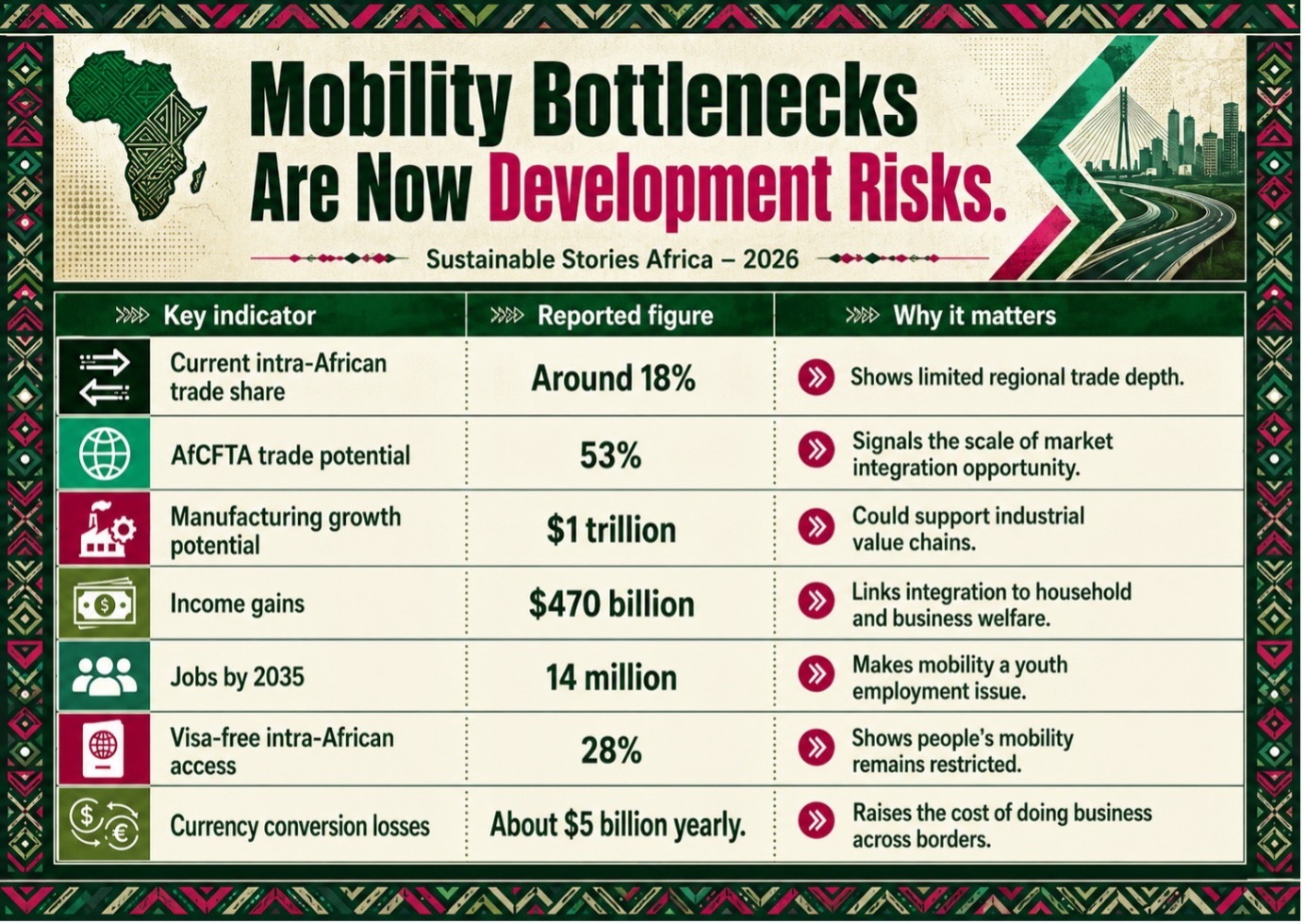
The stakes are large. Full implementation of the African Continental Free Trade Area could lift intra-African trade to 53%, up from about 18%, grow manufacturing by $1 trillion, generate $470 billion in income and create 14 million jobs by 2035. But those gains depend on whether Africa can actually move.
Mobility Bottlenecks Are Now Development Risks
Only 28% of African citizens can travel visa-free within the continent. Four countries, Mali, Niger, Rwanda, and São Tomé and Príncipe, have ratified the African Union’s Free Movement of Persons Protocol, highlighting slow policy alignment.
This stands in contrast to migration realities, where over 72% of sub-Saharan African migrants move within Africa, driven by work, education, safety, and economic opportunity.
The disconnect underscores a structural challenge: mobility within Africa remains constrained by fragmented systems, high costs, and administrative inefficiencies.
- For traders, this translates into customs delays and unrecognised product standards
- For students, inconsistent recognition of qualifications
- For skilled workers, such as clean-energy technicians, regulatory barriers to labour mobility.
Logistics operators also face longer, costlier, and less predictable routes. The report warns that unless these frictions are addressed, the African Continental Free Trade Area risks remaining more effective in principle than in practice, limiting its potential to drive regional integration and economic growth.
Why Trade Still Meets Border Friction
The African Continental Free Trade Area (AfCFTA) aims to create the world’s largest single market by reducing tariffs, harmonising regulations, and improving trade infrastructure.
However, implementation remains uneven, with persistent bottlenecks limiting progress. Tariff reductions alone have proven insufficient, as businesses continue to face border delays, rejected certificates, complex payment systems, and restrictions on service providers' movement.
Non-tariff barriers remain a significant constraint, including inconsistent customs procedures, regulatory misalignment, sanitary standards, labelling requirements, licensing restrictions, and weak mutual recognition systems.
These “behind-the-border” challenges increase costs and complexity for businesses. Payment inefficiencies further compound the problem, with Africa losing an estimated $5 billion annually to currency conversion, often requiring transactions to foreign currencies.
While initiatives like the Pan-African Payment and Settlement System offer solutions, infrastructure gaps persist. Travel across Africa remains slower and costlier than in other regions, reflecting structural limitations in transport systems originally designed for export routes rather than intra-African trade.
Open Corridors Can Build Better Economies
Africa’s mobility challenge presents a significant economic opportunity, particularly in strengthening regional value chains across clean energy, critical minerals, agro-processing, logistics, digital commerce, and the circular economy.
With the continent holding about 30% of global critical mineral reserves, and the Democratic Republic of Congo accounting for roughly 70% of cobalt production, the shift from extraction to value addition will depend on cross-border movement of skills, capital, technology, and standards.
The report highlights that renewable energy could account for 70% of jobs by 2030, while the circular economy may unlock 11 million jobs and $546 billion in value. Digital payments are projected to reach $1.5 trillion.
However, gaps persist: mobile penetration stands at 44% and mobile internet at 27%, with up to $79 billion needed to build a continent-wide digital economy. Improved mobility could lower costs, formalise economies, and drive inclusive, climate-smart growth.
What Africa Must Fix To Move
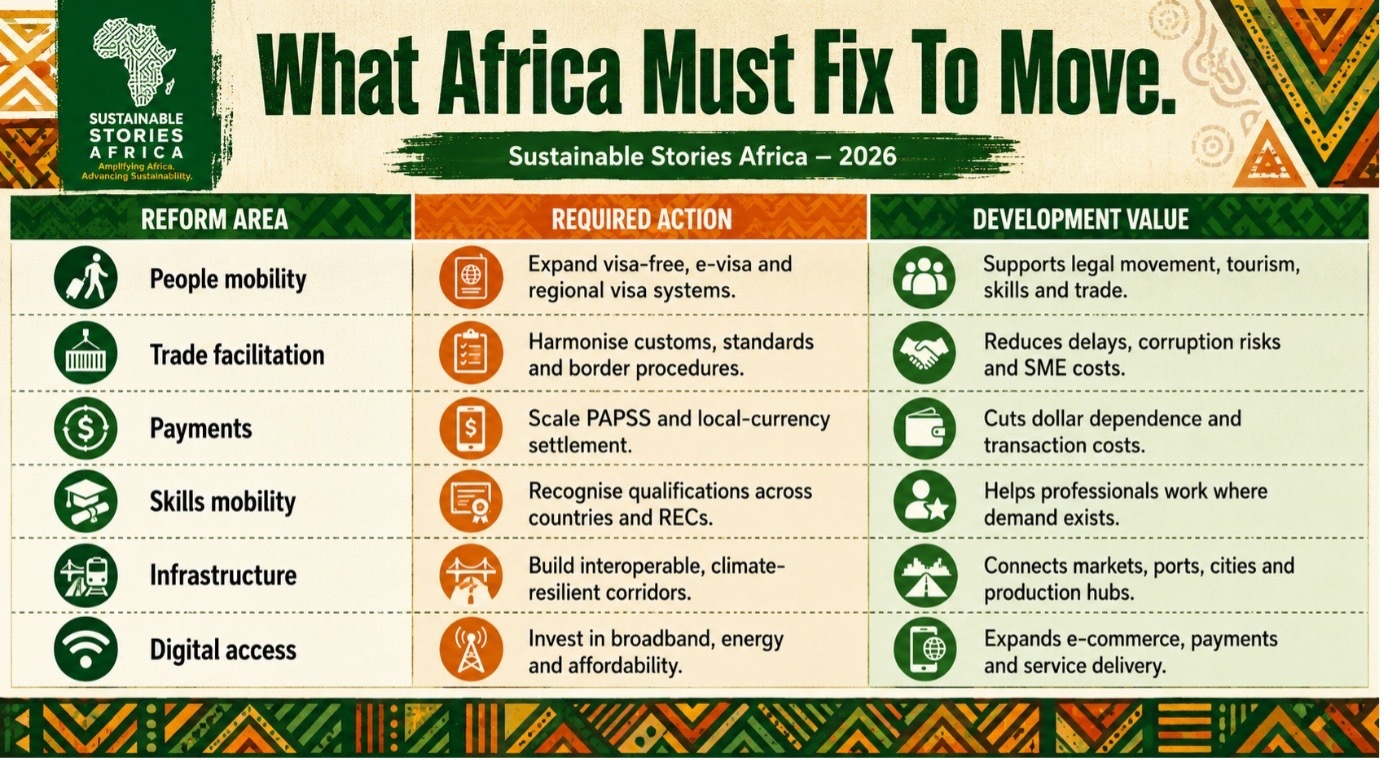
The report outlines a practical reform agenda to unlock mobility and regional integration across Africa.
It calls for accelerated visa openness, including expanded e-visa systems, longer-term and multiple-entry visas, improved access to information, and a phased transition towards visa-free travel.
It also urges renewed political commitment to the African Union’s Free Movement of Persons Protocol, noting that concerns about security, reciprocity, and labour markets should be addressed through stronger border systems, biometric tools, legal alignment, and data-sharing frameworks, not prolonged delays.
In parallel, regulators must reduce non-tariff barriers by scaling single-window customs, one-stop border posts, and mutual recognition agreements, particularly to ease constraints on SMEs and informal traders.
The report further highlights the need for reoriented infrastructure financing, with initiatives like the EU Global Gateway identifying strategic corridors. Future investments must prioritise intra-African connectivity, climate resilience, and sustainable construction practices.
Integration Must Become an Everyday Reality
Africa’s mobility question is ultimately a governance question. Agreements matter, but implementation determines whether a trader crosses the border faster, whether a student’s certificate is recognised, whether a manufacturer can source regionally, and whether a young technician can follow opportunity across a legitimate pathway.
The report’s most useful contribution is the connection of big policy promises to daily economic experience.
It shows that AfCFTA implementation, climate resilience, industrialisation and youth employment are not separate agendas.
They depend on the same foundation: a continent that can move its people, goods, services, finance and ideas with greater trust, speed and fairness.
Path Forward – Move People, Goods, Capital, and Skills
Africa’s next priority is implementation: ratify mobility protocols, reduce non-tariff barriers, scale PAPSS, recognise qualifications, and build climate-resilient corridors that connect African markets inward.
The objective is clear: make integration visible in ordinary life. When movement becomes cheaper, safer and more predictable, ESG and sustainability goals gain practical force through jobs, trade, resilience and stronger regional cooperation.