
Africa's airports recorded the world's fastest passenger, cargo, and aircraft movement growth in Q1 2026, even as the Middle East collapsed and global demand cooled, according to ACI World's latest Airport Industry Report.
While fuel prices spike and Middle East traffic craters, Africa's airports are posting the industry's strongest gains. What is driving this quiet aviation boom?
New ACI World data shows African passenger, cargo, and movement growth outpacing every other region, raising urgent questions about capacity, connectivity, and investment.
Africa's Quiet Aviation Ascent
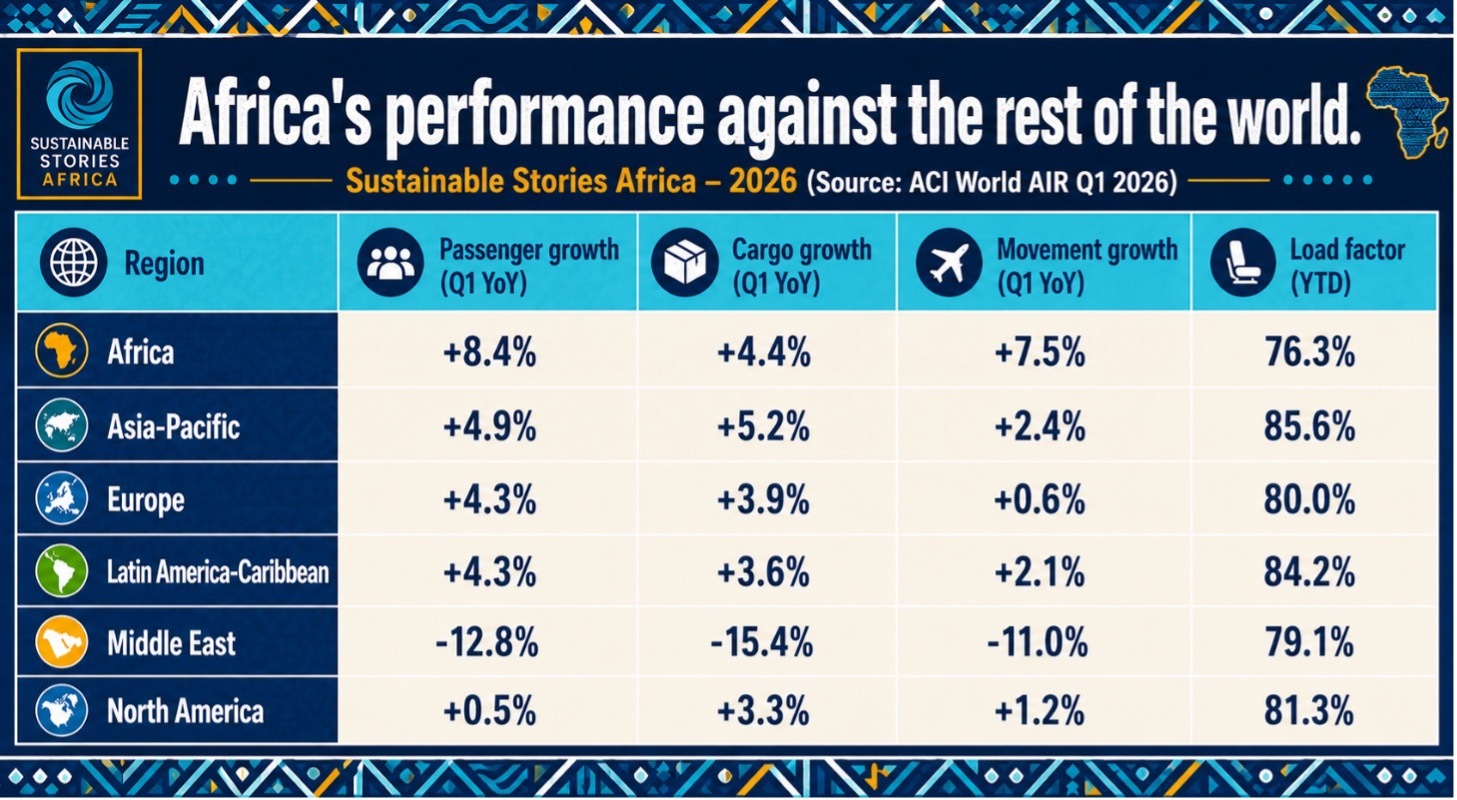
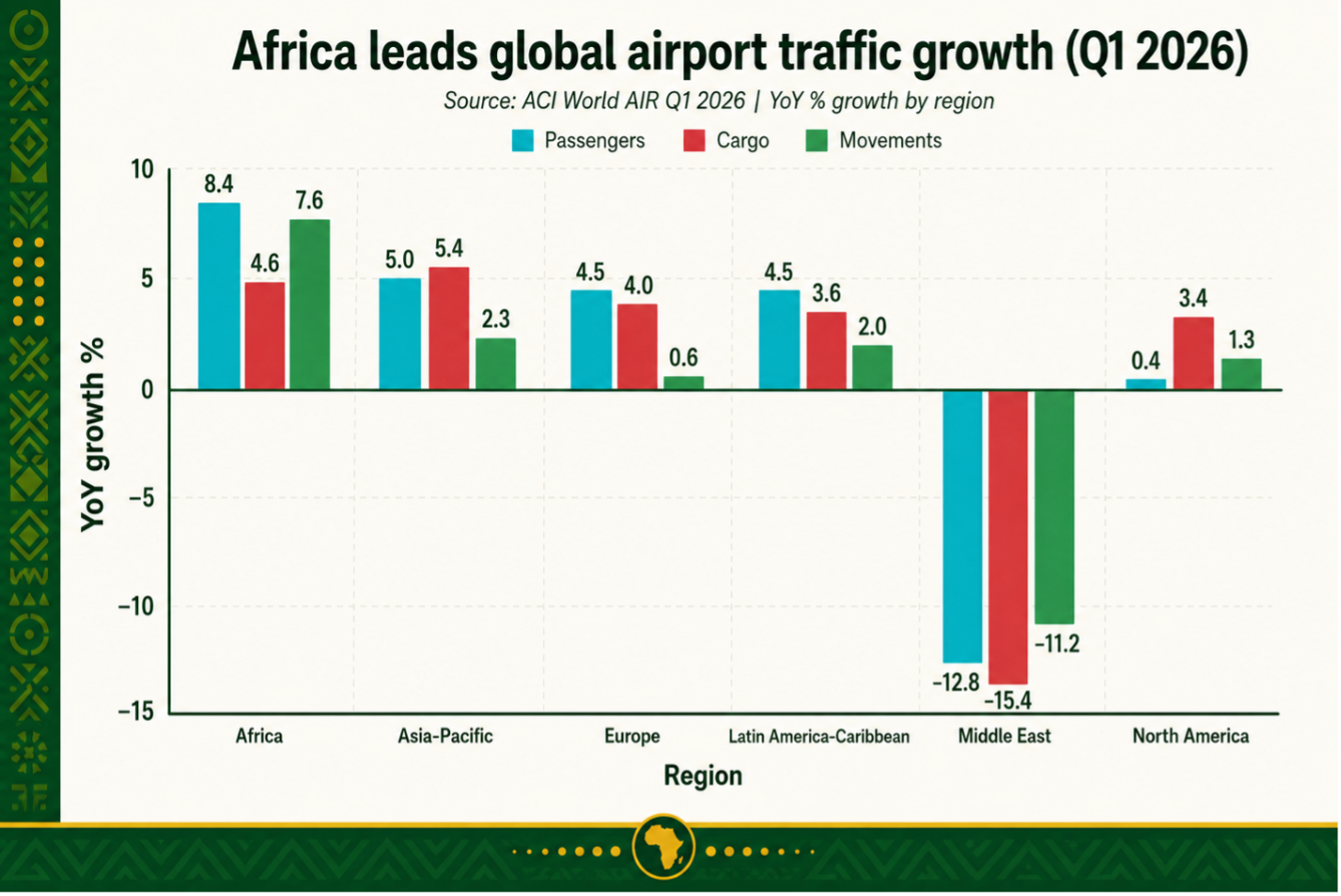
Africa recorded passenger growth of 8.4% in Q1 2026, aircraft movement growth of 7.5%, and cargo growth of 4.4%, each the highest among ACI World's six global regions.
This came as global passenger traffic grew a more modest 2.8%, dragged down by a 12.8% collapse in Middle East traffic tied to regional conflict.
For African markets, the numbers matter beyond bragging rights. Stronger air connectivity underpins trade, tourism, and investment flows across a continent still building out infrastructure to match its economic ambitions.
The report's data, spanning January to March 2026, situates Africa as an unexpected bright spot in an otherwise anxious global aviation picture.
Africa Outpaces World Every Segment
Africa did not just grow; it led. Passenger traffic rose 8.4% year-on-year, more than double the global average of 2.8%, while aircraft movements climbed 7.5% against a global rate of just 1.2%.
Cargo volumes expanded 4.4%, ahead of Europe and Latin America-Caribbean, and trailing only Asia-Pacific's 5.2%.
Load factors also strengthened, with Africa's Q1 average reaching 76.3% year-to-date, up 2.4 percentage points year-on-year, even as fuel costs surged to roughly $155 per barrel globally.
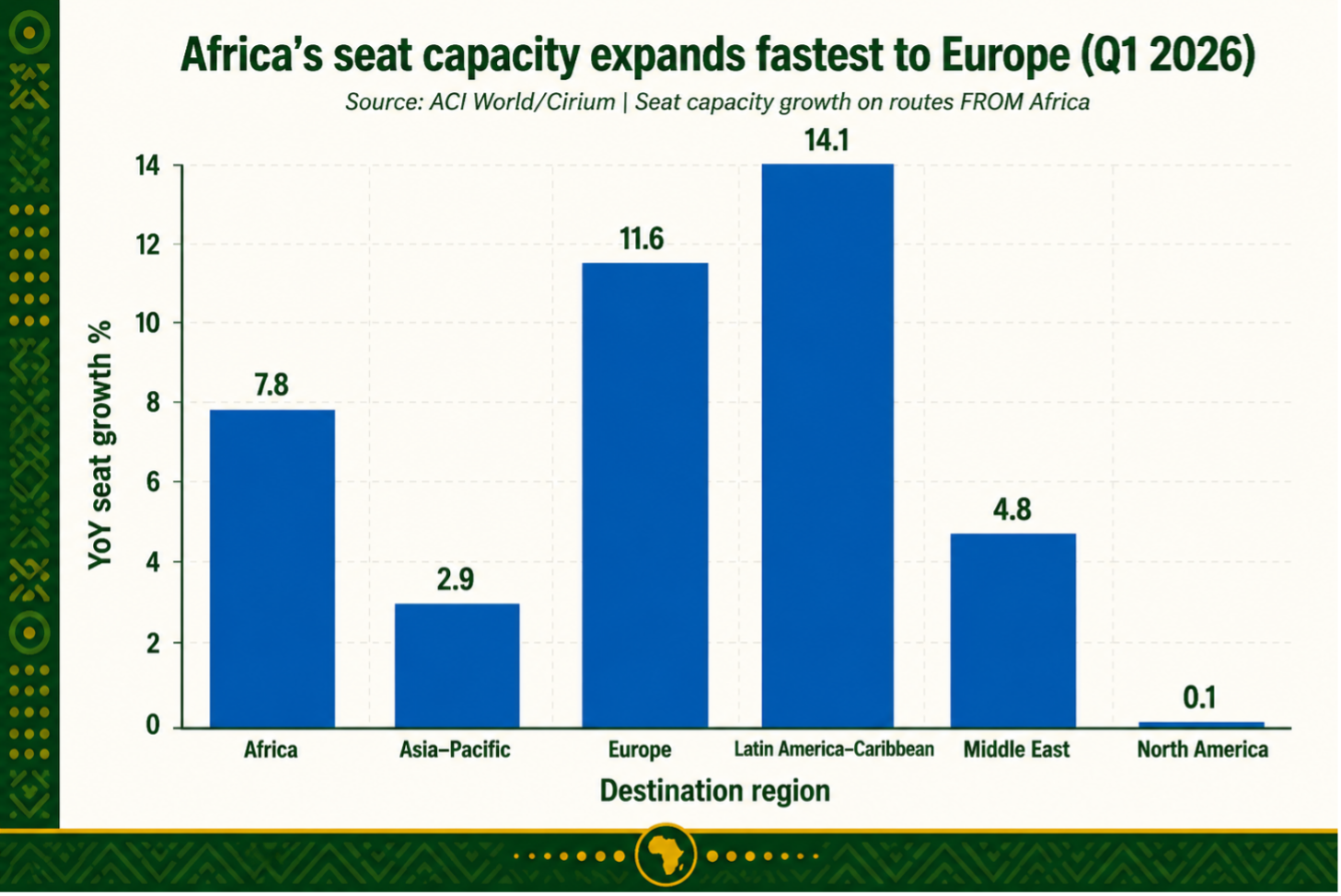
Scheduled seat capacity on routes originating in Africa grew fastest toward Latin America-Caribbean (+20.6%), followed by Europe (+6.1%) and North America (+5.4%), signalling deepening south-south and transatlantic linkages.
 |  |
Beyond aggregate figures, specific African city-pairs surfaced among the report's tracked "regional major routes," offering a rare country-level lens on where this growth is concentrated.
- North African hubs, Algiers (ALG) and Cairo (CAI), anchor routes to Europe and the Middle East
- East African hubs, Addis Ababa (ADD) and Nairobi (NBO), drive links to Asia-Pacific and Latin America; Southern Africa's Johannesburg (JNB), Cape Town (CPT), and Durban (DUR) dominate intra-African traffic
- West Africa's Lagos (LOS) and Abuja (ABV) feature on domestic and transatlantic corridors.
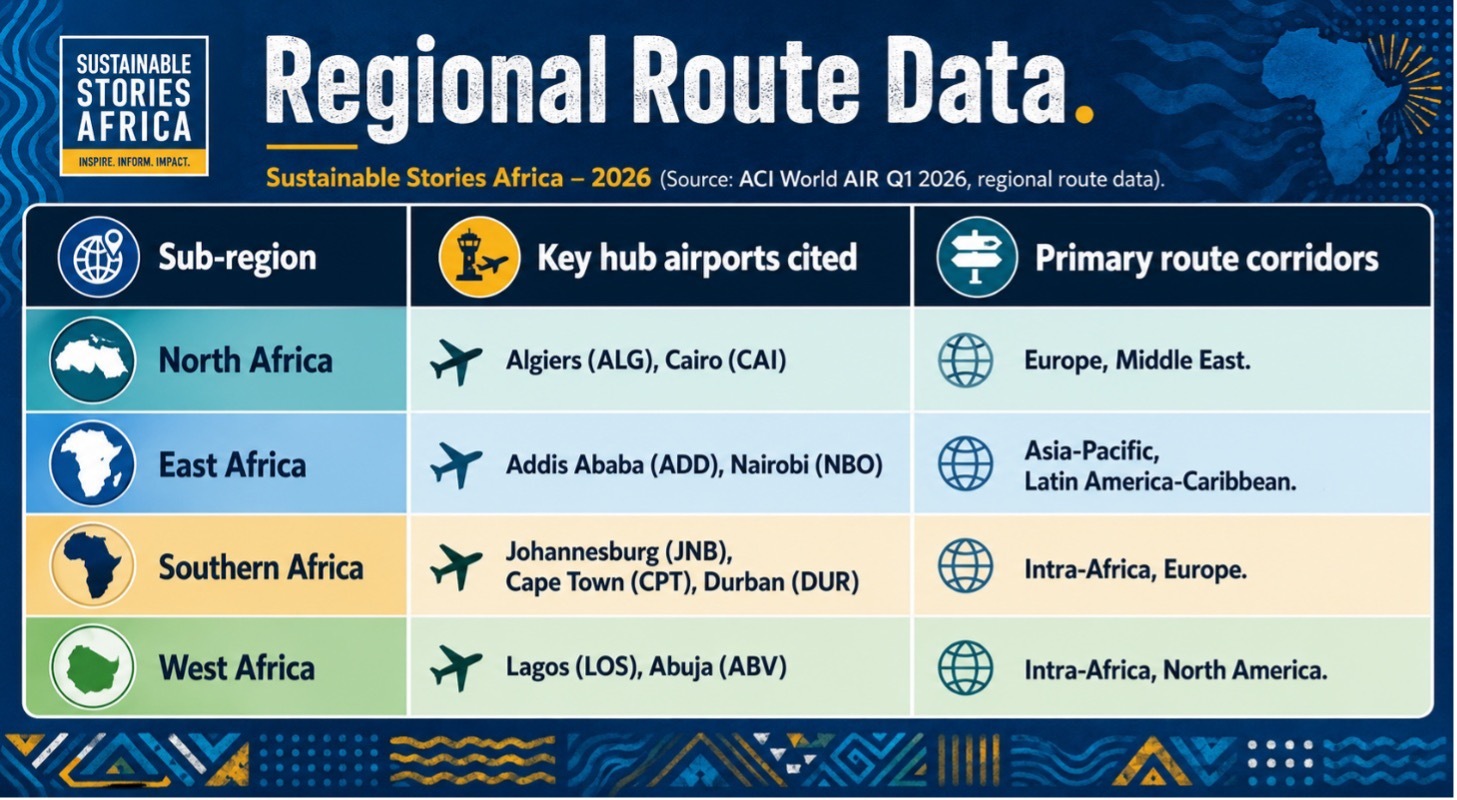
It is worth noting that ACI World tracks Africa as a single statistical region of 55 countries and territories rather than reporting formal sub-regional aggregates, so the table above reflects the specific hub airports referenced in the report's route-level data rather than official North, West, East, or Southern Africa traffic totals.
Growth Faces Headwinds Ahead
Africa's momentum carries real stakes: stronger connectivity can accelerate intra-African trade, tourism revenue, and investment into airport infrastructure across the continent's fast-urbanising cities.
Advanced bookings for Q2 2026 travel to and from Africa fell 11.4% year-on-year, a smaller decline than Europe (-12.5%) but still a signal of softening momentum ahead.
Scheduled seat capacity growth on Africa-origin routes is also projected to slow from 8.2% in Q1 to 1.9% in Q2 2026, a reminder that gains achieved this quarter are not guaranteed to hold without sustained investment in fleet capacity, route development, and airport infrastructure.
If momentum stalls, African carriers and airports risk losing the connectivity gains that support tourism receipts, trade logistics, and diaspora travel corridors that have underpinned this quarter's growth.
Investment Must Match Momentum
Sustaining Africa's lead requires airlines, regulators, and airport operators to act on three fronts now:
- Expanding scheduled seat capacity ahead of demand rather than reactively, accelerating fleet renewal amid a global backlog of 18,100 aircraft and near seven-year delivery timelines, and deepening intra-African route networks to reduce reliance on distant hub connections.
Policymakers should also prioritise data transparency, pushing for country-level and sub-regional traffic reporting so African aviation growth can be tracked, financed, and benchmarked with the same granularity as other regions.
Path Forward – Data Drives Africa's Ascent
Africa's Q1 2026 aviation performance is a signal, not a guarantee.
Sustaining it will require coordinated investment in fleet capacity, intra-African route expansion, and improved data infrastructure to track sub-regional and country-level progress transparently.
Regulators, airlines, and financiers now have evidence that African aviation demand is resilient even amid global uncertainty, the task ahead is converting that momentum into durable, well-financed connectivity gains before Q2's softer booking signals become a longer-term trend.