Africa’s jobs debate is often framed in terms of unemployment. The deeper issue is job quality, productivity and whether young people can move from survival work into dignified livelihoods.
Youth Summit 2026 showed why Africa’s future work agenda must align education, agriculture, entrepreneurship, finance and governance into a measurable jobs compact.
Africa’s Jobs Reality Demands Precision
Africa does not have the luxury of treating youth employment as a campaign slogan. It is now one of the continent’s biggest development tests, shaping social stability, household income, tax bases, migration, gender inclusion and climate resilience.
The World Bank Group Youth Summit 2026 placed this challenge inside a global conversation on digital-age jobs.
However, for Africa, the message requires local translation. The question is not simply whether young people will work.
Many already do. The question is whether their work will be productive, safe, stable and capable of supporting a dignified life.
That distinction matters because Africa’s labour market is not only facing a shortage of jobs. It is facing a shortage of quality pathways.
The Work Exists, But Quality Lags
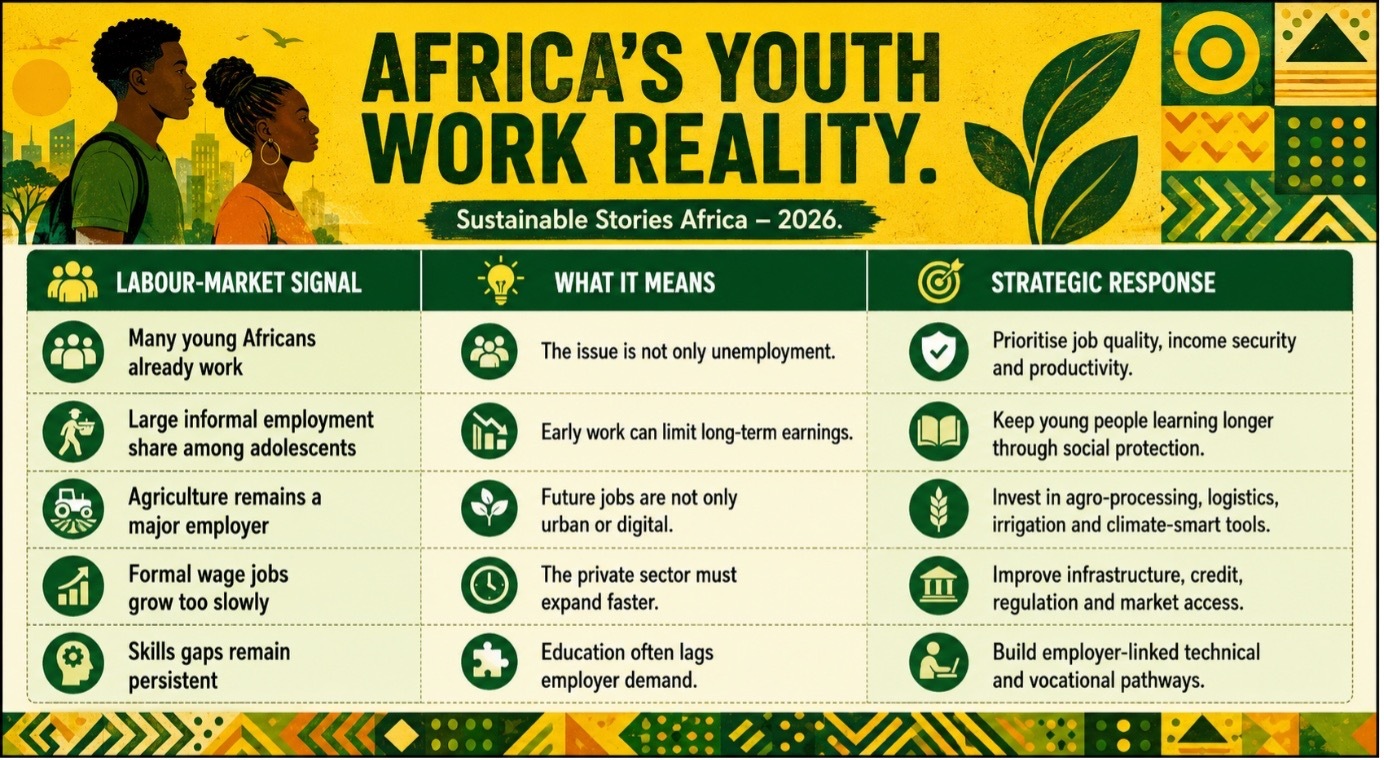
The headline numbers can be misleading. Young Africans are often described as unemployed, but many are working early, informally and under pressure.
Large numbers enter work before completing education, especially in rural and low-income settings, where poverty pushes adolescents into agriculture, petty trade, household enterprise or casual labour.
This is not a failure of ambition. It is a systems failure.
- Too many young people are forced to choose between learning and earning.
- Too many young workers are trapped in jobs that do not build skills, savings or mobility.
- Too many small businesses operate below productivity potential because power, logistics, finance, regulation and market access remain weak.
The result is a paradox: Africa has energy, talent and enterprise, but too much of it is absorbed into low-return activity.
A Demographic Asset Needs Better Systems
The Youth Summit’s theme, #FutureWorks: Designing Jobs for the Digital Age, offers a useful frame because it moves the discussion beyond job counting.
It asks what kind of work future economies should create, who gets access to it and what institutions must change.
Africa’s strongest assets are visible: a young population, expanding digital connectivity, entrepreneurial small firms, agricultural potential and a continental market that can support larger value chains.
However, assets do not automatically become jobs. They require policy choices.
- Education systems must provide foundational competence before specialisation.
- Agriculture must become more productive and better connected to processing, storage, logistics and finance. Small firms must gain access to markets, not just training workshops.
- Digital platforms must raise productivity without normalising precarity.
The future of work in Africa will therefore be hybrid. It will include coders and AI operators, as well as solar installers, extension workers, food processors, cold-chain technicians, nurses, builders, logistics operators, mechanics, creators and climate-smart farmers.
Productive Work Can Reduce ESG Risk
Better jobs are not only an economic objective. They are an ESG issue.
- When young people lack credible work pathways, the risks spread across society. Poverty deepens.
- Migration becomes more desperate.
- Informality weakens tax systems.
- Gender inequality widens when young women are excluded from training, finance and safe work.
- Climate vulnerability grows when rural livelihoods remain low-productivity and exposed to shocks.
By contrast, productive youth employment strengthens sustainability outcomes.
- A cold-chain business can reduce food loss.
- A solar technician can expand clean energy access.
- A digital payments agent can deepen financial inclusion.
- A skilled construction worker can support safer housing.
- A trained care worker can improve health and social resilience.
This is the point often missed in debates about jobs: work is infrastructure. It connects families to income, firms to productivity, governments to revenue and communities to stability.
What Africa Must Now Prioritise
Governments need to make job quality measurable.
- Employment strategies should track income, productivity, safety, skills progression, gender inclusion and transition into more stable work, not only the number of people trained.
Education reform must begin early.
- Foundational literacy, numeracy and digital fluency are the base of all future jobs.
- Technical education should be linked to real sectors and local employers.
- Apprenticeships need quality standards so they do not become unpaid labour disguised as opportunity.
Agriculture policy must be treated as a jobs policy.
- Investments in storage, rural roads, renewable energy, irrigation, extension services and processing can create work across value chains.
- This is especially important because food systems sit at the intersection of employment, climate adaptation and household welfare.
Businesses should build youth pipelines rather than complain about skills shortages.
- Firms can partner with training providers, publish competency maps, support apprenticeships and source from youth-led suppliers.
Financiers should back the firms that create work.
- Youth employment will not scale without working capital, equipment financing, patient equity, guarantees and access to procurement for small and growing businesses.
Path Forward – Turn Youth Potential Into Dignified Work
The path forward is clear: Africa must move from youth employment rhetoric to delivery of quality jobs.
That means aligning skills, finance, agriculture, enterprise growth and infrastructure around measurable livelihoods.
The prize is a demographic dividend that is not abstract.
It is young people earning better, building firms, strengthening communities and helping African economies grow with dignity.