
AI is already changing how students learn, how teachers work and how institutions judge knowledge. The real question is no longer whether schools will use AI, but whether education systems can shape its use before it reshapes learning by default.
A new World Economic Forum report warns that readiness, not adoption, will determine whether AI strengthens education or widens existing gaps across classrooms, communities and labour markets.
AI Is Rewriting The Learning Contract
Artificial intelligence is no longer waiting outside the school gate. It is already in classrooms, homework routines, lesson planning, assessment systems and informal learning spaces, often ahead of policy, teacher training and institutional safeguards.
This article is based on the World Economic Forum’s June 2026 insight report, “Shaping the Future of Learning: Education Readiness for the Age of AI.”
The report frames the central challenge clearly: AI adoption is happening from the bottom up, as students and educators use tools daily without matching updates to curricula, assessment, governance and digital safety systems.
For Africa and other emerging markets, the stakes are even sharper. AI could help overcrowded classrooms, support teachers, expand access to personalised learning and bridge skills gaps.
However, without readiness, it could also deepen inequality, weaken academic integrity, amplify misinformation and reduce the human connection that learning needs.
The Classroom Is Already Moving Faster
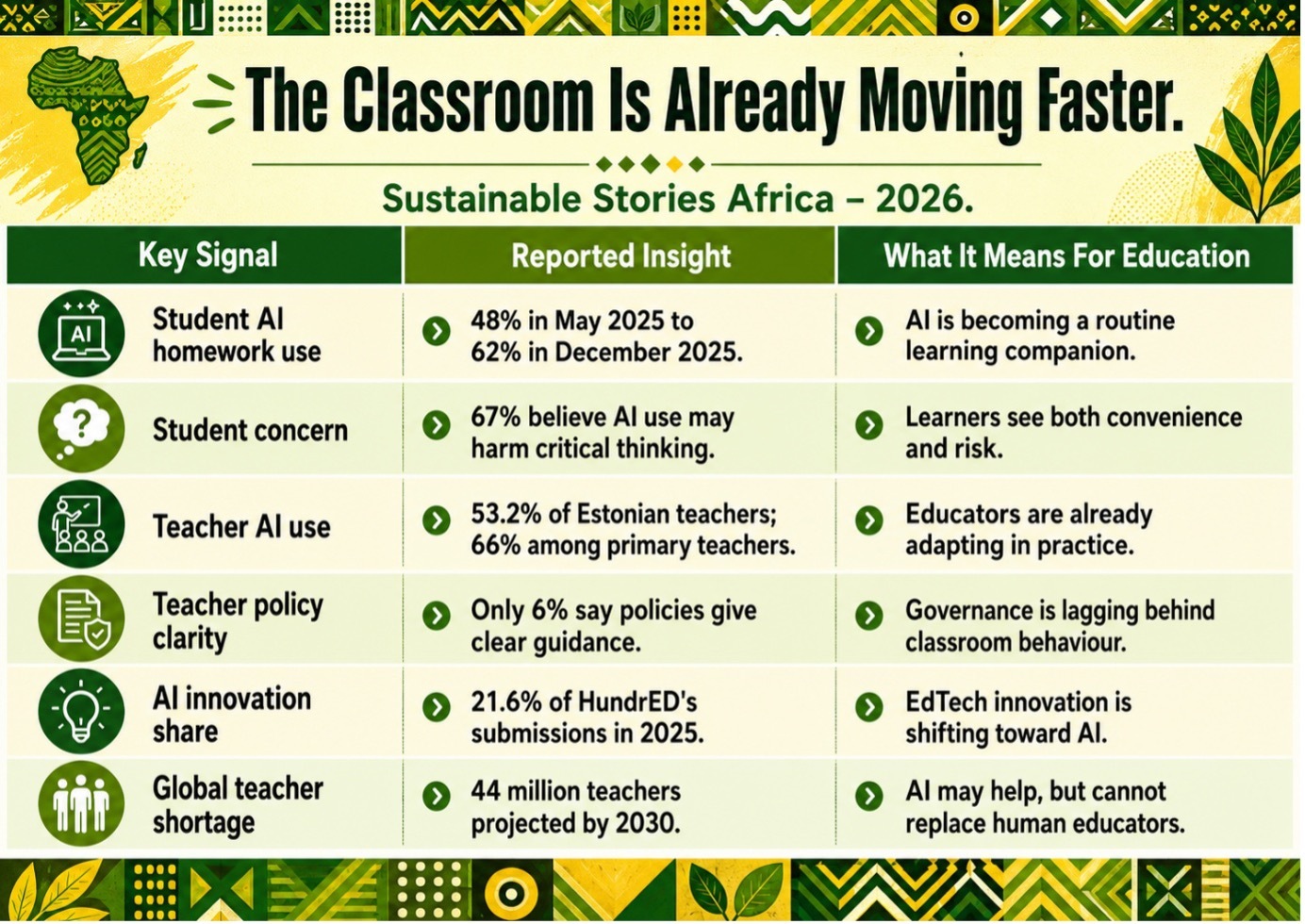
AI has not just arrived in education; it is already reshaping how students learn and how teachers work.
Students use it to draft essays, explain concepts and complete assignments; teachers use it to prepare materials, reduce administrative load and support feedback.
This is the present reality, not a future projection.
The pace is striking. Education is now the second most AI-intensive sector globally, behind technology and media.
AI-linked innovation submissions in HundrED's global collection quadrupled between 2022 and 2025, reaching 21.6%.
However, only 6% of teachers believe existing policies provide clear guidance, a governance gap that leaves powerful tools operating without defined ethical boundaries.
For African education systems already navigating infrastructure deficits, teacher shortages and uneven digital access, the stakes are higher still
If AI adoption follows existing connectivity patterns, it risks deepening inequality rather than democratising learning.
That is the human capital warning policymakers cannot afford to ignore.
The Data Shows A Readiness Gap
The WEF report argues that the challenge is not AI adoption itself, but the misalignment between technological availability, learning behaviour and education systems that were not designed to absorb such rapid change.
That misalignment appears in four major risks.
- Cognitive offloading – When AI reasons through every task step, it may replace the mental effort that builds deep understanding, a risk especially serious for children whose cognitive abilities are still developing.
- Misinformation – Generative AI produces fluent but sometimes false answers. Research shows hallucinating AI models are 34% more likely to use confident phrases like "definitely" or "certainly," making errors feel authoritative.
- Academic integrity – Analysis of nearly 575,000 student conversations on Claude.ai found that 47% sought ready-made answers with minimal cognitive engagement, including explicit requests to avoid plagiarism detection, forcing schools to redefine the boundary between assistance and authentic authorship.
- Human connection – Learning depends on trust, mentorship and emotional safety, qualities AI systems optimised for efficiency and personalisation cannot replicate or replace.
AI Can Strengthen Teachers And Learners
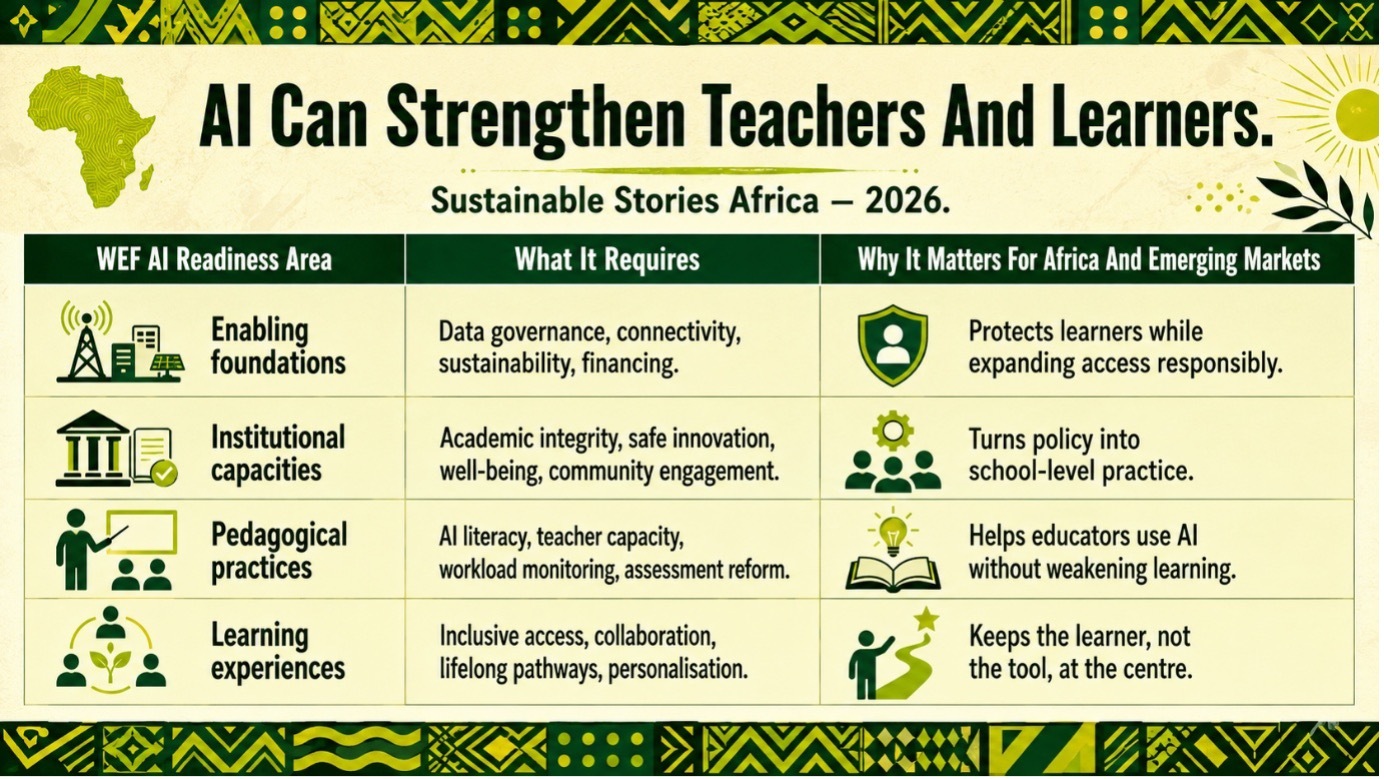
The opportunity is substantial; however, it is conditional.
With a projected global shortage of 44 million teachers by 2030, concentrated heavily across the Global South, AI offers genuine relief by reducing administrative burden and freeing educators for higher-value work: mentorship, individual support, creative dialogue and parent engagement.
On assessment;
- AI-enabled analytics can identify learning gaps earlier and accelerate teacher response, particularly valuable in low-resource classrooms where one teacher serves many learners with vastly different needs.
The inclusion case is equally compelling.
- Real-time translation, captioning and multimodal materials can support learners with disabilities, language barriers or diverse learning styles.
For Africa's large, linguistically diverse youth population, this could be transformational, provided tools are designed for local subjects, cultural relevance, affordability and data rights.
The WEF's position is clear-eyed: AI amplifies human capability only when conditions are right.
Without governance, equity and sustained teacher investment, adoption risks becoming superficial, and benefits will again flow to those already best served.
Governance Must Catch Up With Classrooms
Education systems can no longer afford reactive experimentation. The moment demands deliberate readiness planning across every level of governance.
Governments must begin with honest assessments of the system.
- Mapping digital infrastructure, data protection frameworks, teacher capacity and curriculum gaps before procuring any AI tool. The standard should be simple: does it improve learning outcomes, reduce inequality and protect children?
Schools and universities need.
- Enforceable, plain-language AI-use policies covering when AI is permitted, how assistance must be disclosed and how assessments will test genuine reasoning rather than machine-generated output.
Teachers require training, time and professional autonomy.
- Rather than additional responsibility layered onto already stretched workloads. They remain the critical translation layer between policy intent and classroom reality.
Technology companies and funders must meet higher standards:
- Bias testing, privacy safeguards, age-appropriateness, local-language functionality and low-bandwidth usability are non-negotiable in African contexts.
Finally, parents and communities must be genuine partners.
- AI in education shapes homework habits, mental health, online safety and the meaning of achievement itself, decisions too important to make without families.
Path Forward – Build Readiness Before AI Adoption Deepens
The future of learning will not be decided by tools alone.
It will be decided by governance, teacher support, inclusion, assessment reform and the willingness to keep human development at the centre of digital change.
For African education systems, the priority is readiness before scale.
AI can widen access and strengthen learning; however, only if schools, governments, funders and technology providers build systems that protect equity, truth, creativity and human connection.