Sustainable aviation fuels could deliver major emissions reductions, but global supply remains far below what aviation needs for net zero.
ACI World’s 2026 policy brief argues that airports, though rarely direct fuel buyers, can become powerful facilitators by convening airlines, fuel suppliers, governments, financiers and communities around SAF deployment.
Move Into Aviation’s Climate Frontline
Airports are no longer just gateways for passengers, cargo and tourism. In the aviation sector’s race toward net zero, it is becoming climate infrastructure platforms, places where fuel systems, public policy, finance, community trust and airline decarbonisation now meet.
A 2026 policy brief by Airports Council International World places Sustainable Aviation Fuels, or SAF, at the centre of aviation’s decarbonisation pathway.
The brief says the next five years will be critical, with airports positioned not necessarily as fuel buyers, but as facilitators that can advocate, educate, engage, incentivise and, in some cases, invest in the SAF supply chain.
For African and other emerging-market airports, the message is urgent. Cleaner aviation fuel is not only a climate issue.
It is becoming a competitiveness, finance, tourism, trade and public health issue, especially for countries that depend on air connectivity but still face infrastructure, energy and investment gaps.
The SAF Gap Is Still Huge
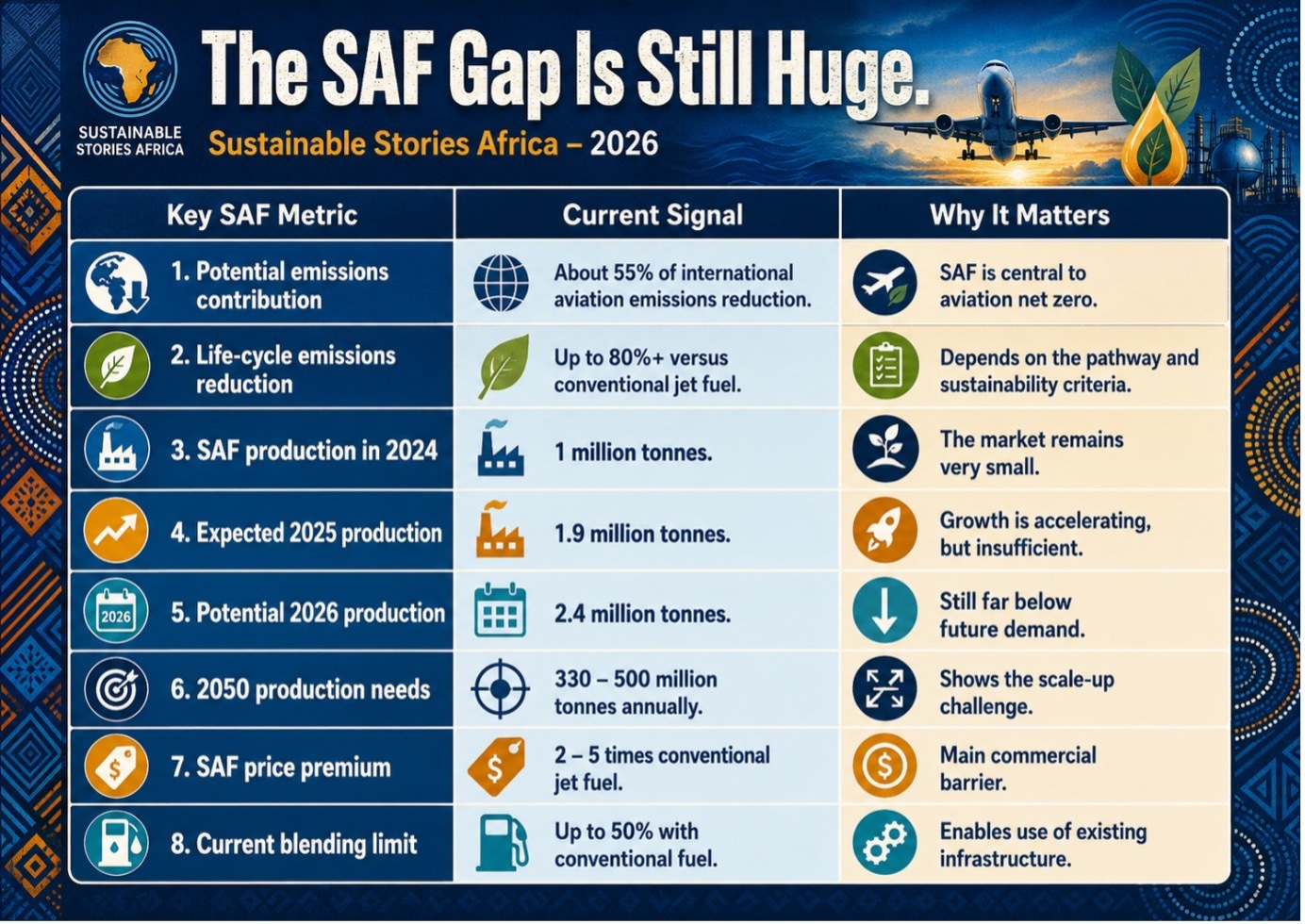
Sustainable aviation fuel (SAF) could cut international aviation emissions by roughly 55%, delivering life-cycle reductions of up to 80% or more compared with conventional jet fuel, depending on production pathway and sustainability criteria, according to ACI World's policy brief.
This potential explains why SAF has become one of aviation's most critical climate tools.
However, the market remains small. Production has doubled annually since 2023, but volumes fall far short of requirements. Global output stood at 1 million tonnes in 2024, estimated at 1.9 million tonnes in 2025, and projected at 2.4 million tonnes in 2026.
By 2050, scenarios suggest annual demand could reach 330–500 million tonnes.
This is aviation's central contradiction: the fuel key to net zero remains scarce, costly, and unevenly available.
ACI notes SAF prices run two to five times higher than conventional jet fuel, with policy gaps, weak incentives, limited facilities, and competing demand slowing deployment.
Airports Can Enable Cleaner Aviation
The strongest insight from the ACI brief is that airports need not own the entire fuel chain to influence it.
Airlines typically contract fuel suppliers directly, while SAF arrives pre-blended and certified as a "drop-in" solution usable at up to 50% blend with conventional jet fuel through existing infrastructure.
The brief's supply chain diagram shows SAF can be accelerated via mass balance or physical segregation, easing pressure for immediate airport-level changes.
However, it also reveals complexity: feedstock, production, certification, blending, transport, storage and aircraft uptake all require careful alignment.
This is where airports add value. Positioned at the centre of aviation ecosystems, they can convene airlines, producers, regulators, financiers and communities, while building SAF roadmaps and feasibility studies that support long-term investment confidence.
For African airports, this role is strategic. Rather than becoming production hubs immediately, they can map demand, identify feedstock opportunities, engage regulators, and build the commercial case for access to cleaner fuel.
Scope Three Makes Airports Care Deeply
For airports, SAF is not only about helping airlines cut emissions; it also shapes their own climate accounting, business resilience and licence to operate. ACI World notes Scope 3 emissions can exceed 90% of an airport's total carbon footprint, meaning decarbonisation cannot stop at terminals or ground operations; aircraft fuel use and airline activity shape the wider emissions profile.
The brief's Figure 2 shows airlines count fuel combustion as Scope 1, while airports classify related emissions under Scope 3 Categories 11 and 6.
However, many airports lack sufficient SAF data to credibly claim reductions, a gap with real consequences for ESG reporting, carbon accreditation and climate-risk management, and growing reputational and regulatory exposure.
The community dimension matters too. ACI notes SAF's lower aromatics and sulphur content improve local air quality.
Virgin Atlantic's Flight 100 showed a 40% reduction in particulate matter (70% for the HEFA-SAF component). Research with DLR and Copenhagen Airport found a 30% drop in ultrafine particles using a 34% HEFA blend, positioning SAF as a public-health co-benefit.
From Observer To Climate Leader
ACI World outlines a three-stage maturity pathway for airports: Observer, Facilitator and Leader.
- Observers build internal SAF understanding and basic data access to target Airport Carbon Accreditation Level 3.
- Facilitators embed SAF into corporate strategy, forming partnerships toward Level 4. Leaders create financial mechanisms, invest in production or research, and pursue Level 5.
Global examples illustrate this range.
- Heathrow set a 5.6% SAF target by 2026, above the UK's 3.6% mandate.
- Sydney Airport.
- Qantas and Ampol delivered nearly two million litres of unblended SAF in 2025, enough for 900 Auckland flights.
- Changi has integrated blended SAF since 202
- Schiphol co-financed a SkyNRG plant
- Kansai supports SAF from waste cooking oil
- Pittsburgh is exploring alcohol-to-jet production.
For emerging markets, the lesson isn't replication but choosing the right role, knowledge builder, advocate, coordinator, funder or infrastructure partner.
What Airports Need To Scale SAF
ACI is clear that airports cannot act alone. SAF deployment requires coordinated action across the aviation, energy, finance and public sectors.
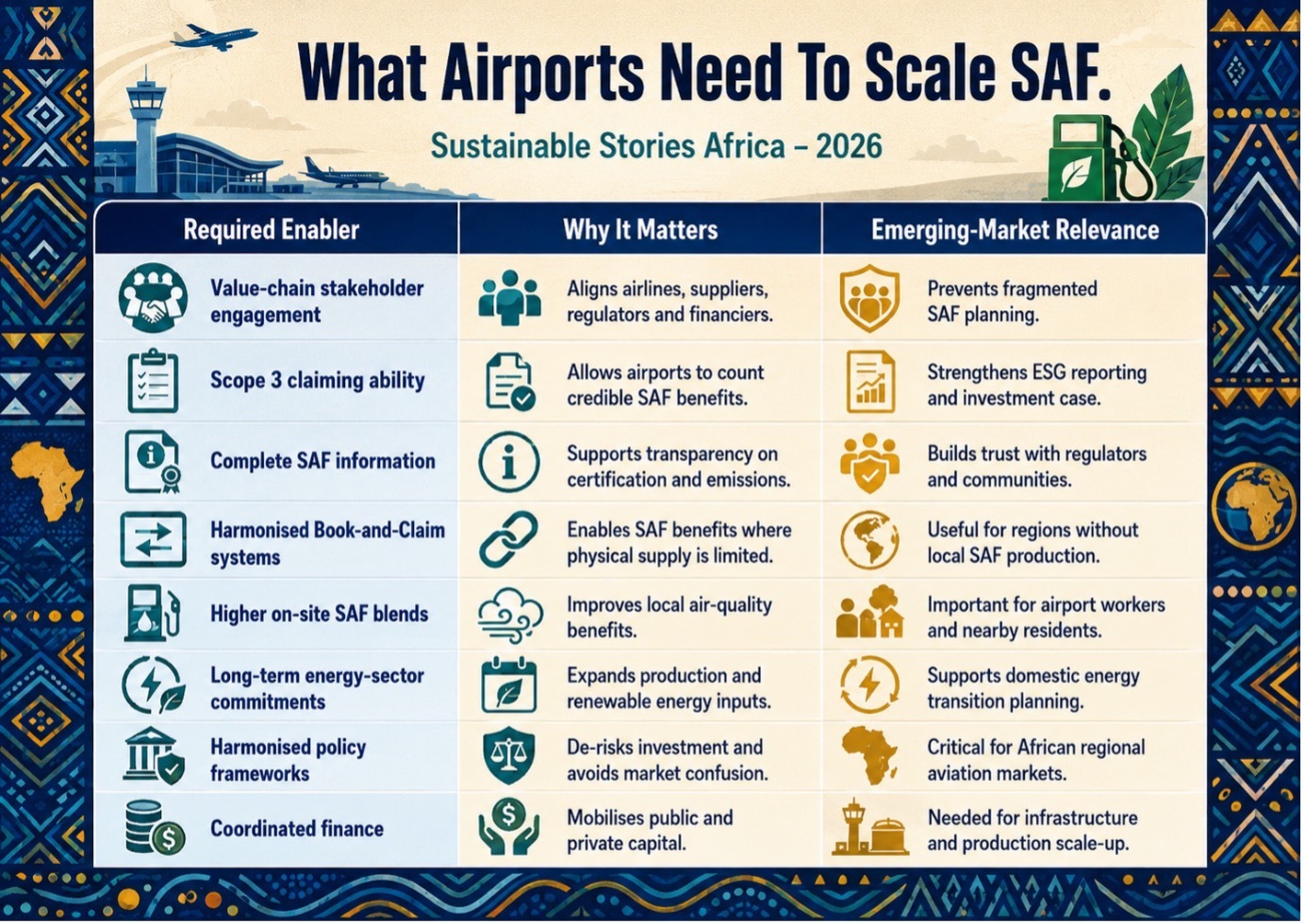
Book-and-Claim mechanisms are especially important for regions where SAF is not yet physically available.
ACI says these systems can support market ramp-up in the short and medium term by overcoming physical supply limitations.
However, they must be harmonised, interoperable, transparent and designed to prevent double counting.
This has direct relevance for Africa.
A well-designed Book-and-Claim system could allow corporates, passengers or airports to support SAF even before every airport has physical access to supply.
However, credibility will be everything. Claims must be verified, traceable and aligned with greenhouse gas accounting principles.
ACI also calls for stronger policy frameworks, implementation support in developing regions, inclusion of airports in capacity-building projects such as ICAO’s ACT-SAF programme, and significant public and private investment.
Africa’s Airports Face A Strategic Choice
For African aviation, SAF presents both risk and opportunity. The risk is exclusion: if SAF markets mature mainly in Europe, North America and Asia, African airports could face compliance pressure without equal access to fuel, finance or infrastructure, while airlines confront uneven cost burdens.
The opportunity is development. Countries with strong agricultural, waste or renewable feedstock potential could build SAF value chains that create jobs and attract climate-aligned investment, with airports acting as demand anchors and policy advocates.
The practical first step isn't a refinery at every airport; it's a SAF strategy: feasibility studies, feedstock assessment, partnerships, regulatory clarity and safeguards to protect food systems, land rights and livelihoods.
Policy Action Must Start Immediately
Multiple stakeholders share responsibility for SAF's future:
- Governments: build stable policy frameworks combining incentives, sustainability criteria and regional cooperation; avoid fragmented mandates that raise costs.
- Airports: develop SAF roadmaps, stakeholder working groups, reliable fuel data, and integrate SAF into ESG strategies.
- Airlines and suppliers: move beyond pilots into long-term offtake agreements that build investor confidence.
- Financiers: treat SAF as transition infrastructure, especially alongside renewable energy and waste projects.
- Citizens: public acceptance matters; education campaigns and outreach can raise SAF awareness where support may grow once benefits are clearly explained.
Path Forward – Build The SAF Ecosystem
Africa’s aviation transition needs early planning, not late compliance. Airports should start with SAF roadmaps, stakeholder coalitions, credible emissions data and policy engagement.
The bigger priority is ecosystem-building. Cleaner fuels will require finance, energy-sector commitment, harmonised rules, transparent Book-and-Claim systems and implementation support. Done well, SAF can advance climate action, improve air quality and strengthen aviation’s social licence to operate.