ACI World’s first-edition 2026 airport traffic forecasting white paper argues that forecasts should be treated as decision-support systems, not promises about the future.
For Africa, the lesson is urgent: stronger data and transparent scenarios could determine whether airports become resilient aviation hubs, tourism gateways and business corridors, or expensive infrastructure that fails to match demand, climate obligations and community needs.
Africa’s Airports Need Foresight Before Expansion
Africa’s airport-development challenge is not simply to accommodate more passengers. It is to determine where demand will emerge, which routes can remain commercially viable, when capacity should be expanded and how growth can be reconciled with financial, environmental and community expectations.
That makes traffic forecasting increasingly important across a continent where airports perform multiple development roles. Some connect national capitals to international markets.
Others support tourism-dependent economies, facilitate high-value cargo, strengthen regional business corridors or provide essential access to geographically isolated communities.
ACI World’s Airport Traffic Forecasting White Paper, First Edition 2026 provides a practitioner-oriented framework for making those decisions. Developed by specialists with a combined 126 years of experience and responsibility for traffic across 51 airports, it covers forecasting periods ranging from the next hour to more than 30 years.
However, the document is a methodological guide, not an Africa-specific traffic outlook: it does not rank African airports or publish continent-wide passenger projections. Its value lies in how its principles can be applied to African markets.
Forecasts Now Shape More Than Passenger Numbers
The central warning is simple: an airport forecast is not a prediction of the future. It is a structured estimate based on historical performance, market conditions, assumptions and professional judgement.
That distinction matters when billions may be committed to terminals, runways, access roads, cargo facilities and commercial developments.
An excessively optimistic forecast can lead to oversized infrastructure, high financing costs and underused assets.
A conservative forecast can leave an airport congested, discourage airlines and weaken the passenger experience.
ACI World identifies forecasting as a foundation for infrastructure planning, staffing, capacity management, commercial development, air service strategy and financial sustainability.
It recommends a process for moving from data and analysis to assumptions, modelling, interpretation and final output. Each stage should be documented and tested rather than adjusted to produce a politically or commercially convenient result.
This is particularly relevant in African aviation, where public ambition, airline negotiations and infrastructure announcements can sometimes move faster than underlying market evidence.
The report warns that forecasts should complement business plans, rather than be manipulated to justify decisions already taken.
Africa’s Airport Roles Demand Different Models
No single forecasting model fits all airports, since demand drivers differ even among airports with similar passenger volumes.
A transfer hub, leisure gateway, and regional airport each respond to distinct market forces:
- Tourism traffic spikes around holidays and favourable weather
- Business travel tracks weekday schedules and economic activity
- Transfer traffic hinges on airline hub strategy
- Regional routes shift with policy, road alternatives, and fares.
Macroeconomic indicators, such as GDP, disposable income, population, trade, airfares, and fuel costs, shape demand, though sensitivity varies by segment, with leisure and visiting-friends-and-relatives traffic more price-responsive than business or long-haul travel.
Visa rules, capacity, regulation, and surface access add further complexity.
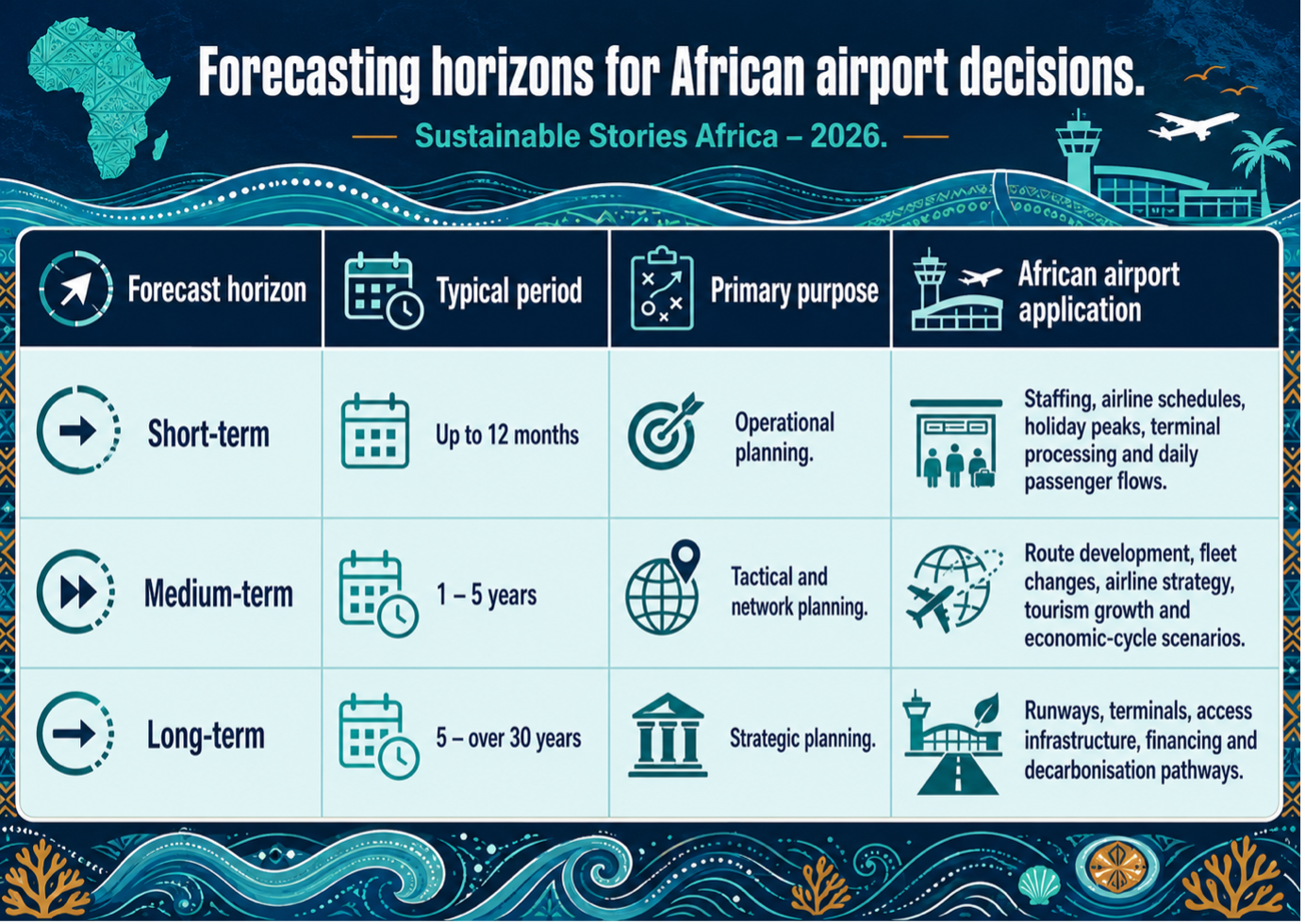
Short-term forecasts offer greater detail and lower uncertainty, whereas long-term projections are aligned to demographic, economic, and regulatory shocks.
African airports therefore require blended approaches: schedule-driven models for operations, time-series models for trends, econometric models linking demand to GDP and fares, and peak-hour models for infrastructure planning.
Elasticity-based or benchmark methods can guide greenfield airports where data remain limited.
Better Forecasts Can Unlock Sustainable Airport Value
The strongest forecasts go beyond passenger totals to explain what traffic means for infrastructure, revenue, connectivity, and environmental performance.
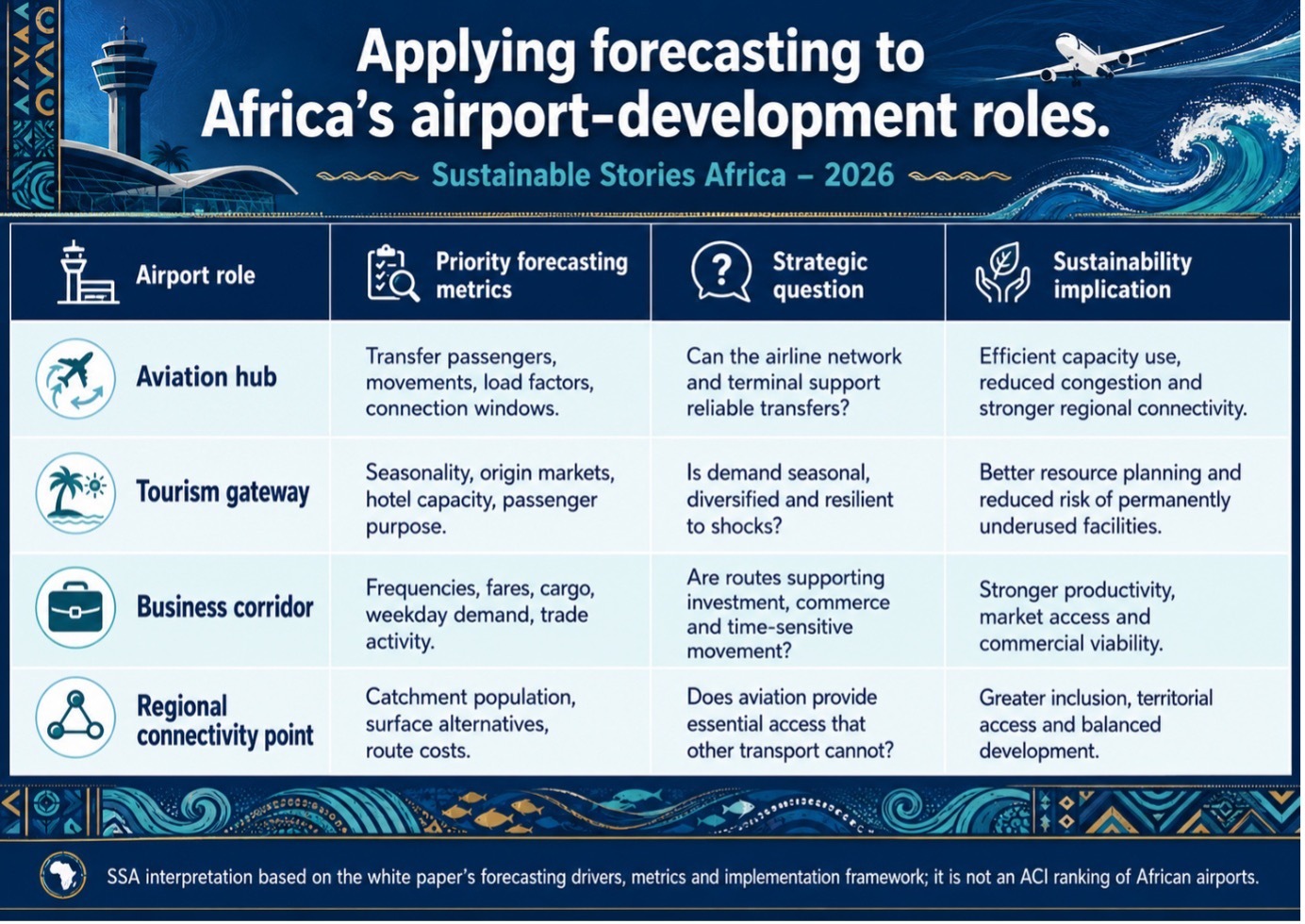
For infrastructure, forecasts shape requirements for check-in, security, baggage handling, immigration, gates, parking, and transport interfaces.
- Scenario analysis helps planners anticipate capacity thresholds and phasing expansion around actual need rather than prestige or political timelines.
- Commercially, passenger volumes, aircraft movements, fleet mix, and traveller profiles drive aeronautical charges and non-aeronautical income from retail, food, lounges, and parking.
- Metrics such as revenue per passenger and per movement strengthen financial planning, though greater segmentation adds uncertainty.
Forecasting also informs environmental planning:
- Traffic projections shape emissions estimates, noise exposure, and decarbonisation scale.
The report ties forecasting to CORSIA, aviation's 2050 net-zero ambition, and ICAO's target of a 5% emissions cut by 2030 through sustainable fuels and cleaner energy.
ACI's parallel goal of net-zero airport operations by 2050 means credible African traffic scenarios could guide future energy demand, fleet composition, and fuel requirements before expansion proceeds.
What African Aviation Decision-Makers Must Do
Better data governance comes first. ACI World identifies operational databases, tower logs, civil aviation authorities, airline schedules, ADS-B records, mobile-location data, and passenger surveys as key sources, though none are interchangeable.
- Schedule data may omit charters; booking systems can underrepresent direct-purchase passengers; mobile data aids catchment analysis but may miss cross-border coverage; surveys reveal travel purpose but require statistical rigour.
- Second, airports need clear institutional ownership of forecasts. Fragmented datasets and objectives across commercial, operational, and finance teams weaken outcomes; external consultants add expertise, but internal oversight and documentation remain essential.
- Third, major investments should be tested against base, high, and low scenarios, distinguishing unconstrained market potential from constrained traffic realistically manageable under runway, terminal, workforce, and environmental limits.
- Fourth, forecasts require continuous validation against actual volumes, movements, load factors, and revenue, with peer benchmarking as a reasonableness check—not a template to copy.
- Finally, modelling sophistication should match institutional capacity. Machine learning suits airports with robust data and specialist skills; simpler, transparent models often serve smaller airports better.
Without defined responsibilities, validation, and documentation, forecasts become unauditable, trust depends on transparent assumptions and honest communication of uncertainty.
Path Forward – Building Africa’s Airports Around Better Evidence
Africa’s airports need forecasts that connect passenger demand with infrastructure, finance, airline strategy and decarbonisation, rather than isolated numbers designed to support predetermined projects.
Governments, operators, regulators, airlines and financiers should build shared data systems, test multiple scenarios and review forecasts regularly.
Better forecasting will not remove uncertainty, but it can make airport growth more disciplined, bankable, resilient and aligned with Africa’s wider connectivity and sustainability objectives.