Rare diseases affect more than 300 million people globally; however, weak data systems often keep patients invisible until diagnosis comes too late, treatment is unavailable, or family finances collapse.
A 2026 World Economic Forum white paper argues that better data can turn one of healthcare’s largest unmet needs into a multitrillion-dollar opportunity for health equity, innovation and economic resilience.
Can Make Rare Lives Visible
Rare diseases are individually uncommon, but collectively they represent one of the largest blind spots in global health. The World Economic Forum’s February 2026 white paper, Making Rare Diseases Count, estimates that more than 300 million patients live with rare diseases worldwide, while the circle of affected families and caregivers expands the direct impact to more than 1 billion people.
The central finding is simple but urgent: rare diseases are not only a medical challenge. They are data, equity, productivity and governance challenges.
Around 95% of rare diseases have no treatment authorised by a major regulatory agency, leaving many patients dependent on delayed diagnosis, fragmented care and high out-of-pocket spending.
For African and other low- and middle-income countries, the stakes are sharper. Where newborn screening is limited, digital records are weak and specialist care is scarce, rare diseases can remain unnamed for years.
Better data will not solve every problem, but it can help health systems identify who is being missed, where money is being lost, and how to target investments.
Hidden Patients, Visible Economic Costs
The most powerful number in the WEF report is not only the patient count. It is the economic burden: rare diseases may cost the world $7.2 trillion to $8.6 trillion annually when direct medical costs, early death, reduced workforce participation and disability-related losses are included.
That figure reframes rare diseases from a niche clinical issue into a systems-level development concern.
- Families lose income when parents become full-time caregivers. Employers lose productivity.
- Governments absorb disability and social-service costs.
- Health systems pay for repeated tests, late-stage complications and poorly coordinated care.
- Insurers and payers face claims that are often dispersed across providers and diagnoses, making the full cost difficult to track.
The report notes that the burden is visible in high-income markets, but far less measurable elsewhere.
- The United States recorded nearly $1 trillion in annual costs from just 379 rare conditions.
- Europe estimated about €250 billion across 43 rare conditions in nine countries.
- Japan estimated JPY 9.9 trillion for 64 rare diseases.
- For most low- and middle-income countries, comparable estimates do not exist.
That absence of data is not neutral. It shapes who gets screened, who gets treated, who gets reimbursed, and who remains invisible.
Data Turns Need Into Evidence
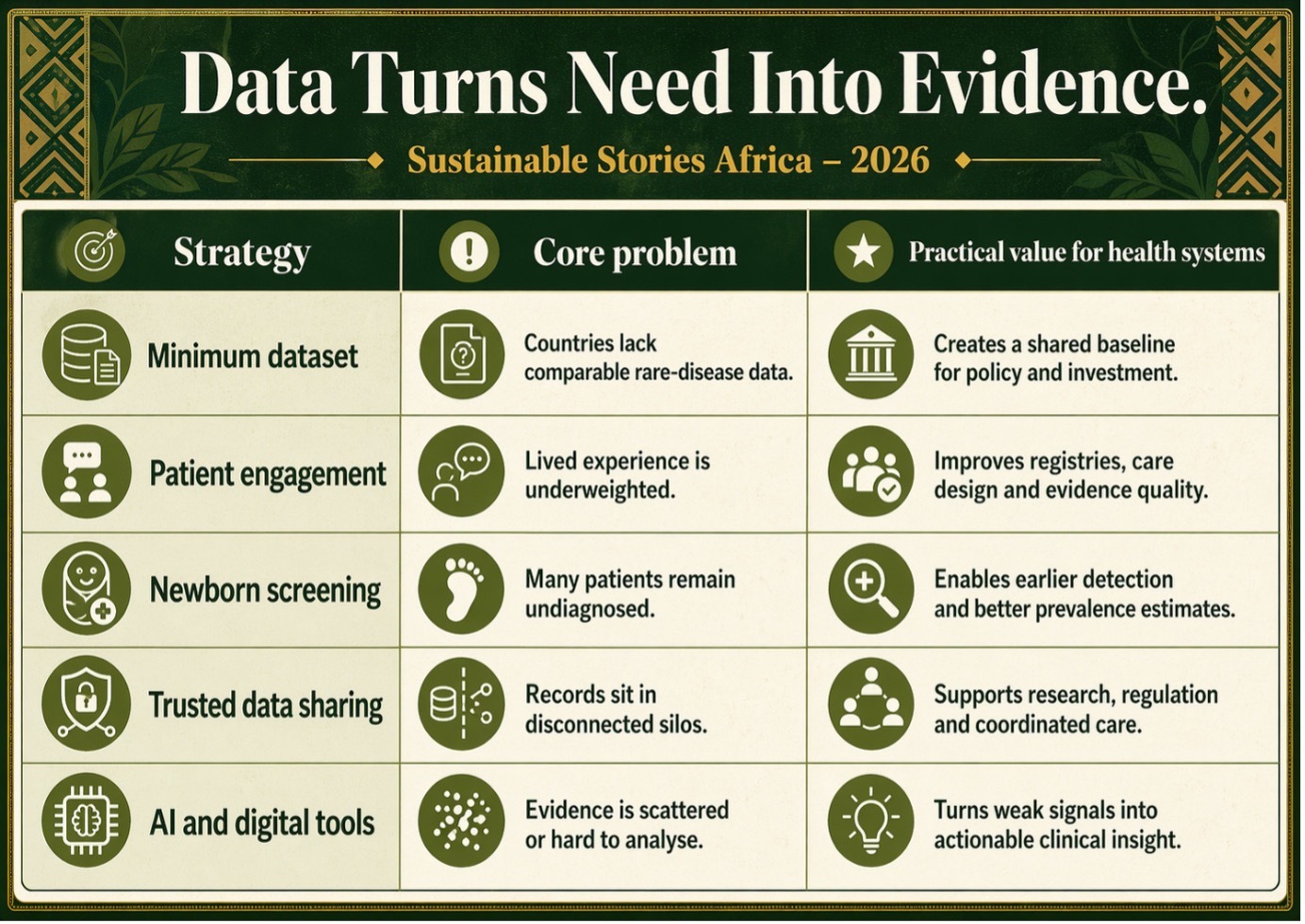
The World Economic Forum’s roadmap on rare diseases centres on five priorities:
- Establishing a minimum cross-country dataset
- Strengthening patient engagement in data collection
- Expanding newborn screening and diagnostics
- Enabling trusted data sharing
- Deploying AI to close evidence gaps.
The urgency is clear. More than 7,000 rare diseases are recognised globally, most genetic, with about 70% emerging in childhood; however, diagnosis remains a major challenge, with only 19% of clinicians reporting confidence in identifying them.
Delays are often severe. In Europe, diagnosis can take four to five years; in African contexts, limited access to specialists can significantly extend this timeline.
The result is prolonged uncertainty, rising costs, and fragmented care. The report identifies a practical entry point: a minimum dataset covering prevalence, diagnostics, therapies, screening, care centres, and policy frameworks.
From there, health systems can expand into financing, workforce capacity, and care quality to build more responsive and inclusive systems.
Earlier Diagnosis Can Change Futures
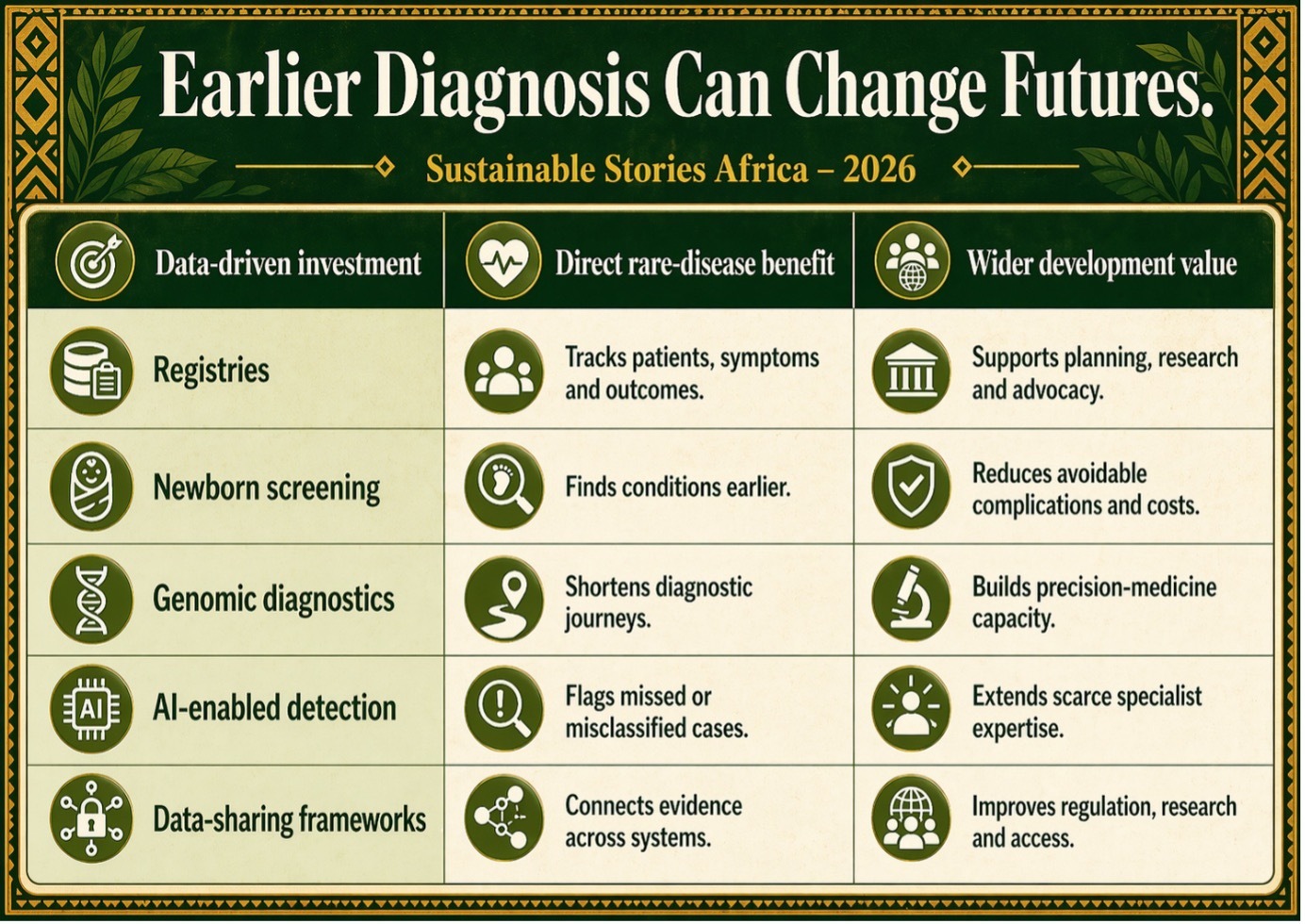
The opportunity is not theoretical. The report shows how investment in rare-disease data can create a virtuous cycle: better screening and diagnosis improve clinical outcomes; system efficiency frees resources; stronger evidence attracts research capital; and rare-disease innovation spills over into wider healthcare.
That spillover is already visible. Rare-disease research has helped advance sequencing technologies, gene therapy, RNA-based therapies, mRNA platforms, precision oncology, adaptive trial design, patient-reported outcomes and early-detection models. In plain terms, tools first sharpened for small patient populations often become platforms for larger medical breakthroughs.
The human meaning is clear.
- A child diagnosed early may receive timely care instead of years of trial and error.
- A caregiver may return to work.
- A hospital may avoid repeated emergency admissions.
- A government may target resources more efficiently.
- A pharmaceutical or technology company may de-risk research by working with better evidence.
For African markets, this is also a capacity-building story. Rare-disease data systems can strengthen broader health infrastructure, including electronic records, genomic medicine, ethical data governance, laboratory networks, clinician training and patient advocacy.
Build Systems Before Crises Deepen
The first action for governments is to name rare diseases as a health-system priority.
That does not immediately require every country to build an advanced genomic programme.
- The WEF report makes clear that even low-cost steps, such as establishing patient registries or improving diagnostic reporting, can improve visibility, coordination and efficiency in constrained health systems.
- Second, countries need rare-disease coding and interoperable data standards. Without consistent classification, patients disappear inside general disease categories, and policy-makers cannot see the real burden. International standards such as ORPHAcodes and ICD-11 rare-disease extension codes can help health systems identify conditions more precisely.
- Third, newborn screening and diagnostic capacity must expand. The report cites evidence that delays in diagnosis across seven rare conditions led to avoidable costs of up to $517,000 per patient.
It also highlights genomic testing programmes such as iHope, which enabled whole- genome and whole-exome sequencing for more than 3,000 families across sites in low-, middle- and high-income countries, with 41.4% of analysed participants receiving a molecular diagnosis.
- Fourth, patient groups must be treated as infrastructure, not afterthoughts. Rare-disease communities often know where the evidence gaps are, which symptoms are most disruptive, and what kind of data would improve daily life. Registries designed with patients can generate evidence to support clinical care, research, reimbursement and regulatory decisions.
- Finally, AI should be deployed carefully and responsibly. The report highlights how AI and digital tools can identify undiagnosed patients, structure fragmented records, and support clinical decision-making.
However, trust, privacy, consent and local governance must come first, especially in markets where health data protections are still developing.
Path Forward – Count Patients, Then Invest
African health systems should begin with practical rare-disease data foundations: registries, coding standards, newborn-screening expansion, clinician training and patient-led evidence. The goal is visibility first, then better care, financing and innovation.
Public, private and philanthropic actors should co-invest in trusted data systems that protect patients and make rare diseases measurable. When patients count in the data, they can count in policy, budgets and health equity.