
Knowing the definition of bankability, affordability, or risk allocation does not mean a practitioner can structure a viable PPP.
The real skill is understanding how one decision changes the rest of the project.
BPMI is presented as a bridge from fragmented knowledge to integrated know-how. Its value depends on whether learners can use lifecycle connections to improve real preparation, procurement and contract management, rather than only examination scores.
Infrastructure knowledge must connect before delivery
PPP practice contains a large vocabulary: economic appraisal, commercial feasibility, fiscal commitments, output specifications, payment mechanisms, risk allocation, market sounding, bankability, financial close and contract management.
Learners may master each definition and still struggle to explain what happens when a weak demand forecast meets a fixed availability payment or when transferred risk cannot be financed.
Dr W. Akhator-Eneka describes BPMI as a structured learning and implementation methodology that connects project management, PPPs, infrastructure finance and CP3P knowledge across the infrastructure lifecycle.
The source article says its intellectual roots lie in a seven-step framework first presented in 2017 and later refined through research, training and practice.
The explainer's important contribution is not the brand name but the learning problem it identifies.
Infrastructure institutions need professionals who can move between disciplines, challenge inconsistent assumptions and translate specialist advice into one coherent business case and contract.
An integrated mental model can help, but it must be teachable, testable and open to evidence.
Memorised concepts fail under project pressure
A candidate can remember that risk should be allocated to the party best able to manage it.
However, it misses the harder questions:
- Can that party control the probability or impact, absorb the loss, price the exposure and maintain incentives?
- A sponsor can define affordability without tracing how foreign-currency debt, inflation indexation or demand volatility changes future government payments.
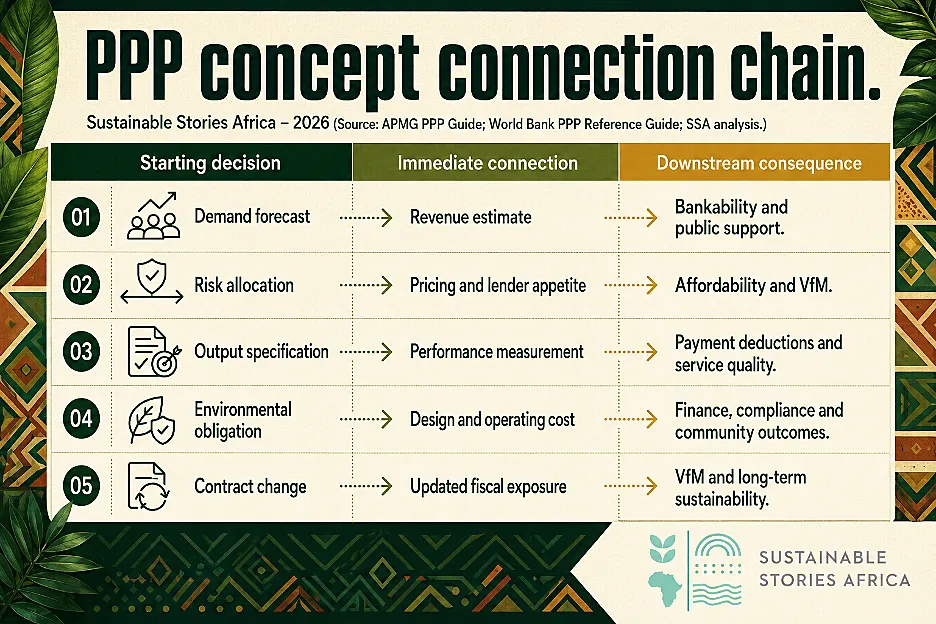
These gaps matter because PPP decisions are interdependent.
- Risk allocation affects financing terms.
- Financing affects user charges or public payments.
- The payments affect affordability and fiscal sustainability; output standards shape monitoring and deductions.
- Poor contract management can erase the value expected during appraisal.
Fragmented learning mirrors fragmented delivery.
Lifecycle maps turn concepts into decisions
An integrated curriculum should begin with public need and project identification, then follow the decisions through screening, appraisal, structuring, procurement, financial close, delivery, operations and handback.
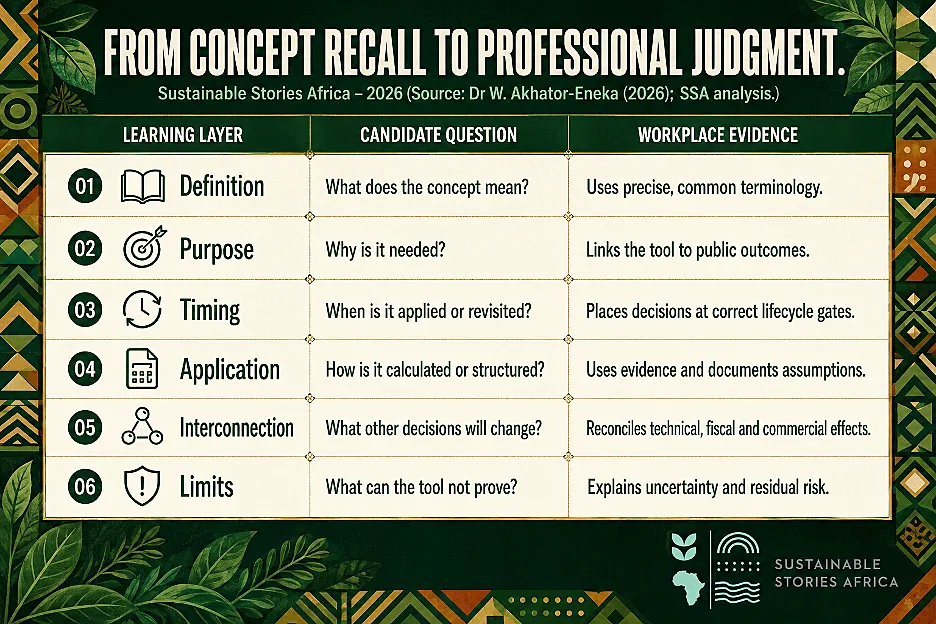
At each stage, learners should answer six questions:
- What is the concept
- Why does it matter?
- When is it used
- How is it applied
- What are its limits
- What other decisions does it change?
Consider Value for Money.
- It connects the economic case for the project, the comparison of procurement options, the efficiency created by risk allocation, whole-life costs, service quality and the evaluation of actual bids.
- Treating it as a single formula obscures qualitative factors and uncertainty.
- Mapping it through the lifecycle reveals why the test must be revisited when the structure or bid changes.
Scenario-based learning is therefore central.
- A toll road with uncertain traffic
- An availability-paid hospital
- An affordable-housing scheme financed through land and cross-subsidy requires different revenue, risk and affordability logic.
The learner should diagnose the system, rather than search memory for a universal template.
Learners should also work with incomplete and conflicting evidence.
- Real projects rarely provide clean data or one correct professional answer.
- Requiring candidates to state assumptions, request missing information, compare options and identify what cannot yet be concluded develops a more useful habit than rewarding premature certainty.
Integrated competence can improve project pipelines
For public agencies, cross-disciplinary practitioners can identify contradictions earlier and commission better specialist work. They can ask:
- Whether the demand study matches the financial model
- Whether environmental obligations appear in cost estimates
- Whether the payment mechanism rewards the intended service
- Whether the contract-management team can measure performance.
For advisers and investors, shared lifecycle language can improve communication and reduce repeated rework.
For communities, better integration can connect consultation and safeguards to scope, affordability and performance rather than leave them in a report that sits outside commercial decisions.
The result should be a stronger pipeline of projects that are justified before they are marketed.
The approach can support multidisciplinary teams without turning every professional into a generalist.
Engineers, economists, lawyers and financiers still provide depth; integrated competence helps them understand the interfaces, challenge inputs responsibly and know when a change must be taken back to another specialist or approval body.
Teaching methods require evidence and openness
BPMI should be documented as a clear competency framework:
- Learning objectives
- Llifecycle map
- Decision tools
- Case studies
- Assessment rubrics
- Boundaries.
Claims about a fixed number of concepts or guaranteed examination performance should be presented as programme claims and validated with transparent completion, pass-rate and practitioner-outcome data.
- Training organisations should use African cases with incomplete data, institutional constraints and affordability tensions, rather than only idealised transactions.
- Employers should assess whether graduates can review a business case, challenge a risk matrix, explain a payment mechanism and prepare a contract-management plan.
Certification matters, but demonstrated judgment matters more.
Evaluation should compare an integrated cohort with a credible baseline.
- Useful indicators include scenario performance
- Retention after several months
- Quality of written reasoning
- Supervisor assessments
- Changes to project outputs.
Exam results can be included; however, they should not be the only proof that the methodology transfers to professional work.
Path Forward – Measure learning by stronger delivery decisions
The next step is to pilot the methodology with a published curriculum and independently assessed cases covering identification, appraisal, structuring and operations.
Its strongest proof will not be recall. It will be practitioners who can connect evidence, expose trade-offs and improve the quality of projects entering procurement across African markets.