Climate finance protects roads, farms and water systems, yet often overlooks the services that keep children, older people and persons with disabilities safe during disasters.
A Brookings framework argues that care systems are resilient infrastructure and estimates that integrating childcare and long-term care could require 3% to 5% of Bangladesh’s GDP while supporting millions of jobs.
Care Must Become Core Climate Infrastructure
Climate adaptation is usually discussed in order of stronger roads, flood barriers, resilient agriculture, renewable energy and early-warning systems.
Far less attention is paid to what happens when a flood closes a childcare centre, a heatwave isolates an older person, or a cyclone prevents a care worker from reaching a patient.
A June 2026 Brookings Institution working paper argues that this omission leaves national adaptation plans incomplete and potentially under-costed.
Written by Caren Grown, Jerome De Henau and Ipek Ilkkaracan, the paper positions comprehensive care services, including early childhood education and care, healthcare and long-term care, as essential social and physical infrastructure.
The implications are especially important for African and other emerging markets, where climate exposure intersects with young populations, rising elder-care needs, weak formal care systems and heavy dependence on unpaid household labour.
The paper’s message is direct: communities cannot be resilient when the systems responsible for caring for their most climate-vulnerable members collapse under pressure.
Climate Plans Still Miss Who Provides Care
The global care crisis and climate crisis are not separate emergencies; they reinforce each other.
Climate-related floods, droughts and disease outbreaks increase demand for care precisely when hospitals, schools and homes may be damaged, forcing care workers into greater danger while women absorb additional unpaid responsibilities.
Before COVID-19, 43% of pre-primary-age children with employed mothers lacked formal childcare, with nearly 80% of these 350 million children in low- and middle-income countries.
The ILO projects that demand for care could reach 2.3 billion people by 2030, including 100 million more older people, a challenge Africa faces acutely given high fertility rates and rising life expectancy.
Climate shocks already expose these gaps: Mozambique's 2026 floods damaged 12,000 homes, 126 schools and 13 health facilities, displacing 100,000 people into inaccessible shelters, while Kenya's drought forced emergency school food distribution.
However, adaptation finance, estimated at $310 – $365 billion annually, largely ignores care.
Agriculture receives 20%, water 19%, healthcare 4% – 6%, and education 2%. Early childhood and long-term care remain almost invisible.
Bangladesh Costing Reveals The Hidden Investment Gap
An analysis of 97 National Adaptation Plans and NDCs found 85% mentioned some care infrastructure component, though references remained fragmented, inconsistently financed and concentrated on health and education.
Children, older people and persons with disabilities were explicitly recognised in only a third of plans, often labelled merely "vulnerable" rather than requiring organised care.
- Only the Philippines explicitly included early childhood education and care (ECEC) infrastructure
- Only four countries, St Lucia, the Philippines, the UAE and Kiribati, mentioned training care workers, and none addressed decent pay or working conditions.
Bangladesh illustrates the financing gap. Despite detailed health and shelter provisions, its plan doesn't treat ECEC or long-term care (LTC) as formal systems requiring climate investment.
Currently, Bangladesh spends just 0.02% of its GDP on formal early childhood care, with LTC receiving virtually no public funding.
The researchers modelled several scenarios to 2035, varying climate conditions, service coverage, staffing ratios, worker qualifications, buildings and energy requirements.
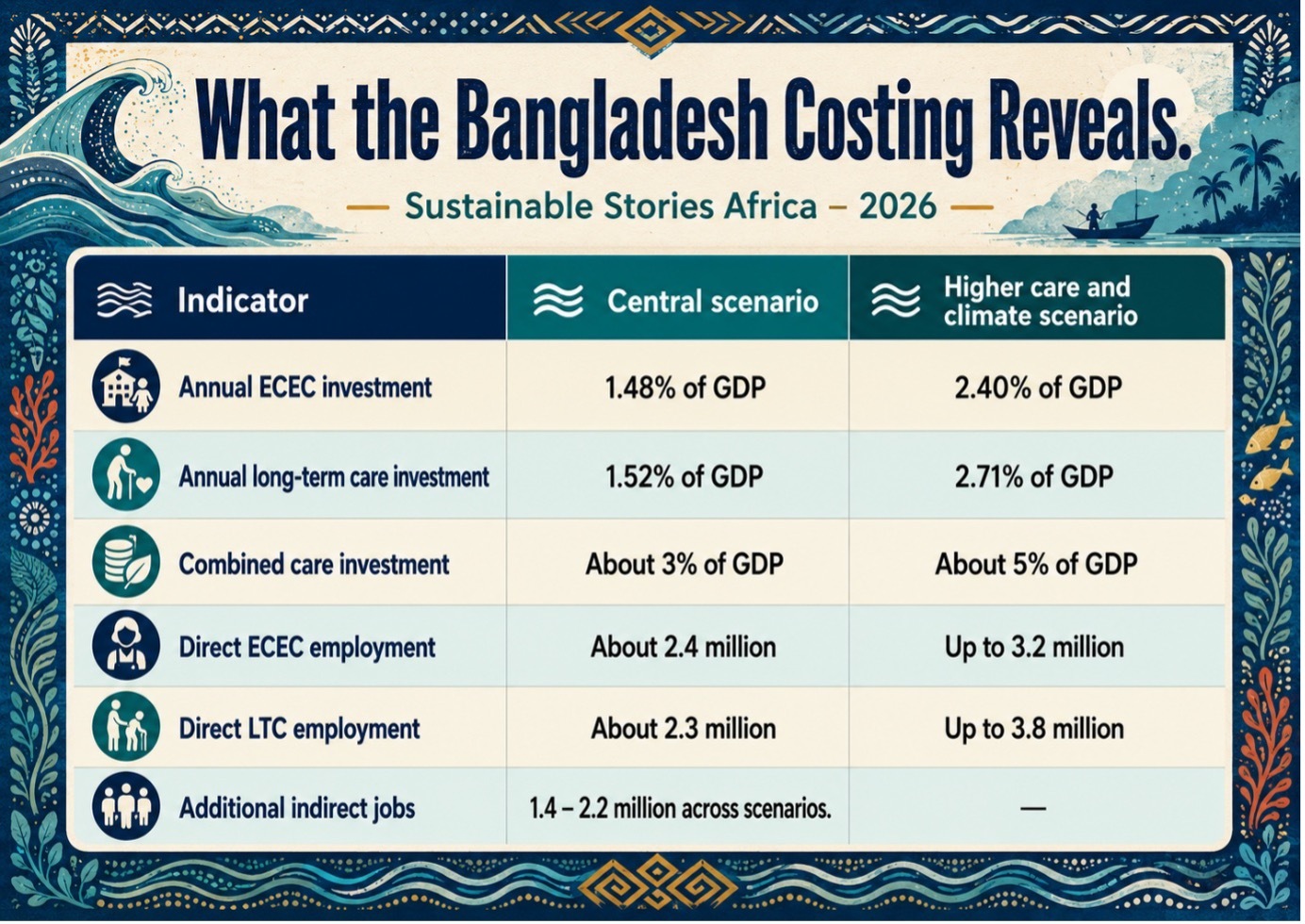
Under the central 2035 scenario, ECEC would require 262,000 new or retrofitted facilities and 2.4 million workers; LTC would need roughly 2.3 million workers.
Staffing dominates costs, 1.06% of GDP for ECEC staff versus 0.42% for buildings and energy, with LTC staff costs at 0.99%. Climate-resilient care demands trained personnel and systems, not just stronger buildings.
Care Investment Delivers Resilience, Jobs, and Growth
A comprehensive care system acts as a shock absorber throughout a climate emergency's full cycle.
It identifies vulnerable people, trains workers in advance, mobilises reserve staff and mobile units during the event, and restores schooling, healthcare and economic activity afterwards.
Infrastructure design matters too.
The paper prioritises nature-based and passive-cooling solutions, such as trees, shading, ventilation, cool roofs, before energy-intensive air conditioning, using renewable backup power where active cooling is necessary.
For African cities facing extreme heat and unreliable electricity, this layered approach may prove more realistic than conventional cooling alone.
Care investment also delivers substantial employment gains.
- Bangladesh estimates suggest 2.2 – 3.2 million direct ECEC jobs
- 1.4 – 3.8 million direct LTC jobs
- 1.4 – 2.2 million indirect jobs.
Broader emerging-market research links care investment to a 6% rise in employment and up to 11% GDP growth after five years, partly offsetting fiscal costs as caregivers, mostly women, enter paid work.
This creates a resilience cycle: care investment generates jobs, strengthens households and reduces climate-shock disruption.
Failure to invest reverses this, driving women from employment, disrupting children's learning and raising emergency costs.
Governments Must Finance Care As Adaptation
African governments should begin by embedding care services within climate adaptation frameworks, including National Adaptation Plans, NDCs, and budget-tagging systems, which should explicitly include early childhood care, long-term care and unpaid caregiver support.
This starts with a national care-needs assessment, mapping of children, older people, persons with disabilities and caregivers against climate-exposed communities using social registries and geographic data.
Countries should then cost both social infrastructures, including staffing, training, wages, buffer workforces, and physical infrastructure, including resilient facilities, water, sanitation and renewable backup power.
Care facilities must also be integrated into disaster planning, serving as resilience hubs when accessible and staffed appropriately.
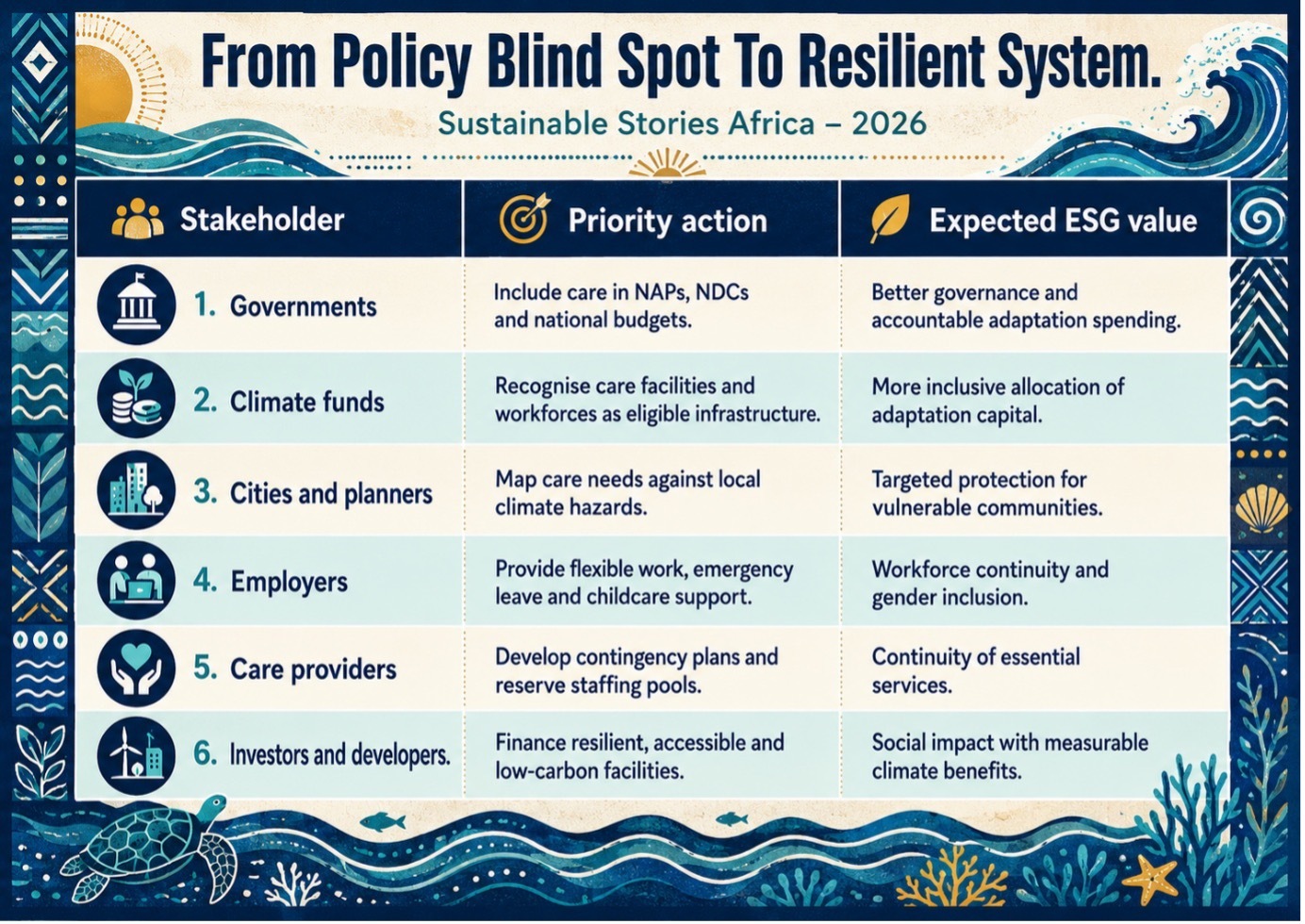
Financing requires coordination among climate, finance, health and social protection ministries, while multilateral banks should revise frameworks that fund hard infrastructure but exclude the workforce systems that make it functional.
Governance safeguards, such as service standards, worker protections, and gender-responsive budgeting, remain essential.
Bangladesh's model isn't a universal price tag; its value lies in offering a transparent methodology African governments can adapt, rather than continuing to omit care simply because it hasn't been measured before.
Path Forward – Building Care Into Africa’s Climate Future
African adaptation strategies should formally recognise childcare, long-term care and supported household care as resilience infrastructure.
Governments must map needs, cost services, protect workers and make facilities climate-ready.
Financing care alongside energy, water, agriculture and transport would strengthen social protection, gender equality and workforce participation
It would also ensure that climate resilience is measured not only by infrastructure that survives, but by people who remain protected, supported and able to recover.