
Nigeria’s central bank has capped certain bank-resolution stays on payment obligations and termination rights at two business days, closing a legal uncertainty that has worried derivatives, repo and securities-lending counterparties since BOFIA 2020.
The clarification strengthens confidence in close-out netting, regulatory capital treatment and risk management for financial contracts involving Nigerian banks and other CBN-regulated financial institutions.
Nigeria’s Contract Certainty Gets Regulatory Clarity
The Central Bank of Nigeria has resolved one of the most technical, yet consequential, questions in the country's financial markets: how long termination rights and payment obligations can be suspended when a bank or CBN-regulated institution enters resolution.
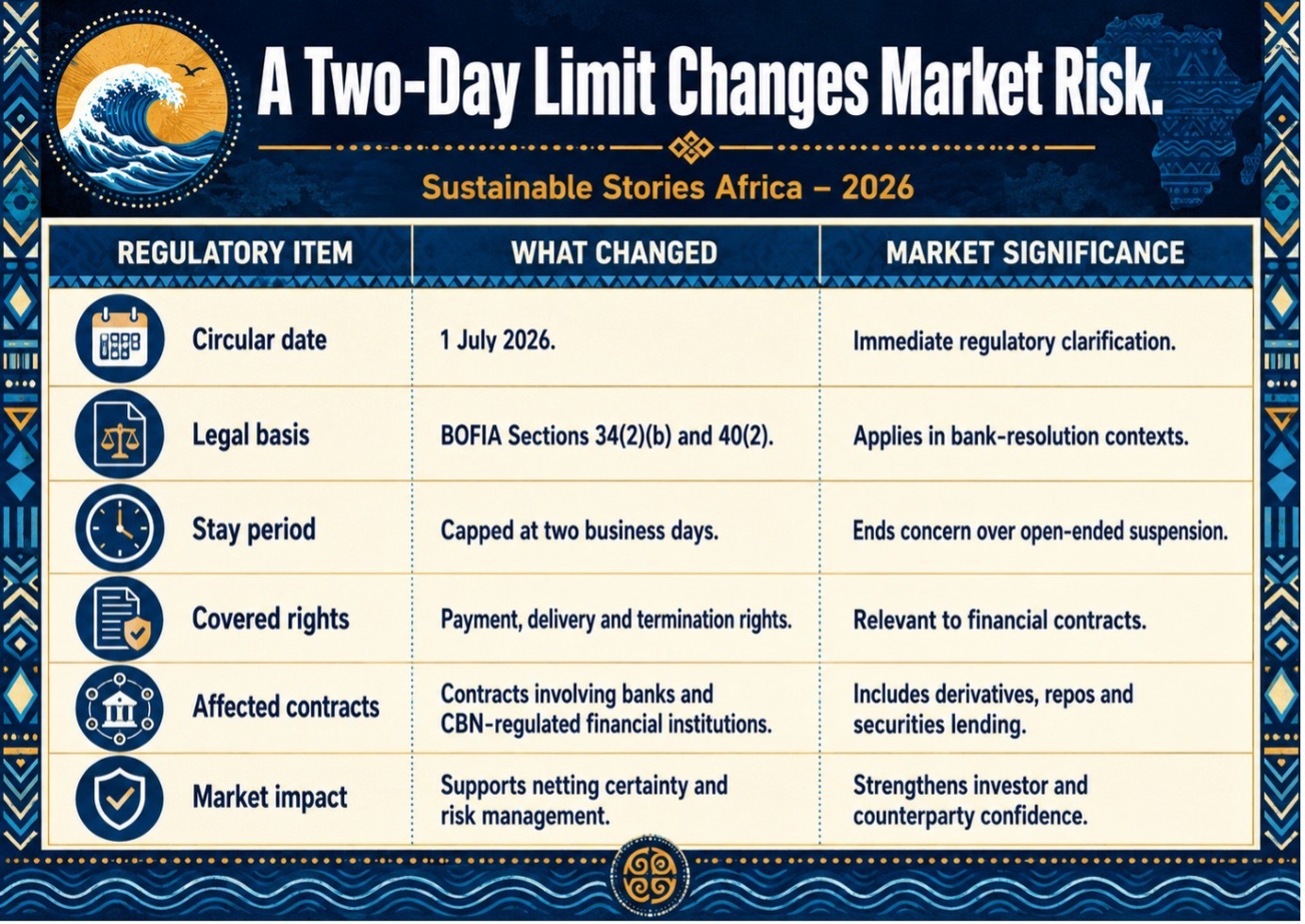
In a circular issued 1 July 2026 (Ref. FMD/DIR/PUB/CIR/001/029), titled "Interpretative Guidance on the Practical Operation of Sections 34(2)(b) and 40(2) of BOFIA, 2020," the CBN clarified that any suspension imposed by its Governor will not exceed two business days from the relevant written order.
For depositors, this may seem remote; for banks, investors, and derivatives counterparties, it closes a persistent gap since BOFIA's 2020 enactment, which granted stay powers without prescribing a maximum duration, leaving ISDA and GMRA counterparties exposed to open-ended suspension risk.
By setting a firm two-day limit, the circular narrows uncertainty, reinforces contractual confidence, and aligns Nigeria's resolution framework with the Financial Stability Board's Key Attributes of Effective Resolution Regimes.
This analysis draws on work by Yinka Edu, Joseph Eimunjeze, Onyinye Okafor, Pamela Onah and Itoro Uwemedimo Etim of Udo Udoma & Belo-Osagie's Banking & Finance team.
A Two-Day Limit Changes Market Risk
A two-business-day cap may look small on paper, but in financial markets it can reshape how institutions price risk, manage collateral and assess legal enforceability.
The CBN's circular, FMD/DIR/PUB/CIR/001/029, provides interpretative guidance on BOFIA's bank-resolution stay powers, which allow suspension of payment obligations and temporary restriction of termination rights during resolution.
Before the circular, BOFIA permitted such suspensions without prescribing a maximum duration, leaving counterparties trading under derivatives, repos and securities lending contracts uncertain about how long a stay could last.
That uncertainty complicated close-out netting; the mechanism collapses multiple obligations into a single net amount after default, since legal and capital treatment depend on knowing when termination rights can be exercised.
The CBN's answer is now clear: the stay period will not exceed two business days.
Why Netting Certainty Matters For Banks
The circular fills an unresolved gap since BOFIA's 2020 enactment, a concern for counterparties trading derivatives, repos and securities-lending transactions with Nigerian banks.
The issue was never whether statutory stays are unusual; they're common in resolution regimes, giving regulators breathing room to manage distressed institutions without triggering disorderly market reactions.
The real problem was the absence of a clear timeline.
In a crisis, time matters: counterparties need to calculate exposure, call collateral or terminate trades to limit losses. An indefinite suspension turns a risk-management tool into an uncertainty; a short, clearly bounded one lets the market plan around it—particularly for ISDA Master Agreements, GMRAs, GMSLAs and other close-out netting arrangements.
The circular also strengthens legal opinions. Nigerian netting opinions can now assess BOFIA's stay mechanics against the two-business-day cap, supporting regulatory capital recognition and cross-border market participation.
Global Standards Meet Local Market Reform
The CBN’s clarification aligns Nigeria more closely with international resolution standards.
The UUBO update notes that the Financial Stability Board’s Key Attributes of Effective Resolution Regimes recommend that temporary stays on early termination rights should not exceed two business days.
It also notes that several key markets typically cap stay periods at 48 hours or two business days.
This alignment matters for Nigeria’s financial-sector credibility.
For global counterparties, financial contracts are not judged only by commercial terms.
They are also judged by enforceability, insolvency treatment, regulatory predictability and whether the legal system provides adequate certainty in stress conditions.
Nigeria’s banking sector is systemically important to the country’s economy. It intermediates credit, supports trade, holds deposits, facilitates payments and increasingly connects domestic capital markets to global counterparties.
A clearer bank-resolution framework supports more than legal neatness. It supports market infrastructure.
In ESG terms, this is a governance story.
Sustainable finance does not depend only on green bonds, climate targets or social-impact projects.
It also depends on predictable institutions, credible rules and transparent regulatory processes. Strong financial governance lowers uncertainty, supports investor confidence and reduces the risk that market stress becomes systemic instability.
Clear Rules Can Unlock Market Confidence
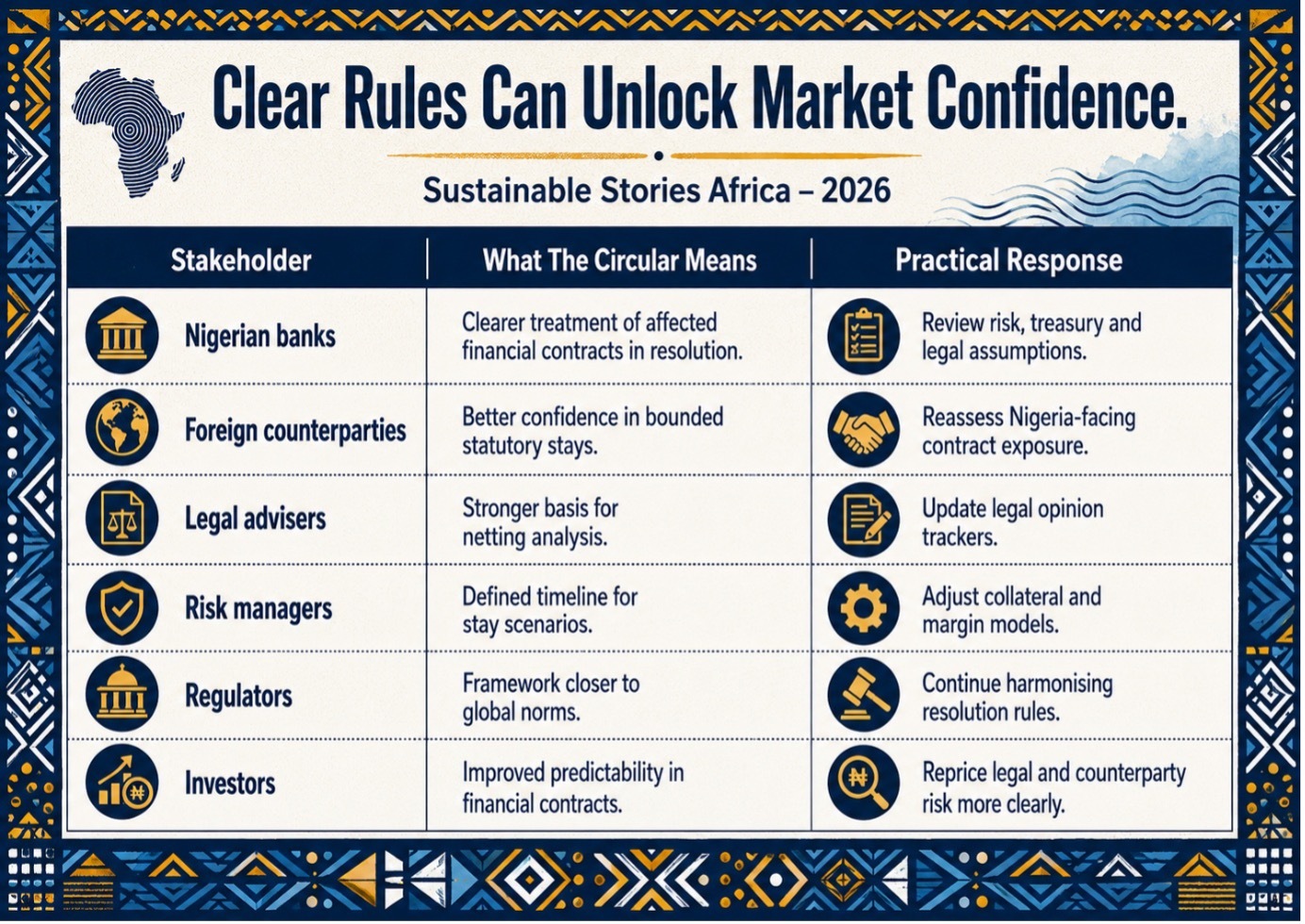
The strongest benefit of the circular is confidence.
- Banks and counterparties can now integrate a defined two-business-day stay into collateral, margining and exposure-management processes.
- Risk teams can update internal assumptions. Legal teams can revisit documentation. Treasury teams can model resolution scenarios with a clearer timeline.
For Nigeria, the potential upside is broader market participation.
- When counterparties trust the ability to enforce laws and rules, they are more willing to transact.
- When they are more willing to transact, banks can access deeper liquidity, better hedging tools and more efficient market pricing.
The circular could also support the development of Nigeria’s derivatives and repo markets.
These markets depend heavily on legal certainty because they are built on enforceable collateral, netting and termination mechanics.
However, the circular is not a cure-all.
- It does not remove resolution risk.
- It does not replace careful due diligence.
- It does not eliminate the need for sound bank supervision, strong capital buffers or credible recovery and resolution planning.
What it does is reduce ambiguity in one important area where uncertainty had been costly.
Must Update Risk Playbooks Now
The practical next step is implementation.
- Firms with exposure to Nigerian banks and CBN-regulated financial institutions should review internal netting opinion trackers, legal risk matrices and contract templates.
UUBO specifically notes that firms and counterparties may wish to update internal netting opinion trackers and risk matrices, and review standard-form documentation for assumptions inconsistent with the two-business-day cap.
- Banks should also brief treasury, legal, compliance and risk teams on the circular’s implications.
Where contracts refer to the BOFIA, the best option remains resolution. Teams should ensure the new interpretative guidance is reflected in internal controls.
- For cross-border counterparties, the key action is to update Nigeria exposure frameworks.
This includes documentation review, netting analysis, collateral rules, margining mechanics and resolution-event playbooks.
- Regulators and market associations also have work to do.
The clarification should be communicated clearly across banking, capital market and derivatives ecosystems, especially where standardised documentation is used.
The CBN has provided the market with a defined timeline. The next responsibility lies with institutions to operationalise it.
Path Forward – Certainty Must Drive Market Discipline
Nigeria’s two-business-day cap strengthens financial governance by replacing open-ended uncertainty with a clear resolution timeline.
That clarity should support the netting of enforceability, market confidence and better regulatory capital treatment.
The priority now is disciplined implementation.
Banks, investors and advisers should update documentation, risk models and internal playbooks so the circular becomes more than a legal clarification; it becomes a stronger foundation for resilient financial markets.