
Chief financial officers are entering 2026 with a wider mandate: protect value, fund growth, manage volatility and prove that AI investment can deliver measurable returns.
A new Oliver Wyman Forum and New York Stock Exchange survey of nearly 500 CFOs shows finance moving from reporting centre to enterprise command room, with implications for African firms navigating capital scarcity, currency pressure, climate risk and digital disruption.
Finance Moves From Control To Command
The chief financial officer’s job is no longer confined to closing the books, managing budgets and protecting the balance sheet.
In 2026, the role is becoming one of the most consequential seats in corporate leadership.
The CFO Agenda 2026, produced by the Oliver Wyman Forum and the New York Stock Exchange, surveyed 494 CFOs across major industries, geographies, ownership structures and company sizes.
Public companies in the sample represent about 12% of global listed equity, giving the findings unusual weight in understanding how finance leaders see the next phase of corporate competition.
For African and emerging-market businesses, the message is direct: the finance function must now connect strategy, risk, capital allocation, AI, sustainability and workforce redesign.
In markets where capital is expensive and uncertainty is constant; the CFO is becoming the executive who turns ambition into disciplined execution.
Finance Chiefs Face A Harder Mandate
Nearly two-thirds of CFOs surveyed cite macroeconomic and geopolitical instability as their biggest worry in 2026.
That anxiety is not abstract. It shows up in volatile currencies, higher borrowing costs, disrupted supply chains, shifting regulation and tighter investor scrutiny, realities familiar to companies operating across Africa and the Global South.
The report’s central finding is that CFOs are now managing five linked agendas at once: a broader leadership mandate, the convergence of cost and growth, finance transformation, scaled AI deployment and redesign of the finance workforce.
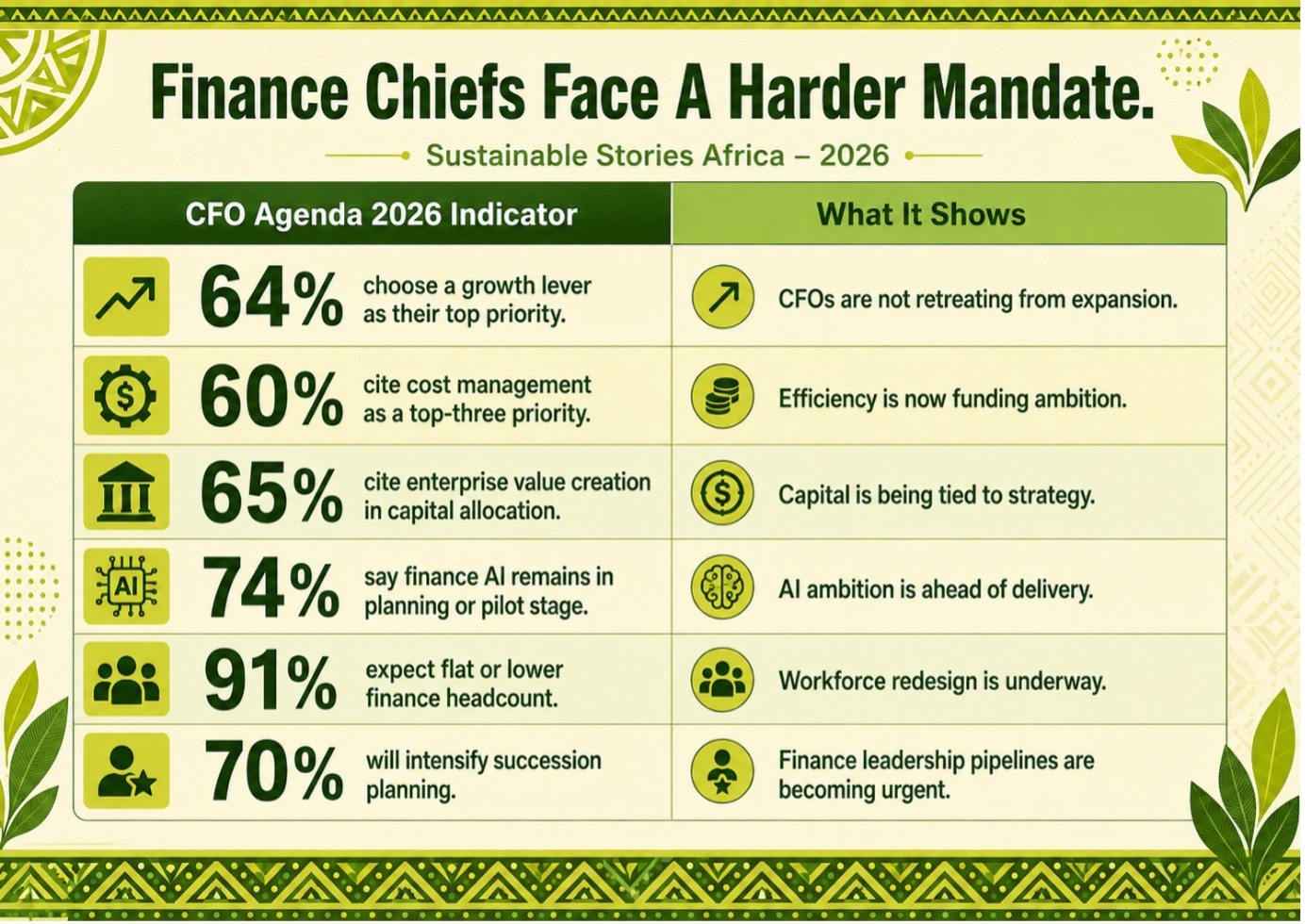
Seven in 10 CFOs rank strategy and transformation among their top three priorities, while 72% expect that part of their role to grow over the next three years.
That shift matters because companies can no longer separate resilience from growth. A manufacturer facing rising energy costs, a bank funding digital infrastructure, or a telecoms firm investing in data systems must make the same hard calculation: which investments create durable value, and which merely add cost?
Cost Discipline Now Funds Growth
The most important shift in the report is the collapse of a familiar corporate divide. Growth and cost management are no longer competing agendas. They are now the same agenda.
Nearly two-thirds of CFOs selected a growth lever as their top priority for increasing shareholder value, with revenue uplift the most common first choice.
However, cost management was the most frequently selected top-three priority, cited by 60% of respondents.
The implication is clear: finance leaders are not using efficiency to shrink ambition; they are using it to fund it.
This is highly relevant for African markets, where firms often face expensive debt, infrastructure gaps and foreign-exchange exposure.
A company that wants to invest in renewable power, digital platforms, logistics capacity or new markets cannot rely only on external capital.
It must free up cash internally, improve working capital, sharpen pricing and allocate resources more deliberately.
Capital allocation therefore becomes the CFO’s strongest lever. The report shows CFOs are guided by enterprise value creation, strategic fit and financial return metrics.
In practical terms, finance chiefs are asking harder questions.
- Does this project strengthen the portfolio?
- Does it improve resilience?
- Does it create measurable returns?
- Can the business fund it without weakening liquidity?
For companies facing ESG expectations, this discipline is especially important. Sustainability initiatives will increasingly need credible business cases: lower energy costs, reduced regulatory exposure, improved access to capital, better stakeholder trust and stronger long-term competitiveness.
AI Can Lift Finance Performance
AI is the most visible test of the new CFO agenda. The report shows strong investment appetite: 61% of CFOs expect enterprise AI spending to rise by 5% to 20% in 2026, while another 16% expect faster growth.
However, only a small share of finance functions have deployed AI-assisted tools or autonomous agents at scale.
This gap between ambition and execution is where the CFO’s role becomes decisive. AI cannot be treated as a technology fashion cycle.
It must be governed as capital investment, with clear use cases, ownership, risk controls, productivity targets and value tracking.
The most promising finance use cases are not exotic. They are practical: planning, forecasting, scenario modelling, decision support, spend analytics, vendor management, reporting automation, controls, audit and fraud detection.
These areas matter because they determine how quickly companies can read the market, model shocks and reallocate resources.
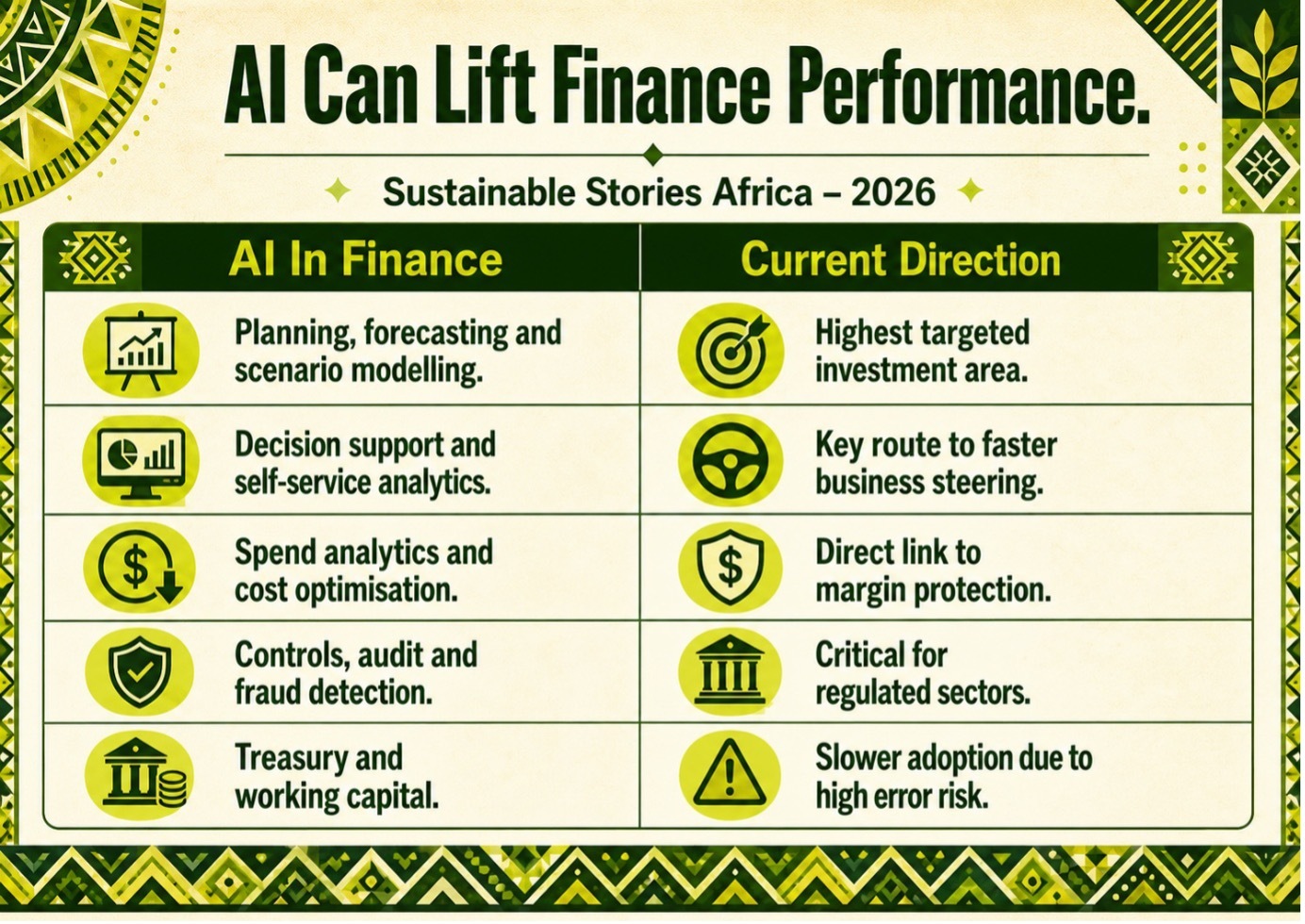
For African companies, AI-enabled finance could help model currency stress, energy-cost exposure, customer affordability, climate-related operational risks and supply-chain disruption.
However, the report warns that investment alone will not close the gap. Without a clear transformation vision, delivery model and success metrics, AI risks adding cost before it adds value.
Finance Must Redesign Its Workforce
The finance function itself is now under pressure to change. CFOs expect leaner, more centralised functions, more shared services and fewer traditional junior roles.
The report finds that 91% of CFOs expect finance workforce levels to remain flat or decline, while 64% expect a shift away from junior roles.
This does not mean finance work disappears. It means the work changes.
- Routine processing, reconciliation and reporting are increasingly exposed to automation.
- Demand is rising for finance professionals who can interpret data, advise business units, manage transformation, understand technology risk and connect capital allocation to strategy.
That creates a major leadership challenge for emerging-market firms. Many African companies already face skills gaps in data analytics, sustainability reporting, risk management and treasury.
If finance teams are to support ESG reporting, climate transition planning, AI governance and investor communication, companies will need deliberate upskilling rather than passive headcount control.
The report also shows CFOs stepping deeper into enterprise risk. 75% expect greater involvement in strategic and business-model risks, 54% in treasury and market risk, and 44% in cybersecurity, data protection and technology resilience.
Climate and sustainability risk ranked lower globally, at 6%, but for African markets, this may be the blind spot: climate exposure, energy reliability and policy shifts are already material business issues.
Boards, therefore, should not see the CFO merely as the executive who says no. The modern CFO should be the executive who asks:
- What is the risk-adjusted path to growth?
- What must be funded now?
- What should be stopped?
- What data do we trust?
- What value will this investment create?
Path Forward – Discipline Must Drive Sustainable Growth
The 2026 CFO agenda points to a simple priority: companies need finance functions that can connect growth, risk, AI, capital and sustainability into one operating system.
For African businesses, the task is urgent. CFOs must strengthen scenario planning, govern AI investment, build ESG-ready data systems, redesign finance talent and ensure every major investment has a credible route to value.
That is how finance moves from control function to sustainability and growth engine.