China’s emerging sustainability framework for overseas mining is arriving as Africa pushes harder to control more value from lithium, cobalt, graphite, manganese and rare earths.
The shift could give African governments new leverage over Chinese mining companies.
However, this is feasible only if export restrictions, ESG, and industrial policies are designed into power, infrastructure, skills and credible governance.
Africa’s Minerals Bargain Enters New Phase
Africa’s critical minerals story is no longer just about what lies beneath the soil. It is increasingly about who controls the rules above it, the standards, contracts, processing facilities, export policies and community safeguards that decide whether mineral wealth becomes industrial transformation or another cycle of extraction.
That question has become more urgent after China released its National Human Rights Action Plan for 2026 - 2030, and as the China Chamber of Commerce of Metals, Minerals and Chemicals Importers and Exporters advances work on a Sustainable Mining Code.
Together, the frameworks signal a shift in Beijing’s governance of overseas mining investments, including across African markets.
For African countries holding strategic deposits of cobalt, lithium, graphite, manganese and rare earths, the timing is significant.
China remains deeply embedded in global mineral processing and battery supply chains, while African governments are increasingly demanding value addition, local processing and stronger environmental, social and governance standards from foreign investors.
New Rules Meet Old Extraction Realities
The clean-energy transition has made critical minerals strategic assets, with lithium, cobalt, graphite, manganese, nickel and rare earths central to EVs, batteries and renewable technologies.
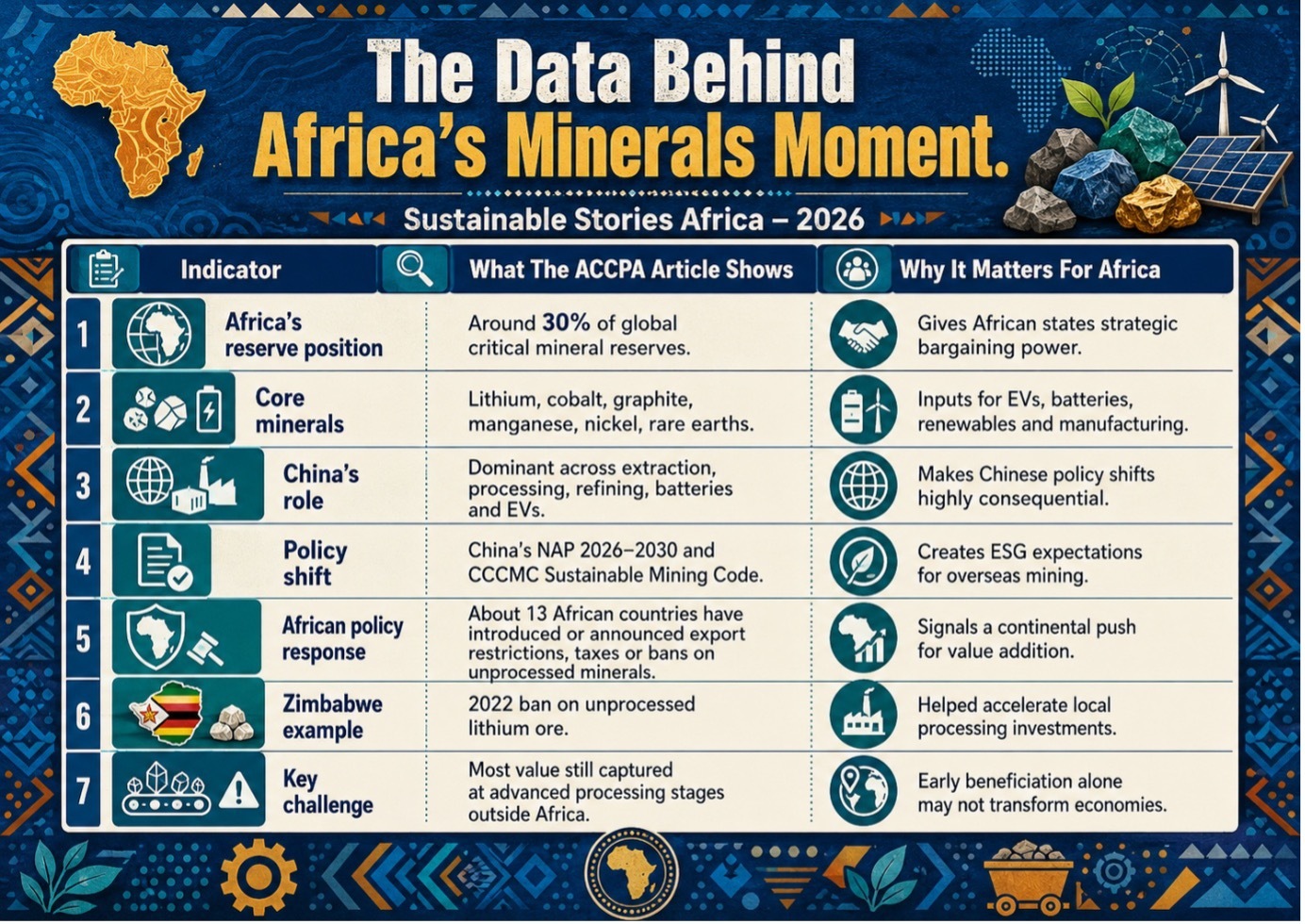
Africa holds an estimated 30% of global reserves, per ACCPA's Obert Bore:
- DRC: central to global cobalt supply
- Zimbabwe: emerging lithium player
- Mozambique and Madagascar: key graphite producers
- South Africa and Gabon: major manganese deposits
However, the deeper story is structural, not geological. For decades, African economies exported raw minerals while higher-value refining and manufacturing happened elsewhere, risking a boom that powers the global transition without building local industry or jobs.
China's evolving frameworks shift this dynamic. Its National Action Plan promotes human rights due diligence abroad, while the CCCMC Sustainable Mining Code addresses environmental management and community relations.
The real test: whether voluntary guidance becomes enforceable practice on the ground.
Geopolitics Is Repricing African Leverage
China's sustainability shift unfolds within a wider contest for critical minerals, as the US, EU, Japan, South Korea and India seek to reduce dependence on Chinese-controlled supply chains through initiatives such as the Minerals Security Partnership, the EU's Critical Raw Materials Act, and the G7's Critical Minerals Action Plan.
This competition is already reshaping African infrastructure. The Lobito Corridor now links the DRC and Zambia to Angola's Atlantic coast; the EU has signed raw materials partnerships with Namibia, Zambia and the DRC; and the US has a preliminary $62.4 billion deal with Kenya over the Mrima Hill rare earth deposit.
For African policymakers, this creates both opportunities and dangers simultaneously.
- The opportunities lie in bargaining power, negotiating better fiscal terms and processing requirements.
- The dangers in strategic displacement, where geology matters less than governance, industrial strategy and enforceable community protections.
Export Bans Reflect Africa’s Processing Ambition
African governments are pushing back against raw-mineral exports, with roughly 13 countries introducing export restrictions, taxes or bans on unprocessed minerals.
- Zimbabwe's 2022 lithium ore ban is the most visible example
- Namibia has restricted unprocessed lithium, cobalt, graphite, manganese and rare earths.
- Zambia and the DRC debate similar measures.
The economic logic is clear: the greatest value in battery supply chains lies not in extraction but in processing, refining and manufacturing.
Export restrictions alone, however, are not an industrial strategy.
Under GATT Article XI, WTO members generally cannot impose quantitative export bans, though limited exceptions exist under Article XX for critical shortages or conservation, requiring careful legal design.
This means African governments need smarter tools: export taxes, local-content rules, special economic zones, infrastructure incentives and skills programmes that convert pressure into genuine industrial capability.
Chinese Investors Are Already Adjusting
Chinese investors have not abandoned African countries in pursuit of value addition; in Zimbabwe, they have adjusted strategies since the lithium export ban.
- Huayou Cobalt, Sinomine Resource Group, Zhejiang Huayou and Chengxin Lithium accelerated investment in local processing.
- Huayou through its Arcadia Lithium Mine, Sinomine via lithium sulphate infrastructure at Bikita Minerals.
This shows African industrial policy can shape investor behaviour when markets and political conditions make adaptation viable.
However, a caution remains: new investment concentrates on early-stage beneficiation, not advanced refining, precursor manufacturing or battery production, meaning Africa may still miss the highest-value chain segments.
The difference matters. A processing plant creates jobs and revenue; however, a full battery ecosystem demands stable electricity, specialised skills, water management, transport corridors and predictable regulation.
From Compliance Burden To Market Advantage
China’s emerging mining sustainability framework could become more than a compliance story. For African markets, it could become a development tool.
- If African regulators align national mining codes with stronger ESG expectations, communities could gain better consultation, safer working conditions, stronger grievance channels and more credible mine-closure planning.
- Investors could also gain clearer operating rules, reducing conflict and project delays.
- For companies, responsible mining is no longer a reputational add-on. It is becoming a market-access issue.
- Battery manufacturers, automakers, financiers and consumers increasingly want proof that minerals were sourced responsibly.
African countries that can certify stronger ESG performance may become more attractive to long-term capital.
The upside is tangible: better mining standards, more domestic processing, stronger public revenue, local jobs, supplier development and improved infrastructure.
The downside is equally clear: weak enforcement could allow old harms to continue under new sustainability language.
For mining communities, the real question will be simple: does the new framework change what happens on the ground?
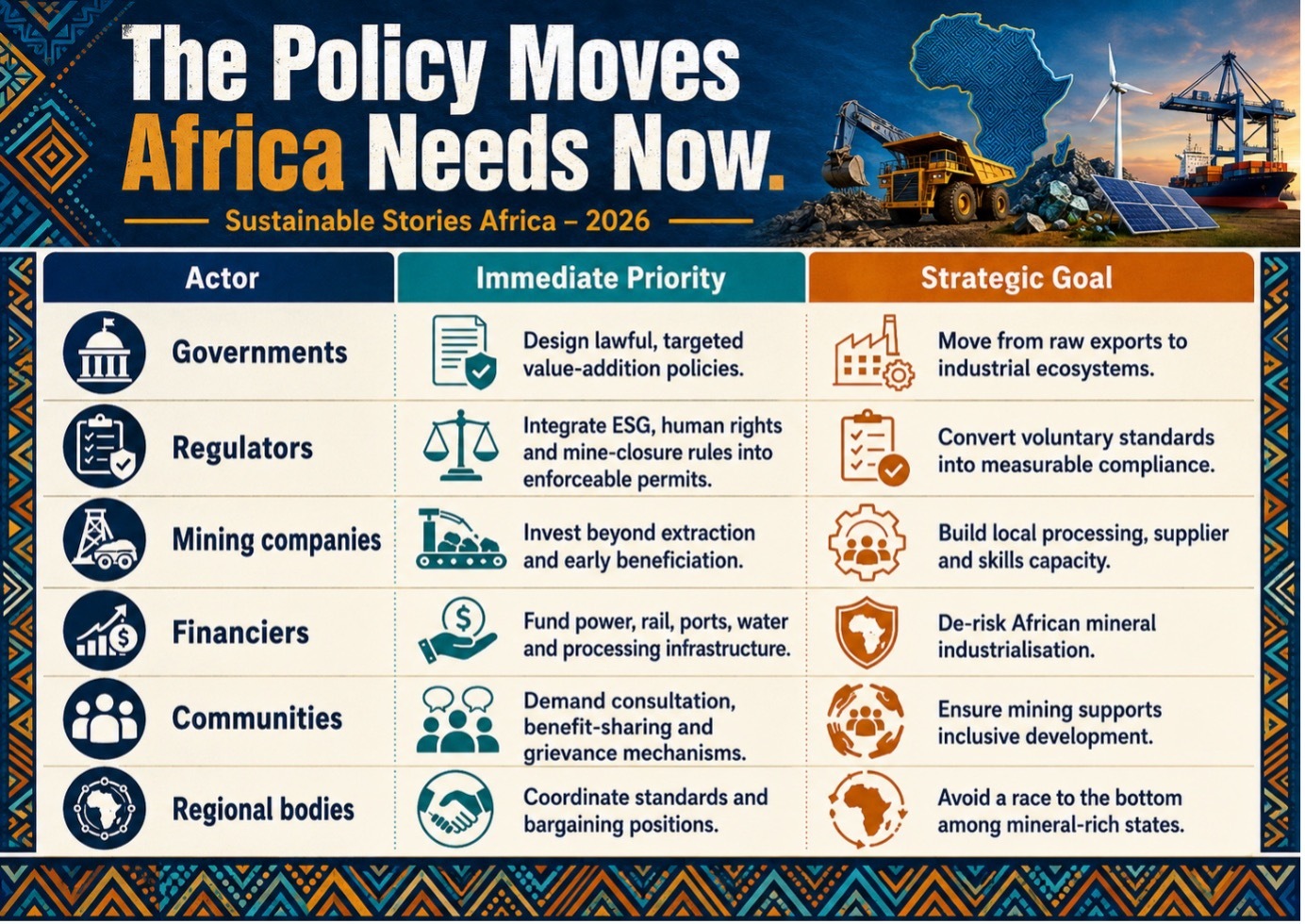
Industrial Policy Must Match ESG Ambition
Africa's next phase of critical minerals strategy must avoid two extremes: unrestricted extraction that exports value, and poorly designed restrictions that deter investment without building industry.
The better route is negotiated industrialisation, leveraging China's sustainability signals and Western supply-chain anxieties alongside Africa's mineral endowment to secure stronger terms, while recognising that minerals alone cannot build industries without electricity, skills, finance and regional markets.
This is where ESG becomes practical: environmental standards protect land and biodiversity, social safeguards protect workers, and governance rules protect contracts and revenue.
Follow-through will decide the outcome. Separate negotiations and early-stage processing risk capturing only a modest share of value; coordinated, smarter regulation could make critical minerals a defining development lever for the next decade.
Path Forward – From Minerals To Manufacturing
Africa’s priority should be clear: use China’s sustainability shift and global minerals competition to negotiate a new resource bargain built on ESG compliance, value addition, local jobs and industrial capability.
The next test is implementation. Export restrictions must be legally sound, infrastructure-backed and regionally coordinated.
Responsible mining standards must move from policy documents to mine sites, communities, contracts and supply chains.