The global financial system is moving toward climate alignment, but not fast enough for the countries most exposed to climate shocks.
A new Task Force report says emerging and developing economies need investment-led, development-centred finance, not fragmented reform.
The core question is urgent: can the international financial architecture mobilise enough affordable capital to help countries grow, adapt and decarbonise without deepening debt vulnerability?
Development Must Lead Climate Finance
The world is running out of time to keep warming within 1.5°C, but the countries most exposed to climate disruption are still receiving too little affordable finance to adapt, grow and transition.
A new strategy report by the Task Force on Climate, Development and the International Financial Architecture argues that climate finance reform must now move beyond ambition statements and institutional tweaks.
It calls for a development-centred approach that places green structural transformation, fiscal stability and resilience at the heart of global finance.
For Africa and the wider Global South, the issue is no longer whether climate change is macro-critical.
It is whether the global financial system can support countries in building clean-energy, resilient infrastructure, jobs and productive capacity before climate shocks and debt-servicing costs overwhelm development gains.
Climate Finance Is Still Falling Short
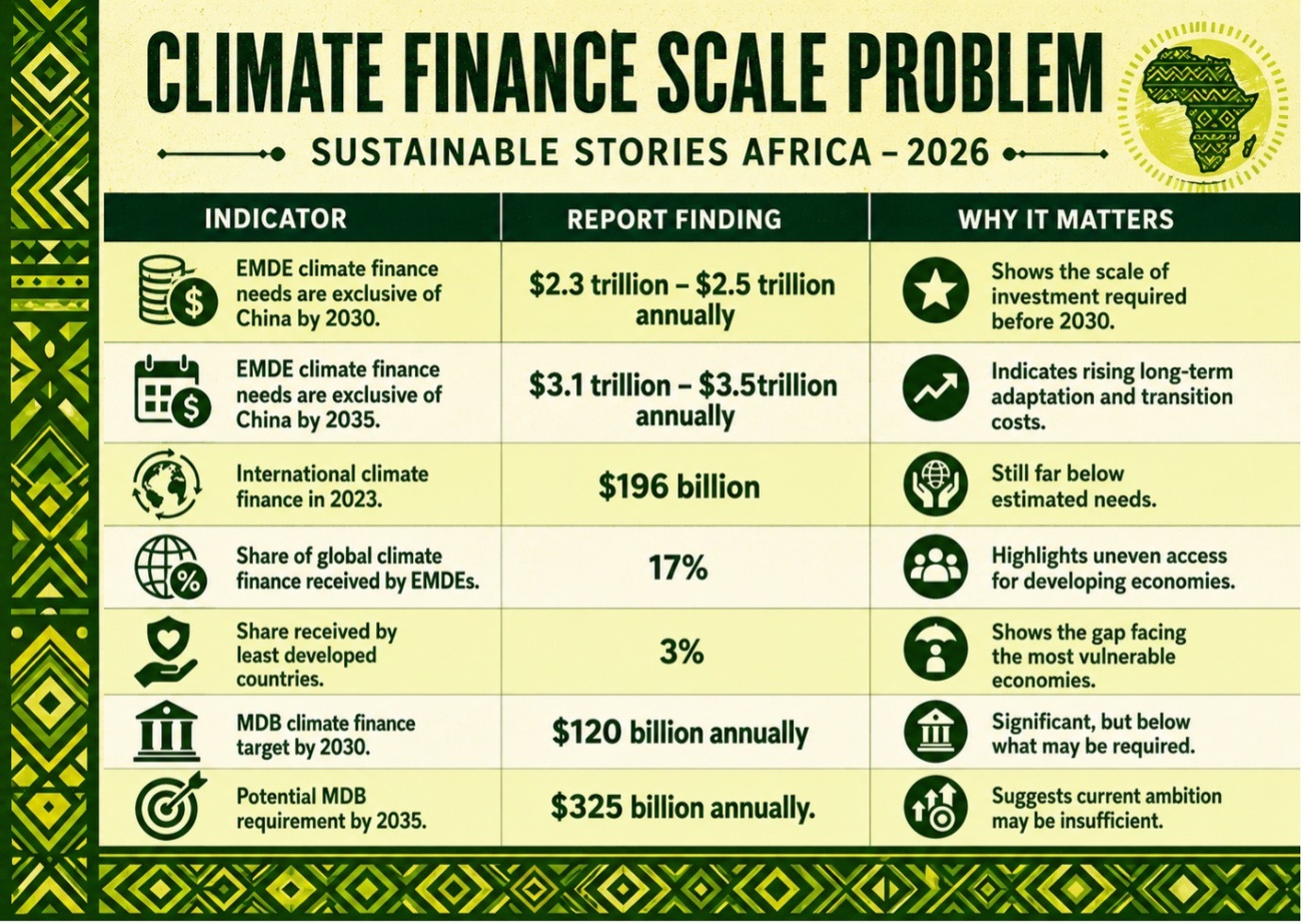
Emerging market and developing economies, excluding China, will need between $2.3 trillion and $2.5 trillion annually by 2030 to fund clean energy, adaptation, resilience, and loss and damage.
By 2035, the need is expected to increase to between $3.1 trillion and $3.5 trillion.
However, international climate finance reached only $196 billion in 2023.
That figure represents a threefold increase compared to 2018; however, it remains far below the required scale.
Even more concerning, emerging and developing economies received only 17% of total global climate finance, while least developed countries received just 3%.
This is the central warning in the Task Force report: the international financial architecture has made progress; however, the financing available remains too small, too expensive and too unevenly distributed to support the scale of transformation required.
The report also comes at a moment when African countries are facing overlapping pressures.
- Climate-related hazards are intensifying.
- Debt service costs are rising.
- Private capital remains cautious.
- Domestic resource mobilisation is constrained by slowing growth, high borrowing costs and fiscal stress.
In this context, climate underinvestment is not only an environmental risk. It is a development risk.
Progress Has Not Closed Financing Gaps
The global financial architecture has moved. The IMF adopted a climate strategy in 2021 and established the Resilience and Sustainability Trust to address balance-of-payments risks linked to climate and health emergencies.
It has since integrated climate risk into surveillance, debt sustainability analysis and financial sector assessments.
Multilateral development banks have matched that ambition.
- Balance-sheet optimisation reforms are expected to unlock $357 billion in additional lending over a decade.
- MDBs have collectively pledged $120 billion in annual climate finance for low- and middle-income countries by 2030.
- The World Bank, Asian Development Bank and others have strengthened climate diagnostics, Paris alignment frameworks and common reporting standards.
However, the report's message is unambiguous: progress is insufficient. The Baku to Belém Roadmap targets $1.3 trillion in climate finance by 2035.
Meeting just one quarter of that through MDBs would require $325 billion annually, nearly three times the current trajectory.
Private Capital Has Not Delivered Enough
The "billions to trillions" logic, that public finance would unlock private climate investment at scale, is not delivering.
MDBs mobilise just $1.20 in private finance for every $1 invested at the aggregate level; for the World Bank, that ratio drops to $0.62.
Cross-border private climate investment in emerging and developing economies reached only $42 billion in 2023, a marginal improvement, but nowhere near what clean power, resilient infrastructure and industrial transformation require.
The credit environment compounds the problem. Sub-Saharan Africa has seen a significant rise in below-investment-grade sovereign ratings between 2003 and 2023, pushing up risk premiums, shortening debt maturities and making long-term clean investment increasingly expensive, even where economic logic is compelling.
The paradox is sharp: Africa holds abundant solar, wind, hydro, minerals and market potential.
However, without affordable long-term capital, those endowments cannot be converted into clean industrial growth.
Debt Pressure Is Crowding Out Development
The report’s development-centred argument becomes sharper when debt service enters the picture.
African countries spent almost 17% of government revenue on debt servicing in 2023.
Globally, 3.3 billion people live in countries where interest payments exceed public spending on health and education.
That statistic captures the human reality behind the debates on financial architecture.
When debt payments outrank clinics and classrooms, development is no longer only constrained by domestic policy.
It is constrained by the terms, costs and structure of global financing.
The report also notes that carbon pricing, while useful, cannot carry the financing burden alone.
Direct carbon pricing covers less than 30% of global emissions, with an average price below $20 per tonne of carbon dioxide in jurisdictions where it exists.
Global carbon pricing revenue reached about $100 billion in 2023, with roughly half earmarked for climate and environmental purposes.
For developing regions, the message is practical: carbon pricing can help, but it cannot substitute for concessional finance, MDB reform, tax cooperation, debt relief where necessary and stronger domestic institutions.
Green Transformation Can Create Growth
The report reframes the climate agenda decisively, not as a burden, but as a structural growth opportunity.
Its country typology is particularly relevant for Africa, where many economies occupy multiple categories simultaneously: fossil fuel exporters like Nigeria, Angola and Algeria facing transition risk; mineral-rich economies like Zambia and DRC holding critical opportunity; and climate-vulnerable Sahel and island states requiring urgent resilience investment.
The evidence on returns is compelling. Clean energy carries a fiscal multiplier of 1.1 to 1.7, compared with just 0.4 to 0.7 for fossil fuels.
A $25 billion climate finance injection into Sub-Saharan Africa could raise electricity production by 24% and lift GDP growth by 0.8% over a decade.
Every $1 invested in resilience generates an estimated $10 in broader benefits.
Climate Risks Are Now Macro-Critical
The report's sharpest warning is structural: climate risk has become a financial stability issue.
Countries now face three interlocking exposures:
- Physical risks from floods, droughts and slow-onset changes.
- Transition risks from shifting away from fossil fuels.
- Spillover risks when climate policies elsewhere reshape trade, finance and fiscal positions.
The inequality of exposure is stark. Nearly 90% of Sub-Saharan Africa's population faces high vulnerability on at least one climate dimension, income, education, social protection, energy access, water or markets, compared with fewer than 3% in high-income countries.
This is why climate finance must be treated as development finance.
Where vulnerability is structural, resilience cannot rely on emergency response alone; it must be embedded in infrastructure, fiscal planning, agriculture, urban policy and financial regulation.
Institutions Must Move From Reform To Scale
The report's recommendations are direct and actionable.
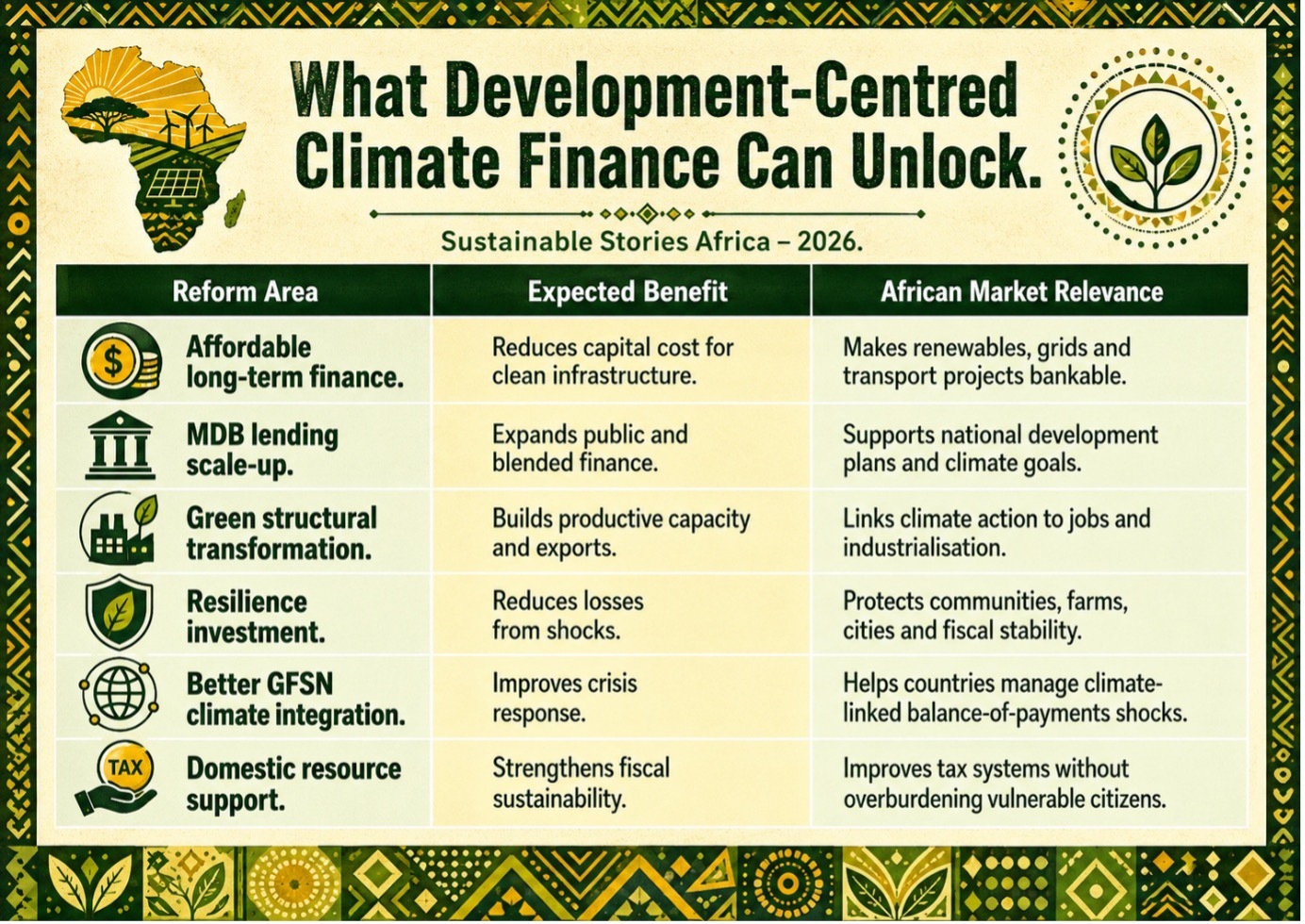
- Scale MDBs – more concessional finance, stronger capital adequacy reforms, hybrid instruments and coordinated country platforms aligned with national development strategies
- Strengthen the Global Financial Safety Net – IMF tools, regional financing arrangements and development finance institutions must respond to climate-linked shocks before they become fiscal and social crises
- Reform private capital mobilisation – blended finance must protect fiscal stability and serve public purpose, not socialise risk while privatising reward
- Deepen domestic resource mobilisation – better tax systems and public financial management, supported by international cooperation and affordable finance, without worsening inequality
- Tie climate finance to transformation – the goal is resilient economies, competitive industries, stronger grids, productive jobs and better public services, rather than merely project pipelines
Path Forward: Finance Must Serve Development
The Task Force’s message is direct: climate finance reform must put development first, or it will fall short of both climate and growth objectives.
For Africa, the priority is affordable long-term capital, stronger MDBs, climate-aware safety nets and nationally led green transformation.
The measure of success will be whether finance protects people, expands opportunity and builds economies resilient enough to withstand the next shock.