
Corporate Affairs is moving from communications support to strategic risk leadership as AI, geopolitical uncertainty, and stakeholder scrutiny reshape business expectations.
Early Oxford–GlobeScan survey findings show 74% of respondents believe the function needs revision. For African and emerging-market companies, the message is clear: trust now needs systems, not slogans.
Trust Is Now A Business System
Corporate Affairs leaders are being asked to manage a harder operating reality: one where reputation, trust, technology risk and geopolitical pressure now meet inside the same boardroom.
That was the central signal from GlobeScan’s London breakfast roundtable with the European Association of Communication Directors, held on April 28, 2026.
The session reviewed early findings from the seventh Oxford–GlobeScan Global Corporate Affairs Survey, which brought together senior professionals from organisations including Unilever, Coca-Cola, APCO, Ipsos, National Grid and Chevron.
For African and emerging-market businesses, the discussion matters because the same pressures are already clear.
AI-driven misinformation, tighter ESG scrutiny, policy volatility, supply chain risk and rising public expectations.
The new test is whether Corporate Affairs can move beyond messaging and become a stronger engine for governance, resilience and value creation.
Expectations Are Outrunning Old Models
A survey of 294 Corporate Affairs professionals across more than 50 countries has delivered a pointed verdict: 74% say their practice needs revision. Crucially, respondents did not read this as a decline; they read it as complexity outpacing existing operating models.
The GlobeScan-EACD findings identify three converging pressures. Geopolitical risk now directly shapes investment, regulation and supply chains. Artificial intelligence has shifted from a productivity asset to a trust liability.
Corporate purpose can no longer live in mission statements; it must be visible in spending, incentives and daily decisions.
With 79% of participants reporting to board or CEO level, these are not communications teams reacting to headlines. They are decision-makers reshaping strategy.
For Africa, the implications are immediate. Whether managing tariff reform, social media crises, local-content scrutiny or inflation pressures, reactive communications is no longer sufficient. Stakeholders now demand clarity, evidence, speed and accountability.
AI, Trust, and Risk Now Interlock
The line between business opportunity and business risk is narrowing.
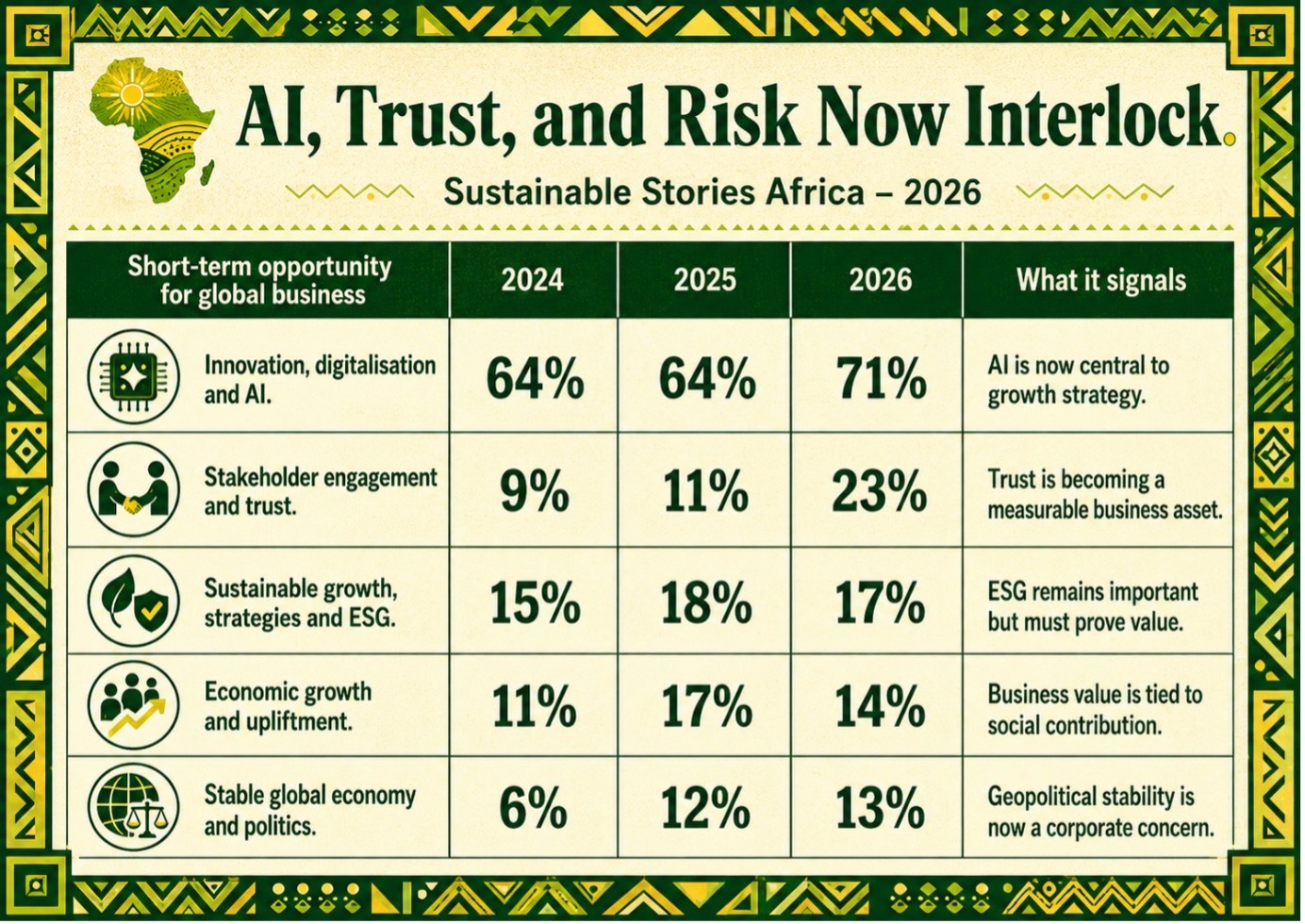
A GlobeScan-EACD survey shows innovation, digitalisation and AI ranked as the top short-term global business opportunities, rising to 71% in 2026 from 64% in both 2025 and 2024. Stakeholder engagement and trust also climbed sharply, from 9% in 2024 and 11% in 2025, to 23% in 2026.
The data carries a cautionary undertone. Companies increasingly recognise that adopting AI without building trust can convert growth tools into liabilities.
AI-driven misinformation emerged from roundtable discussions as one of the most complex, least resolved challenges in Corporate Affairs, not only because false information spreads rapidly, but because AI systems can resurface damaging content long after an incident fades, keeping reputational harm alive across investor, employer and public audiences.
Governance compounds the problem. AI-related risks straddle technology, communications, legal and leadership teams, leaving ownership and decision-making authority unclear precisely when speed is critical.
For African markets, the stakes are higher. Misinformation travels fast across WhatsApp, X and TikTok, regulatory responses remain uneven, and institutional trust is often fragile. In this environment, AI risk is not merely reputational; it threatens market stability, consumer protection and corporate governance.
Better Corporate Affairs Can Build Value
The GlobeScan-EACD discussion points to a clear opportunity: Corporate Affairs is not losing relevance; it is gaining proximity to power.
As the function moves closer to strategy, risk, legal, sustainability and executive leadership, it earns a seat at the table before problems become crises.
Participants agreed that the function must now help organisations interpret external change, connect issues across departments and support decision-making under uncertainty. This is a meaningful shift, from managing narratives to shaping them at the source.
For African and Global South companies, the practical upside is significant. A strengthened Corporate Affairs model can help energy companies explain tariff reforms without alienating consumers, banks communicate fraud risks without triggering panic, and agribusinesses connect climate adaptation to food security and farmer livelihoods.
However, a deeper challenge remains: the gap between the purpose articulated and the purpose as practised.
Participants flagged that sustainability commitments, net-zero pledges and community narratives lose credibility when capital allocation, procurement decisions and performance incentives tell a different story.
This is where Corporate Affairs becomes essential to ESG integrity. The function can identify where messages and decisions conflict, where communities feel unheard, and where investors require measurable, verifiable progress, converting purpose from declaration into operating discipline.
Redesign The Function Before Crises
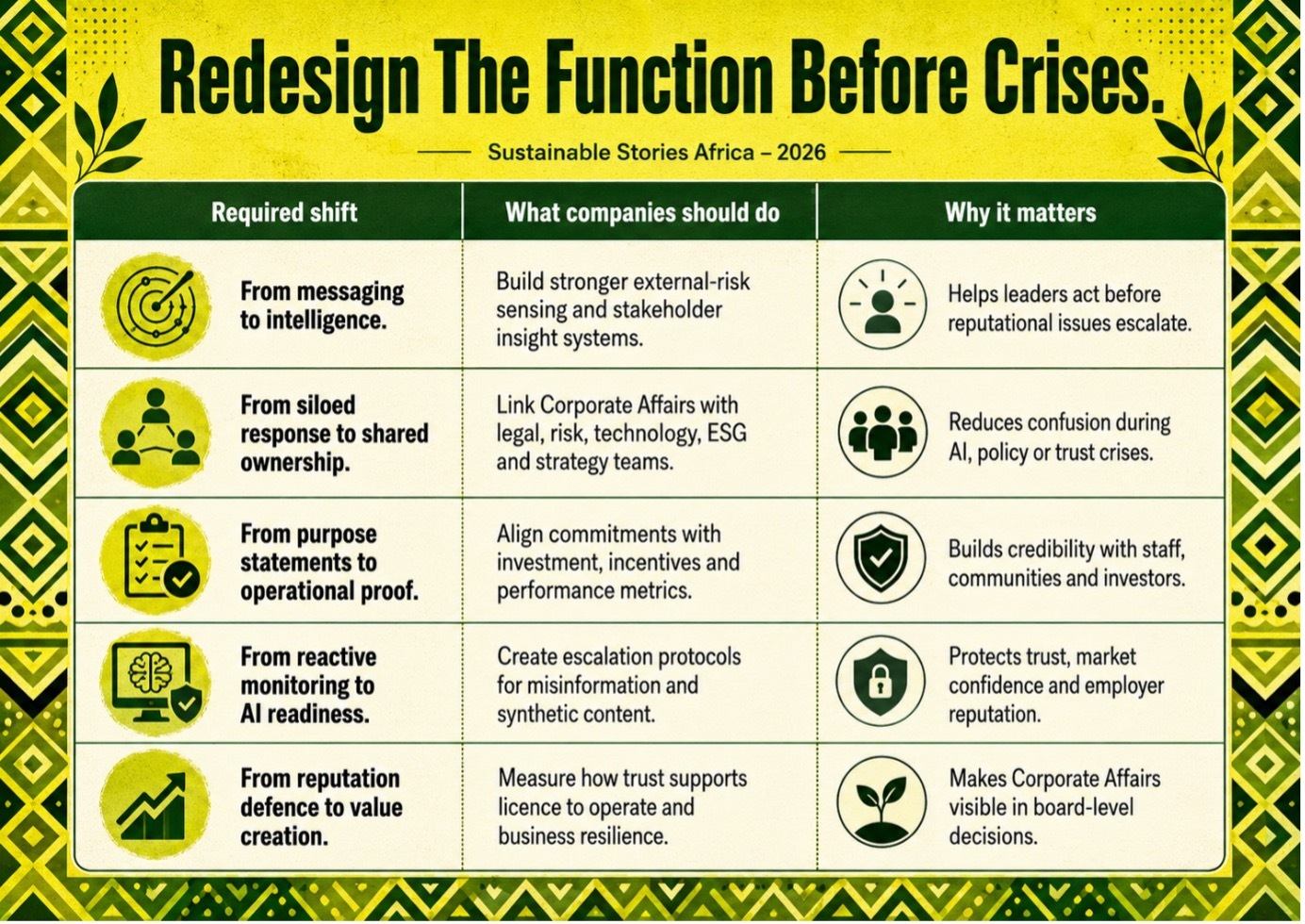
The GlobeScan-EACD report points toward a practical redesign agenda.
Corporate Affairs teams need clearer strategic direction, stronger integration with business leadership and more anticipatory approaches to risk.
AI capability should no longer be treated as a specialist add-on; it is becoming a core requirement for reputation, trust and stakeholder management.
For boards,
- The first decision is structural: Corporate Affairs needs access to decision-making early enough to influence outcomes. It should not be invited only when a crisis becomes public.
For executives, the next decision is operational:
- Risk ownership must be defined before misinformation spreads. Companies need clear escalation routes, named decision-makers, scenario protocols and evidence standards. In an AI-driven environment, waiting for certainty can be costly; responding without verification can be equally damaging.
For regulators and industry bodies;
- The task is to create clearer standards around AI-driven misinformation, platform accountability and corporate disclosure. Participants in the roundtable argued that Corporate Affairs should not merely monitor and respond, but help shape organisational positions and engage policymakers, industry groups and platforms.
For African companies;
- The agenda should also include local language monitoring, community engagement, employee advocacy, media training and trust-building with regulators. A misinformation crisis in Lagos, Nairobi, Johannesburg, Accra or Cairo will not always follow the same pattern as one in London or New York. Response systems must reflect local realities.
The people dimension is equally important.
- The report notes that participants repeatedly returned to skills, collaboration and integration. Tools matter, but they are not enough. Corporate Affairs teams need judgement, cultural fluency, data literacy, ESG understanding and the authority to coordinate across the business.
Path Forward – Make Trust Operational, Not Decorative
The next phase of Corporate Affairs should be built around readiness: AI governance, misinformation protocols, stronger ESG evidence, board access and integrated risk ownership.
For African markets, the priority is clear. Companies that treat trust as infrastructure will be better placed to protect reputation, attract investment, manage regulation and create durable stakeholder value.