
CP3P candidates face a body of knowledge spanning policy, economics, finance, procurement, law, risk and contract management.
Memorising definitions may create familiarity, but scenario questions demand relationships and judgment.
A strong preparation plan follows the PPP lifecycle, tests concepts in context and separates course-provider performance claims from the official examination standard.
The goal is both a pass and professional competence.
Passing begins when concepts become connected
The Certified Public-Private Partnership Professional pathway is built around a deceptively simple challenge:
PPPs require many disciplines to work together.
- Candidates are expected to understand not only what appraisal, bankability, affordability, fiscal commitments or risk allocation mean
- They also need to know when each is tested and how it changes another decision.
Dr W. Akhator-Eneka's source essay promotes BPMI as a way to organise that complexity.
- It describes a training offer built around a large set of concepts and an ambitious target score.
Please treat these details as provider claims, not as official guarantees. The independently useful principle is that integrated, scenario-based learning is stronger than isolated recall.
The official APMG guide provides the anchor.
- Preparation-level candidates work through the PPP framework, project identification and screening, appraisal, and structuring.
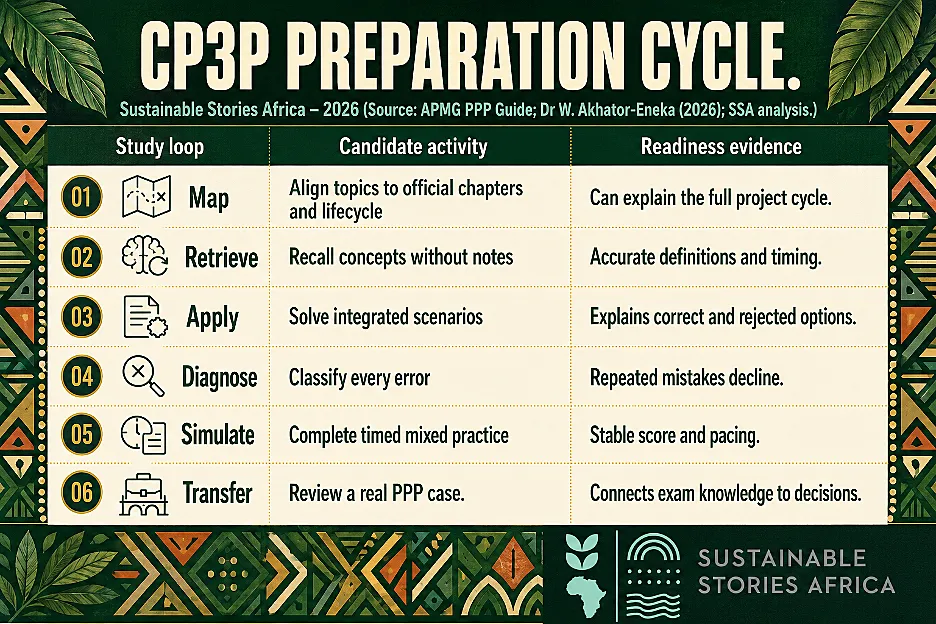
- A credible study plan should map the syllabus, retrieve concepts from memory, apply them to unfamiliar cases, review errors and practise under timed conditions.
The exam tests relationships under uncertainty
A question about risk allocation may also test bankability, incentives, cost, public exposure and Value for Money.
A question about output specifications may turn on payment deductions and monitoring.
A question about affordability may require the candidate to distinguish the project's economic value from the government's ability to meet long-term commitments.
This is why passive rereading underperforms.
- Recognition feels like knowledge until answer options introduce two technically plausible choices.
- Candidates need to retrieve the governing principle, place the scenario in the project cycle, eliminate choices that confuse stages or responsibilities, and select the answer most consistent with the guide.
Build preparation around four learning loops
First:
- Map the official syllabus and examination specification.
- Create a lifecycle overview that shows the purpose, outputs and approval decisions for each chapter.
Second:
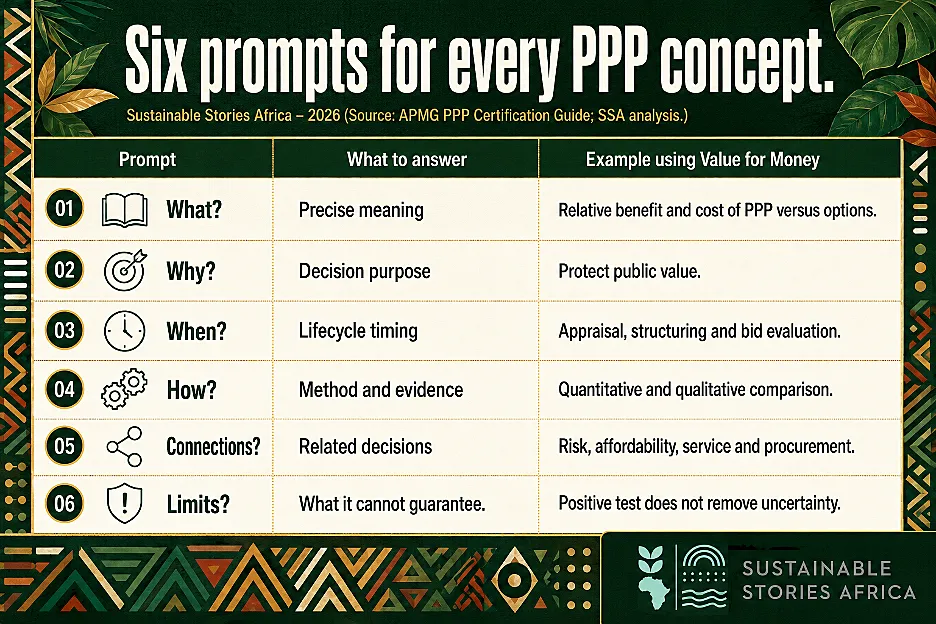
- Build concise concept cards using six prompts: definition, purpose, timing, method, connections and limitations.
- Cards should be written in the learner's own words and checked against the guide.
Third:
- Apply concepts through scenarios.
- For every practice question, explain why the correct answer fits and why each distractor fails.
- Record errors by type: knowledge gap, stage confusion, exception missed, careless reading or time pressure.
Fourth:
- Revisit weak areas through spaced retrieval and mixed practice rather than repeating entire chapters equally.
A weekly case should integrate several domains.
- For example, assess whether a proposed hospital PPP is economically justified, affordable, commercially feasible and suited to an availability payment.
- Then identify major risks, specify outputs and decide what evidence government needs before procurement.
This turns the syllabus into a decision system.
Candidates should maintain a one-page lifecycle map and an error ledger.
- The map prevents chapter knowledge from becoming isolated; the ledger reveals whether weak performance comes from missing knowledge or flawed exam technique.
- Review should prioritise recurring, high-consequence errors instead of following the comfortable order of the textbook.
Exam discipline supports workplace competence later
The same habits that improve performance in examination, such as clear definitions, lifecycle sequencing, documented assumptions and structured elimination, also support professional review.
- A practitioner who can explain how a risk decision affects price and affordability is more useful than one who can only repeat the preferred allocation principle.
Confidence should therefore come from evidence: consistent practice scores, fewer repeated errors, the ability to explain answers without notes and stable timing.
Marketing promises such as a guaranteed score, fixed preparation duration or universal concept count should not replace the candidate's own diagnostic data or the official examination rules.
Study groups help when they require explanation rather than consensus.
- Each member should defend an answer using the guide, identify the lifecycle stage and explain why alternatives are weaker.
If disagreement remains, the group should record the unresolved principle and verify it from the official source rather than vote on what sounds familiar.
Candidates need a controlled final sprint
In the final fortnight, candidates should complete timed mixed sets, analyse errors the same day and focus revision on high-frequency weak connections.
- They should confirm current exam format, identification requirements and provider rules from official APMG channels.
- New unofficial material should be limited if it conflicts with the guide's terminology.
On exam day, read the question stem for lifecycle stage, decision owner and qualifying words.
- Translate long scenarios into a short issue statement, answer before overthinking, flag uncertain items and preserve time for review.
- After certification, convert notes into a professional reference and apply the framework to a real project case.
Preparation also needs basic controls: a realistic calendar, protected study sessions, sleep, accessible exam technology and contingency time.
- These may seem separate from technical mastery, but fatigue and logistical uncertainty reduce retrieval and judgment.
A disciplined final week consolidates knowledge instead of attempting to learn an entire syllabus again.
Path Forward – Pass the test, then prove competence
A practical study plan combines the official guide, retrieval practice, scenario analysis, error tracking and timed simulation.
Candidates should judge readiness by repeatable performance, not confidence alone.
The certificate opens a door; it does not complete professional formation.
The next test is using the same integrated reasoning to improve live PPP decisions.