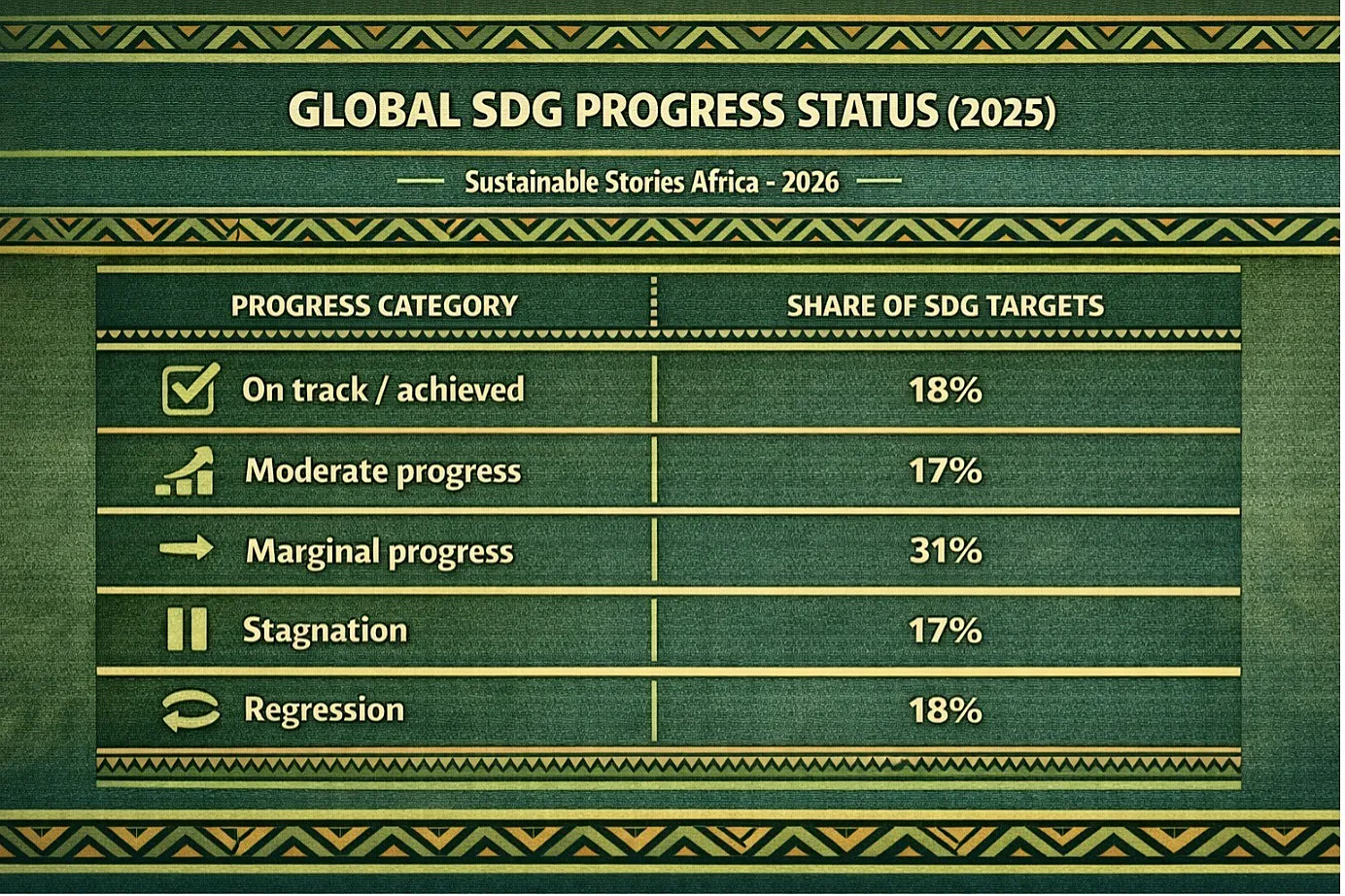
Ten years after the adoption of the 2030 Agenda, the world is facing a stark reckoning. Only 35 per cent of Sustainable Development Goal (SDG) targets are on track or making moderate progress, while nearly one in five has moved backwards.
The Sustainable Development Goals Report 2025 reads less like a progress update and more like an emergency briefing, laying bare how climate shocks, conflict, inequality and fragile financing are colliding to slow global development at a moment when acceleration is most needed.
A Decade In, Progress Under Strain
A decade after world leaders committed to "leave no one behind," the global development agenda stands at an uncomfortable inflexion point.
The Sustainable Development Goals (SDGs), once framed as an achievable roadmap to shared prosperity, are now under pressure from overlapping crises that few anticipated at their current scale.
The Sustainable Development Goals Report 2025 offers a data-driven reality check. While millions have gained access to electricity, social protection and education since 2015, progress remains uneven and increasingly fragile.
Only 18% of SDG targets are fully on track, while 48% are advancing too slowly and 18% have regressed below 2015 baselines.
With just five years remaining, the report reframes sustainable development not as a distant aspiration, but as a narrowing window for decisive action, one shaped as much by political will and financing choices as by data, governance and institutional resilience.
A Global Development Emergency Unfolds
The headline finding of the SDG Report 2025 is unambiguous: the world is off track.
Over 800 million people remain trapped in extreme poverty, carbon dioxide concentrations are the highest in over two million years, and 2024 became the hottest year on record, briefly breaching the 1.5°C threshold.
Conflict and instability have compounded these pressures. More than 120 million people are now forcibly displaced, double the number recorded in 2015, while debt servicing costs in low- and middle-income countries reached a record $1.4 trillion, crowding out spending on health, education and climate resilience.
What emerges is not a single failing goal, but a system under strain, where progress made in one area is repeatedly offset by reversals in another.
Progress Exists, But It Is Uneven
The report is careful not to dismiss real gains. Since 2015, more than half of the world's population has benefited from at least one form of social protection, up by 10 percentage points.
Child marriage, maternal mortality and under-five deaths have declined, while internet connectivity has expanded by roughly 70% globally.
However, these advances mask widening gaps. Only one in five countries is on track to halve national poverty rates by 2030, and 75% of the global extreme poor are projected to live in sub-Saharan Africa or fragile, conflict-affected states by mid-decade.
The data also reveals structural blind spots. While SDG indicators now enjoy stronger methodological coverage than in 2016, critical gaps persist in areas such as gender equality, climate action and governance, precisely where policy choices are most contested.
Global SDG Progress Status (2025)
| Progress Category | Share of SDG Targets |
|---|---|
| On track / achieved | 18% |
| Moderate progress | 17% |
| Marginal progress | 31% |
| Stagnation | 17% |
| Regression | 18% |
Six Transitions Can Still Change Outcomes
Rather than treating the SDGs as 17 isolated ambitions, the report argues for acceleration through six systemic transitions: food systems, energy access, digital connectivity, education, jobs and social protection, and climate and biodiversity action.
These transitions represent leverage points where coordinated policy and finance can unlock multiple goals simultaneously.
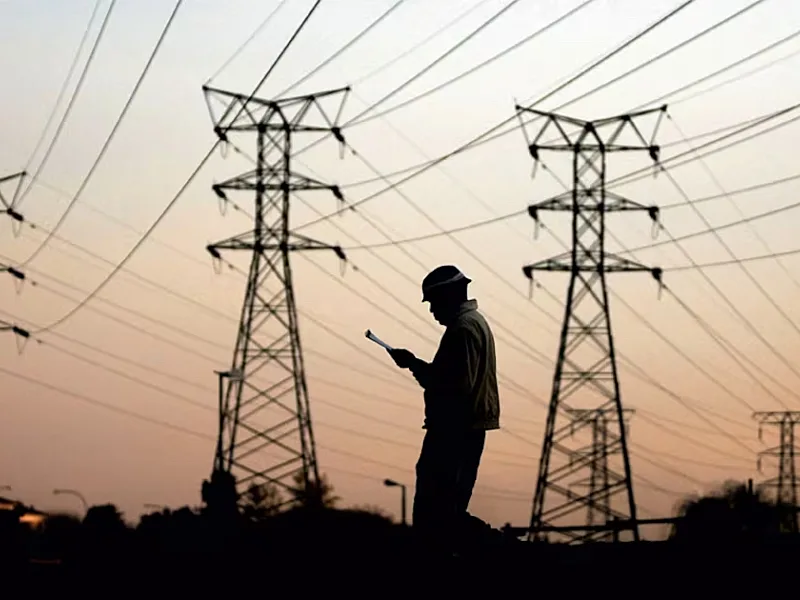
Energy access, for example, underpins health, education and productivity, while digital connectivity increasingly determines inclusion in labour markets and public services.
Similarly, scaling social protection is no longer framed as welfare spending, but as economic infrastructure that will buffer households against shocks and preserve human capital during crises.
The implication is clear: incrementalism will not work. What is required is an integrated investment system that recognises how climate, inequality and economic resilience intersect.
Financing, Data and Political Will
The report identifies financing as the critical bottleneck. Despite rising global needs, a $4 trillion annual SDG financing gap persists, while funding for statistical systems, which are essential for evidence-based policymaking, remains fragile and heavily donor-dependent.
Disruption of data, such as the suspension of major household surveys in 2025, exposes the vulnerability of global monitoring when national systems lack sustainable domestic funding. Without reliable data, governments cannot target resources, track inequality or course-correct policies in real time.
Equally central is governance. Strong institutions, transparent budgeting and inclusive participation, particularly of women and marginalised groups, are presented not as social add-ons but as prerequisites for delivering results at scale.
PATH FORWARD – Five Years To Act Decisively
The SDG Report 2025 leaves little room for ambiguity. The next five years will determine whether the 2030 Agenda remains credible or becomes a missed global promise.
Progress is still possible, but only through accelerated investment, integrated policy and renewed multilateral cooperation.
Urgency, not optimism, is now the organising principle. The evidence shows what works. The challenge is whether political courage and financing ambition can finally match the scale of the task ahead.