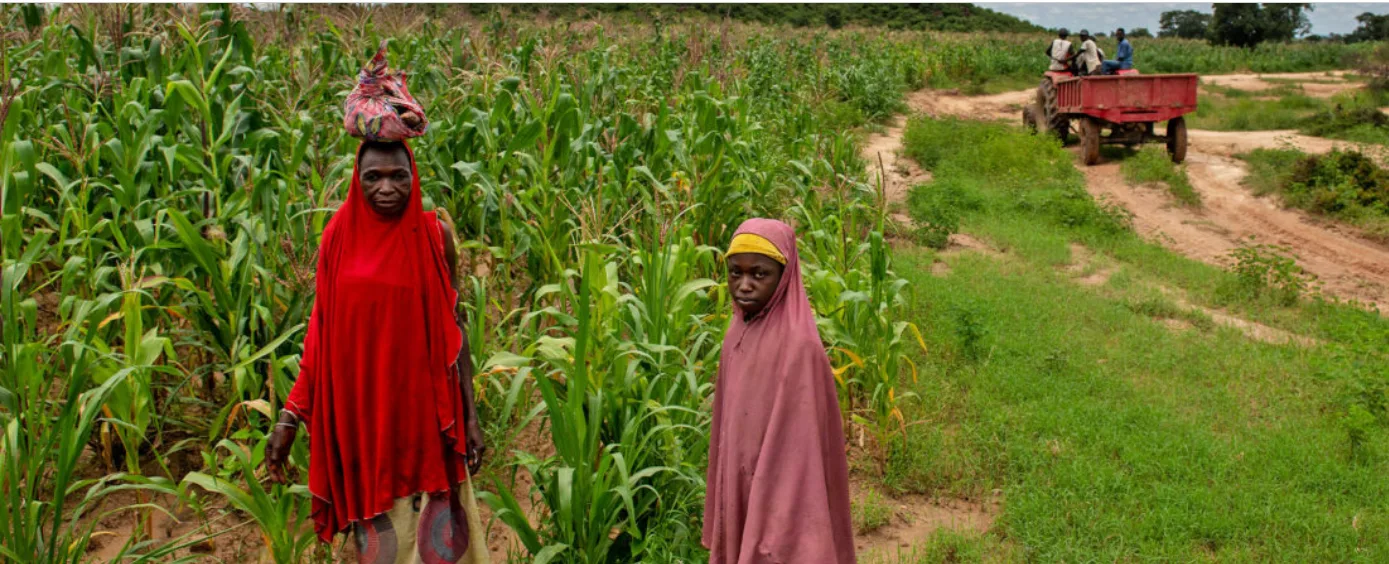
Global food supplies remain broadly stable, yet hunger is worsening. The pressure is moving through prices, conflict, fertiliser markets and climate shocks.
For African and emerging markets, the question is no longer only whether food exists. It is whether households, farmers and governments can still afford the systems that keep food moving.
Food Security Is Becoming Less Affordable
Global food and nutrition insecurity is rising even as the world avoids a full-scale shortage of major staple crops, creating a sharper and more unequal crisis for vulnerable countries.
The World Bank’s May 2026 Food & Nutrition Security Update highlights how conflict, fertiliser volatility, weather risks and domestic food inflation are converging into a new affordability shock.
Agricultural and cereal price indices have risen since March, while the threat of El Niño could deepen production risks through 2027.
For Africa, this is not an abstract global market story. It is the price of maize in a town market, the cost of fertiliser for a smallholder farmer, the strain on humanitarian agencies in Sudan and South Sudan, and the lean-season risk facing nearly 52.9 million people in West and Central Africa.
Food security is becoming a test of governance, climate resilience and social protection.
Stable Supplies, Rising Hunger, Fragile Households
The World Bank update sends a difficult signal: food insecurity is rising even as major staple supplies remain broadly stable.
This means the crisis is no longer about production alone. It is increasingly shaped by access, affordability and disruption.
Agricultural price indices have risen 3% since March, cereal prices are up 4%, while maize and wheat closed 5% and 11% higher, respectively, tightening diets, household budgets and food-import bills.
The Middle East conflict has widened the risk map. Disruptions to oil, gas and fertiliser flows through the Strait of Hormuz pushed urea prices up 46% month-on-month. Fertiliser prices are projected to rise 31% on average in 2026, reaching their least affordable level since 2022.
That matters because unaffordable fertiliser today can spiral to higher food prices tomorrow, especially for low-income countries.
Prices Reveal The Hidden Food Crisis
The World Bank data highlight a global food system facing price pressures, climate and conflict-linked disruption.
Wheat and maize prices are 19% and 5% higher year-on-year, respectively, while maize and wheat remain 23% and 18% above January 2020 levels.
Rice prices are lower; however, rice markets remain exposed to weather and policy shocks.
Domestic food inflation is still uneven. In low-income countries, conditions worsened between January and March 2026, with food inflation accelerating by 5%, from 40% to 45%.
Other income groups improved; however, poorer households remain more exposed because food accounts for a larger share of monthly income.
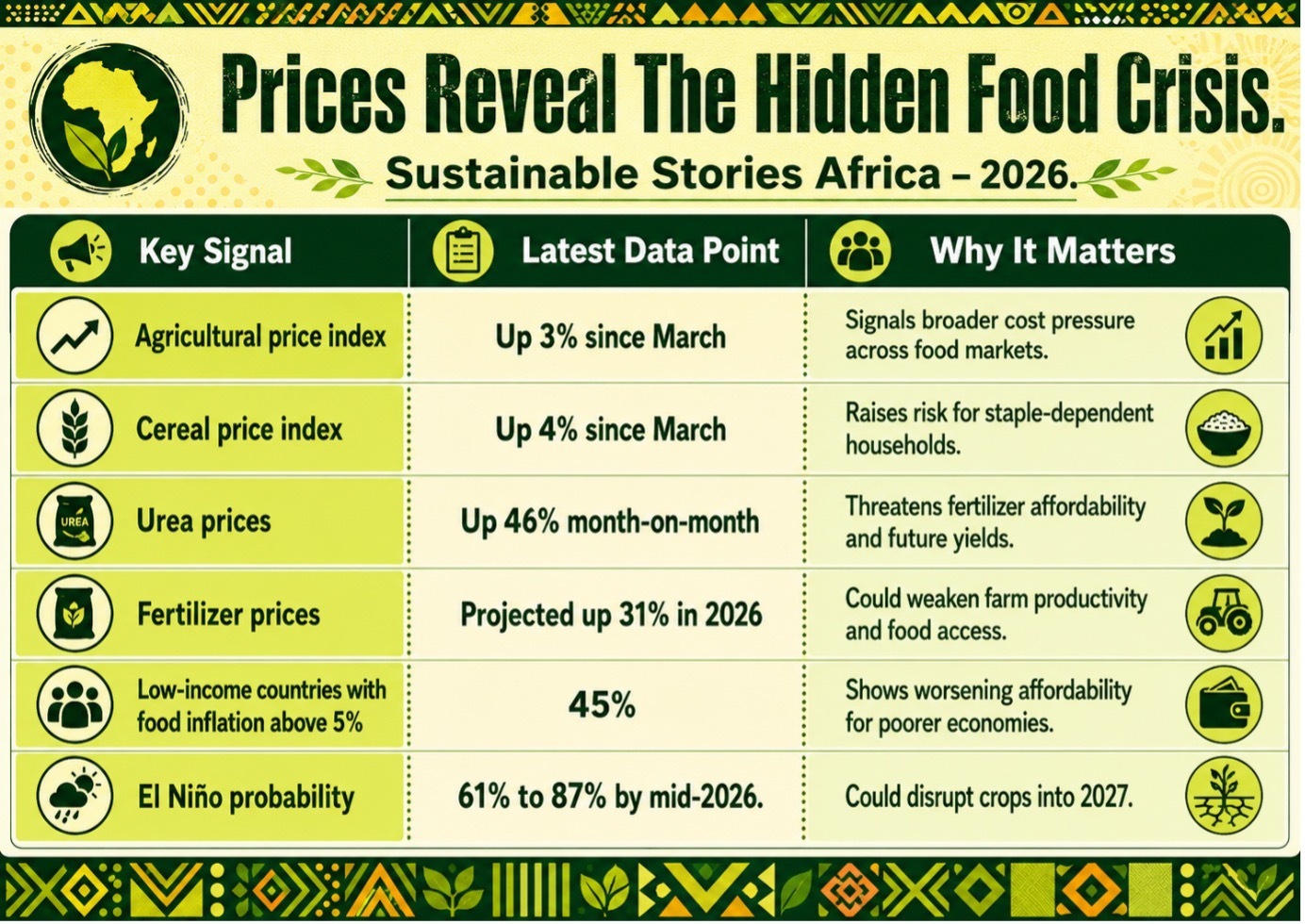
The climate risk is rising too. El Niño’s probability is estimated at 61% to 87%, threatening harvests and reinforcing why food security is a systems issue.
Africa Faces A Split Food Reality
Africa’s food security picture is split between stronger harvests and worsening hunger in conflict-affected areas.
In West and Central Africa, the 2025/26 cereal season produced 80.4 million tonnes, 4% above the previous season and 7% above the five-year average.
Local cereal and imported rice supplies improved, while millet, sorghum and maize prices were stable or lower in several Sahelian markets in March and April 2026.
However, supply gains are not reaching everyone. Nearly 52.9 million people may face acute food and nutrition insecurity between June and August 2026, especially in the central Sahel, Lake Chad Basin and northeastern Nigeria.
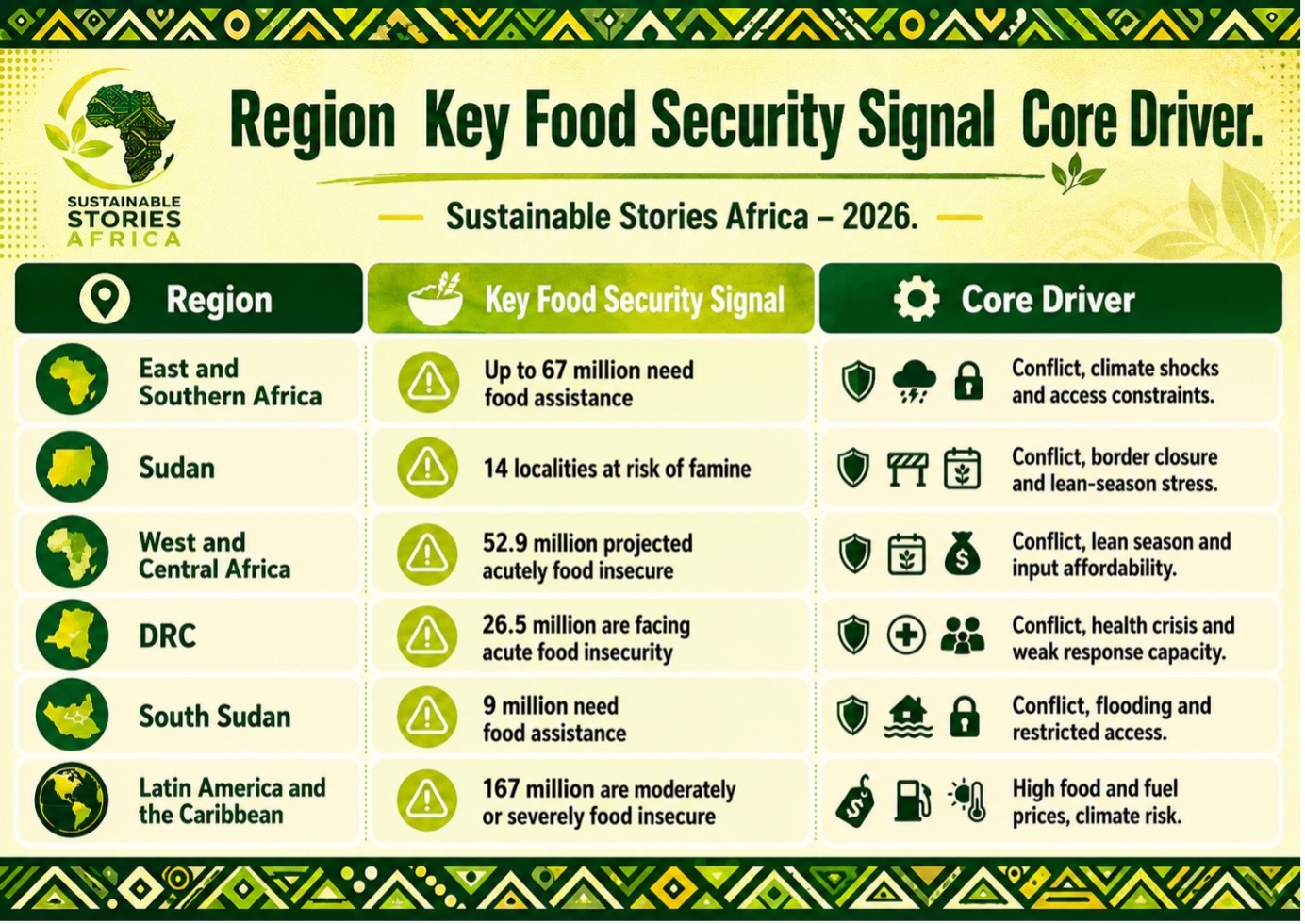
East and Southern Africa face greater pressure: up to 67 million people need food assistance; Sudan has 14 famine-risk localities, South Sudan has 9 million people in need, and the DRC has 26.5 million people acutely food insecure.
Resilient Food Systems Can Protect Families
The opportunity is to ensure that food security policies range from emergency reactions to resilience-building.
For African governments, food systems should be treated as critical infrastructure.
- Roads, storage, irrigation, electricity, digital market information, extension services, climate intelligence and social protection all shape whether food stays available and affordable.
For farmers, the priority is stable access to inputs.
- Volatile fertiliser markets require smarter procurement, targeted subsidies, regional fertiliser trade, soil-health programmes, and organic, bio-based and climate-resilient inputs. The goal should be productivity protection, not blanket subsidies alone.
For households and markets.
- Stronger food systems mean fewer skipped meals, steadier prices, better child nutrition, reduced crisis coping, more predictable supply chains, lower inflation volatility and stronger investor confidence.
Food security also strengthens ESG outcomes by linking climate adaptation, social protection, decent livelihoods, responsible supply chains and public accountability.
Governments Must Move Before Shocks Compound
The next phase of food security response requires coordinated action from governments, regulators, financiers, businesses and citizens.
Governments must strengthen early-warning systems and connect them directly to budget decisions.
- Climate forecasts, market data and nutrition surveillance should trigger faster procurement, food reserve releases, cash transfers and humanitarian access planning.
- Data alone will not protect families without response capacity.
Regulators and trade authorities should avoid panic restrictions that deepen regional shortages.
- Where export controls are necessary, they should be targeted, time-bound and aligned with regional food security goals.
Financiers should expand working capital for processors, input distributors, warehouse operators and smallholder-facing agribusinesses.
- Climate finance must move closer to farms through irrigation, solar cold rooms, storage, climate-smart seeds and digital advisory systems.
Businesses need shorter, more transparent supply chains and greater investment in local processing.
Citizens need protection, not blame, through social protection, school feeding, nutrition programmes and targeted food support.
Path Forward: Build Resilience Before Food Prices Break
Food security policy must now move from crisis response to shock readiness.
African markets need stronger food reserves, climate-smart production, open regional trade, targeted social protection and affordable farm inputs.
The World Bank update highlights that the next food crisis may arrive due to prices before shortages.
The priority is to protect households, keep farmers producing and build food systems that can absorb climate, conflict and fertiliser shocks without pushing millions deeper into hunger.