The World Economic Forum has published a rigorous four-enabler framework for scaling private-sector finance in water and climate adaptation, moving the conversation from aspiration to a measurable, investable methodology.
At its core, the report argues that the barriers are not political but structural: unclear value, fragmented projects, misaligned risk, and unmeasured impact.
For Africa and other emerging markets watching closely, the four-pillar blueprint offers more than a Southeast Asian roadmap.
It offers a universal language for transforming water resilience from a public-good narrative into a commercially credible opportunity, one metric, one project, one bond at a time.
Water Finance Needs a New Measurement Language
The $6.4 billion gap in Southeast Asian water adaptation finance is not simply a funding shortfall; it is a measurement and a failure in structuring. The World Economic Forum's May 2026 white paper argues that until resilience is translated into financial value, aggregated at scale, risk-adjusted for different capital types, and verified through credible MRV systems, private capital will continue to sit on the sidelines.
The report, produced in collaboration with Boston Consulting Group and informed by engagement with over 30 global investors, financiers, and corporates, reviewed 20 global case studies to identify the precise enablers that move AtW projects from concept to bankable investment.
A $12.9bn Problem the Market Cannot Ignore
Southeast Asia's water-related climate challenges represent one of the largest unmet infrastructure financing needs in the world.
With annual AtW investment requirements running at 1.7 – 2.2 times the available public budget, and 88% of adaptation demand going unmet each year, the region, and by extension, all emerging markets, faces a structural crisis.
Water accounts for 90% of global extreme weather events and underpins $58 trillion in annual global economic value, making it the single most important channel through which climate risk manifests.
However, private capital has largely not entered this space. The reason, according to the WEF, is not risk appetite; it is the structural absence of the conditions that make private investment viable: clear value, scale, appropriate risk allocation, and verified outcomes.
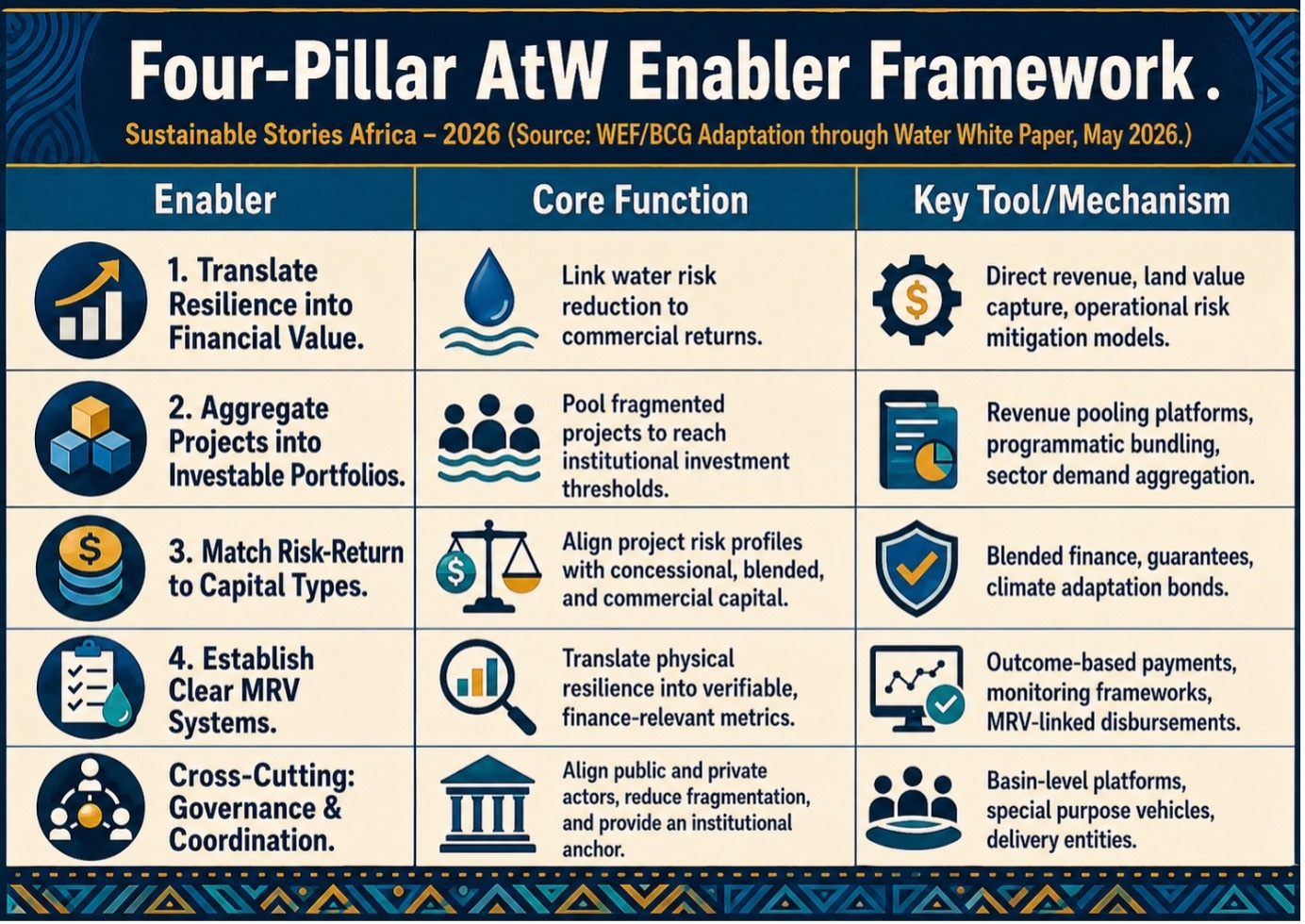
Unpacking Each Enabler with Real-World Evidence
Enabler 1 – Translate Resilience into Financial Value:
- The WEF identifies three private participation models: direct revenue models (where water services or carbon credits generate cash flows), land value capture models (where flood protection unlocks real estate value), and operational risk mitigation models (where corporates co-invest to secure supply chains or operations).
- In Mauritania's Nouakchott Coastal Resilience project, a €60 million ($70 million) blended investment was structured using a semi-public special purpose vehicle, with land sales and lease revenues supporting cost recovery, turning coastal dune protection into a financeable asset.
Enabler 2 – Aggregate Projects into Investable Portfolios:
- Fragmentation is one of the biggest barriers to private capital: individual water projects are often too small for institutional investors.
- The report identifies three aggregation approaches: pooling revenue streams into shared platforms; programmatic bundling under standardised frameworks; and sector demand aggregation, where multiple corporate users pool demand for shared infrastructure.
- Viet Nam's PFES programme exemplifies programmatic aggregation, standardising payments from downstream water users (hydropower, water supply, tourism) into a national mechanism that has collected $554 million for watershed protection.
Enabler 3 – Match Risk-Return to Capital Types:
- Many AtW projects fail to attract private capital not because they lack value, but because risk is distributed incorrectly.
- The WEF identifies three blended finance approaches: de-risking early-stage exposure through concessional debt; reallocating downside risk through guarantees and first-loss capital; and supporting project preparation through grants linked to a clear revenue pathway.
- Malaysia's PBAPP water utility issued a MYR 300 million Sustainability Sukuk to finance drought-resilient water infrastructure, demonstrating how local capital markets can be mobilised for water resilience when the right structures exist.
Enabler 4 – Establish Clear MRV:
- Without verifiable impact data, adaptation finance cannot scale. Only approximately 37% of countries with nationally determined contributions include quantified, time-bound adaptation targets.
- The WEF's MRV framework maps five interconnected aspects: intervention scope, water-system effect, resilience outcome, finance-relevant performance, and MRV architecture.
- The Aire Resilience Company in the UK uses catchment-scale monitoring to give private buyers confidence that natural flood management measures are delivering measurable outcomes; payments of £450,000 per year from a corporate consortium now fund $600 million in flood risk reduction in Leeds.
What Success Looks Like in Numbers
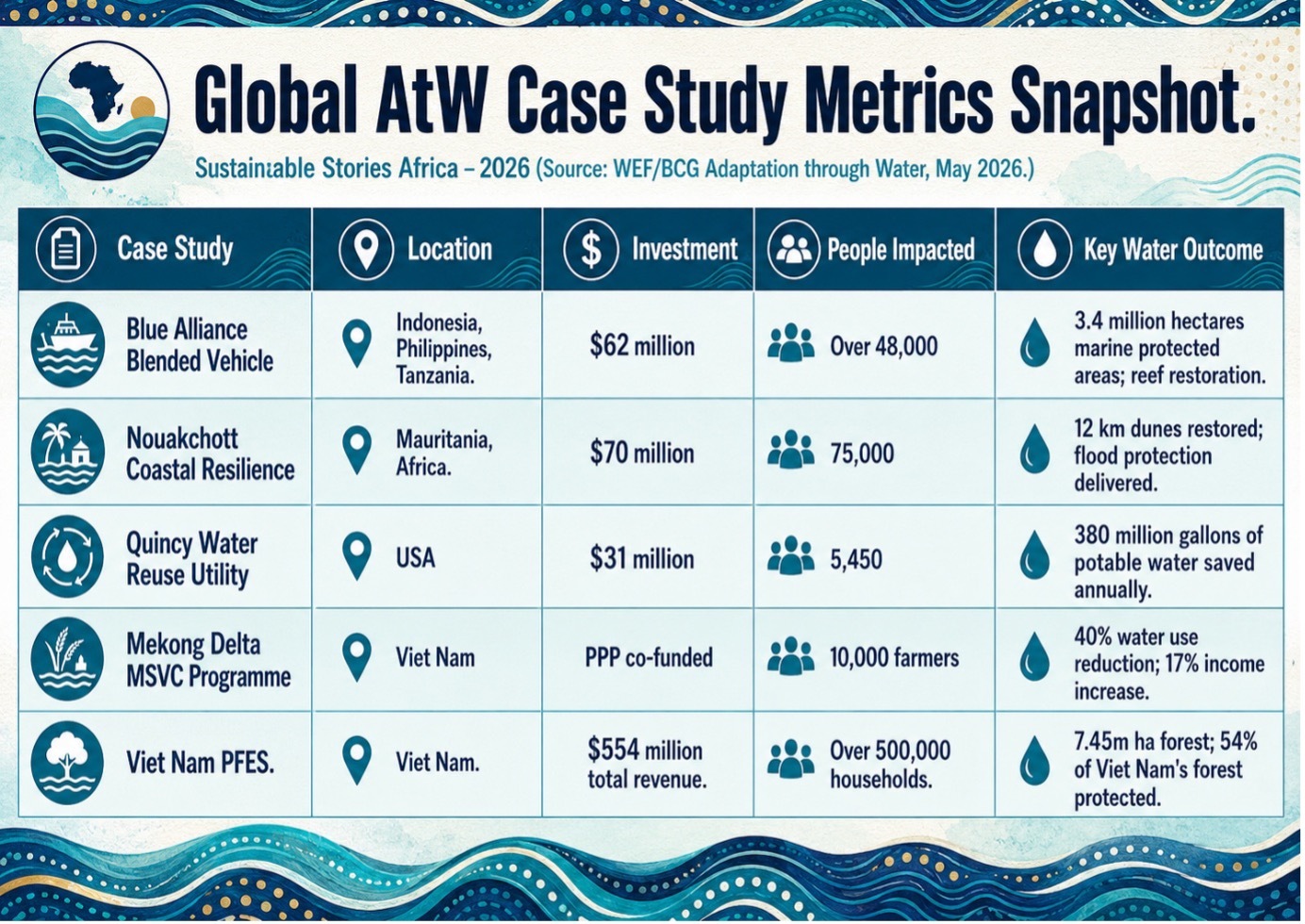 | 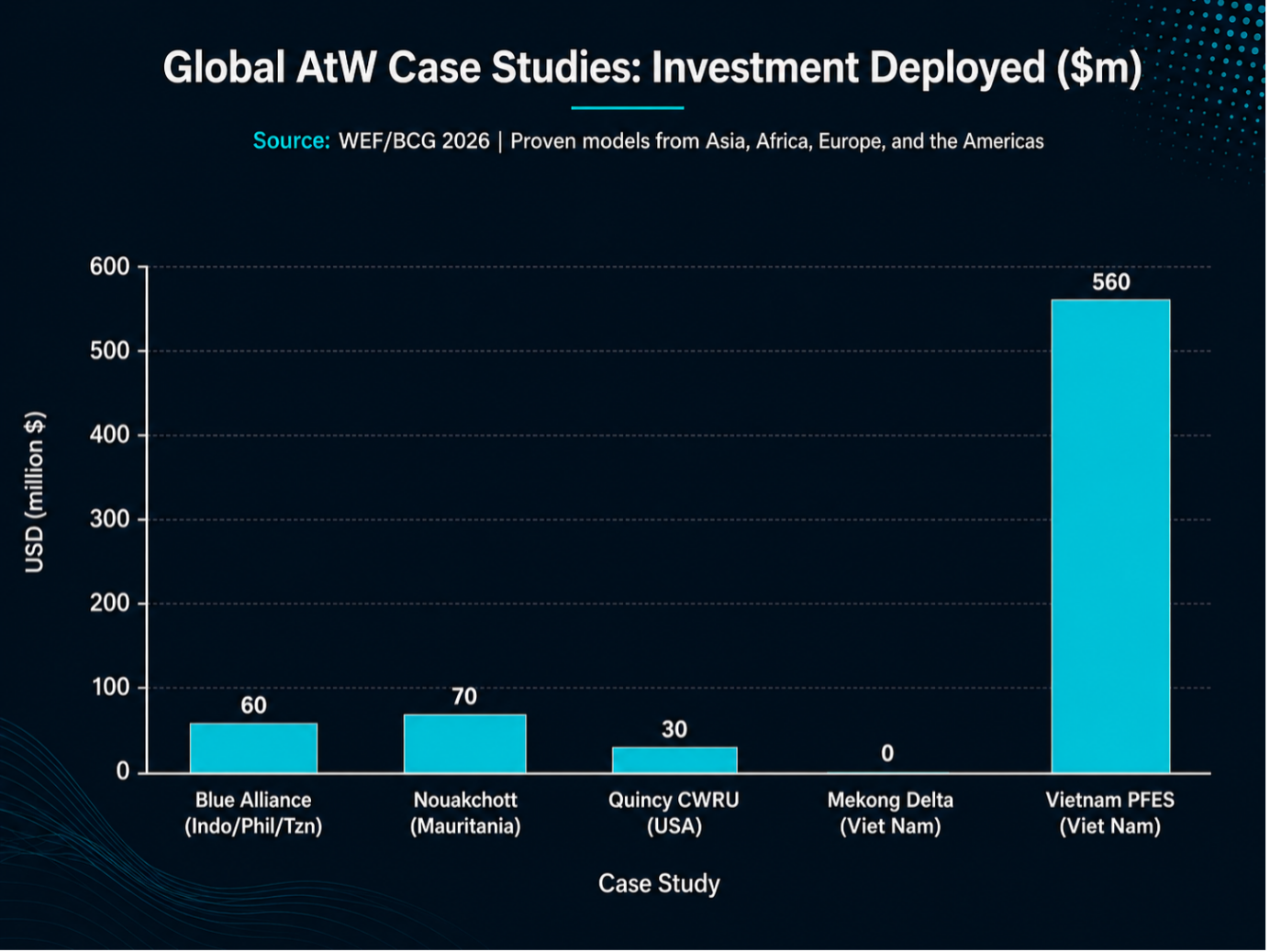 |
These numbers illustrate that the economics of water adaptation are positive when structured correctly.
The Quincy Water Reuse Utility, where Microsoft invested $31 million through a multi-revenue bond structure, now saves 380 million gallons of potable water per year, equivalent to the supply for 5,450 people, while reducing aquifer stress to 5% groundwater sourcing from 100%.
The Metrics That Must Move
For policymakers in Africa and emerging markets;
- The WEF framework translates into specific, measurable actions: establish basin-level water risk accounting linked to GDP exposure; mandate quantified, time-bound adaptation targets in NDCs; create regulatory frameworks for water cost-recovery that incentivise private co-investment; and build MRV infrastructure with independent verification capacity.
For financial institutions;
- The call is to develop standardised climate adaptation bond structures, create first-loss mechanisms for early-stage water projects, and partner with development finance institutions to deploy concessional capital that de-risks watershed restoration and digital infrastructure water reuse.
Path Forward – Metrics Drive Money, and Money Drives Resilience
The WEF's four-enabler framework is not a theoretical construct; it is a practical playbook grounded in 20 case studies, regional stakeholder engagement, and real investment outcomes.
The metrics are clear, the models are proven, and the financing tools exist.
Africa and Southeast Asia share the same fundamental challenge: water risk is accelerating more quickly than adaptation finance is scaling.
The path forward requires institutions and governments to adopt this four-pillar framework, invest in MRV capacity, and engage private capital on its own terms, with bankable structures, verified impact, and credible returns.