Less than 1% of the ocean economy's annual value has been invested in sustainable ocean projects over the past decade.
Blue bond issuances have grown from a $15 million Seychelles pilot in 2018 to $10.4 billion by early 2025, yet remain a fraction of what is needed.
The WEF's June 2026 Regenerative Blue Economy report confirms the inflexion point: for Africa's businesses, investors, and governments, these metrics are simultaneously a risk register and an opportunity map.
Counting the Value and the Cost of the Ocean Economy
The regenerative blue economy is not a philosophical aspiration. It is a data-backed, financially structured argument about how ocean industries can preserve and expand the $2.6 – $5.1 trillion in annual gross value added they generate, by investing in, rather than depleting, the ecosystems that make this value possible.
The WEF's June 2026 Insight Report, produced by its Global Future Council on the Regenerative Blue Economy, synthesises sector-level economic data, financial market trends, and ecological risk indicators to develop a compelling quantified case for systemic change.
The Core Metric That Changes Everything
The single most important number in the WEF report is deceptively simple: less than 1% of the ocean economy's estimated annual gross value added has been invested in sustainable ocean projects over the past decade.
In an economy valued at between $2.6 and $5.1 trillion annually, this means the world is systematically under-investing in the maintenance and restoration of the ecological systems that generate that value.
Meanwhile, harmful fisheries subsidies alone are accelerating to approximately $22 billion per year, capital currently redirected away from restoration and towards extraction.
The implication is stark: the financial system is not neutral in the face of ocean degradation. It is actively subsidising it.
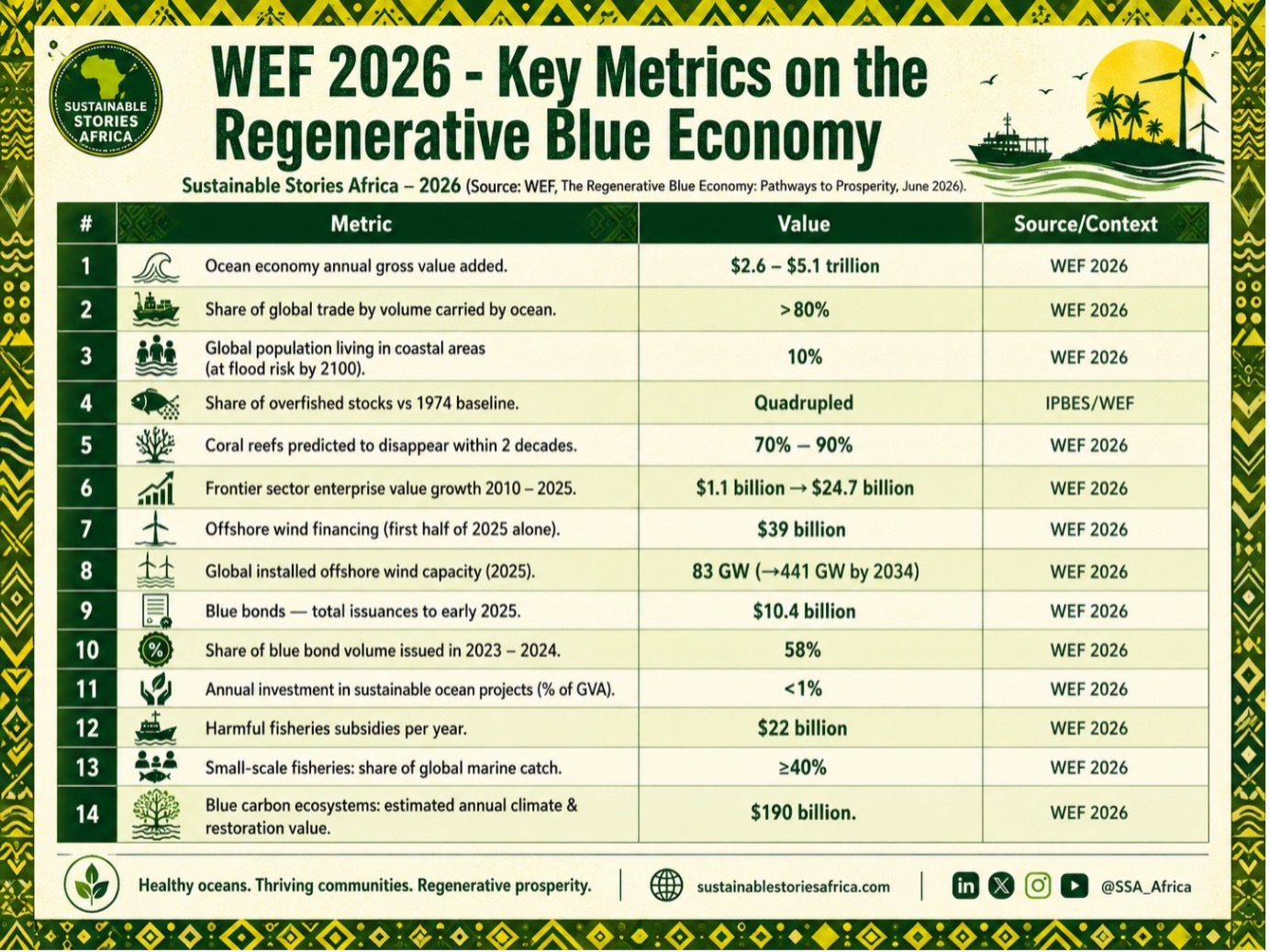
Unpacking the Key Numbers for African Markets
Metric 6 – Frontier sector enterprise value up from $1.1 billion to $24.7 billion:
- The most consequential development in the ocean economy is the emergence of sectors organised around restoration, knowledge-building, and biological innovation rather than extraction.
- Africa's mangrove restoration potential, blue biotechnology capacity, and ocean data gaps represent direct entry points for this frontier investment, particularly given the continent's over 30,000 km of coastline and extensive large marine ecosystems.
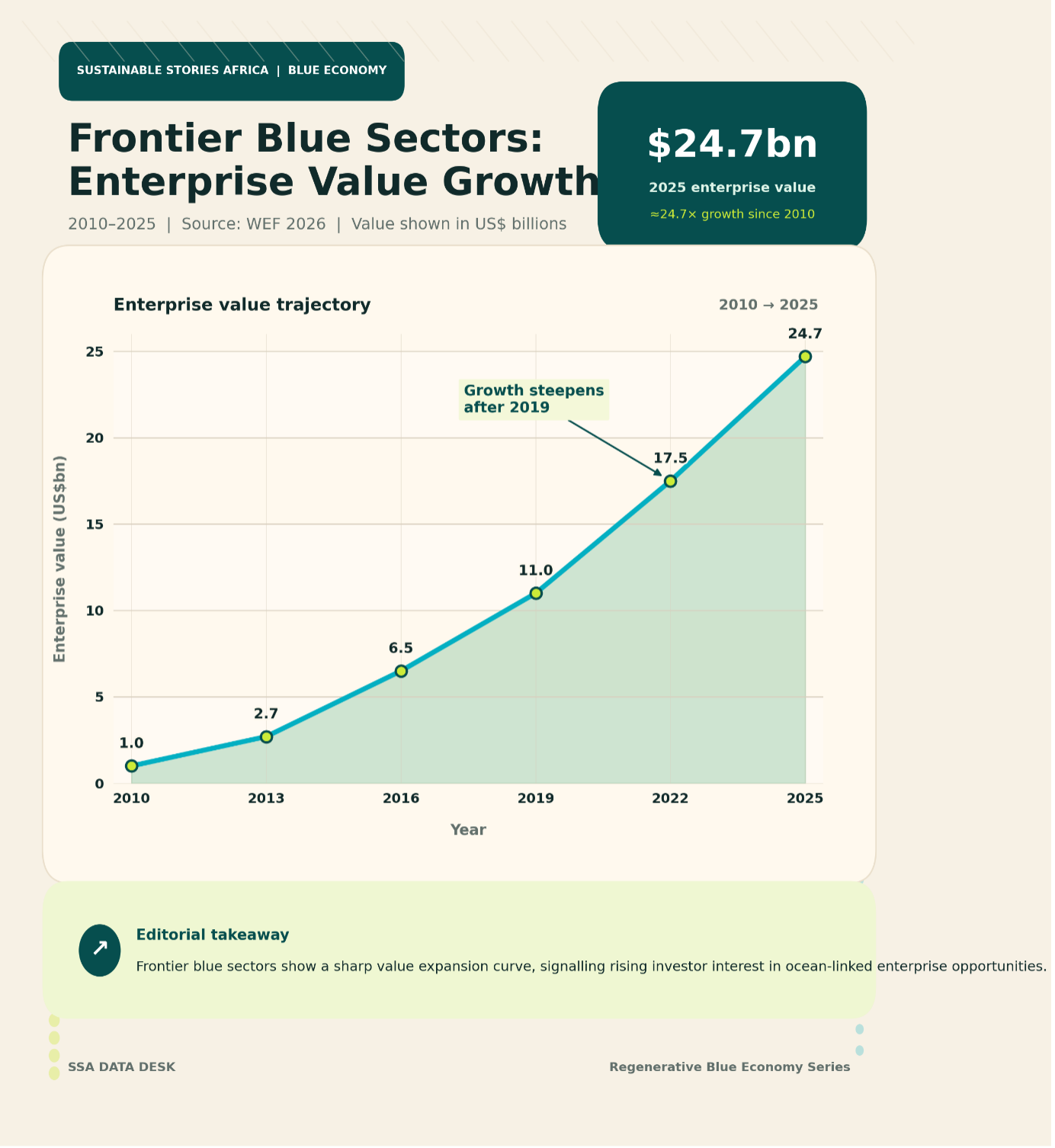
The frontier blue economy's 22-fold growth in enterprise value between 2010 and 2025 signals that regeneration-oriented sectors are moving from fringe to mainstream investment territory, a trajectory Africa's governments and investors must position themselves to capture.
Metric 9 – $10.4 billion in blue bonds:
- Blue bonds have expanded enormously since the Seychelles pioneered a $15 million issuance in 2018. By early 2025, cumulative issuances had reached $10.4 billion, with 58% of that volume issued in 2023 – 2024 alone.
- Corporate issuers, including Ørsted and DP World, have entered the market. For African sovereigns, where coastal and marine ecosystems are integral to national economies, blue bonds represent an immediately accessible financing instrument.
The Seychelles' example is particularly instructive: a small island state with significant debt constraints successfully structured a pioneering blue bond. African island states, coastal nations, and DFI-backed programmes should study and replicate this model.
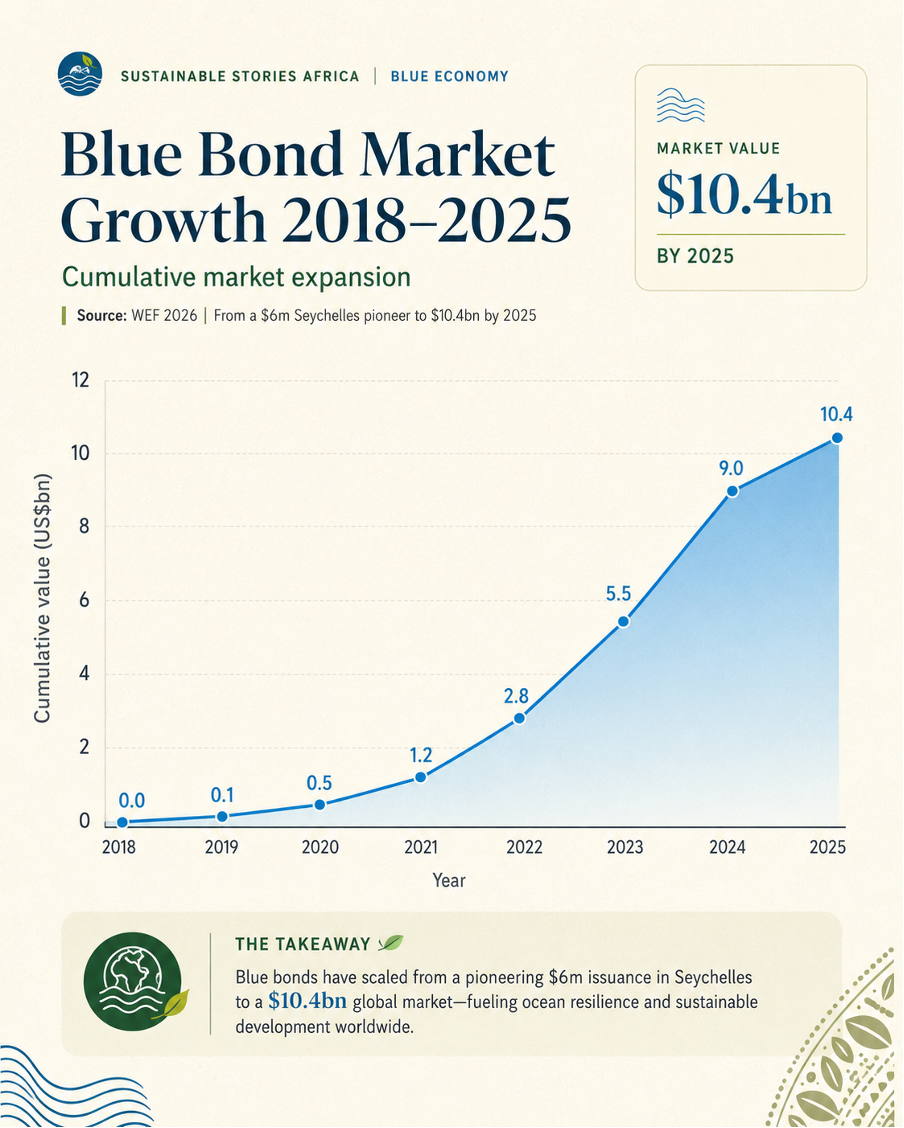
The blue bond market's acceleration, with 58% of all issuances concentrated in just two years (2023 – 2024), signals a structural shift in investor appetite for ocean-positive assets that African sovereigns and corporates can now access.
Metric 12 – $22 billion in harmful fisheries subsidies annually:
- The WEF identifies the redirection of harmful fisheries subsidies as one of the most powerful fiscal levers available to governments.
- African coastal nations that currently provide fuel subsidies, tax exemptions, or vessel support for industrial fishing fleets could redirect a portion of that fiscal support towards community fishing management, stock rebuilding, and ecosystem restoration, generating substantially higher long-term returns in food security, livelihoods, and ecological value.
Metric 13 – Small-scale fisheries support 500 million people and ≥40% of global marine catch:
- However, subsidies and formal finance continue to favour industrial actors. In Africa, where artisanal and small-scale fisheries are the dominant model across West, East, and Southern African coastlines, this structural exclusion from formal finance is both an equity failure and an economic inefficiency.
- The WEF's call for dedicated IPLC and subnational financing windows is directly applicable to African fishing communities.
Metric 14 – Blue carbon ecosystems valued at $190 billion annually in climate and restoration value:
- Mangroves, seagrass beds, and tidal marshes are among the most carbon-dense ecosystems on Earth, yet their blue carbon value remains largely unmonetised across Africa.
- With credible MRV systems and community-governed carbon credit frameworks, this $190 billion annual value stream becomes accessible to African coastal nations as a climate finance mechanism, linking ocean regeneration to NDC delivery.
The Business Case Is Quantified
The WEF's sectoral data makes the investment case concrete. Offshore wind alone attracted $39 billion in financing in just the first half of 2025, signalling that clean ocean energy is already commercially mainstream.
Aquaculture's first-sale value of $296 billion exceeds wild capture fisheries by volume, with high regenerative potential in seaweed, bivalve, and integrated systems.
Coastal and marine tourism contributes $1.5 trillion to global GDP annually, growing at 6% per year before 2020, a sector directly dependent on the health of marine ecosystems, making tourism operators natural partners for restoration investment.
The Hollandse Kust Zuid offshore wind farm in the Netherlands, 1.5 GW of capacity owned by Vattenfall, BASF, and Allianz, developed without government subsidies, demonstrates that regenerative design at a gigawatt scale is commercially viable when enabling policy and partnerships are in place.
Africa's offshore wind potential, particularly along the Southern and East African coastlines, is substantial and largely undeveloped.
Five Metrics That Must Drive African Investment Decisions
For Africa's governments, financial institutions, and private sector actors, the WEF's data translates into five immediate measurement and investment priorities:
- Establish blue economy gross value-added accounting at the national level, disaggregating ocean sectors by contribution to GDP, employment, and ecosystem health.
- Issue sovereign blue bonds with mangrove restoration and MPA management as primary use-of-proceeds categories, modelled on the Seychelles and DP World precedents.
- Redirect harmful fisheries subsidies towards community-managed fisheries, stock rebuilding, and coastal ecosystem restoration programmes.
- Set quantified blue carbon targets in NDC revisions, with MRV infrastructure to verify mangrove and seagrass sequestration and unlock international climate finance.
- Target frontier sector investment, particularly ocean data infrastructure, blue biotechnology, and ecosystem restoration enterprises, as priority areas for public-private co-investment, recognising their 22-fold enterprise value growth trajectory.
Path Forward: The Numbers Are Compelling; the Action Must Follow
The WEF's data portrait of the regenerative blue economy is clear: the ocean generates trillions in value, is being systematically degraded by the industries that depend on it and has a growing toolkit of financial instruments and sectoral models that can reverse this trend.
For Africa, with its extensive coastlines, large marine ecosystems, and undervalued blue natural capital, the metrics are both a warning and an invitation to lead.