Star Oil briefly overtook GOIL in 2025 before GOIL reclaimed Ghana’s petroleum market leadership in early 2026.
The shift tells a larger African business story: local brands can beat global giants when they combine trust, reach, pricing discipline and deep market understanding.
Local Brands Rewrite Ghana’s Fuel Story
In Ghana’s downstream petroleum market, the biggest story is not simply that Star Oil overtook GOIL in 2025. It is that two Ghanaian brands now sit ahead of Shell, one of the most recognised global energy brands.
This article draws on the insights-data document, “Star Oil overtook GOIL in 2025,” authored by Karen Punch, Brand Infrastructure Strategist and creator of the Magnetic Brand Audit. The document was originally presented in a LinkedIn-style article format and published on June 28, 2026.
The central lesson is bigger than fuel. In African markets, proximity still matters.
A company that understands local behaviour, pricing pressures, community location and trust signals can outperform a better-known multinational brand, even in a sector where global scale once looked unbeatable.
Shell’s Third Place Changed The Conversation
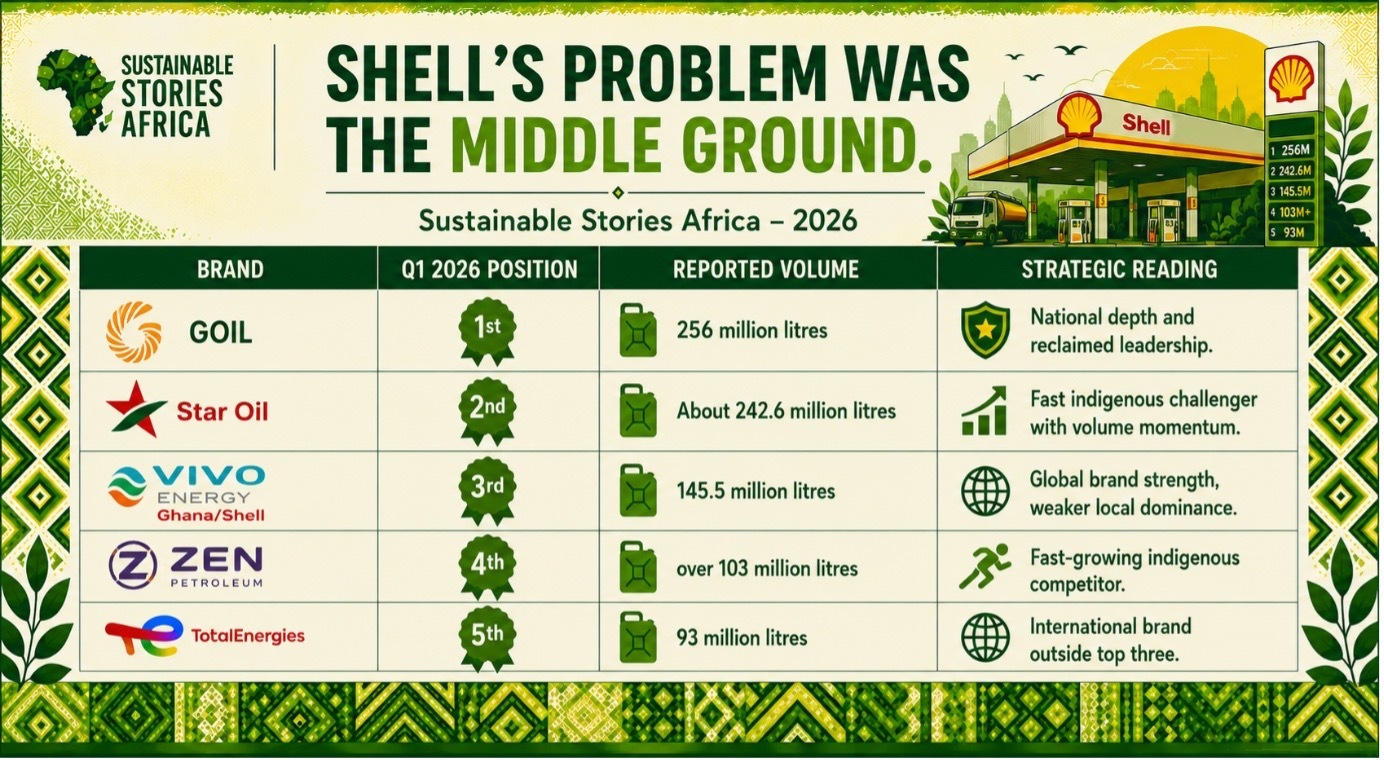
In the first quarter of 2026, Shell, through its local licensee Vivo Energy Ghana, finished third in Ghana’s petroleum market.
For a brand that has been operating in Ghana since 1928, that position is commercially significant.
- GOIL reclaimed the top spot with 256 million litres in Q1 2026.
- Star Oil followed with about 242.6 million litres.
- Vivo Energy Ghana, operating the Shell brand, moved 145.5 million litres.
- Zen Petroleum placed fourth with more than 103 million litres, while
- TotalEnergies placed fifth with 93 million litres.
The shock is not that Ghana’s petroleum market is competitive. It is that the two leading brands are Ghanaian. Together, GOIL and Star Oil moved close to half a billion litres in one quarter, proving that indigenous brands can build scale in sectors long associated with international majors.
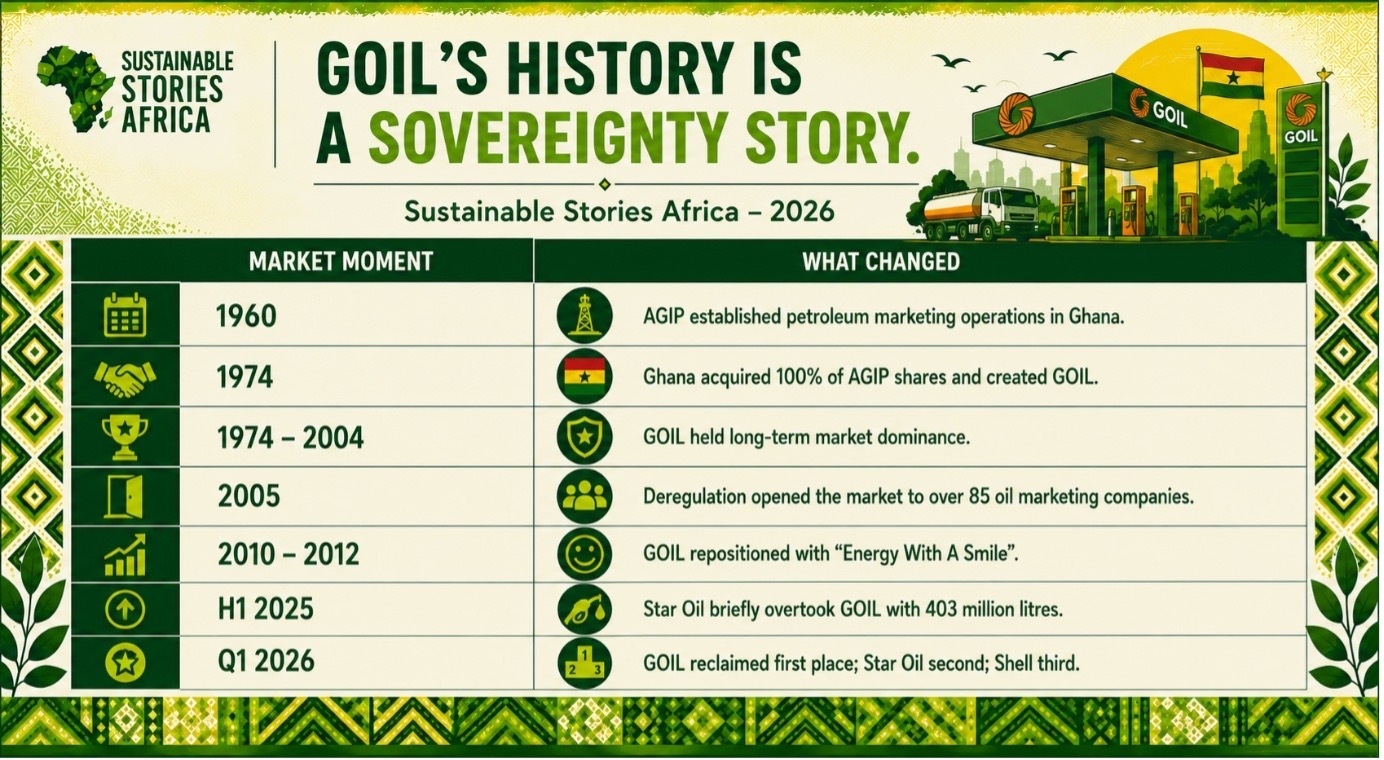
GOIL’s History Is A Sovereignty Story
GOIL’s story began before it became a market leader.
- In 1960, AGIP, an Italian oil company, established a petroleum marketing operation in Ghana.
- Fourteen years later, in 1974, the Government of Ghana acquired 100% of the shares and renamed the company Ghana Oil Company Limited.
That acquisition was more than a transaction. It was an infrastructure statement. Ghana decided that the fuel network powering daily life should carry a national identity.
For three decades after that decision, GOIL remained the dominant brand. Shell, TotalEnergies and other international players were present, but GOIL held its place.
Then came 2005, when Ghana deregulated the downstream petroleum sector, and more than 85 oil marketing companies entered the market.
Star Oil Became The Challenger Nobody Ignored
Star Oil’s rise is the sharper competitive twist. In the first half of 2025, the company recorded a 41% increase in product volumes, reaching 403 million litres and briefly overtaking GOIL as Ghana’s top petroleum brand by total volume.
That performance matters because Star Oil was not defending a 50-year legacy. It was a challenging one. Its growth showed that a fast-moving local operator could compete not only against international brands but also against Ghana’s most established indigenous petroleum company.
Star Oil’s advantage appears to have come from volume, pricing agility and sharper responsiveness in segments where premium international cost structures were harder to defend.
It did not need to defeat Shell globally. It needed to understand Ghana more precisely than Shell did.
That is the insight for African founders, boards and investors: a challenger brand does not have to be bigger everywhere. It must be more relevant somewhere.
Shell’s Problem Was The Middle Ground
Shell’s Ghana story is not a failure of brand recognition. Shell remains globally powerful, and Vivo Energy Ghana operates 244 service stations across the country. The problem is positioning.
GOIL had the depth of national history, community presence and broad-market familiarity. Star Oil had the speed of a challenger, moving aggressively where price and volume mattered. Shell sat between them: premium, established, international, but less locally embedded than GOIL and less agile than Star Oil.
In markets like Ghana, the middle ground can be expensive. Customers may respect global brands, but they often buy from companies that feel accessible, affordable and present in the communities where daily decisions are made.
Local Trust Is Now Market Infrastructure
The Ghana fuel story carries a greater ESG and development meaning.
Downstream petroleum remains carbon-intensive; however, it is also essential infrastructure in many African economies that are still dependent on liquid fuels for transport, logistics, small-business operations and household mobility.
Who controls that infrastructure matters. Local ownership can strengthen domestic value retention, deepen community presence, create national employment, improve contributions to tax visibility and support indigenous enterprise capacity.
However, local leadership also comes with responsibility. Ghanaian brands that outperform international majors must match scale with governance, safety, environmental controls, product quality, worker protection and transparent reporting.
Market share should not become the end of the story. It should become the foundation for better corporate citizenship.
Founders Should Study The Positioning Lesson
The commercial lesson is clear: African brands should not always compete by imitating international brands. GOIL survived deregulation partly by becoming more distinctly itself.
It rebranded, strengthened quality signals through ISO certification, expanded into communities and built a broad-market proposition around service and familiarity.
Star Oil proved a different point. Newer indigenous brands can win by identifying market segments where incumbents are slow, expensive or over-positioned.
That applies beyond petroleum: banking, consulting, logistics, healthcare, food, education, media and technology all face the same pattern.
A local company loses when it speaks in imported frameworks but ignores the pain points it understands best.
It wins when it builds trust infrastructure around lived market knowledge.
Boards Must Convert Shares Into Trust
The next challenge for GOIL, Star Oil and other indigenous brands is to convert market momentum into long-term institutional credibility. Volume leadership is powerful, but it must be supported by disciplined governance.
- Boards should prioritise operational safety, environmental compliance, customer protection, digital transparency, supply chain resilience and climate transition planning.
- Petroleum marketers also need credible strategies for cleaner fuels, energy diversification, emissions management and community engagement.
- Regulators, meanwhile, should ensure that competition remains fair, product quality is protected, and market concentration does not weaken consumer welfare.
The rise of local champions should support national development, rather than create new forms of market opacity.
Path Forward – For African Brand Leadership
Ghana’s petroleum market shows that local brands can win when they understand customers better than global competitors.
The next step is responsible scale. Indigenous champions must pair market share with governance, sustainability, safety and public trust.
That is how local success becomes lasting economic infrastructure.