Up to 3.4 billion people worldwide lack secure, safe and adequate housing, according to UN-Habitat’s World Cities Report 2026.
For Africa’s fast-growing cities, the crisis is no longer only about shelter. It is about jobs, climate resilience, land, finance, public health, and whether urban growth becomes an opportunity or a period of instability.
Housing Is Now Development Infrastructure
The global housing crisis has become one of the defining development tests of the decade, with UN-Habitat warning that decades of underinvestment, rapid urbanisation, displacement, rising costs and climate risks have pushed billions of people into inadequate housing.
In its World Cities Report 2026: The Global Housing Crisis — Pathways to Action, UN-Habitat estimates that up to 3.4 billion people live without secure, safe and adequate housing, including more than 1 billion people in informal settlements and slums.
For African cities, the report lands at a decisive moment. Urban growth is accelerating, housing deficits are widening, rents are rising, and climate shocks are exposing homes built without secure tenure, drainage, cooling, sanitation or formal protection.
Billions Face Inadequate Housing Worldwide Today
The headline number is stark: up to 3.4 billion people worldwide lack adequate housing.
However, the deeper story is that housing has become the meeting point of several crises, including affordability, displacement, informality, sustainability and liveability.
UN-Habitat says these five issues now define the global housing crisis and require integrated, multisectoral action across government, finance, planning, climate and social policy.
The global housing deficit increased from 251 million units in 2010 to 288 million in 2023, despite years of global commitments under the Millennium Development Goals and Sustainable Development Goals.
In 2024, an estimated 133 million people were displaced globally by conflict, persecution, violence, human rights violations and natural disasters. New UN-Habitat research also indicates that about 64 million people were evicted between 2003 and 2023.
This is not simply a housing-sector failure. It is a development failure. A home determines whether a worker can reach a job, whether a child has space to study, whether a family can access sanitation, whether a woman can feel secure, and whether a city can withstand floods, heatwaves and economic shocks.
Affordability And Informality Are Deepening Pressure
Housing affordability has emerged as one of the most visible indicators of global urban stress. UN-Habitat reports that 44% of households worldwide spend more than 30% of their income on rent, with the burden rising to 55% in Sub-Saharan Africa, where low and irregular incomes, limited formal rental supply and rapid urbanisation intensify affordability pressures.
Homeownership is simultaneously moving further out of reach, with global average price-to-income ratios rising from 9.5 in 2010 to 11.7 in 2023 as housing prices consistently outpace income growth.
Informal settlements tell an equally urgent story. The number of urban residents living in informal conditions rose from 895 million in 2000 to approximately 1.13 billion in 2024, driven by demographic growth, displacement, inequality and insufficient affordable housing supply, even as the proportional share has declined.
For African cities, this trajectory demands a fundamental policy reorientation. Informality is not a temporary condition; it is already deeply embedded in the urban fabric.
The critical question is whether governments will continue to demolish informal settlements or commit to upgrading them through secure tenure, infrastructure investment, climate protection and community-led planning frameworks.
Housing Shapes Climate, Health, and Jobs
The report’s strongest development message is that adequate housing is not merely shelter. It is a platform for health, education, social inclusion, economic productivity, legal recognition and climate resilience.
UN-Habitat describes housing as “the roof of the Sustainable Development Goals,” because progress on housing affects multiple global targets at once.
The climate implications are substantial. Buildings account for about 37% of global greenhouse gas emissions, while housing is responsible for an estimated 17% to 21%. That makes retrofitting existing homes, improving energy efficiency and using low-carbon construction materials central to climate action.
Housing is also where climate risk becomes personal. Flood-prone homes, poorly ventilated rooms, heat-trapping roofs, unsafe slopes and settlements without drainage turn climate hazards into household disasters.
UN-Habitat projects that climate-related hazards could destroy 167 million homes by 2040, with informal settlements and low-income communities facing disproportionate exposure and limited adaptive capacity.
However, the opportunity is equally large. Well-located, safe and affordable housing can improve productivity, reduce poverty, support public health and strengthen urban resilience.
The construction sector accounts for about 13% of global GDP and employs more than 280 million people, making housing both a social good and a major economic asset.
Good Housing Can Unlock Shared Prosperity
For Africa, a better housing policy can become an economic strategy.
- A home close to transport, schools, clinics and jobs reduces household costs and improves productivity.
- A serviced settlement with drainage, sanitation and electricity reduces health risks and climate exposure.
- A secure tenure system gives families confidence to improve their homes and communities.
The report argues that the social function of housing must be strengthened while its economic value is harnessed.
In practical terms, that means housing should not be reduced to a speculative financial asset.
However, it also means that responsible private capital should not be excluded. The real task is to balance public purpose, market efficiency and community rights.
This balance is urgent because conventional housing finance does not reach most people who need support.
UN-Habitat identifies four broad groups in the housing finance ecosystem: mortgage-eligible households, potentially mortgage-eligible households, alternative finance-eligible households and financially deprived households.
Conventional finance mainly serves the first group, leaving the others partially reached or excluded.
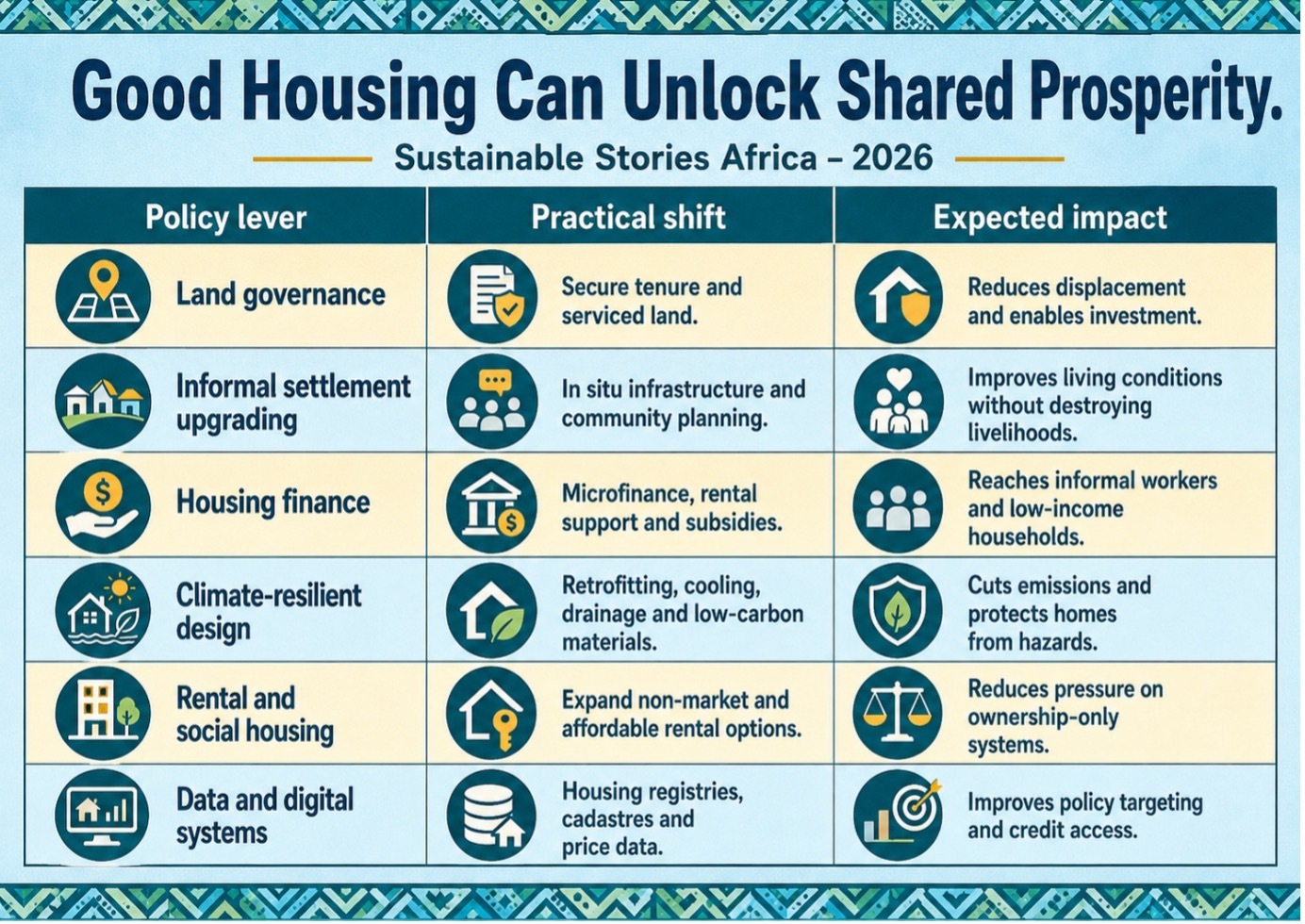
This is where African markets can lead with practical innovation. Mortgage systems alone will not solve housing deficits in cities where many workers earn irregular incomes.
Housing microfinance, savings groups, cooperatives, rental assistance, incremental building support and blended public-private-community models may be more realistic for millions of households.
Governments Must Rebuild Housing Systems Now
Restoring housing as a genuine public priority is the foundation of effective urban policy.
UN-Habitat's review of 50 years of housing policy finds that market-led, ownership-centred approaches have consistently failed vulnerable groups.
Countries that maintain stronger public stewardship over land, finance and regulation achieved more inclusive and stable outcomes.
Housing policy must therefore be aligned with urban planning, employment, infrastructure, transport, climate adaptation and social protection; projects built far from jobs and services deepen poverty regardless of the number of units.
Local governments need stronger mandates and financing, as housing policies are typically written nationally but delivered locally, where municipalities frequently lack the money, authority or institutional capacity to act effectively. Informality must also be reframed.
UN-Habitat calls for recognising informal and community-led housing as legitimate, scalable pathways, prioritising upgrading over erasure.
Finance systems must expand beyond conventional mortgages through targeted subsidies for financially deprived households, alternative income verification for informal workers and stronger rental and social housing instruments.
Finally, housing policy must become climate policy. Building codes, retrofitting incentives, low-carbon materials, flood protection and heat-resilient design are core housing tools, not optional environmental additions, a distinction that African governments must urgently internalise.
Path Forward – Make Housing A Development Platform
Housing must move from the margins of development planning to the centre of urban policy, climate action and economic inclusion.
For African cities, the priority is clear: finance affordable homes, upgrade informal settlements, protect tenants, secure land rights and build climate-resilient neighbourhoods.
Well done, housing can become infrastructure for dignity, productivity and shared prosperity.