The IMF is reviewing how it designs lending programmes and applies conditions to countries in crisis.
A new evidence review says the Fund must confront three difficult questions: whether its programmes restore stability, whether they harm vulnerable citizens, and whether all countries are treated fairly.
For African and emerging markets, the answer matters beyond debt negotiations. It could shape fiscal space, social spending, export growth, climate resilience and trust in global financial governance.
IMF Reform Moment Meets Development Reality
The International Monetary Fund’s 2026 Review of Program Design and Conditionality is arriving at a critical moment for countries facing debt pressure, currency weakness, climate shocks and tightening development finance.
A policy brief from Boston University’s Global Development Policy Centre argues that IMF programmes have improved in some areas, particularly on growth outcomes; however, they still fall short of fully resolving the balance-of-payments problems that often push countries into Fund-supported programmes.
For African economies, the debate is not theoretical. IMF programme conditions can shape public budgets, subsidy reforms, tax policy, social spending, exchange-rate choices, and governments' ability to invest in jobs, resilience, and structural transformation.
Fragile Economies Need Smarter Stabilisation
The IMF’s core mission is to help countries deal with balance-of-payments crises without undermining national or international prosperity.
However, the evidence reviewed by Tim Hirschel-Burns and Marina Zucker-Marques suggests that programme design still carries major weaknesses.
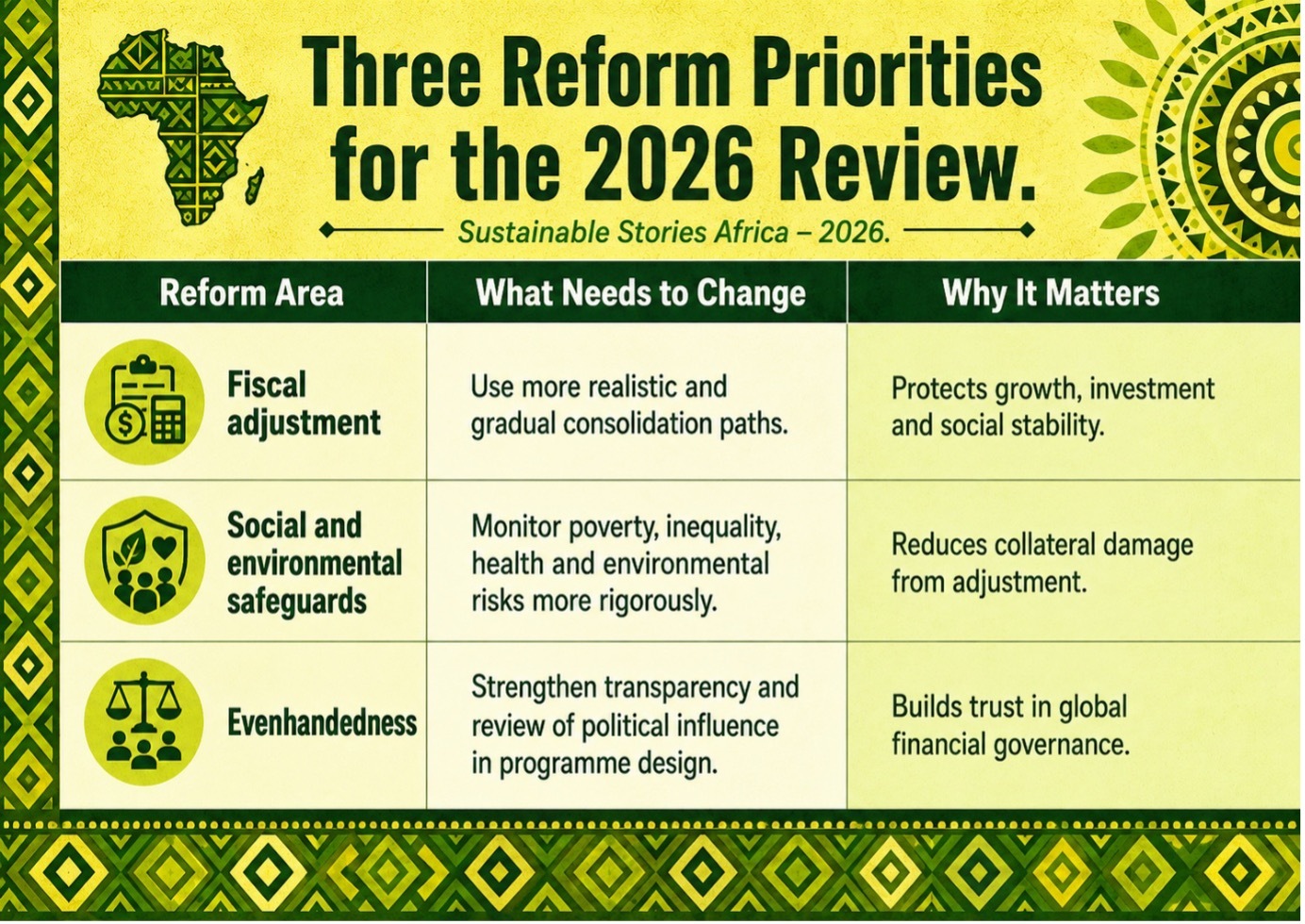
Their brief, based on 21% peer-reviewed academic studies and IMF research, identifies three recurring flaws:
- Programmes often do not sufficiently fix external imbalances.
- They can generate social and environmental harm.
- They appear vulnerable to unequal treatment shaped by geopolitical considerations.
That is why the 2026 review matters. It is not simply an internal institutional exercise.
It is a test of whether the global financial safety net can respond to today’s development pressures without forcing fragile economies to choose between macroeconomic stabilisation and human wellbeing.
For many low- and middle-income countries, especially those with limited access to affordable financing, the IMF can become the lender of last resort.
However, when financial support is tied to rapid fiscal contraction, countries may find themselves stabilising balance sheets while weakening the foundations of future growth.
Evidence Shows Growth Gains Remain Uneven
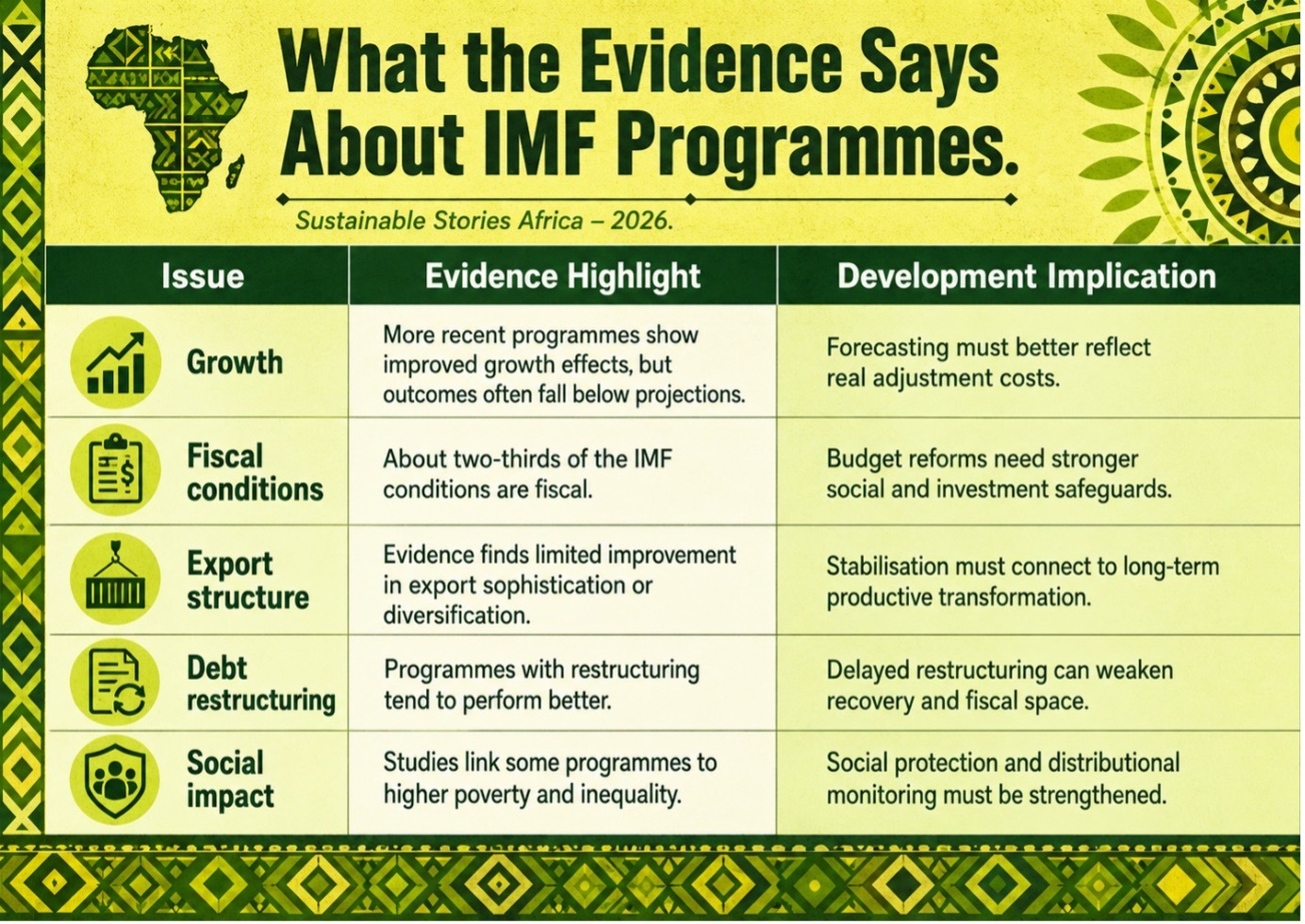
Recent evidence suggests the IMF programmes are not inherently damaging, particularly concessional lending arrangements in countries with stronger institutions. Growth outcomes have improved compared to earlier decades.
However, a critical gap persists: half of all IMF programmes between 2008 and 2019 missed their own growth projections by more than 0.5 percentage points of GDP, largely because the drag of fiscal adjustment on economic activity was underestimated.
For African economies, this gap is not merely statistical.
When governments cut spending to meet programme targets, the shortfall surfaces in hospitals, classrooms, infrastructure and local business activity.
With roughly two-thirds of IMF conditions being fiscal, sequencing matters enormously.
The deeper lesson is structural: stabilisation cannot be judged by short-term budget corrections alone.
Without competitive, diversified exports, external vulnerabilities return, dressed differently, but no less damaging.
Austerity Can Carry Hidden Social Costs
Beyond missed growth projections, the evidence points to deeper collateral damage. Studies reviewed in the brief associate IMF programmes, particularly those with heavy fiscal contraction and multiple structural reforms, with rising poverty, greater inequality, reduced health spending and higher neonatal mortality.
For African households already navigating elevated food, transport, energy and healthcare costs, this is not abstract.
When revenue mobilisation tends heavily on consumption taxes rather than progressive income or corporate taxation, the burden falls disproportionately on those least able to absorb it, eroding public trust alongside purchasing power.
The environmental dimension adds another layer of concern. Evidence links IMF programmes to increased deforestation; however, few programme conditions address forest management.
Governments under fiscal pressure may cut environmental enforcement or accelerate extraction to generate short-term revenue, quietly undermining the climate resilience and natural capital commitments they are simultaneously being asked to honour.
Fairness Questions Challenge IMF Legitimacy
The third flaw identified in the brief is evenhandedness. IMF rules and principles require countries to be treated uniformly, with programme decisions guided by economic conditions rather than political considerations.
However, the literature reviewed suggests that geopolitics can influence access, timing and programme stringency.
Countries aligned with major Western shareholders, or those holding temporary seats on the United Nations Security Council, have been found in some studies to receive more favourable treatment, faster programme approval or fewer conditions.
The brief also highlights research suggesting that countries more aligned with China in United Nations voting patterns may face stricter austerity conditions.
Separately, the IMF’s handling of European borrowers during the eurozone crisis has previously raised concerns about transparency and preferential treatment.
For African countries, evenhandedness is not an abstract governance principle. It affects confidence in the multilateral system.
If countries believe that IMF treatment depends partly on geopolitical alignment, the Fund’s credibility as a neutral crisis-response institution is weakened.
That matters because legitimacy influences cooperation. Governments are more likely to implement difficult reforms when citizens, markets and political actors believe the process is fair, evidence-led and nationally owned.
Better Programmes Can Unlock Resilience
The argument is not against the IMF; it is for a more effective one. Many countries genuinely need emergency liquidity and policy credibility when private capital dries up.
The real question is whether programmes can do more than buy time.
A better-designed programme would pair short-term stabilisation with investment in long-term resilience, such as export diversification, domestic revenue capacity, social protection, climate adaptation and productive infrastructure.
For African economies exposed to commodity volatility, food import dependence and climate shocks, this distinction is urgent.
Narrowly reducing demand may ease pressure temporarily without addressing the structural vulnerabilities that triggered the crisis.
The brief's recommendations are practical: prioritise revenue mobilisation over expenditure cuts, favour progressive taxation, establish social spending floors, strengthen distributional monitoring and embed environmental safeguards.
The opportunity is to align fiscal adjustment with transformation, working alongside national authorities, development banks and sector institutions to ensure stabilisation does not crowd out the investments Africa needs most.
Governments, Financiers Need Coordinated Action
The IMF's 2026 review opens a practical window for change, and the evidence is clear on where to begin.
For the IMF, three tasks are non-negotiable:
- Realism – forecasting models must account for how fiscal cuts genuinely affect output, jobs and revenue, not what theory assumes
- Sequencing – reforms must be designed with national authorities in ways populations can accept and governments can implement; technically sound but politically unworkable programmes deepen instability
- Development alignment – balance-of-payments support must connect to export growth, requiring coordination with development banks, planning agencies and sector ministries
For governments, the responsibility is equally direct: strengthen domestic revenue systems, protect social spending and build credible reform plans before crisis forces harsher choices.
For investors and development financiers, the lesson is to look beyond headline stabilisation. A country's recovery depends not only on signing a programme, but also on whether that programme preserves the investment, institutions and social cohesion that long-term growth requires.
Path Forward – Fairer Finance, Stronger Recovery
The IMF’s 2026 review should move programme design away from excessive austerity and toward realistic adjustment, stronger safeguards, export transformation and fair treatment.
For African and emerging markets, the goal is not softer discipline but smarter recovery: stabilisation that protects people, rebuilds trust, strengthens institutions and supports the ESG foundations of long-term development.