Industrial policy is back at the centre of development strategy; however, the World Bank’s new framework warns that governments must choose tools that match their market size, state capacity and fiscal space.
For African and emerging economies chasing jobs, investment, green growth and resilience, the message is clear: industrial policy can help; however, blunt tariffs and broad subsidies can also raise costs, slow employment, and become hard to unwind.
Growth Needs Smarter Industrial Policy
Industrial policy, once treated with suspicion by many global institutions, has returned as a serious development tool. The World Bank Group’s 2026 policy research report, Industrial Policy for Development: Approaches in the 21st Century, argues that governments can no longer rely only on old formulas of macroeconomic stability, education, infrastructure and open markets.
Global growth has slowed, automation is reshaping labour markets, and protectionism and subsidies have surged.
For Africa and other emerging markets, the stakes are practical. The question is not whether governments should care about which industries grow. They already do.
The sharper question is whether they can target sectors, firms and capabilities without wasting scarce public resources.
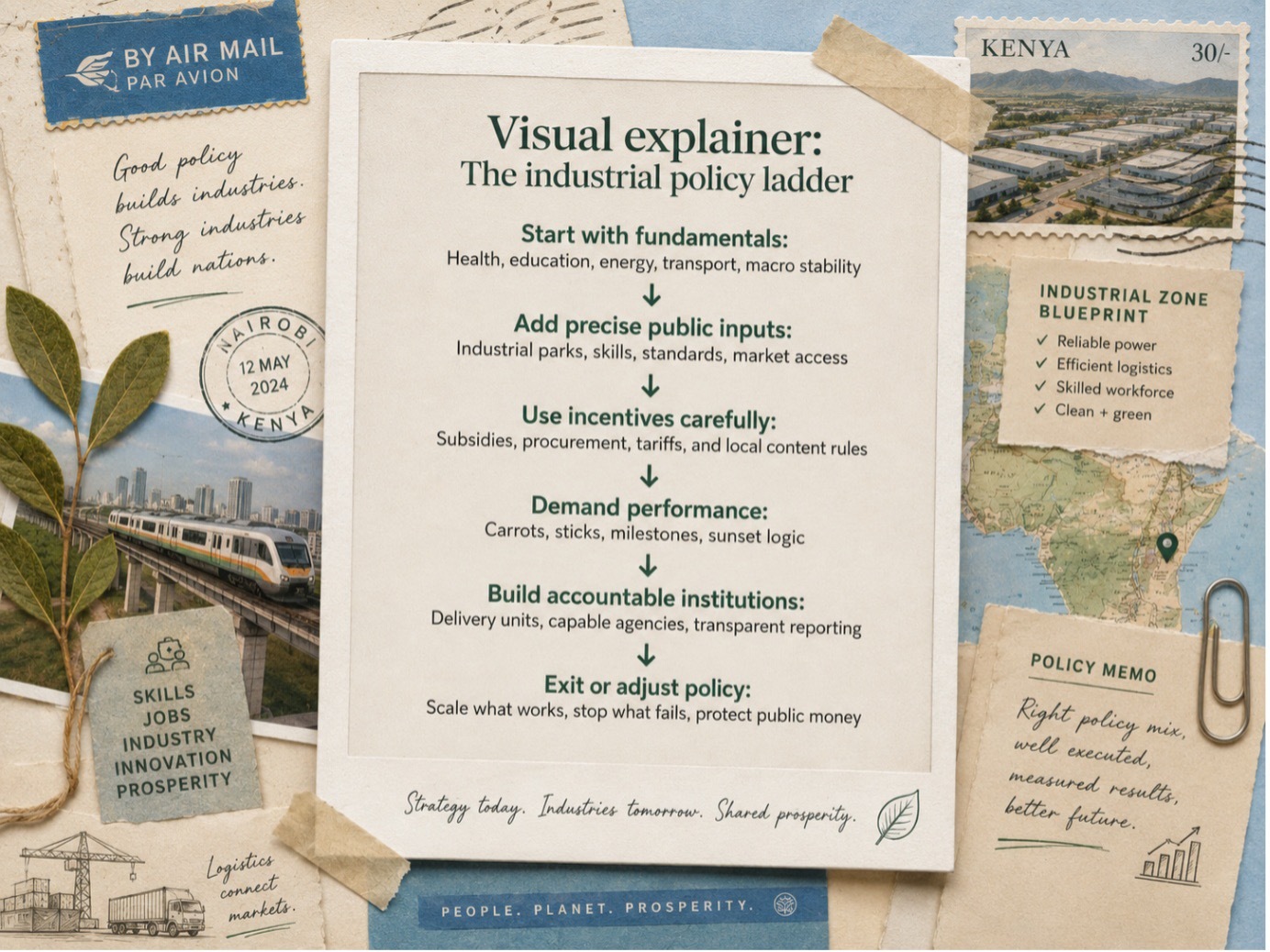
The report’s strongest warning is also its most useful: industrial policy is not a magic bullet. It works best when governments start with precise public inputs, such as industrial parks, skills, market access and quality infrastructure, before escalating to costly subsidies, tariffs or macroeconomic interventions.
Industrial Policy Returns To Development Planning
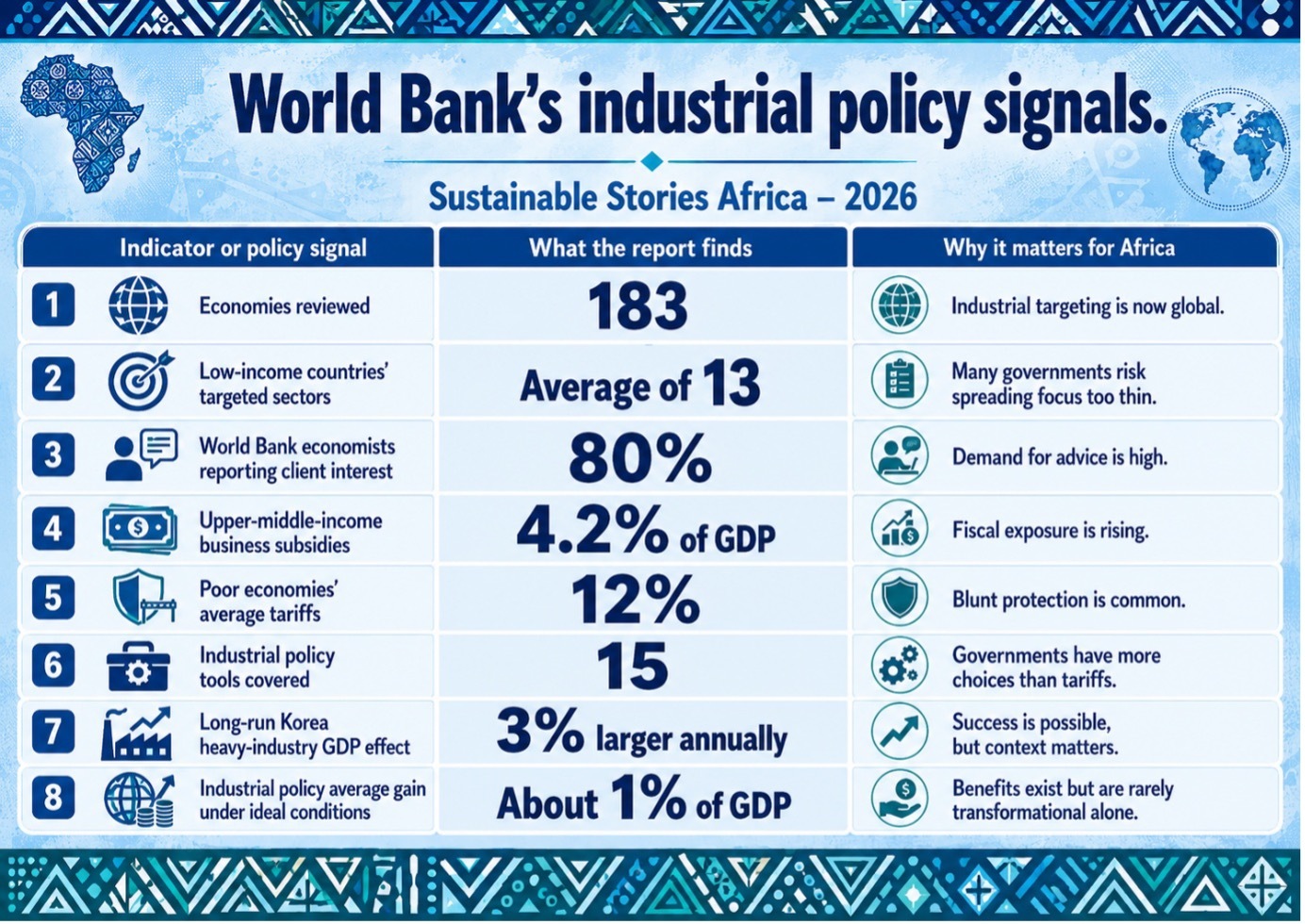
Industrial policy is back, and this time, few governments are apologising for it. A World Bank review of 183 economies found that every country targeted at least one industry for growth, with low-income countries averaging 13 industries, more than twice the number targeted by high-income peers.
In a March 2025 survey, 80% of World Bank country economists confirmed that client governments had sought industrial policy advice, primarily to drive jobs and investment.
For Africa, the implications are significant.
From agro-processing and mining beneficiation to electric mobility, pharmaceuticals, and renewable energy equipment, governments are actively shaping production rather than deferring to markets.
However, execution gaps remain costly.
- The 25 poorest economies, with per capita incomes below $1,200, rely most heavily on tariffs, averaging 12%.
- Upper-middle-income economies now deploy business subsidies averaging a record 4.2% of GDP, signalling that ambition, without implementation discipline, carries serious fiscal risk.
Why Blunt Tools Can Hurt Growth
The problem with industrial policy is rarely the intention; it is the instrument. Tariffs protect domestic producers but raise consumer prices and inflate businesses’ input costs.
Broad subsidies support selected firms but strain budgets, invite political capture, and prove difficult to unwind.
The World Bank note them plainly: too many developing economies prefer sweeping tariffs and subsidies rather than targeted tools like industrial parks and skills development.
For manufacturers in Lagos, Nairobi, Accra, or Kigali, the distinction is practical. Protecting one product line while raising the cost of imported machinery or energy inputs can reduce competitiveness rather than build it.
The report proposes a feasibility framework anchored in three national characteristics: local market size, government bandwidth, and fiscal space.
Smaller, capacity-constrained economies should begin with lighter tools, particularly industrial parks. Stronger economies can progressively deploy production subsidies, procurement strategies, innovation support, and research and development tax credits.
What Works Depends On Capacity
The most effective industrial policy tools are those that directly monitor market failures, and the World Bank report identifies three broad categories:
- Tailored public inputs
- Market incentives
- Macroeconomic interventions.
Industrial parks address coordination failures by concentrating infrastructure, suppliers, labour, and logistics in one location. Skills programmes correct chronic underinvestment in worker training.
Market access assistance and quality infrastructure help firms reach export markets and earn buyer trust.
These tools speak directly to African realities. Firms across the continent frequently fail not because of a lack of ambition but due to unreliable power, transport costs, certification difficulties, and a scarcity of skilled labour.
Critically, the report repositions industrial parks as practical coordination instruments rather than prestige projects.
Governments can implement them with modest fiscal outlay by focusing on land, planning, and infrastructure rather than expensive public ownership.
Ethiopia's nine publicly owned industrial zones, costing over $1 billion, demonstrate precisely why financing models matter.
Better Policy Can Create Better Jobs
The promise of smarter industrial policy is not only GDP growth. It is better jobs, stronger firms, greener production and more resilient economies.
For Africa, that means moving beyond the familiar pattern of exporting raw commodities and importing finished goods.
Industrial policy can support agro-processing instead of raw crop exports, mineral processing instead of unprocessed ore shipments, and digital services instead of narrow dependence on physical goods.
It can also help countries prepare for climate-linked trade rules and green supply chains.
However, job creation involves trade-offs. The World Bank cautions that policies focused on jobs may face a choice between many low-wage jobs and fewer higher-wage jobs.
Green industrial policy may cut domestic emissions but shift pollution elsewhere if poorly designed. Export pushes can generate foreign exchange but may also trigger trade tensions.
That is why targeting matters. Chapter four of the report proposes choosing strategic business activities based on potential development benefits, spillovers, market potential and evolving comparative advantage.
The report also encourages governments to think in portfolios, accepting that some targeted activities will fail.
Governments Must Match Tools To Capacity
The institutional message is direct: industrial policy needs discipline, not slogans.
Successful governments maintain close contact with firms, monitor what is working and adjust policy.
- They use incentives as carrots and sticks, making support conditional on performance.
- They also build transparency, so agencies have clear goals and report results publicly.
This matters because industrial policy is vulnerable to capture.
- A tariff that starts as support for an infant industry can become a permanent shield for inefficient firms.
- A subsidy meant to encourage learning can become a political payment.
- A local content rule intended to build domestic suppliers can raise costs if local inputs are unavailable or weak.
The World Bank’s framework, therefore, argues that governments should ensure they improve fundamentals even while pursuing industrial policy.
If industrial policy buys time, that time should be used to provide reliable power, logistics, skills, competition, taxation and regulation.
The report suggests milestones over a 3 – 10-year period, during which industrial policy is used as a temporary fix while fundamentals improve.
For African policymakers, this is a practical governance test. Industrial policy should not only announce priority sectors. It should answer hard operational questions:
- Which constraint is being solved?
- Who benefits?
- What is the public cost?
- What performance is expected?
- When does support end?
- What happens if targets are missed?
Path Forward – Build Industries With Discipline And Trust
Industrial policy can help African economies create jobs, diversify exports and build climate-resilient industries; however, only when tools match capacity, markets and budgets.
The priority is precision: invest first in public inputs, strengthen institutions, target sectors with evidence, and make incentives conditional.
Africa does not need louder industrial ambition; it needs execution systems that turn ambition into productivity, competitiveness and shared growth.