Corporate leaders increasingly understand sustainability risks, but most still cannot translate them into earnings, cash flows, capital expenditure or enterprise value.
KPMG says that the disconnect is leaving important investment decisions exposed.
The valuation challenge is especially urgent for African companies confronting energy insecurity, water stress, supply chain disruption and expensive capital.
The question is no longer whether sustainability matters, but what action, or inaction, is worth it financially.
Sustainability’s Value Problem Is Now Financial
Sustainability has secured a place in boardroom conversations, corporate strategies and annual reports.
It has not yet secured an equally consistent place in the financial models that determine which projects receive capital, which risks are insured and which acquisitions proceed.
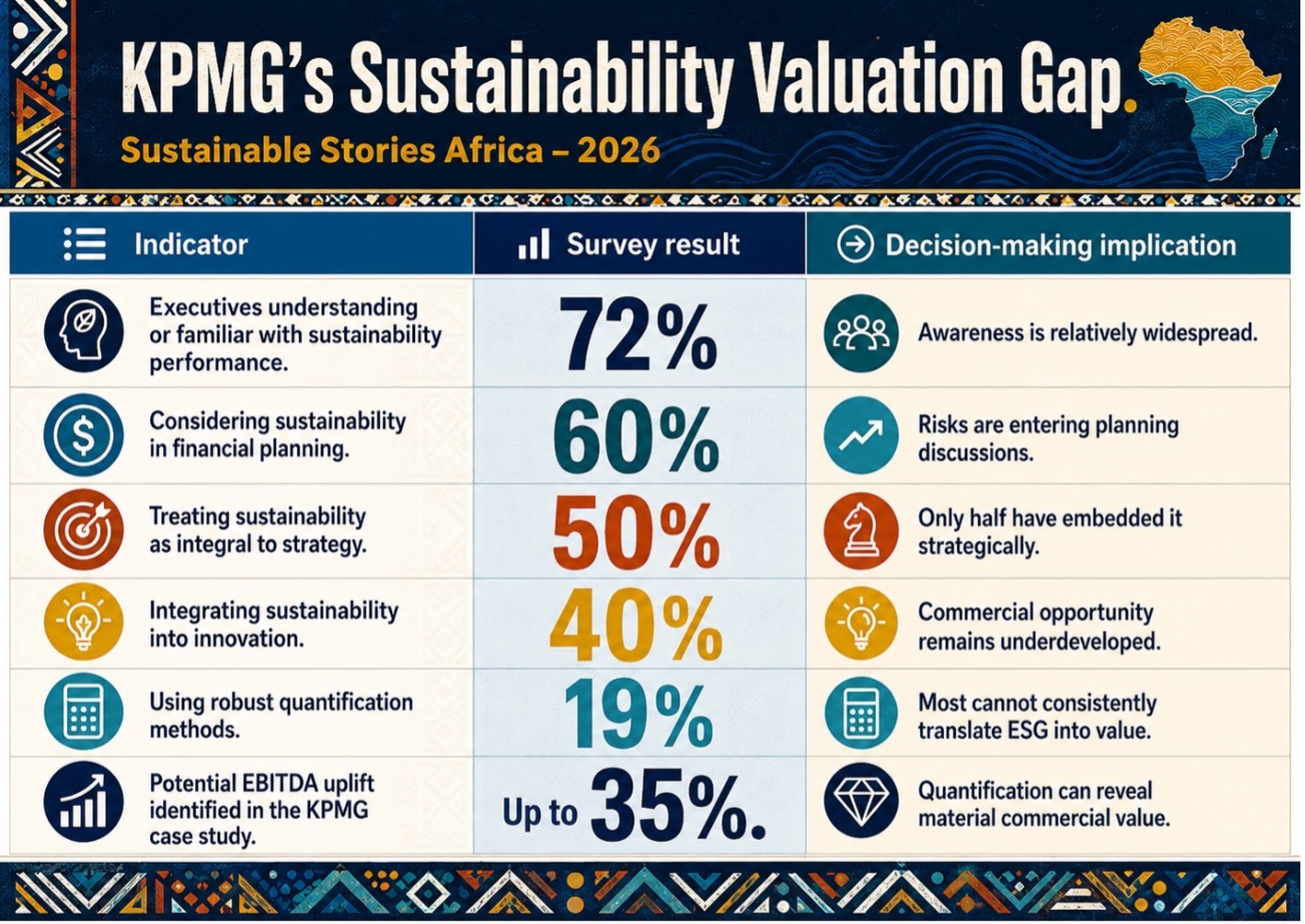
KPMG’s 2026 report, Closing the Sustainability Valuation Gap, finds that 72% of surveyed executives understand their organisation’s sustainability strategy, metrics and performance, or are familiar with its central elements.
However, only 19% use robust methods to quantify the effects of sustainability on financial outcomes, operational gains and innovation.
That 53-percentage-point difference is the report’s defining fault line.
For African and emerging-market businesses, closing it could determine whether sustainability remains an externally driven reporting requirement or becomes a practical tool for protecting margins, strengthening resilience and attracting investment.
Awareness Is High, Quantification Remains Scarce
The sustainability debate has moved past the questions of whether climate, nature, and social risks exist; the harder question is what they mean for revenue, operating costs, asset values, and competitiveness.
KPMG surveyed 2,024 executives across 19 countries spanning the Americas, Europe, the Middle East, Africa, and Asia-Pacific: 60% factor sustainability risks into financial planning, 50% call it integral to strategy.
However, fewer than one in five use advanced valuation methods to quantify financial impact.
This gap creates a critical blind spot. Companies may recognise threats like water scarcity or carbon regulation.
However, unless these appear in forecasts, impairment tests, and valuation models, they carry little weight in capital allocation, causing viable efficiency projects to fail business-case tests while risk-exposed acquisitions proceed unpriced.
KPMG's Julie Vasadi warns the real danger lies in inaction.
For African markets, this inaction proves costly: physical and transition risks are translated into the income statement through electricity costs, damaged infrastructure, disrupted logistics, and constrained access to capital.
Finance Still Cannot Price Sustainability Clearly
The report's argument isn't that companies lack sustainability information; its that available data isn't yet decision-useful in financial terms.
Boards and CFOs typically operate through EBITDA bridges, discounted cash-flow models, and sensitivity ranges, while sustainability teams communicate via emissions inventories and narrative disclosures.
Both languages matter, but they rarely connect.
Sector results reveal where financial pressure drives progress: banking leads at 33% using techniques such as Monte Carlo simulations, followed by energy (31%) and automotive (27%), sectors that confront credit risk, stranded assets, and electrification bets, respectively.
However, even the leading sector reaches only one-third, showing sustainability valuation remains emerging rather than standard practice.
Regulation appears to sharpen awareness: 67% of South African respondents called sustainability integral to strategy, the survey's highest, ahead of Italy (64%) and France/Spain.
This suggests African boardrooms aren't behind in recognising relevance, though awareness doesn't guarantee the ability for valuation; only 27% claim to have a detailed understanding of metrics and performance.
KPMG argues businesses shouldn't wait for perfect data, since traditional finance already operates with uncertainty.
It cites a private-equity fund that withdrew from a deal after testing profitability against realistic water-stress scenarios, exposing how environmental risk could undermine an investment case.
Better Valuation Can Unlock Corporate Growth
Quantification reveals commercial opportunities, not just downside risk.
KPMG's case study for a US private-equity firm preparing a food-and-beverage company for IPO identified over 40 sustainability-related value levers, prioritising six with potential to boost value by up to 35%, spanning climate targets, energy efficiency, waste reduction, workforce well-being, value-chain resilience, and revenue enhancement, each linked to concrete financial outcomes rather than standalone ESG initiatives.
KPMG's sustainable value bridge connects these to baseline EBITDA, sustainability-adjusted EBITDA, and enterprise value, distinguishing realistic base cases from accelerated stretch cases.
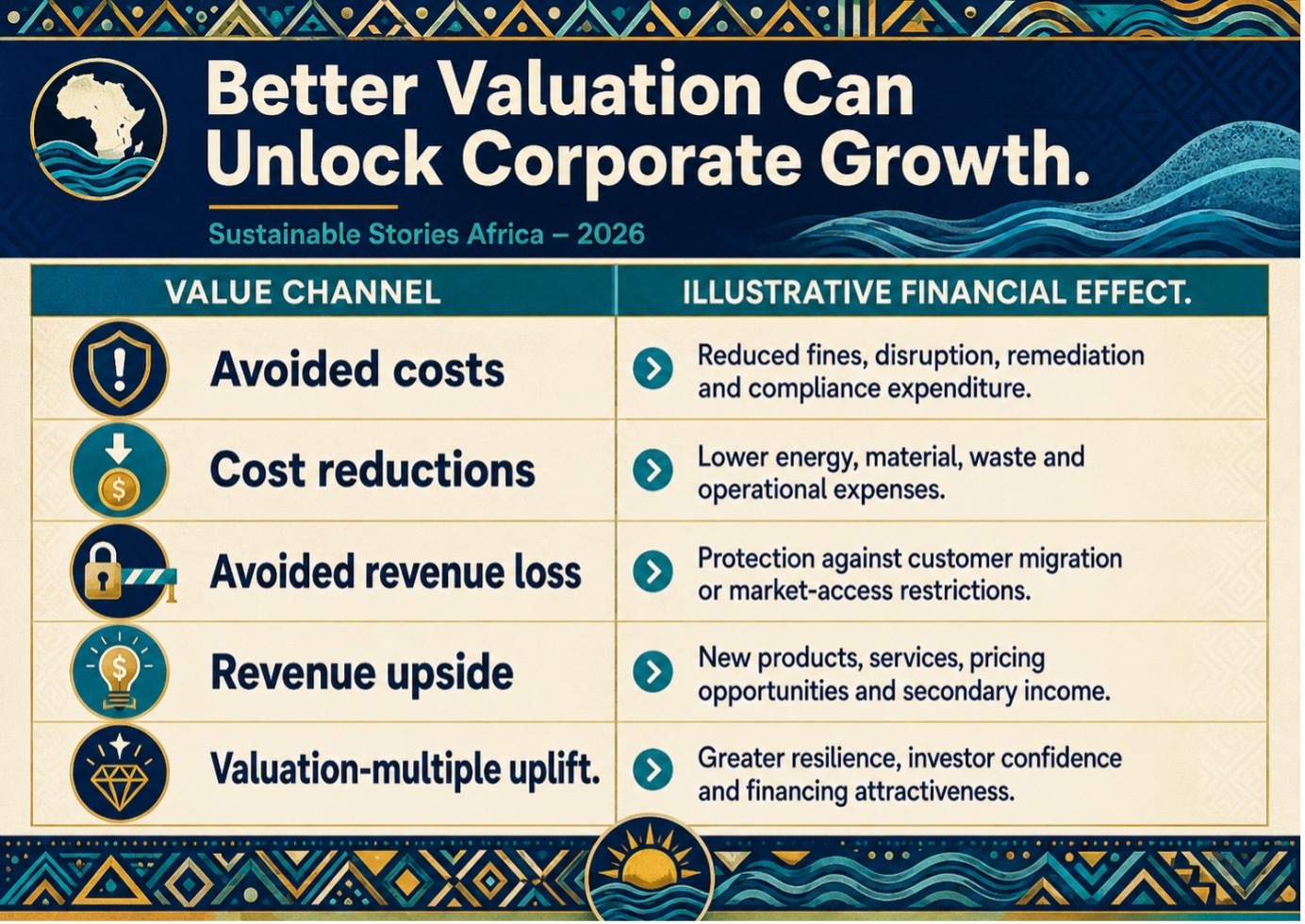
For African companies, this reframes the conversation: solar investment becomes margin protection against unreliable grid supply and diesel costs; water management guards against scarcity-driven disruption; supplier development becomes resilience against currency and logistics risk.
The social dimension gains rigour too; employee safety and community relationships influence productivity and licence to operate.
As WBCSD's Peter Bakker puts it: "Sustainability needs to compete for capital as other investments do
Turn Sustainability Data Into Capital Decisions
Closing the gap requires more than appointing a sustainability officer; finance, strategy, risk, and ESG teams must jointly identify where sustainability affects core value and drivers.
- First: materiality with financial consequence, determining which issues can materially affect revenue, cost, or financing rather than tracking every metric.
- Second: building value-driver trees linking factors like supply-chain controls or energy management to measurable outcomes: input continuity, unit costs, margins.
- Third: quantifying scenarios using documented, pressure-tested assumptions covering CapEx, revenue uplift, and valuation-multiple effects.
Boards must then integrate results into
- Capital allocation, M&A, and impairment reviews, rather than just confining sustainability to a separate report reviewed after decisions are made.
Regulators and stock exchanges can support this by requiring decision-useful disclosure;
- Banks and investors can reinforce it by questioning how risks are priced, not just whether policies exist.
The WBCSD Business Value Initiative, with KPMG participating, is developing shared quantification principles, starting with physical climate risk, with initial outputs expected in late 2026.
African professional bodies, universities, and regulators should build local valuation capacity.
Imported models may not reflect the continent's grid conditions, informal supply chains, or financing costs.
The goal: globally credible methodology with locally relevant assumptions.
Path Forward – Make Sustainable Value Decision-Useful
African companies should connect material sustainability risks and opportunities to EBITDA, cash flow, capital expenditure, balance sheet exposure and enterprise value.
Starting with imperfect but transparent data is more useful than waiting indefinitely for certainty.
Boards, regulators, investors and finance professionals must build shared methodologies, strengthen governance and integrate sustainability into everyday capital decisions.
That is how ESG moves from compliance language to measurable resilience, commercial opportunity and long-term value creation.