
In mergers and acquisitions, the dream is simple: two businesses combine and create something larger than both.
The harder reality is that “2 + 2 = 5” only works when strategy, valuation, integration and cash-flow delivery align.
For African and emerging-market dealmakers, the lesson is urgent. M&A can unlock scale, capital and technology, but weak due diligence, culture clashes and overpricing can turn promised synergy into value destruction.
Real Value Begins After Deal Announcements
Mergers and acquisitions often begin with a beautiful story.
- Two companies combine.
- Costs fall.
- Revenues rise.
- Market share expands.
- Talent, technology and distribution channels come together.
On the presentation deck, the arithmetic looks irresistible: 2 + 2 = 5.
However, the finance lesson from FinPolNomics Green Finance and FinPolNomics Analytica’s Accounting & Finance Nuggets is sharper: real M&A value is not created by the announcement alone.
It is earned after the deal, when assumptions meet integration, culture, debt service and cash flow.
That distinction matters for African and emerging markets, where acquisitions increasingly sit at the intersection of capital allocation, corporate governance, ESG risk, industrial growth and market consolidation.
A deal can strengthen a company’s resilience and competitiveness. It can also weaken balance sheets, disrupt employees, disappoint investors and destroy stakeholder trust if the dream is bought without testing the wake-up.
Synergy Promises Can Quickly Become Zero
The greatest risk in mergers and acquisitions is not that synergy is impossible; it is that synergy is assumed before it is earned.
The classic deal pitch promises revenue growth, cost savings, market expansion, and strategic alignment. These opportunities are real.
- A bank acquiring a fintech platform to reach younger customers.
- An energy company buying renewable assets to meet transition targets.
- A manufacturer securing its distribution chain.
However, the wake-up can be brutal.
- Overvaluation, poor integration, culture clashes, hidden liabilities, and weak execution can rapidly turn projected value into loss.
What FinPolNomics frames as the gap between "2 + 2 = 5" and zero.
This is fundamentally a governance failure before it becomes a financial one. Boards approve strategy.
Executives' price assumptions. Advisers shape models. When deals collapse, the damage spreads, jobs become uncertain, suppliers face delays, communities lose investment promises, and creditors reassess risk.
The Dream Is Built On Assumptions
M&A optimism typically rests on four assumptions, each of which carries its own execution risk.
The first is revenue synergy.
- cross-selling opportunities, wider distribution, and new customer access. This works when the customer strategy is clear, and sales systems are compatible. It fails when market size is overestimated or brand trust is misread.
The second is cost synergy.
- Savings from shared infrastructure, merged technology, and reduced duplication are real but rarely free. Severance costs, system migration, legal harmonisation, and transition delays frequently erode projected gains.
The third is market power.
- Greater market share can strengthen pricing leverage, but it also invites regulatory scrutiny and customer resistance, particularly in banking, telecoms, energy, and healthcare, where affordability and access carry social weight.
The fourth is strategic access.
- Talent, technology, licences, and intellectual property. Increasingly relevant across Africa's digital, energy, and infrastructure sectors, this only creates value when acquirers can retain talent, integrate systems, and convert capability into measurable cash flow.
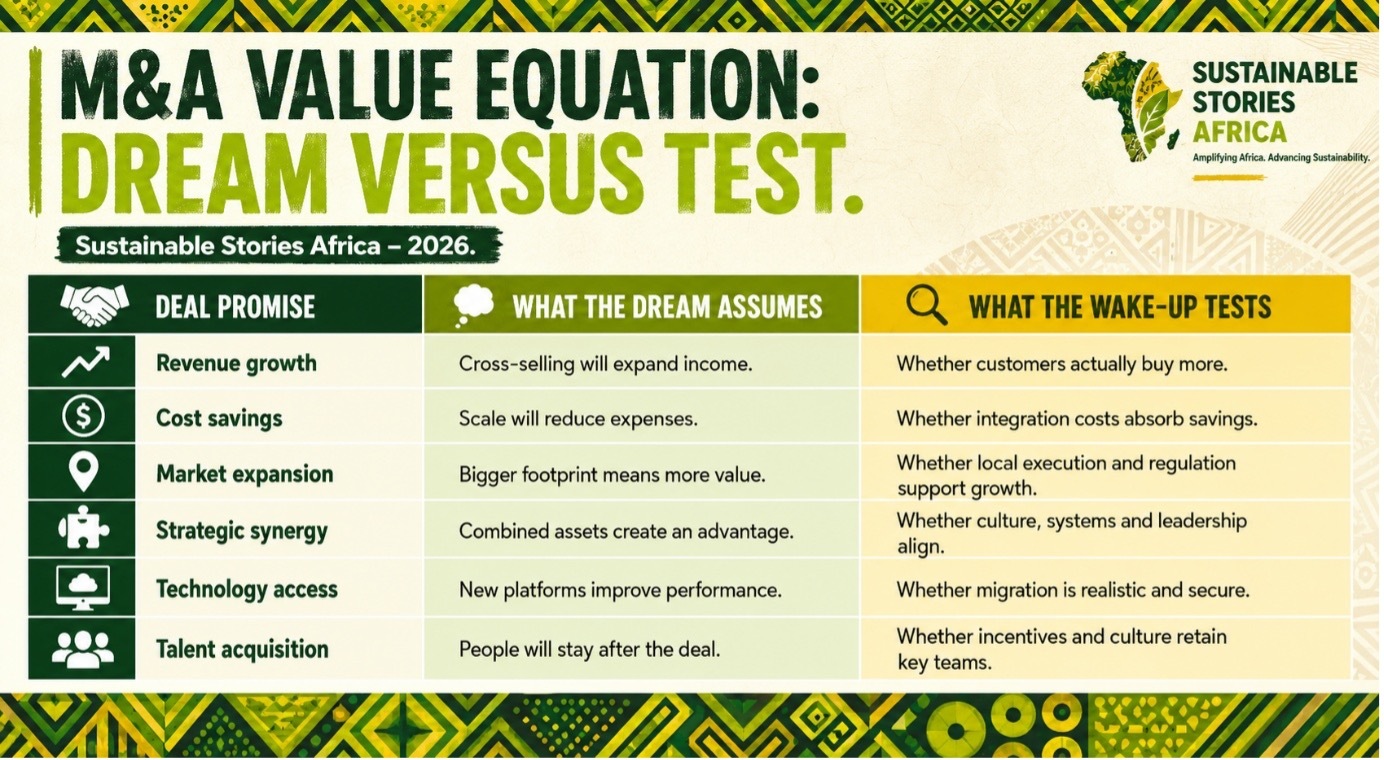
The lesson is direct: synergy must move from language to measurement.
If it cannot be modelled, tracked, and owned by accountable teams, it should not be priced aggressively into any transaction.
Disciplined Deals Can Protect Long-Term Value
Good M&A creates real value; however, only when it is built on discipline rather than excitement. For African companies, this distinction carries particular weight.
Acquisitions can accelerate regional expansion, industrial consolidation, clean-energy transition, financial inclusion, and technology transfer in ways organic growth cannot match.
A well-structured deal can help a bank acquire digital capability, a healthcare provider expand access, or a renewable energy developer build cross-border scale.
The positive outcomes extend beyond shareholder returns to stronger institutions, better services, improved governance, and deeper capital markets.
However, this only materialises when value creation is planned before signing and governed after closing.
Boards must ask hard questions early:
- What exactly creates value?
- Who owns each synergy target?
- What are the integration costs?
- What happens if revenue growth stalls by 12 months?
In emerging markets, these questions are even more critical. Information quality varies, regulatory processes can be complex, and currency, political, and execution risks shift quickly.
A compelling headline valuation can unravel fast when integration is slow, debt is dollar-denominated, or acquired controls are weaker than expected.
The discipline is simple but demanding: test assumptions, price risks, and plan integration early.
Boards Must Price Risk Before Signing
The M&A action agenda begins before any announcement is made, and discipline at every stage separates value creation from value destruction.
- First, boards must separate strategic logic from financial evidence. A deal can make commercial sense and still destroy value if the price is wrong.
- Second, due diligence must go beyond surface-level review. Financial diligence should test earnings quality, debt, and cash conversion. Legal diligence must examine contracts and compliance. ESG diligence should probe labour practices, environmental liabilities, and governance controls. Technology diligence must assess cybersecurity, system compatibility, and data integrity.
- Third, integration must be treated as a value-creation programme, not an administrative exercise. The first 100 days after closing should deliver clear priorities: leadership structure, culture alignment, customer retention, technology migration, synergy tracking, and risk escalation.
- Fourth, synergy targets without owners, timelines, cost estimates, and measurement methods are slogans, rather than value drivers.
- Fifth, investors and financiers must insist on downside scenarios. What if only 50% of the cost savings materialise? What if customer churn rises or key staff leave?
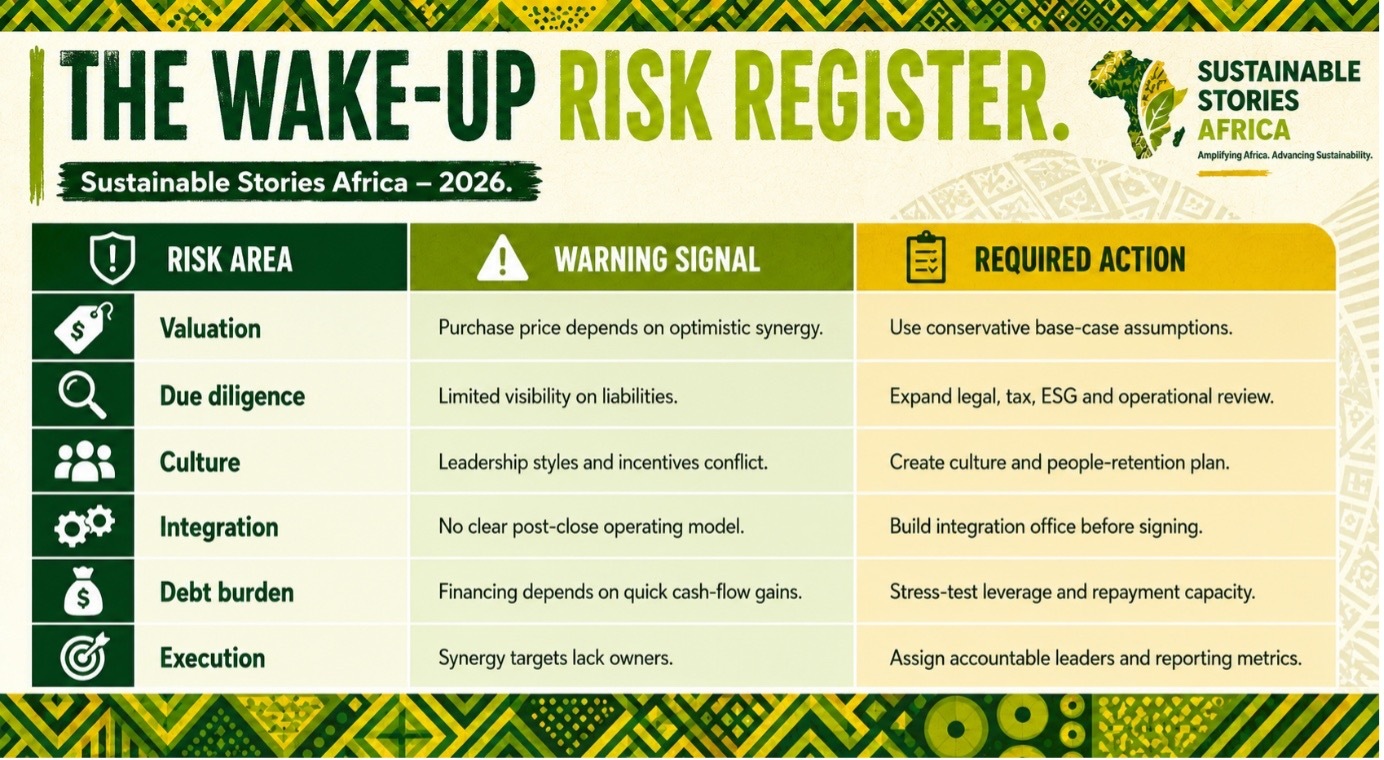
This is where governance becomes practical.
- A board that challenges assumptions is protecting value.
- A regulator demanding transparency is reducing systemic risk.
- An investor testing integration detail is not being pessimistic; it is asking whether the deal can survive reality.
Path Forward – Execution Turns Synergy Into Shared Value
M&A should not be treated as a trophy moment. The real work begins after signing, when strategy must become systems, culture, controls and cash flow.
The priority is disciplined value creation: realistic valuation, robust due diligence, early integration planning, cultural alignment and measurable delivery.
That is how 2 + 2 can become 5, not through the dream of the deal, but through the execution that follows.