Nigeria’s new Net Billing Regulations are being seen by many as a chance for solar users to sell excess power back to the grid. However, the deeper story is bigger: NERC is creating a formal pathway for electricity customers to become active market participants.
For households, businesses, DisCos, investors and state regulators, the regulation raises a defining question: can Nigeria build a distributed, digital and reliable electricity market fast enough?
Nigeria’s Power Market Enters Prosumer Era
Nigeria’s electricity market is entering a new phase, one in which the customer is no longer expected to sit at the end of the grid as a passive consumer of unreliable supply.
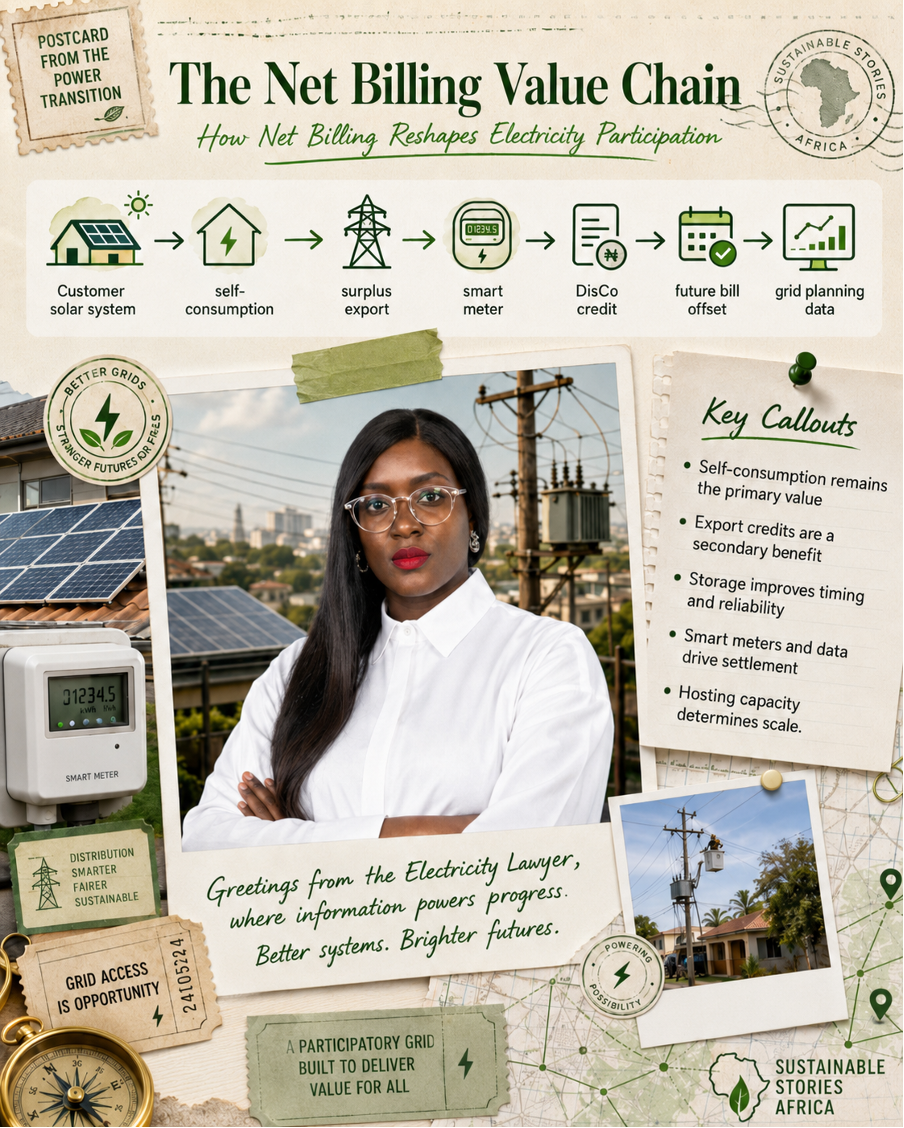
The Nigerian Electricity Regulatory Commission’s Net Billing Regulations 2026 establish a framework that allows eligible electricity customers with on-site solar systems to export excess power to the grid and receive credits against future consumption.
On the surface, the public headline is simple: solar users can now send unused electricity back to the network.
However, Dr Ivie Ehanmo, electricity lawyer, global energy law and regulatory expert, and clean energy market reform strategist, argues in her analysis that the real significance lies elsewhere.
The regulation is not merely about selling solar power. It is about Nigeria’s gradual shift towards a decentralised electricity system shaped by distributed energy resources, customer participation, storage, data, grid readiness and regulatory execution.
Solar Exports Reveal A Bigger Market Shift
The Net Billing Regulations mark a structural shift in Nigeria’s electricity market by formally recognising the “prosumer”, customers who both consume and produce power.
For decades, the system has followed a centralised model, with generation, transmission and distribution flowing in one direction.
This reform challenges that logic, allowing eligible users to generate electricity, meet their own needs and export surplus to the grid.
This matters because Nigeria’s energy crisis is not only about supply, but also about the system design.
Businesses and households have already built parallel energy systems through diesel, petrol and investments in solar. The regulation begins to formalise this reality.
In ESG terms, distributed solar offers clear gains, reducing fossil fuel reliance, improving energy security and enabling climate-aligned investment.
However, execution risks remain; grid readiness, transparent credit settlement and regulatory fragmentation could determine whether this becomes a scalable market transformation or another partial reform.
Self-Consumption Still Drives The Solar Economics
A critical nuance in Nigeria’s Net Billing Regulations is often overlooked: the framework is not designed to create full-time electricity exporters, but rather to maximise self-consumption while allowing value capture from surplus power.
Exported electricity is compensated at rates below retail tariffs, reinforcing that the strongest business case for distributed solar lies in on-site use, reducing grid purchases, lowering operating costs, and improving reliability.
For businesses and institutions, from manufacturers in Lagos to hospitals in Enugu and schools in Ibadan, the primary value remains energy security and cost control, not export revenue.
Surplus credits enhance returns, but do not define them.
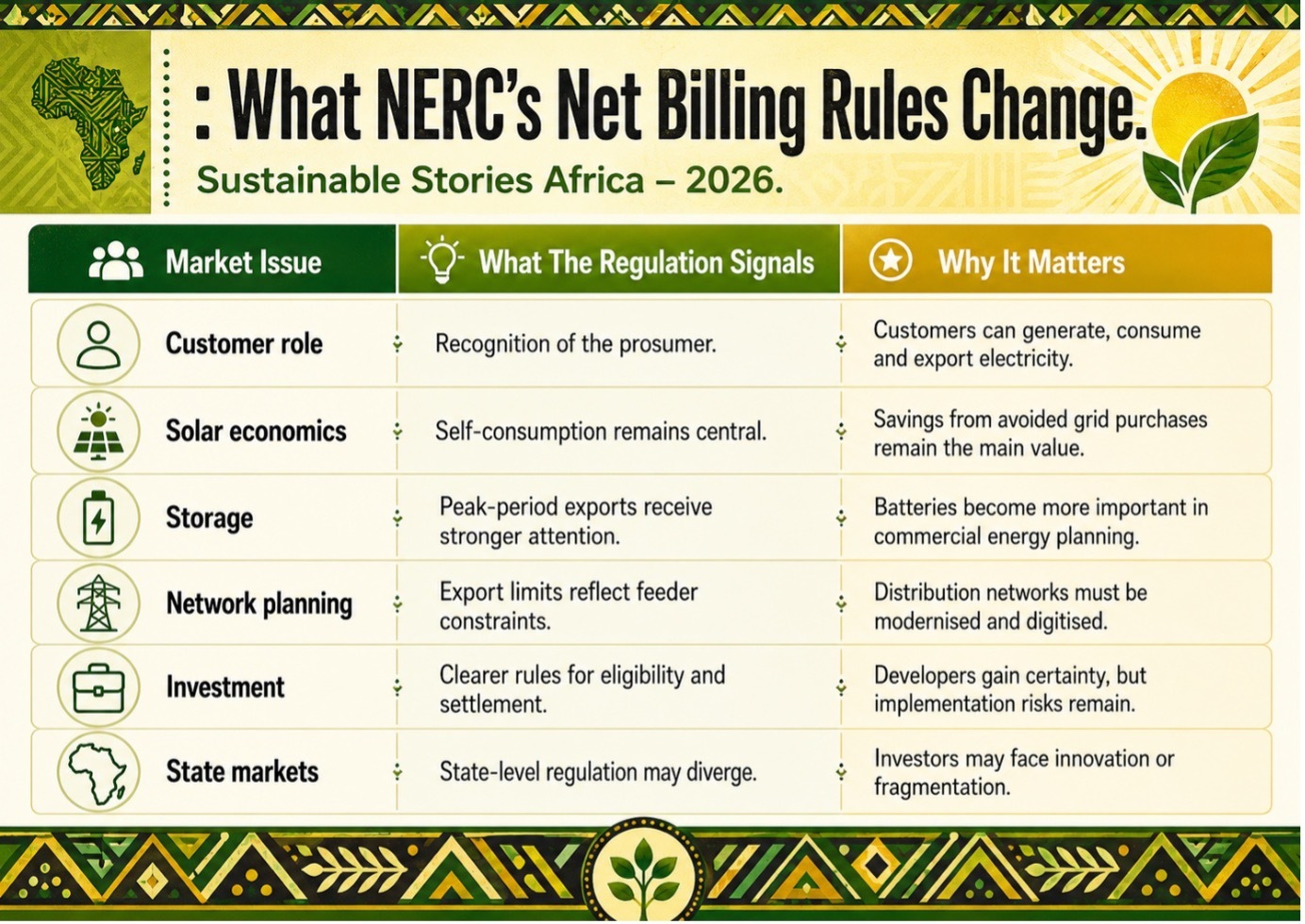
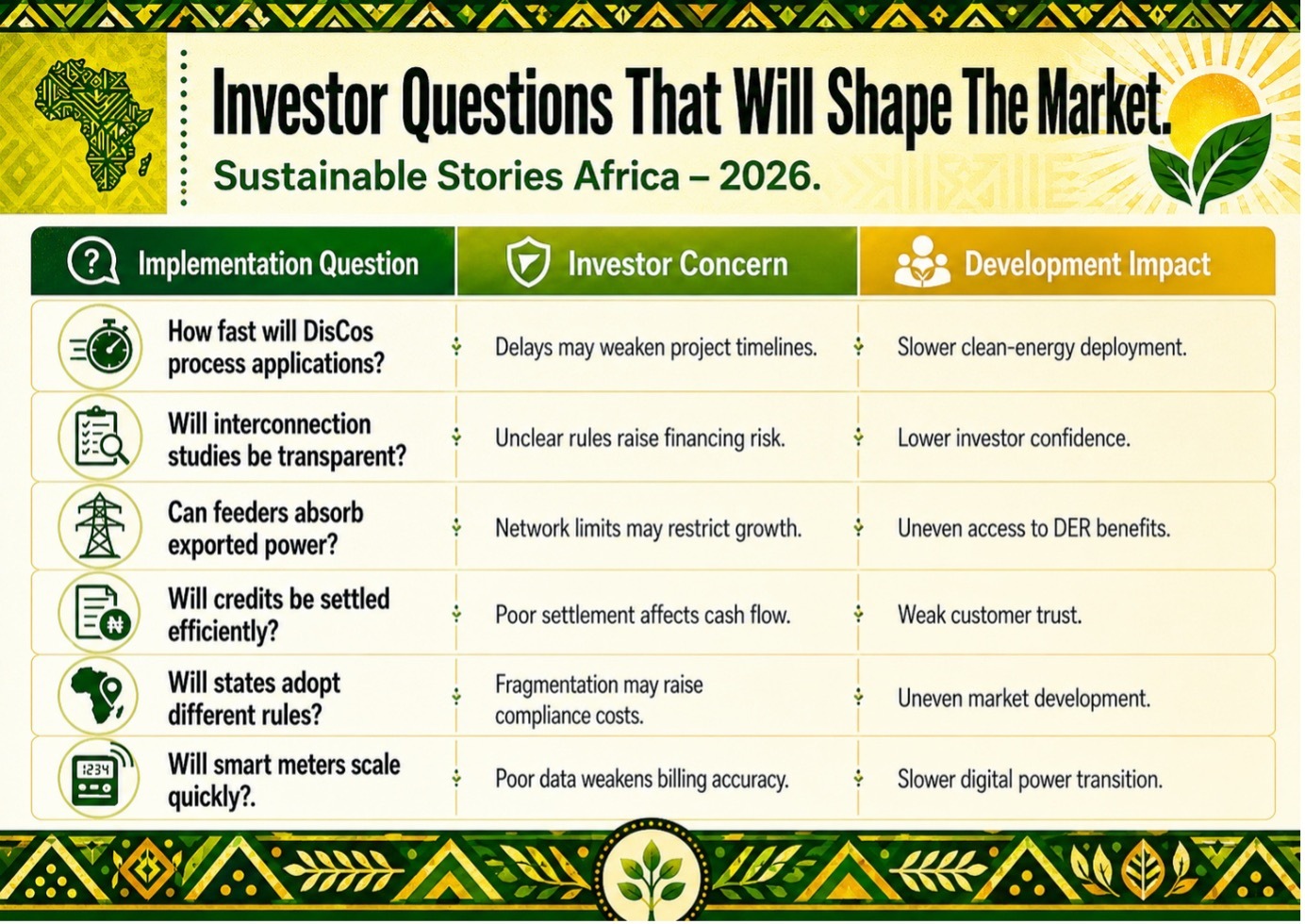
This makes implementation a market-readiness test. Investors will look beyond policy language to execution: how efficiently DisCos process applications, conduct interconnection studies, approve meters and manage credit settlement.
The regulation’s success will ultimately be measured not by the design but by delivery.
Storage And Certainty Can Unlock Investment
The regulation signals a critical next step in Nigeria’s distributed energy transition: the rise of battery storage.
Solar generation peaks during the day, while electricity demand typically rises in the evening, creating a structural mismatch.
Battery storage addresses this gap, enabling excess daytime solar to be deployed during peak demand, improving reliability and easing grid pressure.
The regulation’s approach to evening export compensation points to a future where solar-plus-storage becomes commercially viable, particularly for commercial and industrial users.
For investors, the framework introduces much-needed clarity, from eligibility and technical standards to metering, interconnection and settlement processes. In a market shaped by policy uncertainty, this reduces risk.
However, delivery will define impact. Delays in approvals, opaque interconnection processes, weak data on hosting capacity or unreliable credit verification could stall momentum.
Effective implementation, however, could unlock scalable investment in solar, storage and digital energy systems.
Implementation Will Decide The Market Outcome
The next frontier in Nigeria’s electricity reform may not be generation, but the limits of the grid itself.
Hosting capacity, the volume of distributed energy a network can absorb without compromising stability, is emerging as a defining constraint.
As more customers install solar and export surplus power, distribution companies must manage feeder conditions, transformer limits, voltage stability and shifting demand patterns with far greater precision.
This reframes the reform agenda. Distributed energy growth now depends on distribution network modernisation: advanced metering infrastructure, grid digitalisation, real-time data visibility and transparent hosting capacity assessments.
Without these, scale will stall.
The timing adds complexity. The Electricity Act 2023 is decentralising the sector, with states developing parallel regulatory frameworks.
This creates space for innovation, but also risks fragmentation, from differing interconnection standards to inconsistent export compensation regimes.
The policy challenge is to balance: enabling state-level flexibility while maintaining national coherence.
- For citizens and investors alike, outcomes will be practical.
- Effective implementation could deliver cleaner, cheaper and more reliable power.
- Poor coordination could slow investment, strain networks and deepen scepticism around reform.
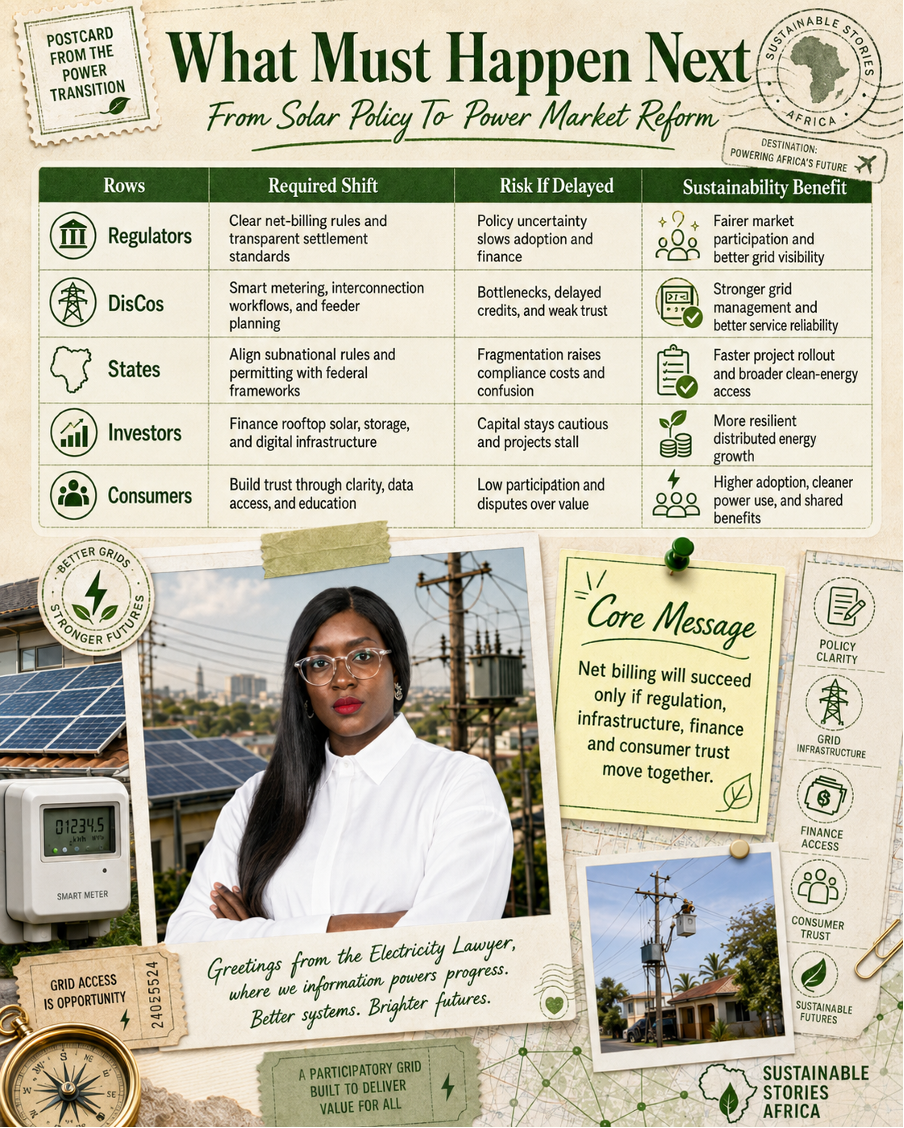
Path Forward – From Regulation To Reliable Distributed Power
NERC’s Net Billing Regulations 2026 are a welcome step, but their success will depend on execution.
The priorities are clear: transparent interconnection, credible settlement, smart metering, hosting capacity disclosure, storage integration and coordinated state-level regulation.
If Nigeria gets this right, net billing can become more than a solar credit mechanism. It can become a foundation for a cleaner, more resilient, more participatory electricity market, one where consumers help shape the grid they depend on.