
Nigeria’s 2025 tax reforms have redrawn the country’s VAT landscape, expanding compliance expectations while protecting selected essentials through exemptions and zero-rating.
A Streamsowers & Köhn analysis shows the new framework is more than a tax adjustment.
It is a governance test for businesses, regulators, consumers and Nigeria’s wider formal economy.
VAT Reform Tests Business Readiness
Nigeria’s new tax regime has moved from policy debate to operational reality, after President Bola Ahmed Tinubu signed four major tax laws on June 26, 2025, including the Nigeria Tax Act, 2025, the Nigeria Tax Administration Act, 2025, the Nigeria Revenue Service Establishment Act, 2025, and the Joint Revenue Board Establishment Act, 2025.
A legal note by Anita Peremoboere, Associate at Streamsowers & Köhn, examines the Value Added Tax provisions under the Nigeria Tax Act, 2025, and explains how taxable supplies, exemptions, zero-rated items, non-resident supplier obligations, remittance duties and input VAT recovery now operate under the new regime.
Streamsowers & Köhn describes itself as a leading commercial law firm with offices in Lagos, Abuja and Port Harcourt, advising Nigerian and international companies, government institutions and industry regulators. Its VAT analysis lands at a sensitive time for businesses trying to balance compliance, cash flow and consumer affordability.
A New Tax Code Changes Compliance
VAT is no longer a back-office formality for Nigerian businesses. Under the Nigeria Tax Act 2025, which repealed several principal tax laws, including the former Value Added Tax Act, VAT remains a 7.5% consumption tax.
However, it now sits within a broader unified tax architecture that significantly raises the compliance stakes.
The tax touches every layer of the economy, from food processors and digital service providers to logistics firms, hospitals and renewable energy companies.
Crucially, VAT becomes due when an invoice is issued for services, a receipt is issued for goods, or payment is made, whichever occurs first. Timing is now as consequential as classification.
A delayed invoice, an incomplete receipt or a poorly reviewed supplier document can trigger reporting errors, cash-flow gaps or future tax exposure.
The broader ambition is clear: Nigeria is consolidating and simplifying tax rules while widening compliance discipline across the economy.
What Counts As Taxable Supply
Nigeria's Tax Act 2025 broadly defines taxable supplies. Goods fall within the VAT net if produced, imported, assembled or installed in Nigeria at the point of supply, including rights over goods where the beneficial owner is a taxable person in Nigeria.
Services are taxable when consumed by a person in Nigeria, regardless of where the provider is located, making cross-border digital and professional services firmly within scope.
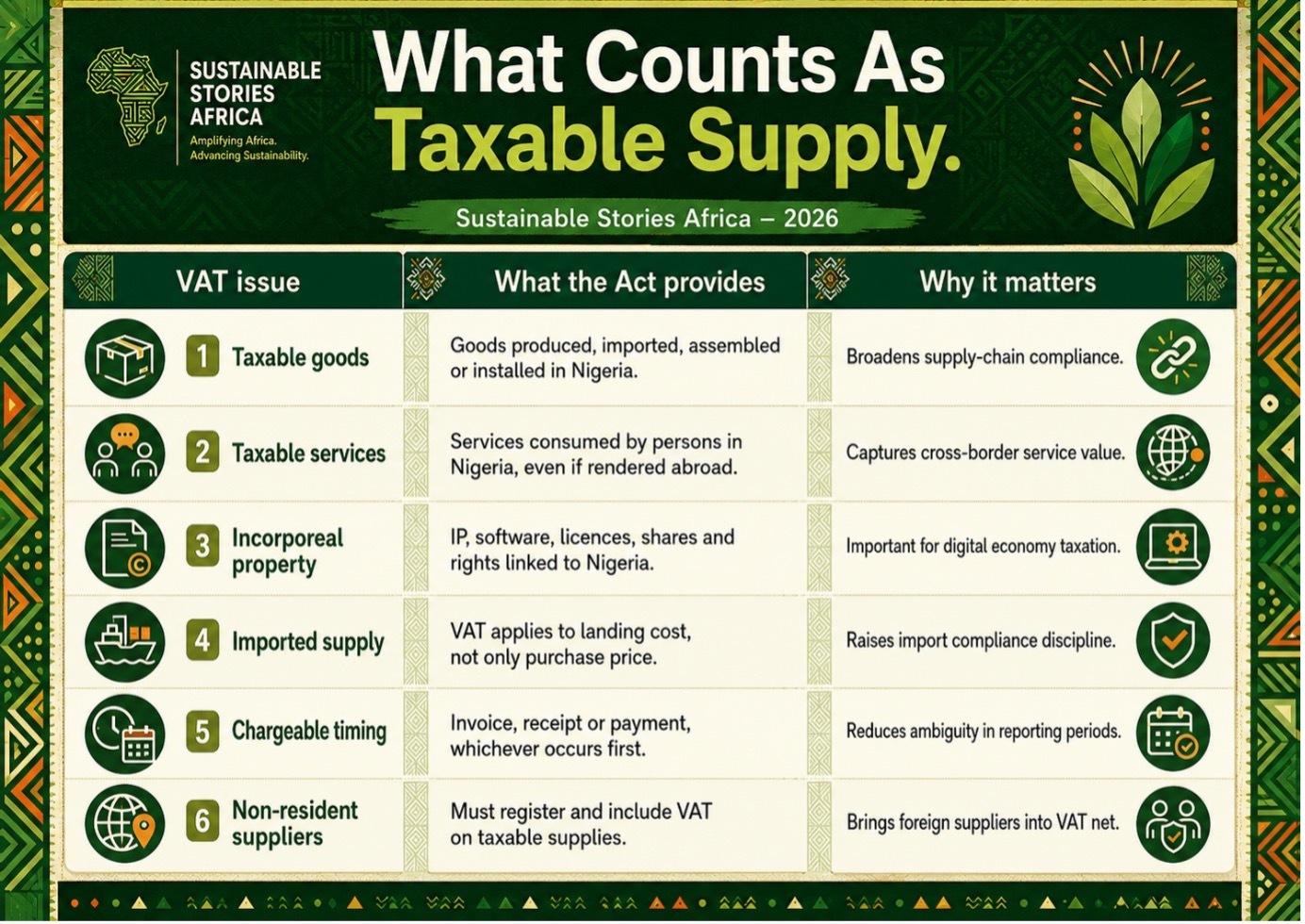
The treatment of imported supplies carries particular significance for traders and manufacturers. VAT is not calculated on the invoice price alone; it applies to the full landed cost, incorporating the purchase price, customs duties, taxes, insurance and packing costs up to the point of entry.
For businesses operating on tight margins, this distinction directly affects pricing, inventory planning and working capital.
Importers who underestimate the VAT base risk unexpected liabilities; those who understand the rule can plan landed costs accurately and avoid pricing shocks.
Relief Measures Protect Essential Sectors
Nigeria's Tax Act 2025 creates two distinct relief channels, exemptions and zero-rated supplies, and the difference carries real economic consequences.
Exempt supplies fall outside the VAT net entirely, but suppliers cannot reclaim input VAT on their production, which can still influence final pricing. Zero-rated supplies are taxed at 0%, allowing suppliers to reclaim input VAT while consumers pay none, a more powerful tool for supporting both producer cash flow and consumer affordability.
Exempt goods and services include oil and gas exports, baby products, locally manufactured sanitary towels, agricultural equipment, shared passenger road transport, land and buildings, humanitarian donor-funded project purchases, and assistive devices, including wheelchairs, hearing aids and braille materials.
Petroleum products, renewable energy equipment and liquefied petroleum gas are also exempt unless otherwise directed by the Minister of Finance.
Zero-rated items span basic food, medical and pharmaceutical products, educational materials, fertilisers, animal feeds, medical services, tuition from nursery through tertiary level, exported goods and services, medical equipment, electric vehicles and EV assembly components.
Food, health, education, agriculture, renewable energy and electric mobility are not merely tax categories; they are development priorities.
Consistent implementation of these reliefs can meaningfully support household welfare, climate transition and export competitiveness.
Businesses Gain Relief But Face Discipline
Input VAT recovery is the most commercially significant benefit available to Nigerian businesses under the Tax Act 2025.
Where input VAT exceeds output VAT charged to customers, businesses can reclaim the difference. Where output VAT exceeds input VAT, only the excess is remittable.
Suppliers of zero-rated goods may also qualify for refunds on VAT paid during production.
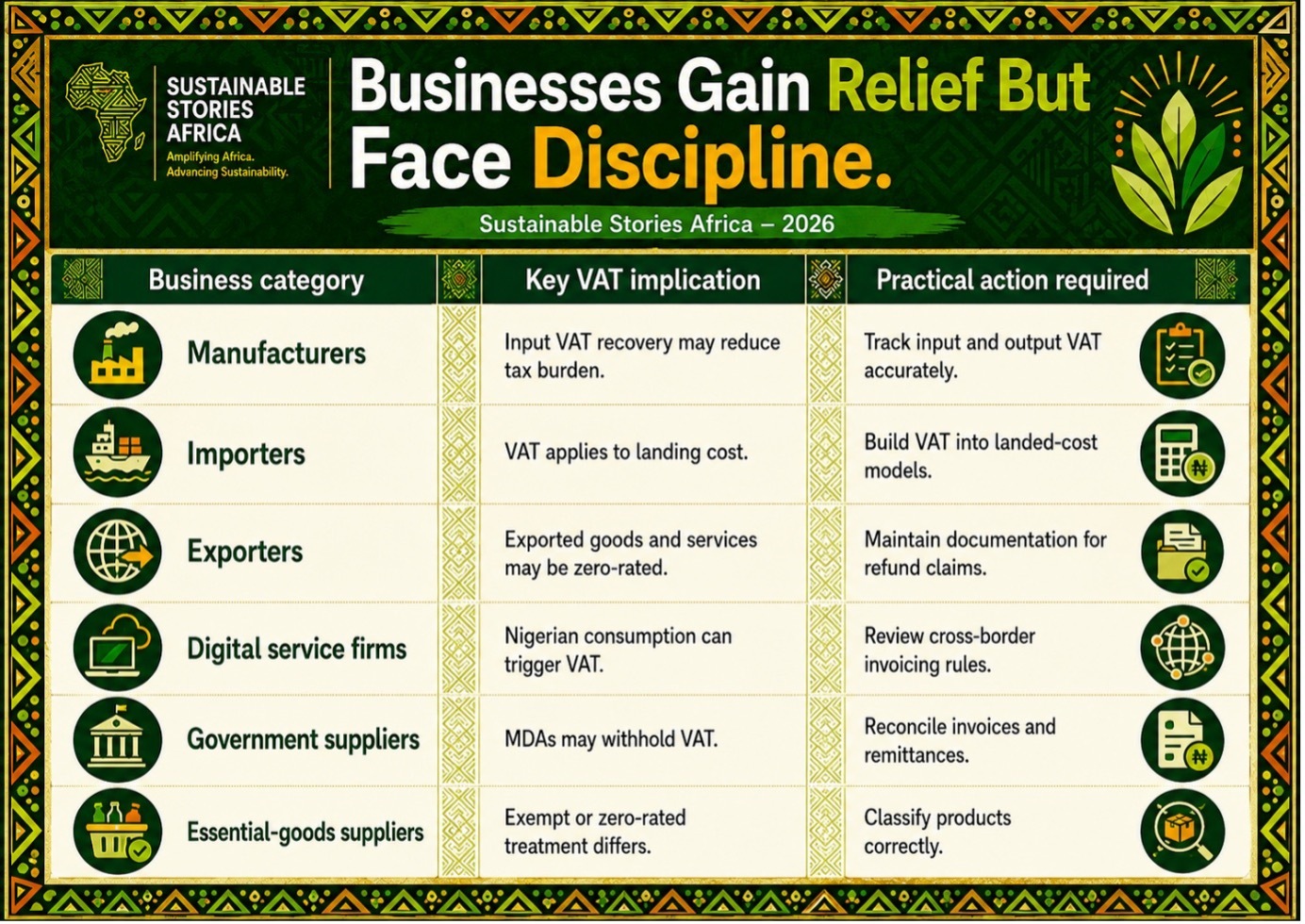
Relief, however, comes with strict documentation requirements. Every taxable supply must be supported by a VAT invoice that carries the supplier's tax identification number, company registration number, invoice number, name and address, date of supply, client details, gross transaction amount, VAT charged and applicable rate.
Critically, responsibility extends to buyers. A business receiving an invoice cannot assume the supplier applied the correct VAT treatment; it must verify compliance and self-account in the method required.
The Nigeria Revenue Service may direct buyers to remit VAT when invoices arrive without it.
Compliance deadlines are tight. VAT collected or withheld must be remitted by the 14th day of the following month, while returns are due by the 21st of each subsequent month.
For firms with weak bookkeeping systems or manual invoicing, the risk of default is real and rising.
Compliance Systems Must Now Improve
The action agenda for Nigerian businesses under the Tax Act 2025 is immediate and practical:
- Review product and service classification: Misclassifying exempt, zero-rated or taxable items creates pricing errors, unrecovered VAT and audit liabilities
- Update invoicing systems: Finance teams must configure digital accounting tools to capture tax identification numbers, VAT rates, transaction dates and remittance status
- Model VAT on landing costs: Importers of machinery, raw materials and consumer goods must calculate VAT on full landed cost, not purchase price alone
- Understand withholding obligations: Nigerian customers dealing with non-resident suppliers are responsible for withholding and remitting VAT charged on taxable supplies
- Treat VAT as a governance issue: Compliance failures affect cash flow, investor confidence and regulatory exposure — boards and senior management must take ownership
The stakes differ by stakeholder.
- For SMEs, accounting discipline is cheaper than penalties or disrupted operations.
- For policymakers, implementation clarity is decisive; a legally sound but administratively slow system still creates friction.
- For consumers, poorly understood exemptions and inefficient refund processes can filter hidden costs into everyday prices, undermining both affordability and trust in the tax system.
Path Forward – Make VAT Work Fairly
Nigeria’s VAT reform can strengthen tax governance, protect essential sectors and improve business cash flow; however, only if firms classify supplies correctly, issue proper invoices, recover input VAT transparently and meet remittance deadlines.
The next priority is implementation discipline. Regulators must provide clear guidance and efficient refunds, while businesses invest in accounting systems.
Well done, VAT reform can support compliance, fairness, formalisation and sustainable economic growth.