
Nigeria’s free zones are not being dismantled, but their old promise of automatic tax insulation is being rewritten.
A new tax framework now links incentives to export performance, documentation, and tax administration.
For investors, regulators, and more than 500 licensed enterprises, the question is no longer whether a company is inside a free zone, but whether it can prove why its incentives should remain.
Nigeria’s Free Zones Face New Rules
Nigeria’s tax reform has placed the country’s Free Trade Zones at a defining policy crossroads, shifting the regime from broad fiscal insulation to a more conditional model built around export performance, minimum thresholds, and documented compliance.
This article is based on the SSKÖHN Notes publication, “Nigeria’s Tax Reset and the Free Zone Regime: Implications for Free Zone Operators,” authored by Azukaego Mbamalu and Priscilla Ben-Okoh of Streamsowers & Köhn, a Nigerian commercial law firm with offices in Lagos, Abuja, and Port Harcourt.
It also follows the Sustainable Stories Africa news-feature approach of connecting policy change to markets, governance, and human impact.
At stake is more than taxation.
For African and emerging markets, the reform speaks to a wider development challenge: how to attract investment, protect public revenue, reward real production, and ensure that fiscal incentives deliver jobs, exports, infrastructure, and long-term economic value.
A Tax Shelter Meets Accountability
For over three decades, Nigeria's free zones ran on a simple proposition: capital in, jobs created, value exported, taxes waived.
This model built one of Africa's most visible free zone systems, attracting over $200 billion in cumulative investment across 42 zones, creating over 100,000 direct jobs, and generating N620 billion in government revenue within five years.
However, the model bred tension in governance. Without clear export-performance thresholds, the boundary between free zones and Nigeria's customs territory grew porous; many businesses engaged the domestic economy through sales and subcontracting while retaining tax immunity, raising fiscal equity concerns for fully taxable competitors.
The Nigeria Tax Act and Tax Administration Act, both 2025, mark a decisive break from this legacy. Free zones aren't abolished, but the legal basis for accessing incentives has changed: location alone no longer qualifies. Performance, substance, and compliance now matter.
From Blanket Relief to Conditional Incentives
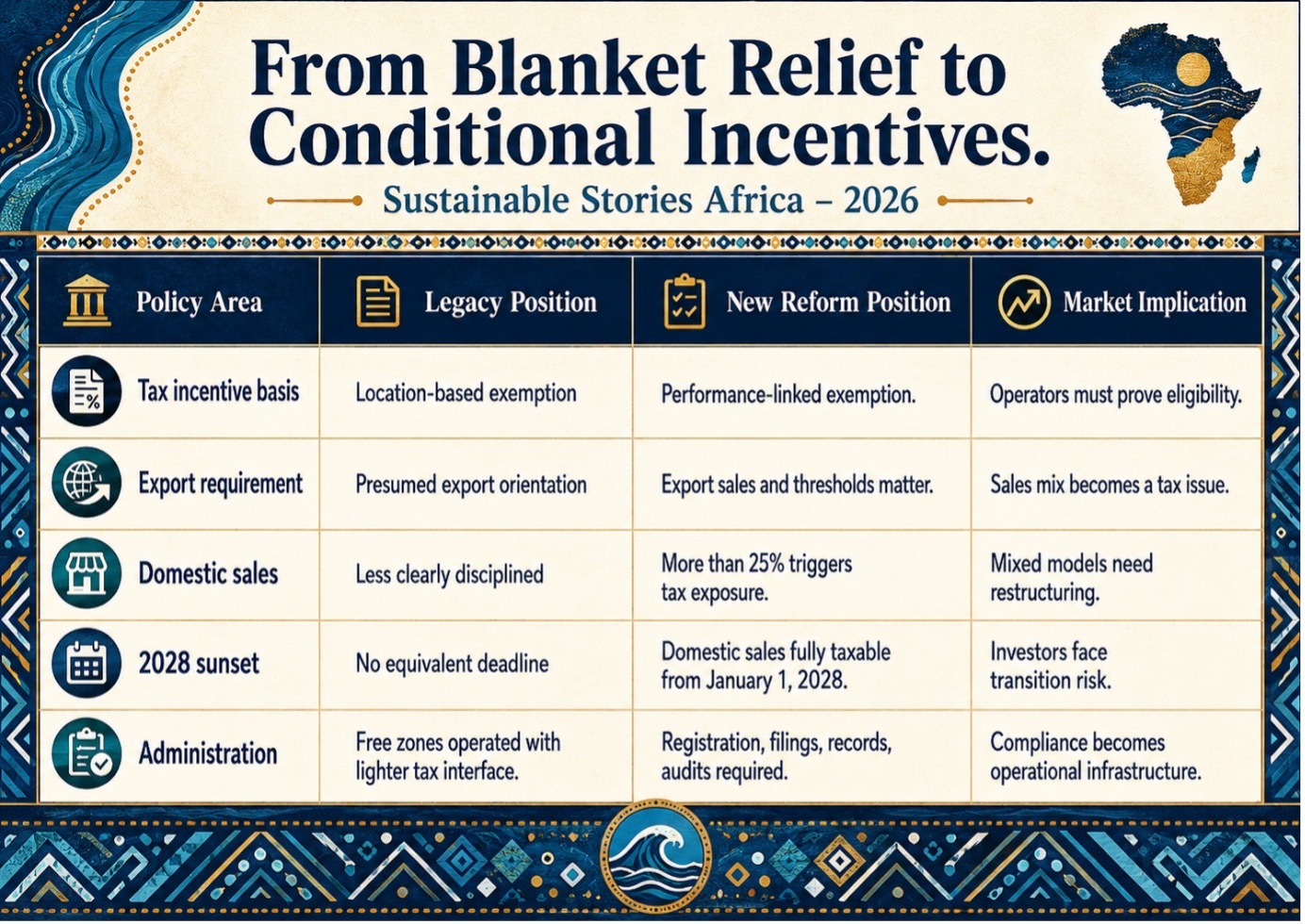
Before reform, Nigeria's free zone regime ran largely on statutory insulation. Approved enterprises enjoyed broad privileges under the NEPZ and OGFZ Acts, including exemption from federal, state, and local taxes, duty-free imports, full foreign ownership, and unrestricted profit repatriation, giving investors certainty to model long-term projects around automatic tax exemptions.
The new framework changes that structure. Sections 197(2) and 197(3) of the Nigeria Tax Act repeal the broad exemptions granted under NEPZ and OGFZ. Although non-fiscal privileges, foreign ownership rights, profit repatriation, and rent-free construction land remain intact.
The core fiscal incentive, however, is redesigned. Under Section 60 and the Second Schedule, entities retain 100% exemption only where sales are fully export-oriented or where domestic sales stay below 25%.
Beyond that threshold, tax becomes payable on customs-territory profits. From January 1, 2028, all such profits become fully taxable, regardless of percentage, unless the President defers this date.
The reform also introduces a 15% minimum effective tax rate for multinational entities with global turnover above €750 million and for companies with domestic turnover of N50 billion or more, aligning with OECD BEPS Pillar Two, but broadening its reach through Nigeria's domestic threshold.
Large free zone operators may now face a top-up tax if their effective rate falls short
Better Incentives Can Build Trust
The strongest case for the reform isn't simply more tax revenue; it's more credible incentives. African governments face a recurring challenge of attracting investors into manufacturing, energy, and industrial corridors while funding education, healthcare, and infrastructure through domestic revenue.
Poorly monitored incentives weaken both sides, reducing revenue without delivering sufficient jobs or exports, and creating unfair competition against fully taxable domestic firms.
A more transparent free zone model, tied to export performance and economic substance, is easier to defend publicly and sustain politically.
- For citizens, the benefit is practical: zones should support jobs, skills, local suppliers, and export competitiveness, not just host warehouses and corporate structures.
- For investors, the benefit is predictability; clearer rules reduce future policy shocks.
The concern is timing. Many zone investments assumed long-term fiscal insulation; debt tenors and return models may now need to be reviewed.
Well done, the reform strengthens investment credibility; done poorly, it risks unsettling capital when patient industrial finance is most needed.
Businesses Must Rebuild Compliance Systems
For operators within the free zone, the response should be strategic, not reactive. Four priorities stand out:
- Sales-mix review: determine export versus domestic revenue shares, and model exposure under both the 25% threshold and the January 1, 2028, sunset.
- Contract review: test tax change clauses, gross-up provisions, transfer pricing terms, and financing covenants against the new legal environment, as routine clauses may now determine who bears new tax costs.
- Administrative readiness: under the NTAA, enterprises must register with the Nigeria Revenue Service, obtain a Tax Identification Number, file returns, and maintain documentation—even where full exemption is claimed.
- Related-party and outsourcing risk: where manufacturing is outsourced to a Nigerian resident company, income may be attributed to that company unless the arrangement is demonstrably at arm's length.
Withholding tax and VAT require sharper mapping too. There is no general withholding exemption for free zone enterprises; payments, such as dividends, interest, and royalties, may trigger obligations, while goods crossing into customs territory may attract standard VAT.
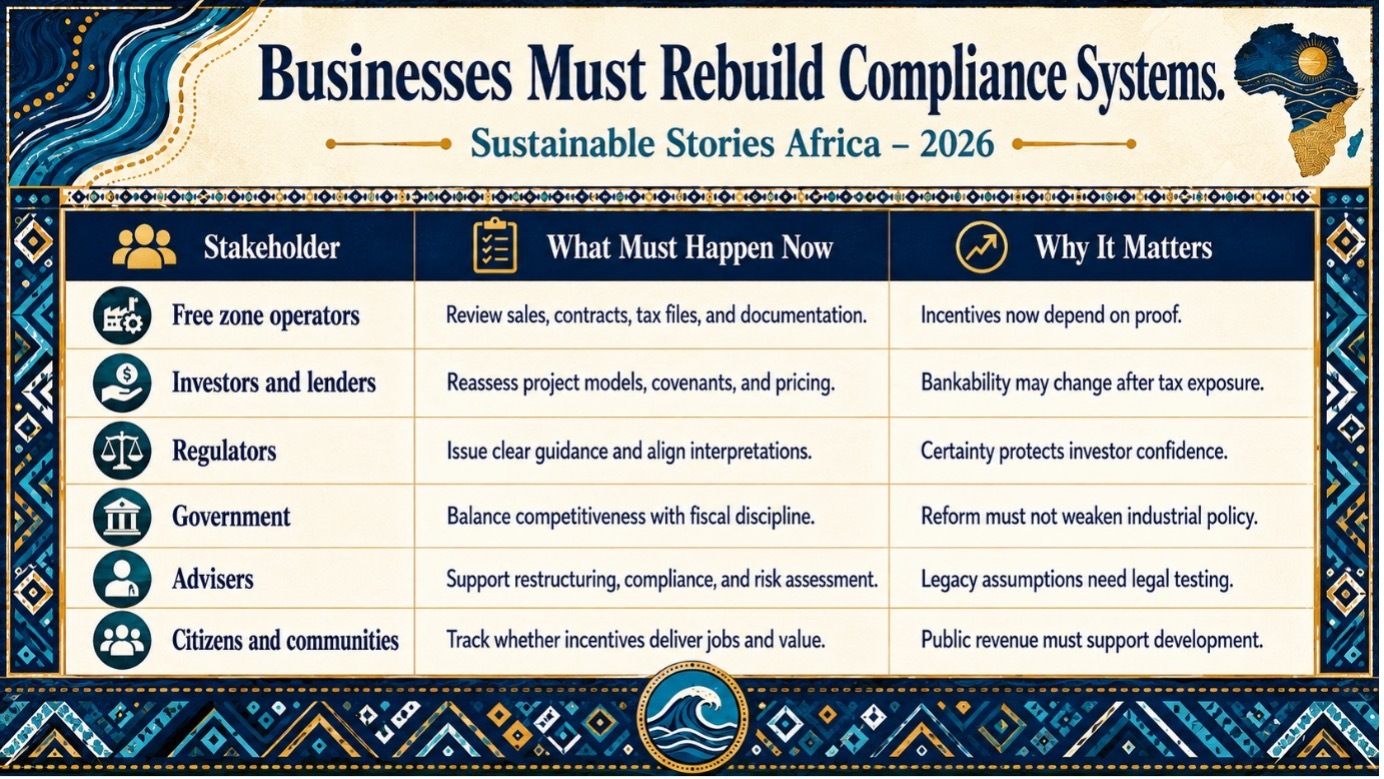
The government has work to do as well. The reform strengthens Nigeria's investment climate only if implementation stays clear, consistent, and predictable; investors adapt to rules they understand, not uncertainty or abrupt enforcement.
Path Forward – Make Incentives Earn Public Trust
Nigeria should use the transition to build a free-zone model anchored on exports, jobs, compliance, and transparency.
Operators should treat January 1, 2028, as firm unless a formal Presidential order extends it.
The goal is not to punish investment. It is to ensure that incentives deliver measurable public value, strengthen governance, and keep Nigeria competitive in a global economy where tax substance now matters.