
Nigeria’s telecoms and media regulation is shifting from legacy licensing to a broader digital governance model that covers platforms, data, cybersecurity, broadband, competition and media plurality.
The test is whether regulation can protect consumers while accelerating innovation, digital inclusion and infrastructure investment.
Digital Rules Now Shape Everyday Life
Nigeria’s communications and media sectors are entering a more complex regulatory era, where telecoms law, broadcasting rules, data protection, cybersecurity, platform oversight and competition enforcement increasingly overlap.
This article draws on Panoramic Telecoms & Media: Nigeria, generated on June 4, 2026, with law stated as of May 18, 2026, and contributions by Tamuno Atekebo, Favour Osayuwamen and Chukwuyere Elzuogu of Streamsowers & Köhn.
The document shows a market in transition.
- The Nigerian Communications Commission regulates communications.
- The National Broadcasting Commission regulates broadcasting
- The Federal Competition and Consumer Protection Commission increasingly shapes digital-market accountability.
For citizens, this is about access, affordability, privacy, content, safety and who controls the pipes and platforms of Nigeria’s digital economy.
Nigeria’s Digital Market Is Being Rewired
Nigeria’s telecoms and media landscape is no longer defined only by mobile calls, radio stations or television licences
It is now shaped by broadband roll-out, mobile virtual network operators, satellite connectivity, platform governance, data localisation, cybersecurity, digital broadcasting and competition enforcement.
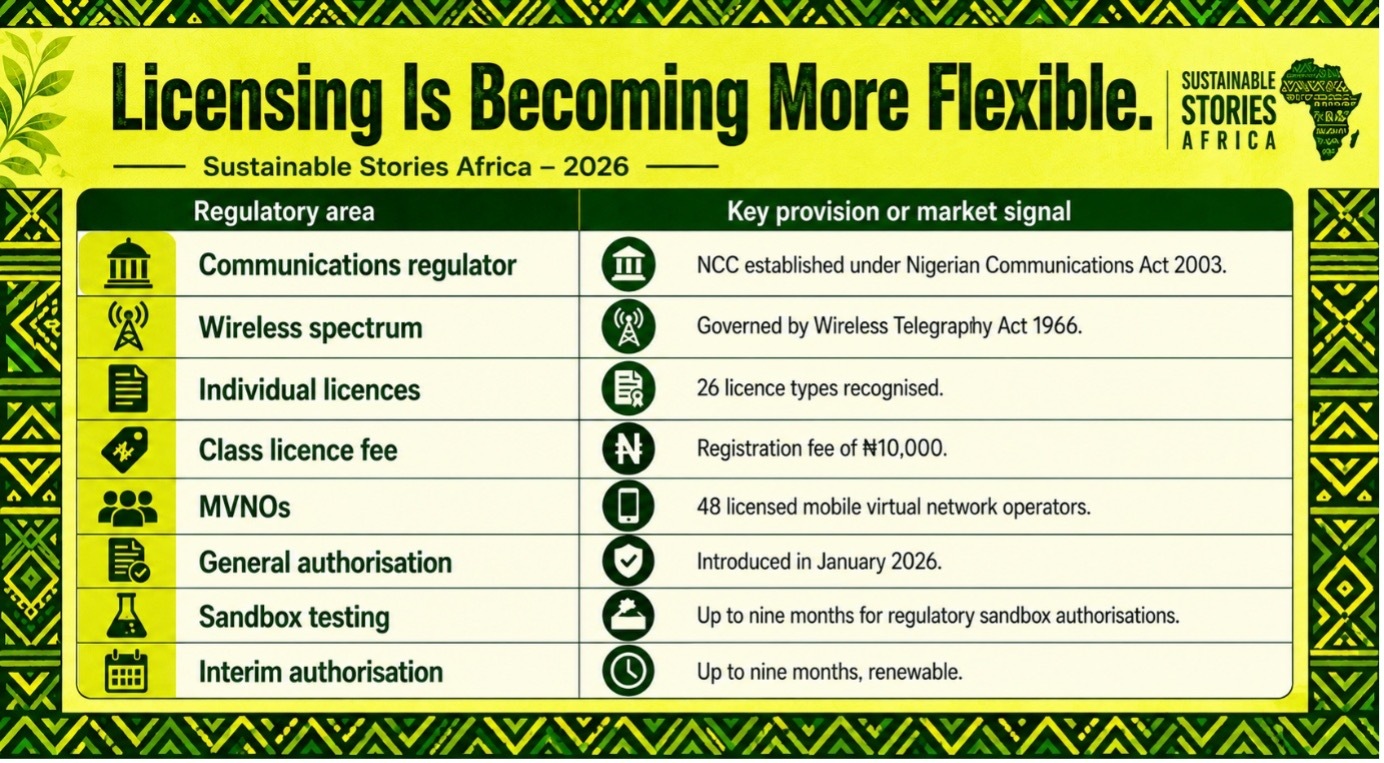
- The Nigerian Communications Act 2003 established the NCC as the principal communications regulator, while the Wireless Telegraphy Act 1966 continues to frame wireless spectrum use.
- The Ministry of Communications, Innovation and Digital Economy is responsible for broad-sector policy, including the use of communications as a platform for national economic and social development.
- In the media, the National Broadcasting Commission Act regulates broadcasting and establishes the NBC as the broadcast regulator.
The Broadcasting Code sets minimum standards of broadcasting.
Together, these frameworks show a sector moving from analogue regulation to a hybrid digital governance system.
Licensing Is Becoming More Flexible
A major shift is visible in licensing. Nigeria’s communications sector operates through two broad authorisation frameworks: individual licences and class licences.
Individual licences are service-specific and can be granted through auctions, first-come, first-served procedures, beauty contests or administrative processes.
The report notes 26 licence types under the individual licence category, including internet services, fixed wireless access, unified access services, electronic directory services, international gateway services, collocation services and commercial basic radio communications network services.
Class licences operate as general authorisations and require registration with the NCC. They cover services such as sales and installation of terminal equipment, repairs and maintenance of telecom facilities, cybercafés and cabling services.
Innovation Now Needs Controlled Experimentation
One of the most important developments is the NCC’s General Authorisation Framework, introduced in January 2026. It creates flexible pathways for new services that fall outside existing licensing categories.
The framework uses three instruments: Proof of Concept, Regulatory Sandbox and Interim Service Authorisation.
- Proof of Concept permits controlled non-public testing for up to three months, renewable once.
- Regulatory Sandboxes allow limited real-world deployment to users under strict supervision for up to nine months.
- Interim Service Authorisations provide temporary pathways for full commercial service pending the creation of formal licensing categories.
This is important for emerging technologies such as satellite-to-device connectivity, hybrid broadband systems, non-terrestrial networks, digital platforms and AI-enabled communication services.
It allows innovation to be tested without abandoning consumer protection, cybersecurity, data privacy or regulatory oversight.
Competition Rules Are Getting Sharper
Nigeria’s telecoms competition framework is also evolving. Historically, the NCC has imposed ex-ante obligations where operators held significant market power.
Earlier market studies identified voice, data, upstream and downstream segments for regulatory attention.
The document records that MTN held significant market power in mobile voice, while Globacom and MTN collectively held significant market power in upstream segments.
Obligations have included accounting separation, tariff controls, required submissions to the NCC and interconnection obligations.
The NCC has also engaged a consultant to conduct an independent market study on competition in the telecoms sector.
The study focuses on factors such as infrastructure availability, market concentration, pricing behaviour, access to essential facilities, consumer usage patterns, affordability, switching behaviour and quality of service.
- For consumers, this matters because market power can affect pricing, service quality, network access and innovation.
- For investors, it signals that scale alone will not be enough; dominant firms must increasingly prove fair access, transparency and consumer value.
Data, Cybersecurity, and Platforms Converge
Nigeria’s telecoms rules now intersect strongly with data protection and cybersecurity. The Nigeria Data Protection Act 2023 and the Nigeria Data Protection Commission’s General Application and Implementation Directive 2025 govern personal data processing, lawful bases for processing, data-subject rights, controller obligations and cross-border data transfers.
In February, the NDPC and NCC executed a memorandum of understanding that aims to improve personal data and privacy protections in the telecoms sector.
This reflects a regulatory shift from isolated oversight to coordinated digital governance.
Cybersecurity is also central. The Cybercrimes Act 2015 and Cybercrimes Amendment Act 2024 provide the main legal framework for cybercrime prevention, detection and prosecution.
They also support the protection of critical national information infrastructure and computer systems.
Platform regulation is expanding too. The revised Internet Industry Code of Practice introduces obligations for online and digital communications platforms.
Separately, NITDA’s Code of Practice for Interactive Computer Service Platforms requires large platforms with more than one million registered users to maintain local incorporation, a physical Nigerian contact address, a liaison officer and human oversight of automated tools.
Broadband And Satellites Define Inclusion
Nigeria’s digital inclusion story is now linked to broadband and non-terrestrial networks.
The report highlights continued reforms in spectrum management, broadband access and satellite connectivity.
For next-generation access networks, wholesale wireless access service licensees must roll out services across state capitals over time, beginning with three state capitals in year one and expanding further in subsequent years.
The government’s Project BRIDGE aims to deploy a nationwide fibre backbone through a public-private partnership.
Satellite connectivity is also becoming more prominent.
The NCC’s consultation on satellite direct-to-device connectivity reflects an emerging regulatory focus on non-terrestrial networks that can strengthen coverage, emergency communications and resilience, especially in remote and underserved areas.
For households and small businesses, these policies are not abstract.
They affect whether children can learn online, whether traders can accept digital payments, whether rural clinics can connect to health systems, and whether local content creators can reach markets beyond their immediate communities.
Media Reform Meets Digital Broadcasting Transition
Nigeria’s media sector is also undergoing structural change.
Broadcasting ownership is restricted: NBC must be satisfied that a broadcast licence applicant is not fronting for a foreign interest, and foreign investors' participation is limited to a position in which Nigerians hold the majority of the shares.
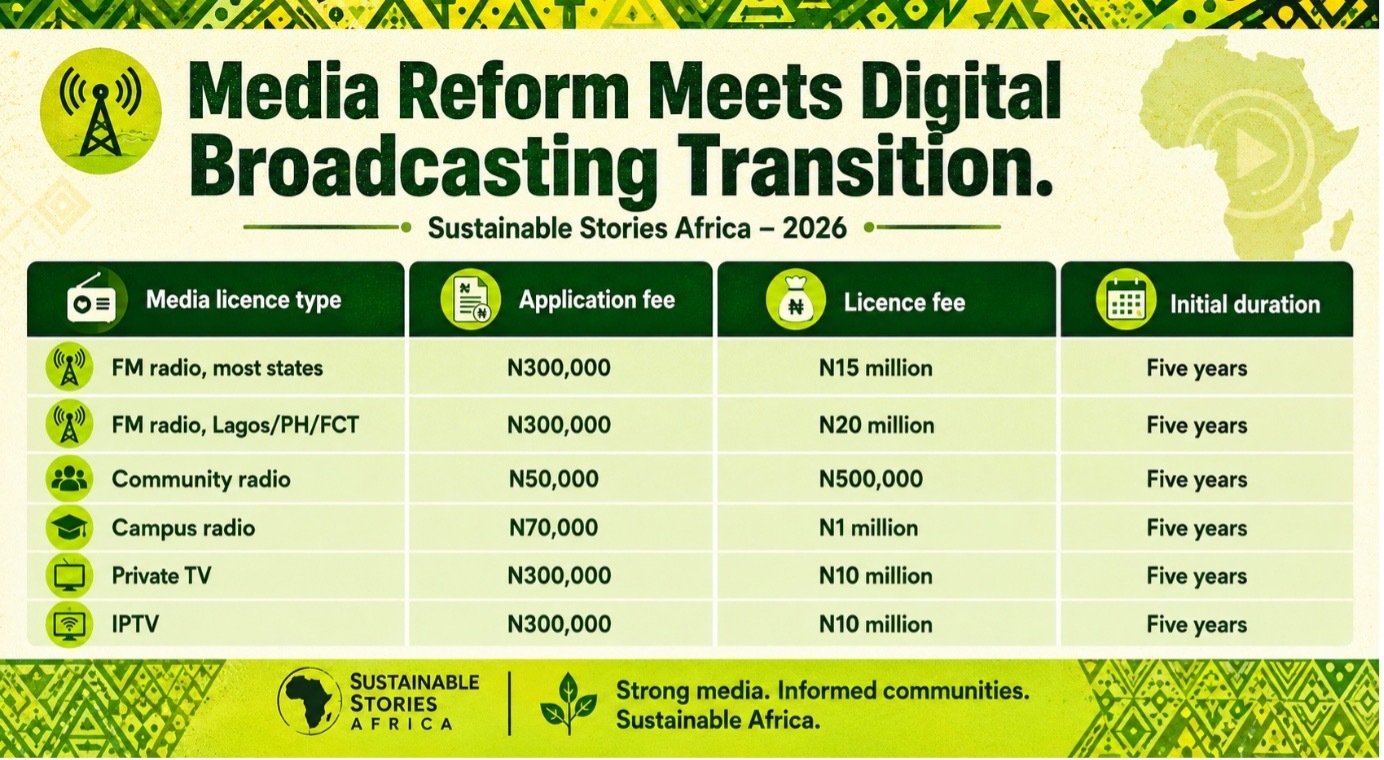
Licensing fees vary by service. FM radio licences can cost N15 million or N20 million depending on location, while community radio licences cost N500,000 and campus radio licences cost N1 million.
Private TV, multi-channel TV and IPTV licences are listed at N10 million, with IPTV multichannel pricing still under review.
The digital switchover remains central.
Nigeria’s DSO programme is tied to satellite-enabled infrastructure, nationwide access, high-definition channels and possible reallocation of freed-up frequencies to mobile broadband.
Local Content Remains A Policy Anchor
Local content remains a major feature of Nigeria’s broadcasting regime.
The Broadcasting Code permits foreign content where it is relevant to Nigerian education, information or entertainment, but local content rules are designed to support Nigerian cultural expression and production capacity.
A broadcast programme may qualify as local content where the producer, directors or authors are Nigerian.
The amended Broadcasting Code also requires that 75% of leading authors, the major supporting cast, programme expenses, and post-production expenses are Nigerian-linked in defined circumstances.
For Nigeria’s creative economy, this is a development lever.
- Better enforcement could support local producers, actors, editors, language communities and regional studios.
- Poor implementation, however, could increase costs or limit content diversity if regulation becomes rigid rather than developmental.
Regulators Must Balance Control And Growth
The action agenda is clear. The NCC, NBC, FCCPC, NDPC and NITDA must coordinate more effectively as telecoms, media, platforms, data and competition converge.
Without coordination, companies face overlapping obligations, while consumers may still lack practical remedies.
- Operators should prepare for deeper compliance on data privacy, cybersecurity, customer terms, platform governance, competition rules, spectrum usage and reporting.
- Media companies should strengthen local content systems, licensing compliance, advertising approvals and digital distribution strategies.
- The government must also ensure that regulation does not become a barrier to innovation.
The General Authorisation Framework is promising because it links experimentation to accountability.
Its success will depend on transparent processes, timely approvals and predictable supervisory standards.
Path Forward – For Digital Inclusion
Nigeria’s next digital reform phase should prioritise affordable broadband, fair competition, stronger data protection and coordinated platform oversight.
The opportunity is significant: regulation can either slow innovation or make it safer and more inclusive.
The best outcome is a digital market where citizens are protected, investors have clarity, and local creators can grow.