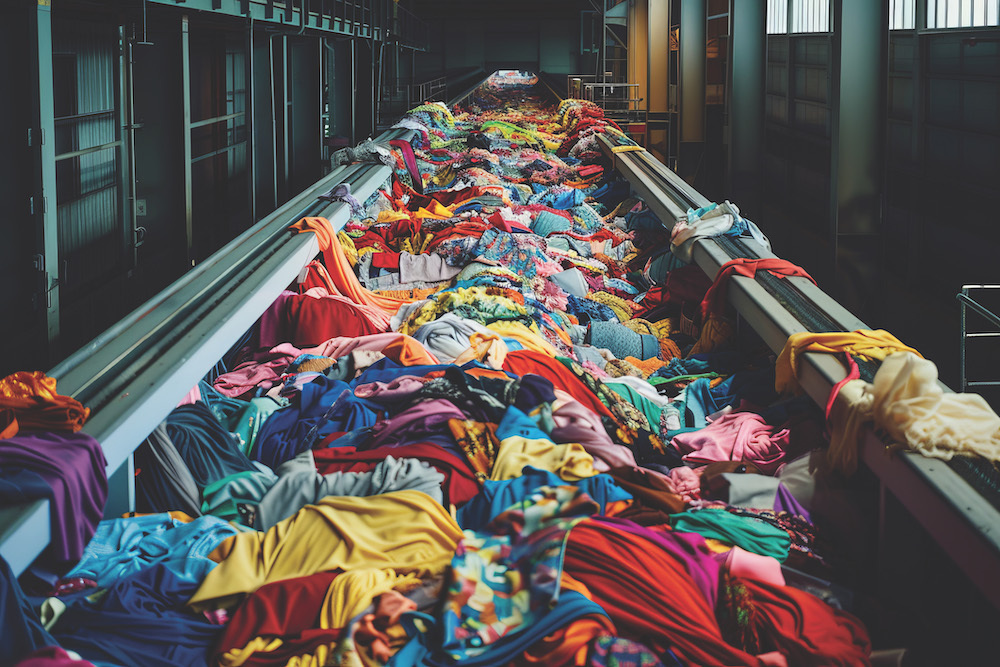
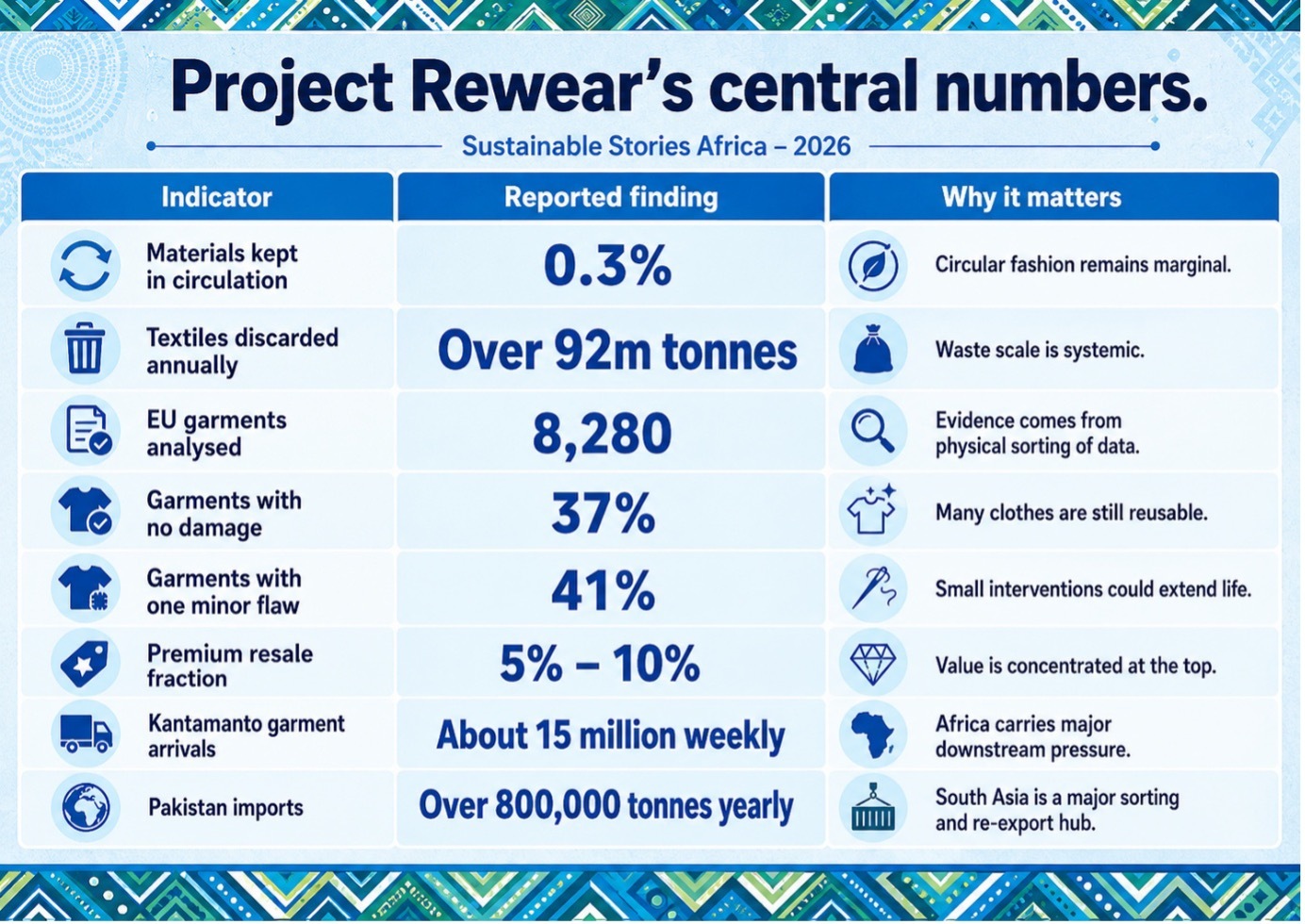
Fashion’s circular promise is colliding with a hard market reality: only 0.3% of materials stay in circulation, while more than 92 million tonnes of textiles are discarded yearly.
Project Rewear says reuse, repair and resale can help; however, only if the system tackles overproduction and unfair waste flows.
For Africa and other emerging markets, the sharper question is whether Rewear becomes a route to jobs, dignity and lower emissions, or another channel for exporting risk.
Fashion’s Circular Promise Meets Waste Reality
The global fashion industry’s secondhand boom is no longer a niche sustainability story. It is now a development, trade, climate and justice story, with Africa and Asia standing at the receiving end of a system that still produces too much, sells too cheaply and discards too easily.
A May 2026 study by Fashion for Good and Circle Economy, Sorting for Circularity: Project Rewear, argues that keeping clothes in use can reduce waste, support livelihoods, and unlock new circular business models.
However, its central warning is direct: Rewear cannot fix fashion’s waste crisis if brands keep expanding production and shifting disposal burdens to lower-income markets.
The report draws on garment analysis in four European countries, case studies in Ghana and Pakistan, and pilots with reverse fashion.
United Repair Centre and Save Your Wardrobe. Its findings show a system full of reusable material; however, short on incentives, infrastructure and fairness.
A Waste Crisis Hidden Inside Closets
The most important finding is also the simplest: the problem is not that most used clothing is beyond saving. The problem is that the economics of saving it often do not work.
Project Rewear analysed 8,280 post-consumer garments from sorting facilities in the Netherlands, Spain, Lithuania and Poland.
It found that 37% had no damage and another 41% had only one minor flaw, yet repairs, cleaning and other “preparation for reuse” activities remain limited because costs frequently exceed expected resale value.
At the same time, only the top 5% – 10% of garments typically command premium prices in Rewear markets.
That means an item can be technically wearable but commercially invisible. A stained jacket, a faded pair of jeans or a jumper with pilling may still have use value; however, not enough market value to justify labour, logistics, photography, authentication, cleaning or repair.
What The Numbers Reveal About Rewear
The global fashion industry is in crisis. Textiles account for between 2% and 8% of global greenhouse gas emissions, consume approximately 215 trillion litres of water annually, and contribute 9% of microplastic pollution. With 100 – 150 billion garments produced each year and up to 30% never sold, oversupply has become structural.
The burden of this excess falls disproportionately on the Global South. Around 25% of separately collected EU textiles are exported, 46% to Africa and 41% to Asia.
EU used-textile exports have tripled since 2000, reaching nearly 1.7 million tonnes in 2023.
Ghana's Kantamanto Market in Accra illustrates the human cost. Home to 30,000 traders, the market receives bales classified as rewearable; however, researchers found 86.5% of 2,474 sampled garments were damaged.
Traders absorb quality risks without visibility, navigating exchange-rate volatility, freight costs, and import duties. One trader summarised the core problem plainly: "The supply exceeds the demand."
Pakistan occupies a pivotal transit role, importing over 800,000 tonnes annually, with 30% – 35% re-exported to East African markets.
Karachi's Export Processing Zone and Faisalabad's recycling clusters underscore how secondhand textiles now drive complex, cross-continental supply chains.
Circular Markets Can Reward Better Choices
Project Rewear does not dismiss Rewear. It argues the opposite: reuse, repair, resale and upcycling can create economic, social and environmental value when properly supported.
The opportunity is already visible. Ghana’s Kantamanto ecosystem includes traders, repairers, upcyclers, tailors and waste collectors who keep large volumes of clothing in use.
Pakistan’s sorting, resale and recycling networks show how secondhand flows can support livelihoods and feed material recovery systems.
Europe, meanwhile, has growing infrastructure, policy momentum and digital resale platforms.
The pilot highlights where the business case can be developed. Reverse-fashion tested AI-enabled sorting to capture higher-value garments more efficiently.
United Repair Centre worked to divert 164 pieces from lower-value export towards higher-value European secondhand markets through repair and creative repair.
Save Your Wardrobe built an open-source aftersales diagnostic tool to help brands identify repair and care opportunities, with broader pilot data showing aftersales lead times reduced from a 21-day baseline to a mean of three days.
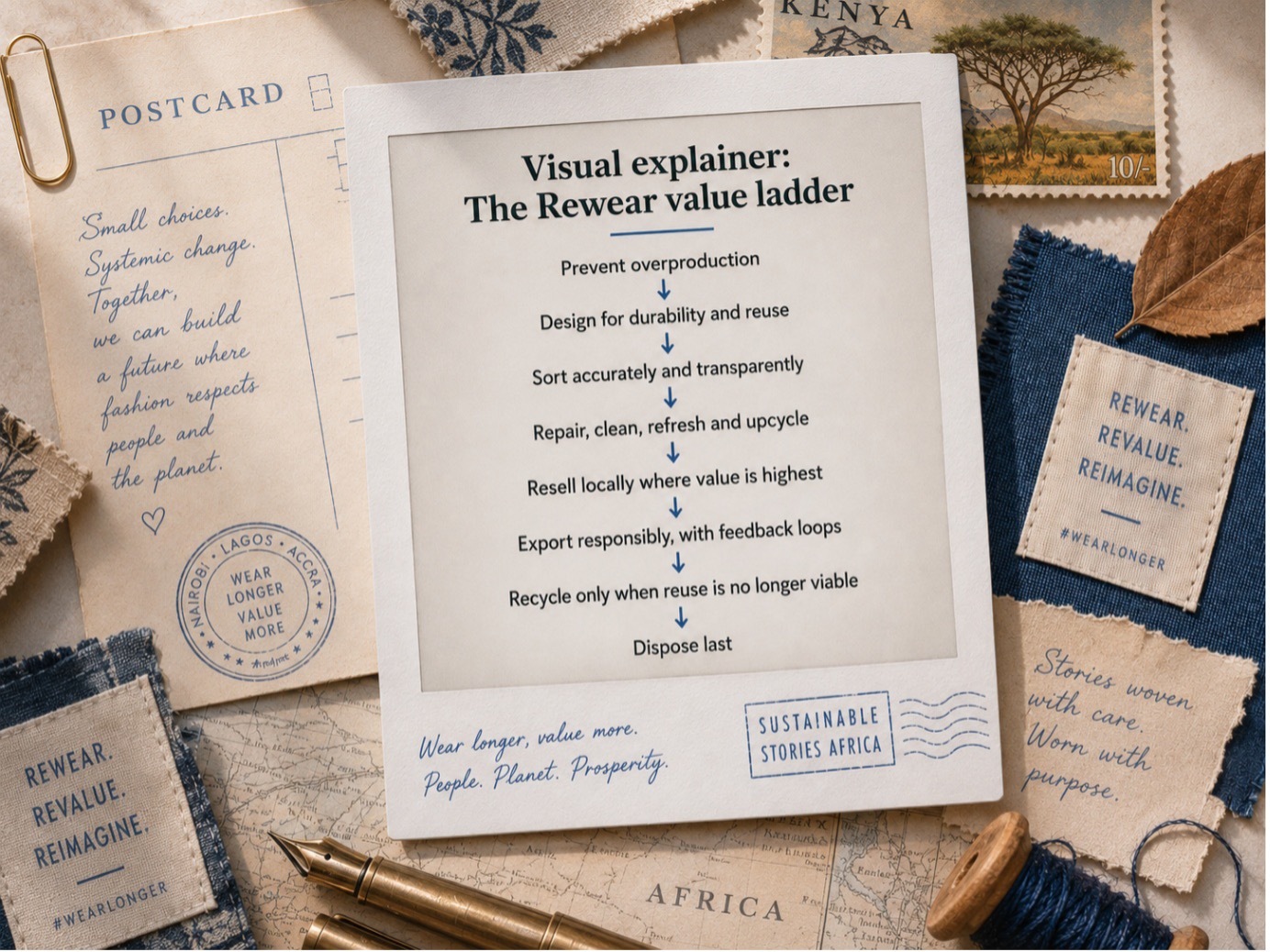
This ladder matters because the report’s core message is not simply “more resale.” It is better sequencing, fairer responsibility and stronger incentives across the full value chain.
What Stakeholders Must Do Next Together
For brands and retailers, the report’s challenge is direct: move Rewear from a sustainability side project to business as usual. That means dedicated teams, measurable KPIs, revenue targets for repair and resale, better forecasting to reduce overproduction, and product design informed by what happens at the end of use.
The report highlights targeted repair strategies, especially for categories such as outerwear and denim, where repair economics appear stronger.
For policymakers, the task is to correct a market that still favours cheap new clothing over longer-lasting garments.
- This includes supporting repair and reuse actors, considering VAT exemptions, designing Extended Producer Responsibility schemes that fund not just collection and recycling but also reuse and preparation for reuse, and improving trade classifications so “rewearable” exports are not used to disguise waste.
For investors and financial institutions, circularity needs to include models.
- The report calls for patient capital that recognises durability, reuse and material retention as value, while also adapting funding mechanisms so informal and semi-formal actors, repairers, traders, sorters and reuse networks can access finance and technical support.
For collectors, sorters and retailers, the next frontier is operational:
- AI-enabled and demand-driven sorting, repair assessment protocols, worker upskilling, transparency around sorting criteria, and feedback loops between exporters, importers and secondhand retailers in destination countries. Without those links, circular fashion risks remaining a clean story at the point of collection and a messy reality at the point of disposal.
The deeper issue is cultural. Fashion still values novelty more than longevity. Rewear asks the market to value what already exists: the coat that can be repaired, the denim that can be resold, the T-shirt that should never have been overproduced, and the trader whose labour keeps waste from becoming pollution.
Path Forward – A Just Circular Fashion
Rewear can help build a lower-waste fashion economy; however, only if brands reduce overproduction, policymakers reward reuse, investors fund circular infrastructure and destination markets receive fair support, rather than hidden burdens.
For African markets, the priority is justice-led circularity: better-quality imports, stronger local repair systems, financing for informal actors, and policies that protect livelihoods while rebuilding domestic textile capacity.
Circular fashion must not become waste colonialism with better branding.