
Artificial intelligence may create new opportunities, but young people will need more than optimism to access them.
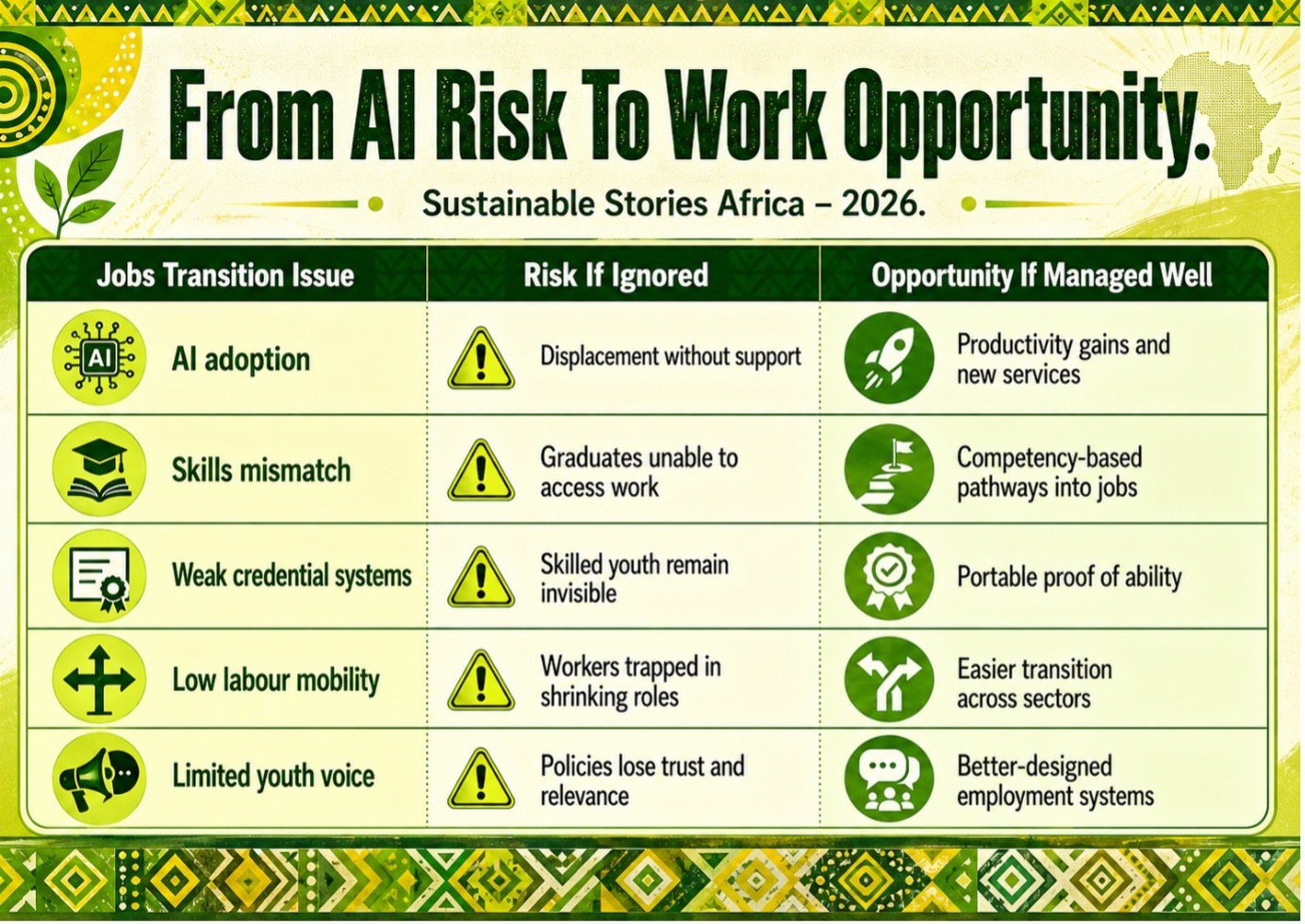
Youth Summit 2026 showed that the real frontier is not only AI adoption. It is skills, proof, labour mobility, trusted credentials and institutions that help workers move as jobs change.
AI’s Jobs Promise Needs Access
The global future-of-work debate is often stuck between two extremes. One side treats artificial intelligence as a job destroyer.
The other treats it as a productivity miracle. The more useful question is narrower and harder: who will be able to benefit?
At the World Bank Group Youth Summit 2026, the “Jobs in a Changing World” panel moved the discussion toward that question.
The message was that AI can support learning, productivity and enterprise growth, but only when young people have the skills, credentials and mobility to turn new tools into real income.
For emerging markets, that is the centre of the matter. Technology can widen opportunity, but it can also widen the distance between those who can prove their value and those left invisible to employers, financiers and platforms.
Skills Are Becoming The New Currency
The World Economic Forum expects a major churn in the global labour market by 2030. New jobs will emerge, old roles will decline, and many existing occupations will be redesigned.
In that environment, a worker’s future will depend less on a single qualification earned once and more on continuous learning.
The Youth Summit discussion reflected this shift. Panellists highlighted the movement toward skills-first hiring, in which employers value demonstrated capabilities alongside or sometimes above formal credentials.
That shift could be transformative for young people who learn through non-traditional routes: bootcamps, apprenticeships, online courses, community innovation hubs, small-business experience or informal work. But skills-first systems only work when proof is trusted.
A young woman who can repair solar systems, analyse customer data, operate digital accounting software or manage aquaculture sensors needs more than competence.
She needs a recognised way to show that competence to employers, clients, banks and procurement officers.
This is why credential infrastructure is becoming part of jobs infrastructure.
Mobility Will Decide The Winners
Skills alone are not enough. Workers also need mobility.
Labour mobility is the ability to move from one role, sector, location or business model into another without losing all accumulated value.
It requires transferable skills, recognised credentials, affordable retraining, job information, social protection and employers willing to hire based on potential.
Without mobility, AI disruption becomes harsher. A worker may know how to learn but still be unable to move if training is unaffordable, credentials are not recognised, childcare is unavailable, internet access is weak, or employers require experience that young people cannot get.
The Youth Summit panel reportedly used labour mobility to explain why AI outcomes can differ across countries. Where workers can shift into emerging roles, technology can expand employment. Where mobility is blocked, displacement can become permanent.
This lesson is highly relevant for African labour markets, where informality, weak training systems and limited social protection already make transitions difficult.
The future of work cannot be built on telling young people to “adapt” while leaving the systems around them unchanged.
AI Can Support Inclusive Growth
The promise is still real. AI tools can help young entrepreneurs draft business plans, analyse markets, translate content, improve customer service, automate simple tasks, access learning and reduce costs.
In agriculture, AI-enabled tools can support weather information, pest alerts, soil analysis, irrigation planning and market matching.
In health and education, they can improve administration, tutoring and diagnostics support when used responsibly.
- For businesses, the opportunity is productivity. Small firms that use digital tools well can reduce waste, reach customers faster and better manage operations.
- For governments, AI can improve labour-market intelligence by identifying skills gaps, sector demand and training outcomes.
However, the benefits must be designed, not assumed.
- If AI is deployed without governance, it can reproduce bias in hiring, exclude people without digital access and concentrate gains among already advantaged workers.
- If credential platforms are expensive or fragmented, they can create another gatekeeping system.
- If training programmes are not linked to demand, they can produce certificates without livelihoods.
Build Skills Proof, Not Training Theatre
The action agenda is practical. Governments should create national skills taxonomies that identify the competencies required in priority sectors.
These frameworks should be simple enough for employers to use and flexible enough to evolve as technology changes.
Training providers of AI should be measured through outcomes. Completion rates matter, but placement, income progression, employer satisfaction and learner mobility matter more.
Public funding should reward programmes that move young people into real work.
- Employers should redesign hiring. Entry-level roles should focus on competencies, portfolios, assessments and apprenticeships.
- Firms should invest in young workers instead of treating the skills gap as someone else’s problem.
- Development partners and financiers should support interoperable credential platforms, youth enterprise finance, digital public infrastructure and local innovation ecosystems.
They should also fund evidence, so governments know which programmes actually improve livelihoods.
Young people should be treated as co-designers.
Their lived experience can reveal where systems fail: the application fee that blocks access, the unpaid internship that excludes poor applicants, the certificate employers do not recognise, the digital platform that rewards visibility over value.
Path Forward- Make AI A Youth Employment Dividend
The path forward is to make AI adoption inseparable from inclusion. Skills-first hiring, trusted credentials, labour mobility and youth participation must become core parts of national jobs strategies.
The future of work should not be a lottery where only the already-connected win. With better systems, AI can become a bridge to opportunity rather than another barrier.