
Economic formulas are not only classroom tools. They are practical decision aids for reading inflation, jobs, output, demand, costs, revenue and investment risks.
For African economies facing price shocks, employment pressure, fiscal limits and business uncertainty, basic economic literacy can strengthen public policy, corporate planning and household resilience.
Economic Literacy Is Now Market Infrastructure
In a period of persistent inflation, currency pressures, youth unemployment and rising business costs, economics is no longer a subject reserved for classrooms, analysts or central banks.
It has become a survival language for citizens, investors, entrepreneurs and policymakers trying to understand why prices rise, why jobs disappear, why profits shrink and why governments make difficult trade-offs.
A FinPolNomics Green Finance and FinPolNomics Analytica educational brief on “10 Important Economics Formulas” frames the issue clearly: the economy becomes practical when people can measure output, prices, jobs, demand, supply, revenue, profit and interest.
That idea fits Sustainable Stories Africa’s editorial approach of connecting data, governance and lived realities through an accessible news-explainer format.
For African and emerging markets, the stakes are immediate. A farmer, manufacturer, student, civil servant, bank analyst or finance minister may not use the same spreadsheet, but they are all affected by the same economic forces.
The formulas explain the forces behind daily decisions.
Formulas Explain Everyday Economic Pressure
The most important insight from the brief is not that there are ten formulas to remember. It is that each formula translates an economic pressure into something measurable.
- Gross Domestic Product explains national output.
- Inflation rate explains the pace at which purchasing power is eroded.
- The Unemployment rate measures joblessness.
- Elasticity shows how consumers and suppliers react to price changes.
- Total revenue, total cost and profit explain whether businesses can survive.
- The multiplier shows how spending ripples through an economy.
- Real interest rate shows the true return after inflation.
Together, these formulas form a basic operating system for economic decision-making.
They help people move from opinion to evidence.
In African markets, that shift matters because many decisions are made under pressure.
A small business owner deciding whether to raise prices, a government evaluating subsidy costs, a bank assessing loan affordability, or a household planning school fees all face versions of the same question: what does the data say?
The formulas do not remove uncertainty. However, they make uncertainty easier to organise.
Ten Formulas Behind Market Decisions
The formulas highlighted in the brief can be grouped into four practical decision areas: national output, price stability, labour market health and business performance.
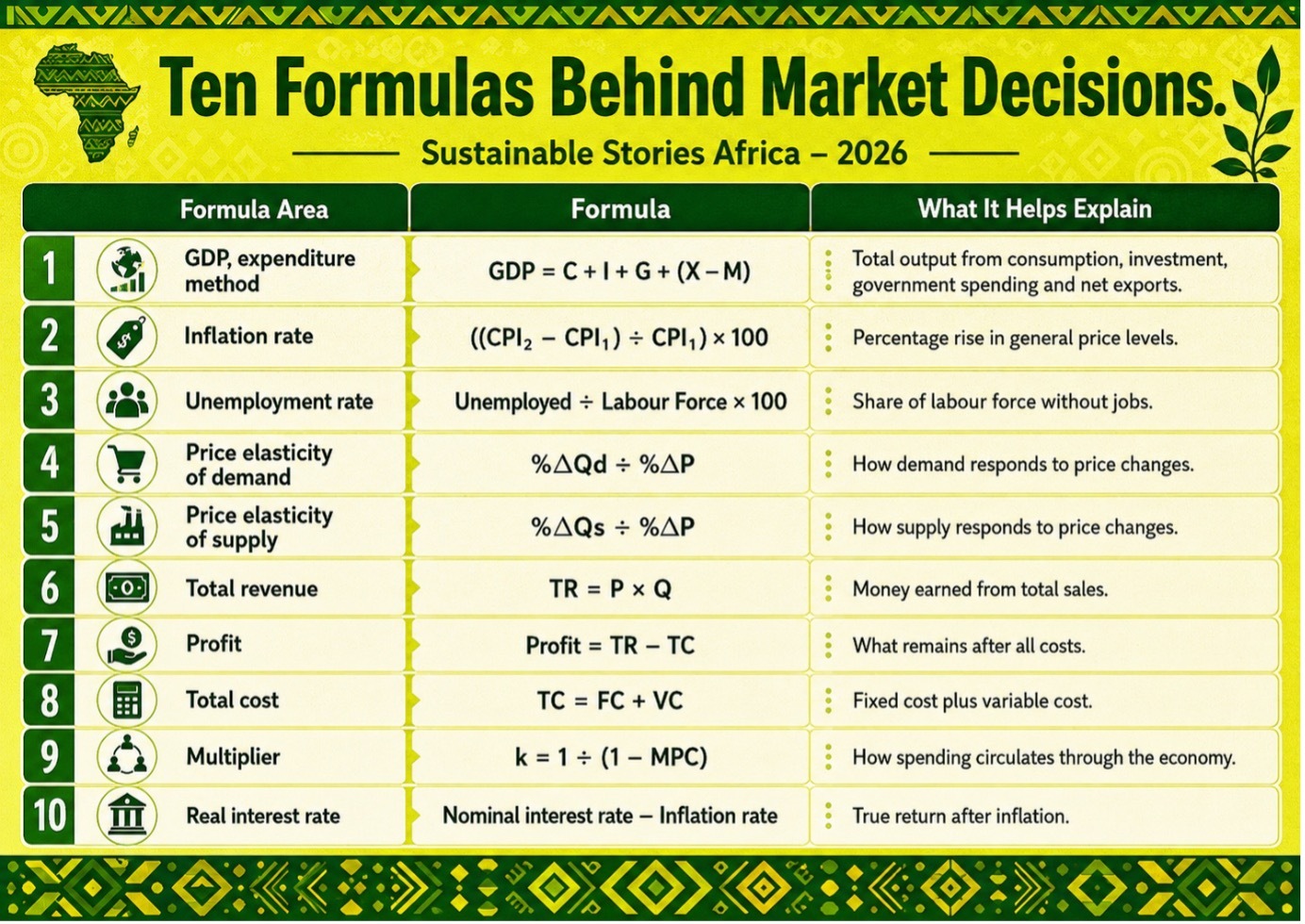
The GDP formula is especially useful for policy conversations. It shows that national output is not driven by a single factor only.
Consumption, investment, public spending and trade all matter.
- When imports rise faster than exports, net exports weaken GDP.
- When investment slows, future productive capacity is affected.
The inflation rate is equally central. It explains why a salary increase may still feel inadequate if prices are rising faster.
- For governments, it helps assess cost-of-living pressure.
- For investors, it shapes return expectations.
- For households, it determines purchasing power.
The Unemployment rate gives structure to one of Africa’s most urgent development concerns: jobs.
However, the formula also shows its limits. It measures people in the labour force who are unemployed, but may not fully capture informal work, discouraged workers or underemployment.
In many African economies, those gaps matter.
Economic Literacy Can Improve Choices
The strongest opportunity is that these formulas can democratise economic understanding.
For citizens, they provide language for accountability. Instead of saying “things are hard,” people can ask sharper questions:
- Why is inflation outpacing wages?
- Why are public investments not increasing productivity?
- Why are imported goods affecting local prices?
- Why are interest rates high even when nominal returns appear attractive?
For businesses, the formulas improve pricing and planning. Total revenue, total cost and profit are not abstract. They help firms understand whether growth is real or cosmetic.
- A company can sell more units and still lose money if costs rise faster than revenue.
- A retailer can raise prices and still lose customers if demand is elastic.
- A manufacturer can expand production, but struggles if variable costs keep climbing.
For governments, the formulas support better policy communication.
- When fiscal choices are explained in terms of output, employment, inflation and investment, citizens are more likely to understand the trade-offs.
Economic policy becomes less mysterious and more accountable.

This is where economics intersects with ESG and development. Better economic literacy can support fairer pricing conversations, stronger consumer protection, more transparent fiscal policy, responsible lending and better market participation.
Make Economic Knowledge More Practical
The next step is to move economic education beyond memorisation.
Schools and universities should teach formulas through African case studies.
- Fuel prices, food inflation, exchange rates, small-business costs, youth employment and public infrastructure spending.
- Students should not only calculate inflation; they should understand what it means for transport fares, school fees and household budgets.
Media organisations should also play a stronger role. Business and development journalism can use formulas to explain why policy decisions matter.
- A story on food prices can include inflation logic.
- A story on jobs can clarify unemployment and underemployment.
- A story on tariffs can explain demand, supply and consumer welfare.
Regulators and governments should simplify public communication.
- Budget statements, monetary-policy updates and development plans should include accessible explanations of the indicators they rely on.
- Citizens cannot participate meaningfully in economic debate if the language remains closed to specialists.
Businesses should train managers and entrepreneurs to use these formulas as operating tools.
- For SMEs, this may be the difference between growth and collapse.
- Understanding fixed costs, variable costs, total revenue and profit can help business owners avoid pricing mistakes and unsustainable expansion.
Financial institutions should also develop economic literacy as part of consumer education.
- Real interest rate, for example, is crucial for savers, borrowers and investors.
- A high nominal return may be weak once inflation is considered.
Path Forward – Turn Formulas Into Decisions
Economic formulas should become everyday decision tools across schools, newsrooms, boardrooms and public institutions.
The priority is not rote learning, but applied literacy that helps people understand prices, jobs, output, costs and returns.
For African markets, this is a governance issue as much as an education issue. Better economic understanding can improve accountability, strengthen business resilience and help citizens make more informed choices in uncertain times.