
Nigeria's housing and community infrastructure problems are often described as shortages of money or assets.
A closer reading suggests another constraint: fragmented information, weak trust and stakeholders who rarely meet around a verified project.
Dr W. Akhator-Eneka's proposed Housing and Infrastructure Projects Channel offers a useful question for policymakers and investors: can aggregation turn scattered needs into credible, financeable and maintainable delivery pipelines?
Fragmented needs demand one trusted table
A genuine property owner may struggle to find a serious buyer while a willing buyer avoids the market because title, pricing and agency information appear unreliable.
In another community, residents may know exactly which road, clinic or water system is failing; however, the need never becomes a properly scoped project.
These are different markets, but the blockage is similar:
- Credible participants, information and responsibilities are dispersed.
Dr W. Akhator-Eneka's August 2026 essay proposes a channel that aggregates screened housing opportunities and syndicates collaboration around community infrastructure.
The housing arm would organise preliminary information before buyers undertake their own legal, valuation and technical checks.
The infrastructure arm would convene communities, public authorities, professionals, businesses, financiers and development partners around defined service problems.
The idea matters beyond one platform.
- Across African cities, transaction opacity raises search costs and infrastructure needs remain stranded before feasibility.
The explainer is therefore less about creating another listing site than about building a disciplined pipeline from need identification to governance, finance, delivery and maintenance.
Trust gaps keep viable projects invisible
In housing, fragmentation lets the same property be advertised inconsistently, makes genuine sellers difficult to distinguish from questionable listings and forces each buyer to rebuild basic information from scratch.
Preliminary screening cannot guarantee good title; however, it can remove obviously weak opportunities and create a more orderly handover to lawyers, surveyors, valuers and engineers.
Community infrastructure faces a related visibility problem.
- A deteriorating primary-health centre may require building repairs, equipment, water, power, staff support and a workable operating budget.
Treating each item as a separate donation can produce a renovated shell without reliable services.
The practical unit of action is the complete service system, rather than the most visible asset.
Aggregation must become disciplined project preparation
An aggregator creates value only when it improves decision quality.
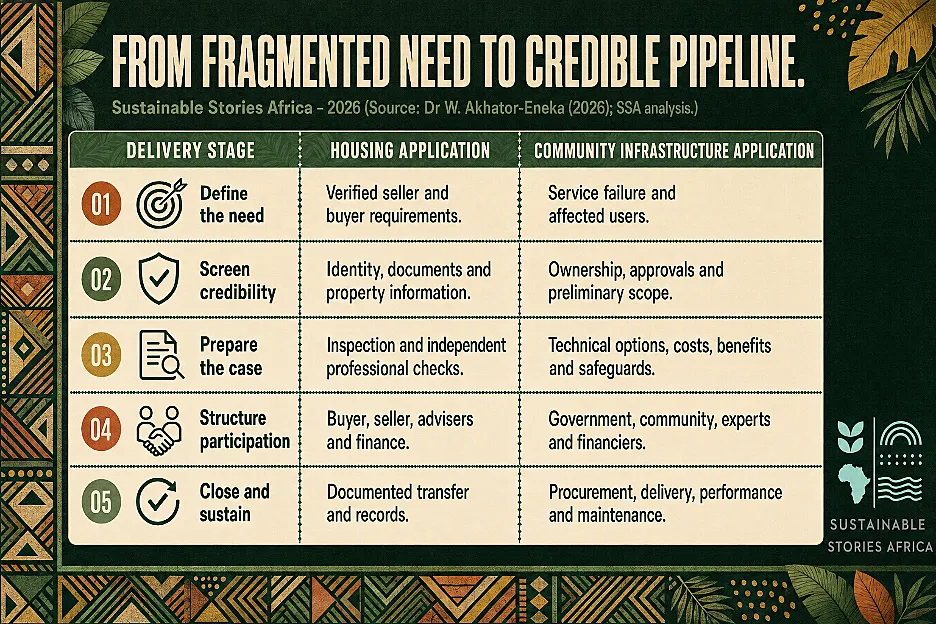
- For a house, that means consistent property information, seller identification, an initial document screen, clear disclosure of what has not been verified and access to independent professional review.
- The platform should never imply that preliminary due diligence transfers the buyer's responsibility or guarantees ownership.
For a community road:
- Preparation starts by defining the affected corridor, users, drainage condition, ownership, approvals, intervention options, cost range and maintenance responsibility.
- A targeted rehabilitation may deliver more immediate value than complete reconstruction.
Once the scope is credible, stakeholders can discuss who contributes land, approvals, technical work, grant support, commercial finance or local oversight.
This is where the source essay's BPMI concept becomes relevant.
- The proposed method connects project management, finance, risk, procurement, stakeholder engagement and sustainability instead of allowing each discipline to operate as an isolated assignment.
- International PPP guidance supports the underlying logic: identify the service need and technical solution before selecting a procurement or financing model.
Aggregation must also produce comparable data.
- Standard intake forms, document status, geolocation, preliminary cost ranges, beneficiary profiles and decision logs can make opportunities searchable without pretending every project is equally ready.
- A visible readiness score would help separate an identified need from a prepared investment and show exactly which evidence or approval is missing.
A credible pipeline creates shared value
If designed well, a trusted housing channel can reduce wasted searches for buyers, widen market access for genuine sellers and create properly sequenced work for professional advisers.
- For lenders and investors, standardised information may reveal a pipeline rather than a collection of unrelated transactions.
That does not eliminate risk; it makes risk easier to see, price and assign.
For communities, syndication can shift conversation from repeated appeals to a project proposition.
- Residents bring local knowledge and accountability; government retains statutory authority and public-interest duties; specialists establish technical requirements; businesses and philanthropies can support viable components; financiers assess repayment or sustainability.
The gain is not private participation by itself, but coordinated participation around outcomes.
The platform could also help smaller community projects reach scale. Several clinics, water points or road interventions with standard designs and monitoring may form a programme attractive to development partners or corporate contributors.
Bundling must preserve local consultation and site-specific safeguards; efficiency should not erase the differences that determine whether a service will actually work.
Governance must protect trust and affordability
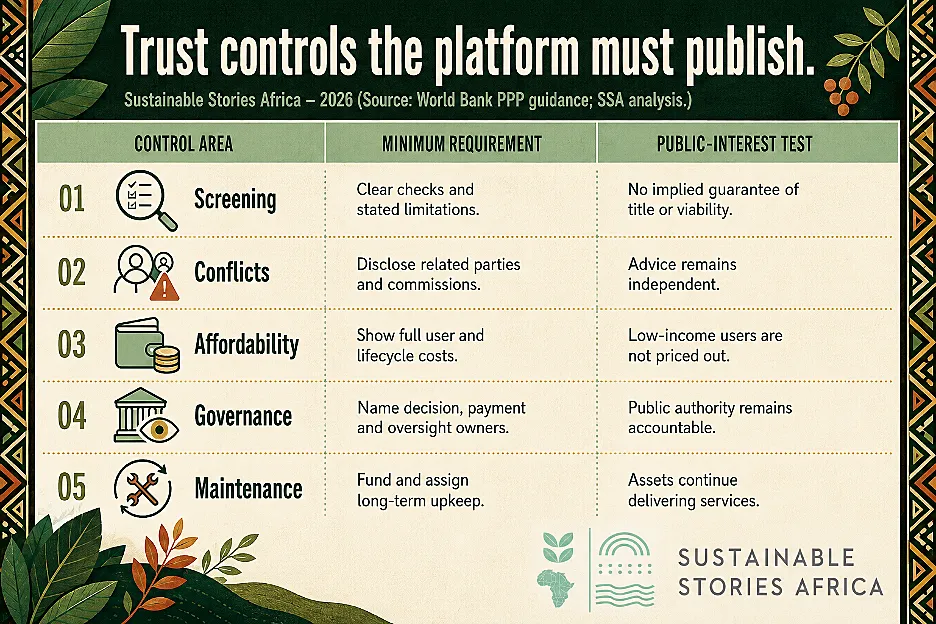
The platform would need published screening criteria, conflicts-of-interest controls, data-protection rules, complaint channels and a clear separation between marketing, verification and professional advice.
- Fees and commissions should be disclosed. Community projects require documented needs assessment, beneficiary consultation, approvals, procurement rules, environmental and social safeguards and a maintenance plan before funds are mobilised.
Public authorities should also resist treating collaboration as a substitute for government.
- The state still defines service standards, protects affordability and accounts for public assets.
- Private and philanthropic resources should close defined delivery gaps, not weaken access or transfer unmanageable risks to residents.
Every project should publish who owns the asset, who pays, who operates, how performance is measured, and what happens when arrangements fail.
A pilot should use an independent review panel and publish a short completion report.
- The report should compare the original need, promised contributions, actual cost, procurement, delivery time, beneficiary experience and maintenance status.
Without that feedback loop, the channel may aggregate activity while learning little about which collaboration structures are repeatable.
Path Forward – Build trust before mobilising project capital
The practical next step is a small, transparent pilot: a limited set of screened properties and one community project with documented need, scope, approvals, a funding plan, and a maintenance owner.
Measure success by verified transactions, service improvements, affordability, and sustained operation, rather than t the number of listings or stakeholders gathered.
Trust becomes infrastructure only when it survives delivery.