Municipal waste is no longer just an urban sanitation problem.
A new World Bank Group/IFC-backed guide frames digital waste systems as a practical tool for cutting costs, improving accountability and moving cities toward circularity.
For African and emerging-market cities, the message is clear: smart bins and apps matter, but governance, data ownership, public trust, and phased rollout will determine whether technology becomes a reform or another stalled procurement.
Trash Data Becomes New Urban Infrastructure
Waste management is entering a data era. In Waste, Reimagined: Practical Guidance for Digitalizing Waste Management, a May 2026 report developed by the World Bank Group and Eunomia, digital tools are presented as a way for municipalities and waste companies to improve planning, governance, service reliability, cost control and circular-economy performance.
The stakes are immediate for African and other emerging-market cities, where rapid urban growth is colliding with limited municipal budgets, uneven service coverage, weak billing systems and rising public pressure for cleaner streets.
The report’s central argument is practical rather than futuristic: cities do not need to begin with the most advanced technology.
They need to diagnose the problem first, start with tools that solve real service failures, protect data, train people and scale only after pilots prove value.
Waste Costs Are Becoming Governance Risks
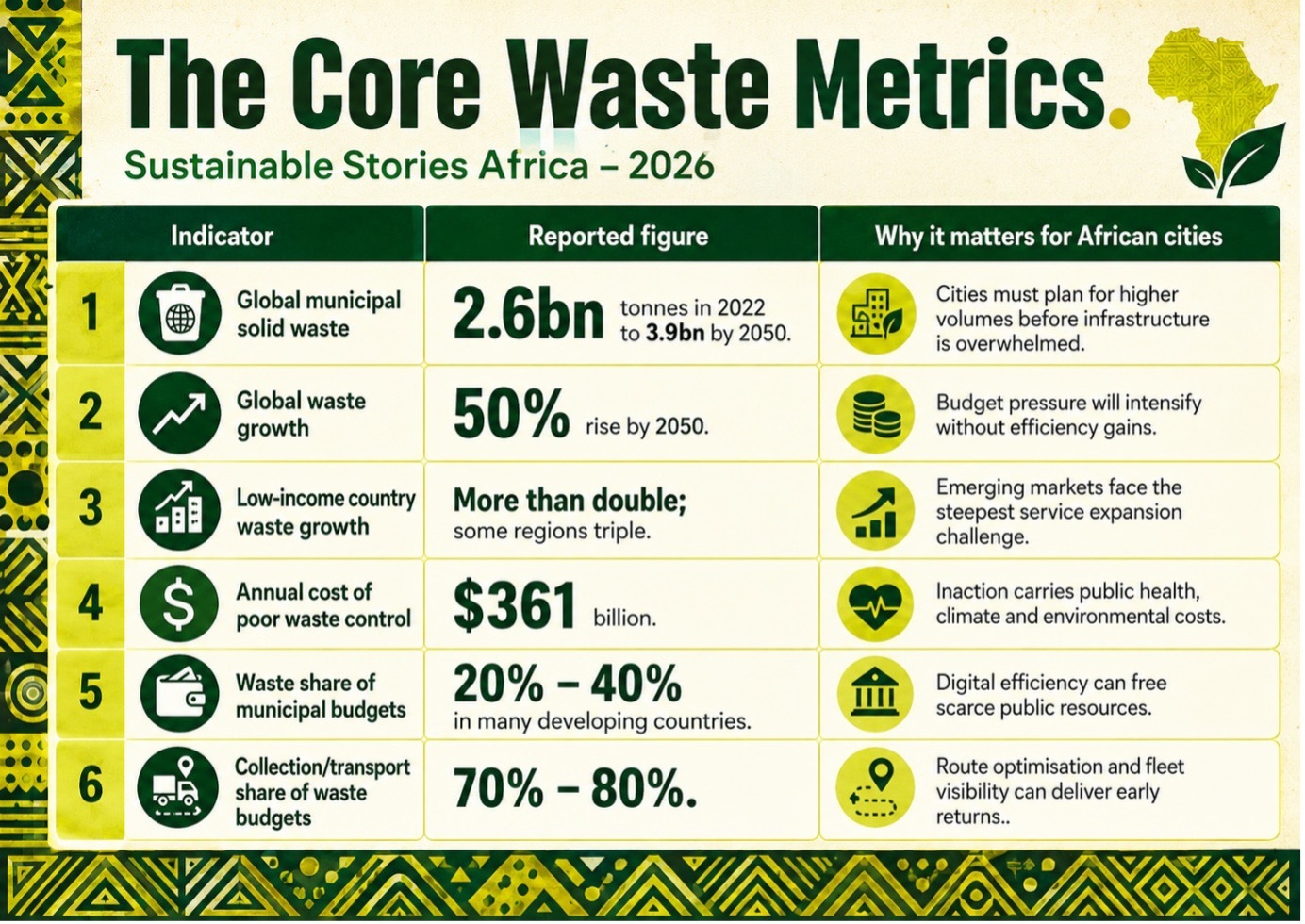
Global municipal solid waste is projected to rise by 50% by 2050, from 2.6 billion tonnes in 2022 to 3.9 billion tonnes.
In lower-income countries, volumes are expected to more than double, and in some regions triple, placing severe pressure on waste systems already struggling with collection, disposal and public trust.
The financial warning is even sharper. Uncollected waste, open dumping and open burning are estimated to impose $361 billion in global health and environmental impacts annually.
The report also warns that the share of uncontrolled municipal solid waste could rise from 38% in 2020 to 41% by 2050 if systems do not improve.
For city managers, this is not only an environmental issue. In many developing countries, waste management already consumes 20% – 40% of municipal budgets, with collection and transportation responsible for 70% – 80% of waste budgets.
That means a missed collection route, a leaking billing system or a poorly monitored contractor is not a small inefficiency; it is a fiscal governance problem.
Five Proof Points Across Waste Systems
The report groups digital waste tools into four practical categories: citizen and business engagement tools, collection and logistics tools, treatment and facility management tools, and digital trading platforms or marketplaces.
Each addresses a different service pain point: low participation, missed pickups, high fuel use, weak facility control, poor material recovery or limited market access for recyclables.
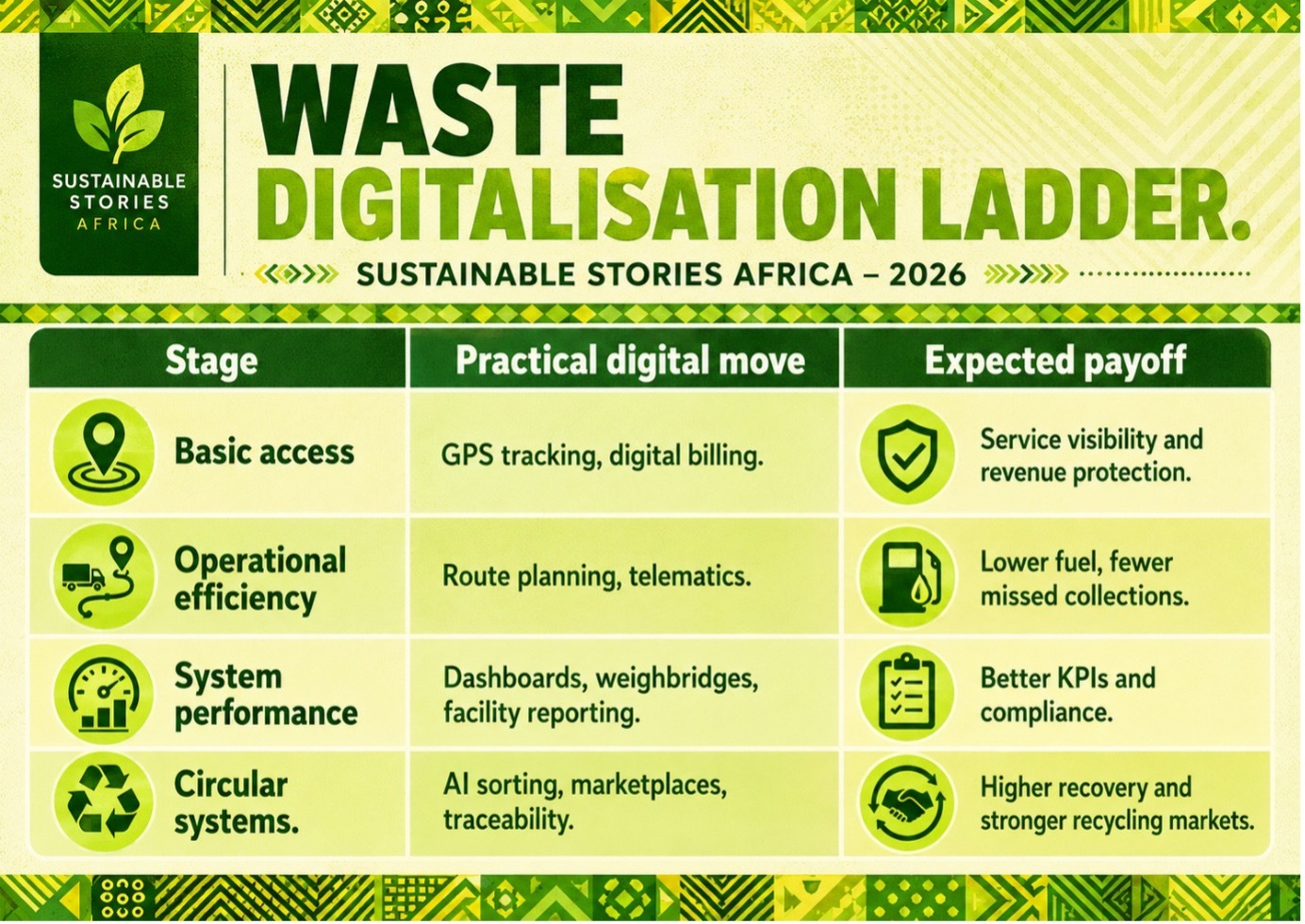
The most relevant lesson for African municipalities is that digitalisation is not one product. It is a sequence. Basic GPS tracking can show where trucks actually go. Digital billing can reduce leakage and improve fee collection. Route optimisation can reduce fuel and overtime. Smart bins can improve collection timing. AI-enabled sorting and digital marketplaces can support higher-value recycling once the basics are working.
The evidence is increasingly measurable.
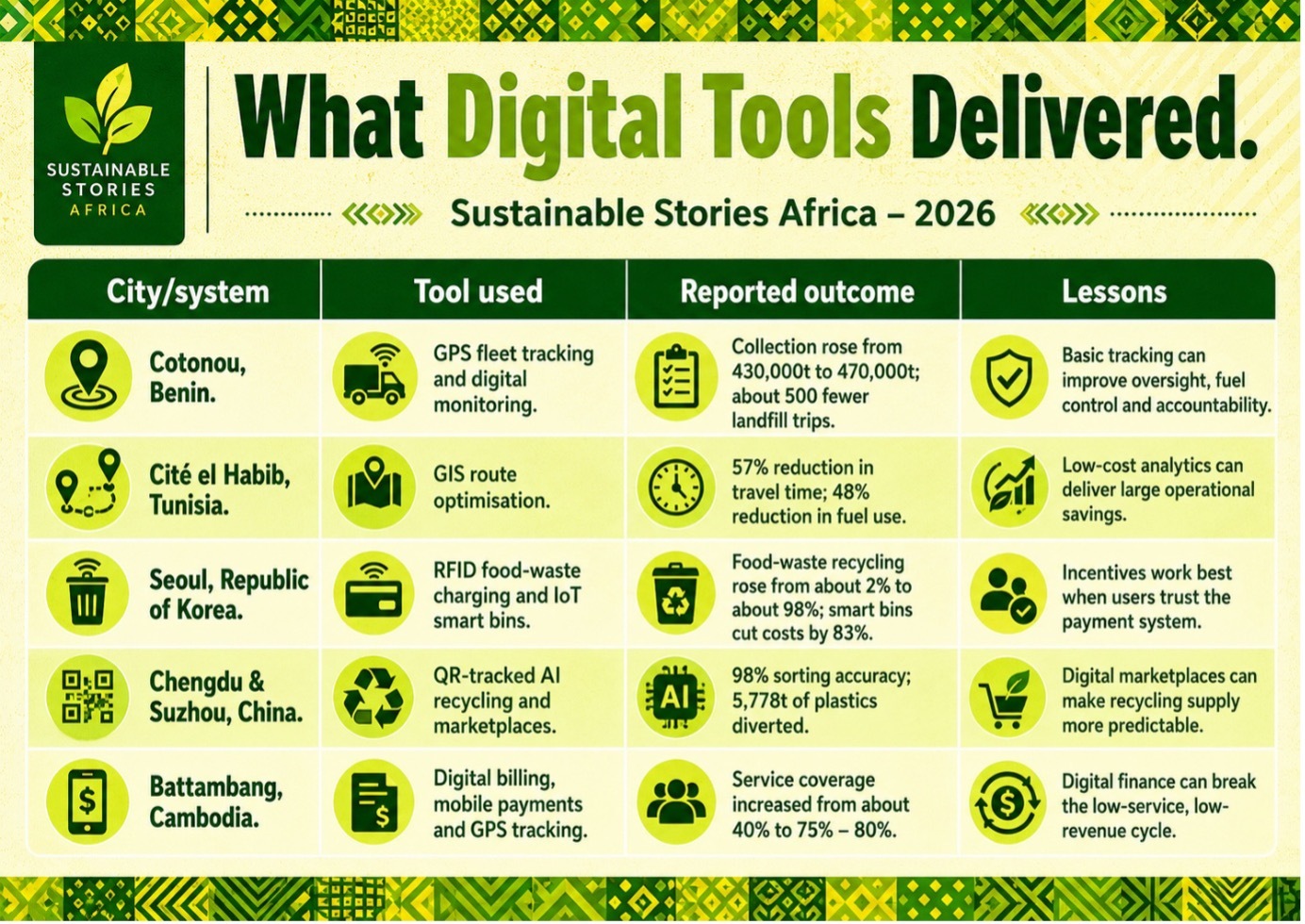
- In Cité el Habib, Tunisia, route analytics and telematics cut collection time by up to 57% and fuel use by 29% – 48%.
- In Seoul, IoT smart bins reduced collection frequency by 66% and helped lower costs by 83%.
- In Chengdu and Suzhou, connected systems combining education, incentives, smart bins, and centralised sorting improved sorting accuracy up to 98%.
- Cotonou, Benin, offers one of the clearest African examples. GPS-enabled tracking for collection vehicles costs about $465 per vehicle to install, plus about $23 per month per unit. The result was fewer missed pickups, better route compliance, fuel savings, a roughly 9% increase in waste collected from 430,000 tonnes to 470,000 tonnes, and about 500 fewer landfill trips.
- Battambang, Cambodia, shows how service trust and digital payments can reinforce each other. Before reform, only about 40% of households received solid waste service. After the city adopted a platform combining digital billing, mobile payments and GPS tracking, coverage rose to about 75% – 80%.
One stakeholder said households could “pay directly by the app or to a bank,” capturing the shift in convenience behind the numbers.
Cleaner Services Can Build Public Trust
Digital waste systems are often sold as efficiency tools. However, their deeper values are institutional: they make service visible.
- A city that can see truck routes, bin status, fee compliance, missed pickups, recycling yields and contractor performance has a stronger basis for budgeting, enforcement, ESG reporting and public communication.
That matters because weak waste systems erode trust in government.
- A household that pays for irregular collection may stop paying.
- A collection company with no route visibility may lose fuel and time.
- A recycler with unreliable material supply may underinvest.
- A municipality without data may struggle to justify financing or enforce service contracts.
The report stresses that digitalisation works best when paired with governance reform, stakeholder engagement and strong data management.
It also warns that results depend on local conditions, including governance, data quality, route design, citizen behaviour, infrastructure and vendor capability.
For African markets, the best promise is not a fully automated “smart city” overnight.
It is a cleaner, more accountable service loop: residents receive better information, trucks follow verified routes, payment systems become more transparent, regulators receive auditable data, and investors see clearer evidence of performance.
From Pilots To Scalable Waste Reform
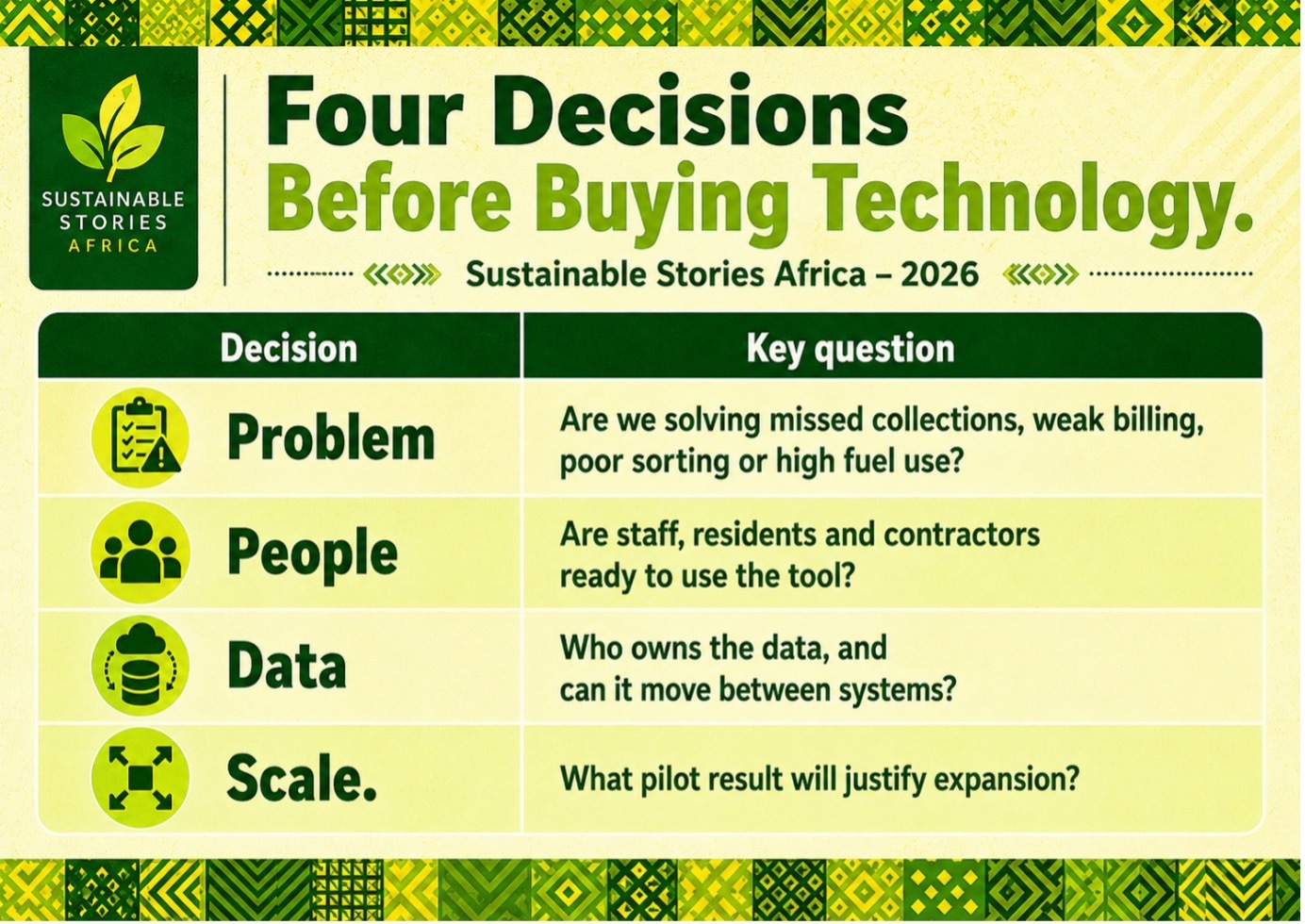
The action agenda is clear. Cities should stop buying technology before defining the service problem.
The report recommends identifying priorities, preparing staff and workflows, integrating tools with existing systems, and phasing rollout through pilots before scale-up.
The first quick wins are usually not glamorous: digital billing, GPS fleet tracking, route optimisation, digitised weighbridges and citizen engagement systems.
These tools can create the baseline data needed for more advanced systems later, including AI sorting, predictive maintenance and digital marketplaces.
Data governance must be treated as infrastructure. Municipalities and operators need clear rules on data ownership, access, portability, cybersecurity, vendor accountability and audit rights.
Without that, a smart platform can become a new form of dependency, locking cities into fragmented systems that cannot communicate with future tools.
- For financiers, the opportunity lies in supporting measurable, staged investments rather than one-off equipment procurement.
- For regulators, the task is to set standards for reporting, privacy, interoperability and service-level performance.
- For waste companies, digital competence will increasingly become a competitive advantage as municipalities demand proof of service quality.
Path Forward – Data Governance Must Drive Circular Cities
Municipalities should start with clear objectives, baseline data, procurement rules that protect data ownership, and pilots that prove fuel, service or revenue gains before scale-up.
Investors and operators should back modular tools, staff training, public engagement and interoperable systems.
The prize is cleaner service, credible ESG reporting and stronger circular-economy markets.