The World Economic Forum’s Future of Inclusion Lighthouses 2026 report argues that inclusion is no longer a side programme.
It is becoming a test of how companies attract talent, build trust and compete.
The data is sobering: equal opportunity scores remain below five out of seven globally, even as leading companies show measurable progress.
Inclusion Becomes A Competitiveness Test
The World Economic Forum has named its 2026 Future of Inclusion Lighthouses, spotlighting companies using measurable, scalable and sustained inclusion strategies to improve access to work, leadership, finance, skills and opportunity.
The report, published by the Forum’s Centre for the New Economy and Society in June 2026, arrives at a time when companies are under pressure to prove that inclusion is more than values language, it is a business capability tied to productivity, innovation, resilience and market relevance.
Its core message is clear: progress remains fragile; however, the frontier is moving.
- The most effective companies are no longer treating inclusion as isolated campaigns.
- They are embedding fairness into hiring, promotion, performance management, product design, leadership accountability, data systems and local partnerships.
Inclusion Progress Remains Slow Worldwide
The most striking finding is not that companies are talking more about inclusion. It is that global perceptions of equal opportunity remain stubbornly low.
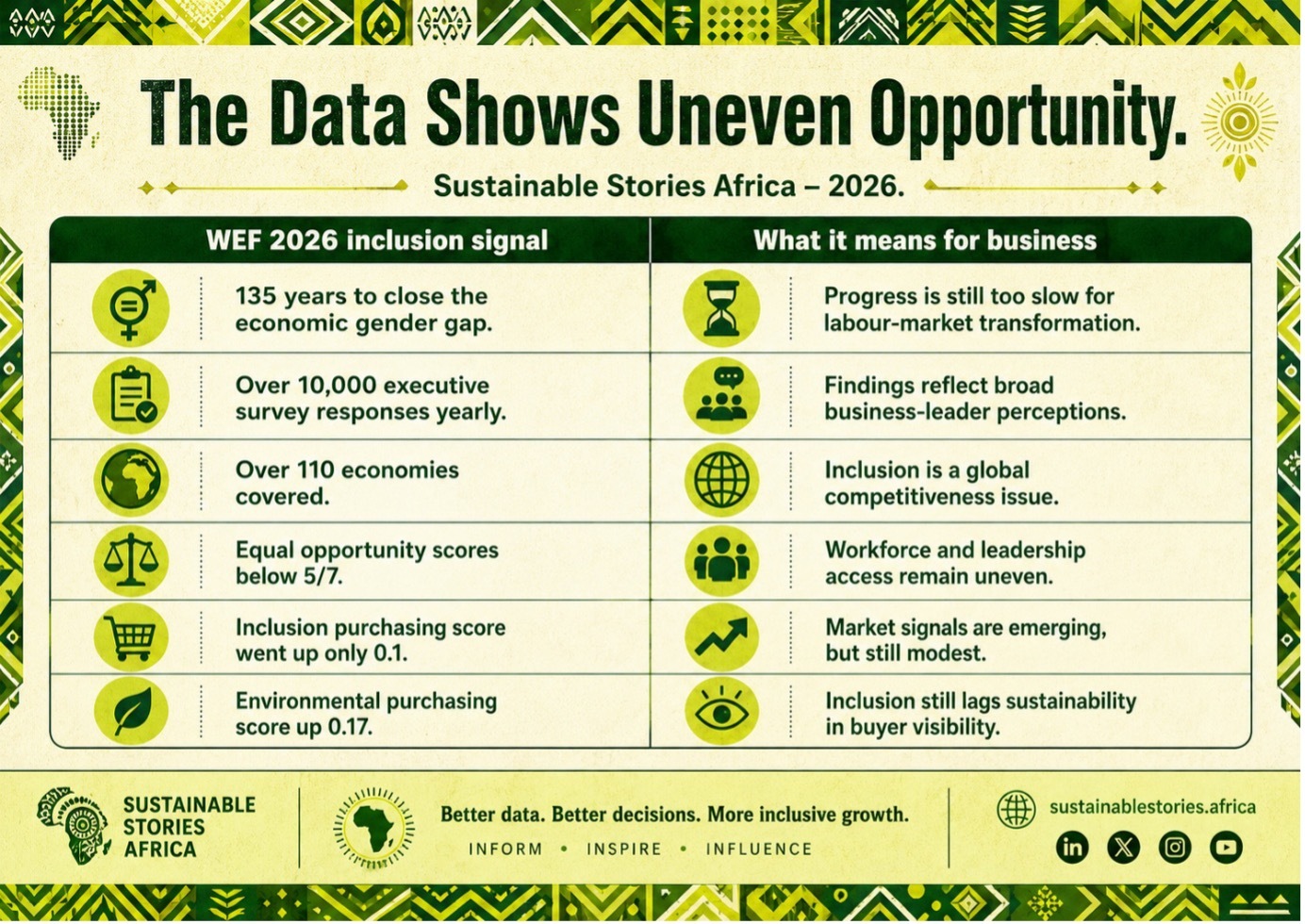
According to the report, the WEF Executive Opinion Survey captures more than 10,000 executive responses annually across more than 110 economies.
Its 2021 – 2025 data suggests significant gaps remain in equal workforce and leadership opportunities for women, people with disabilities, racial, ethnic and religious minorities, and people from lower-income backgrounds.
In 2025, no underrepresented group scored five out of seven on perceived equal opportunity in hiring and retention.
Women scored highest at 4.9, while people with disabilities scored lowest at 3.8.
Perceptions of leadership opportunities were broadly similar, highlighting that the gap is not only about entry into jobs, but also progression into influence.
The report also notes that, at the current pace, it would take 135 years to close the global economic gender gap, based on the 2025 Global Gender Gap Report.
That figure gives the inclusion debate its urgency: slow progress is not neutral. It shapes wages, careers, household resilience, innovation pipelines and the distribution of economic power.
The Data Shows Uneven Opportunity
The World Economic Forum’s Lighthouse Programme shifts inclusion from sentiment to evidence. Across four editions and 150-plus submissions, the data reveal a lopsided maturity: 53% of entries addressed gender parity.
However, 65% of the awarded Lighthouses centred on women. Disability and racial minorities each claimed 14% of awards; LGBTQI+ initiatives, 11%.
Gender leads because its metrics and frameworks are established; disability, socioeconomic background, age, neurodiversity, and race remain inconsistently measured.
Consumer behaviour mirrors the gap. From 2021 to 2025, inclusion-related purchasing scores rose just 0.1 on a seven-point scale, half the 0.17 gain for environmental attributes.
The report attributes this to clearer environmental labelling and campaigns.
Focus areas tell their own story.
- 30% of awarded programmes targeted formal job access or labour-market re-entry.
- 5% addressed progression and leadership through mentoring, sponsorship, networking, coaching, and AI matching.
- 46% centred workforce efforts.
- 31% adopted whole-of-business approaches.
- 23% focused externally on consumers and communities.
The pattern is clear: inclusion is advancing where measurement exists — and stalling where it does not.
Lighthouses Prove Inclusion Can Scale
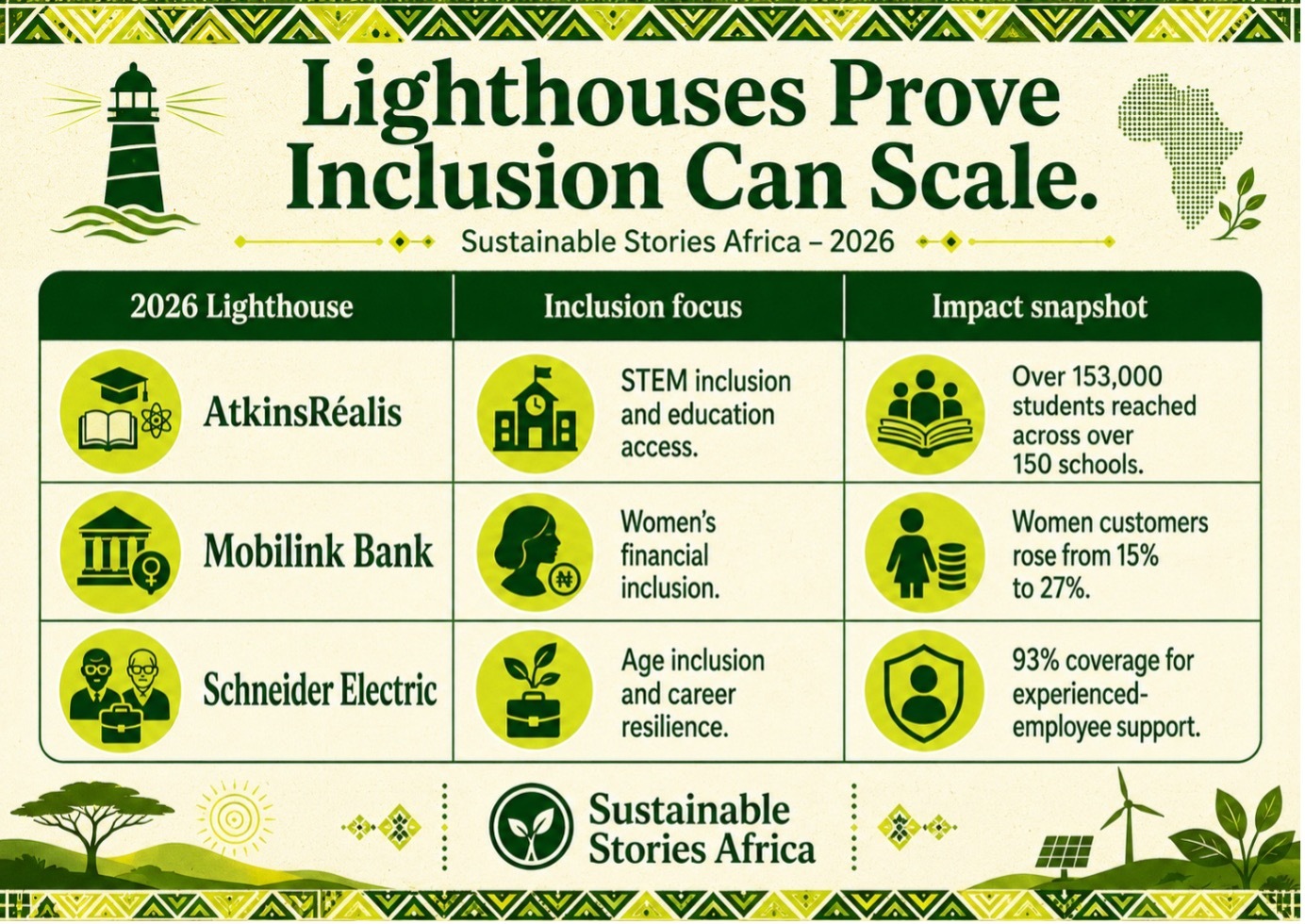
AtkinsRéalis, the Canadian engineering and nuclear group, appointed 126 STEM professionals as school governors across 150-plus schools in 50-plus local authorities, reaching 153,000 students.
58,140 from minority ethnic backgrounds, 39,321 on free school meals.
Female governors rose from 21 to 54; schools in deprived areas jumped from 18 to 58. The intervention rebuilds the talent pipeline at its source.
Mobilink Bank in Pakistan embedded women’s inclusion in its growth strategy.
Women customers grew from 15% (2019) to 27% (2025); 58,000 new women’s accounts opened in 2025 alone; 219 interns converted to full-time roles since 2023; 31,000-plus women gained financial and digital literacy.
Inclusion became a market-expansion lever.
Schneider Electric tackled age, the overlooked dimension.
Its Senior Talent Programme lifted experienced employees (over 51) in countries with career-conversation training and three-plus lifelong career offers from 43% (2022) to 93%, with a 6-point increase in Employee Engagement Index.
Demographic shift met deliberate retention.
For African and Global South markets, the lesson is direct: inclusion gains traction when it unlocks real bottlenecks, girls in STEM, women in finance, older workers in productivity, persons with disabilities in accessible workplaces, and low-income groups in career networks.
Companies Must Build Inclusion Systems
The report’s practical message is that inclusion cannot depend on goodwill alone. It needs systems.
That means companies must start with root-cause analysis.
- A gender-finance problem may reflect mobility limits, product design, digital access, documentation requirements or social norms.
- A leadership gap may reflect informal sponsorship networks, biased performance systems or narrow definitions of readiness.
- A disability gap may reflect inaccessible recruitment, workplace design or assistive technology barriers.
Second, leaders must define success meaningfully.
- The strongest cases do not stop at awareness campaigns.
- They measure account ownership, promotion rates, engagement, retention, representation, training uptake, school reach, student access, supplier participation and portfolio impact.
Third, inclusion must be owned by accountable business leaders.
- In the Lighthouse cases, governance matters: boards, CEOs, executive committees, ESG steering groups, HR councils and cross-functional teams help move inclusion from “nice to have” to operating discipline.
Fourth, solutions must be context-specific.
- WEF repeatedly stresses that there is no one-size-fits-all model. Global companies need coherence in values and standards, but local adaptation in delivery.
- A programme in Pakistan, the United Kingdom, France or Nigeria must account for regulation, culture, infrastructure, labour-market realities and trust.
Finally, data and AI must be used carefully.
- AI-powered mentoring and digital platforms can expand access to networks; however, only if they are governed responsibly.
- Inclusion technology should reduce hidden barriers, not reproduce them at scale.
The report’s highlighted initiatives widen the lens.
- EY elevated socioeconomic background as a workplace inclusion issue across more than 400,000 colleagues in over 150 countries and territories.
- Microsoft’s neurodiversity programme embedded neuroinclusive practices across business functions, tools, teams and talent systems, reaching more than 10,000 employees through neurodiversity-focused training and integrating neuroinclusion into training for more than 220,000 employees and managers globally.
For companies in Africa, this is not just a human-resources agenda.
- It is a board, ESG, productivity, talent and market-access agenda.
- Investors increasingly want stronger workforce data.
- Young workers expect fairness and flexibility.
- Customers are slowly factoring inclusion into trust.
- Regulators are asking harder questions about representation, rights and opportunity.
Path Forward – Make Inclusion Measurable And Local
The next phase of inclusion must be practical: measure gaps, redesign systems, empower local teams, use data responsibly and link inclusion to productivity, innovation, finance, procurement and leadership.
For African markets, the opportunity is significant.
Companies that widen access to skills, capital, networks and decent work will look fairer, and build stronger talent pipelines, more trusted brands and more resilient economies.