
Finance pressure is no longer just about closing books, meeting deadlines or surviving audit season. It is becoming a test of judgment, emotional control and institutional resilience.
A new FinPolNomics finance insight highlights nine behaviours that separate high-performing finance professionals from reactive teams when pressure rises, from slowing the pace to asking better data questions.
Calm Discipline Beats Panic In Finance
In finance, pressure usually arrives before the calendar gives permission. It comes at month-end close, during audit season, before board reporting, when cash flow tightens, or when a difficult decision must be made with incomplete information.
That is the core message behind FinPolNomics Green Finance and FinPolNomics Analytica’s latest “Accounting & Finance Nuggets” insight, titled “9 Things High-Performing Finance Professionals Do Differently Under Pressure.”
Released as a practical professional guide, the visual insight argues that technical competence alone is no longer enough.
Under pressure, the finance professionals who deliver better outcomes are those who remain calm, think clearly and act deliberately.
For African and emerging-market finance teams, the message lands at a critical time. Inflation, currency volatility, audit complexity, liquidity stress, board scrutiny and governance expectations are forcing finance professionals to operate as risk managers, communicators and decision advisers, rather than just record keepers.
Pressure Now Tests Finance Leadership
The most important insight from FinPolNomics is direct: under pressure, financial performance becomes behavioural before it becomes technical.
The framework positions nine behaviours around one governing principle — disciplined thinking under stress.
The contrast is sharp. Calm discipline outperforms panic. During month-end close, audit cycles and board reporting, rushed judgment erodes controls, distorts analysis and fractures team confidence.
When numbers arrive late or assumptions go unchallenged, leadership decisions stall and risks quietly embed themselves.
FinPolNomics is not motivational language. It is an operational discipline framework that links emotional control to sharper judgement, fewer errors and stronger institutional decisions.
For boards, investors and regulators, this is ultimately a governance question. Finance pressure is a control environment test.
Nine Behaviours Create Better Judgement
The nine behaviours at the heart of FinPolNomics are not leadership slogans. They are practical habits that sharpen decision quality precisely when deadlines are tight and consequences are real.
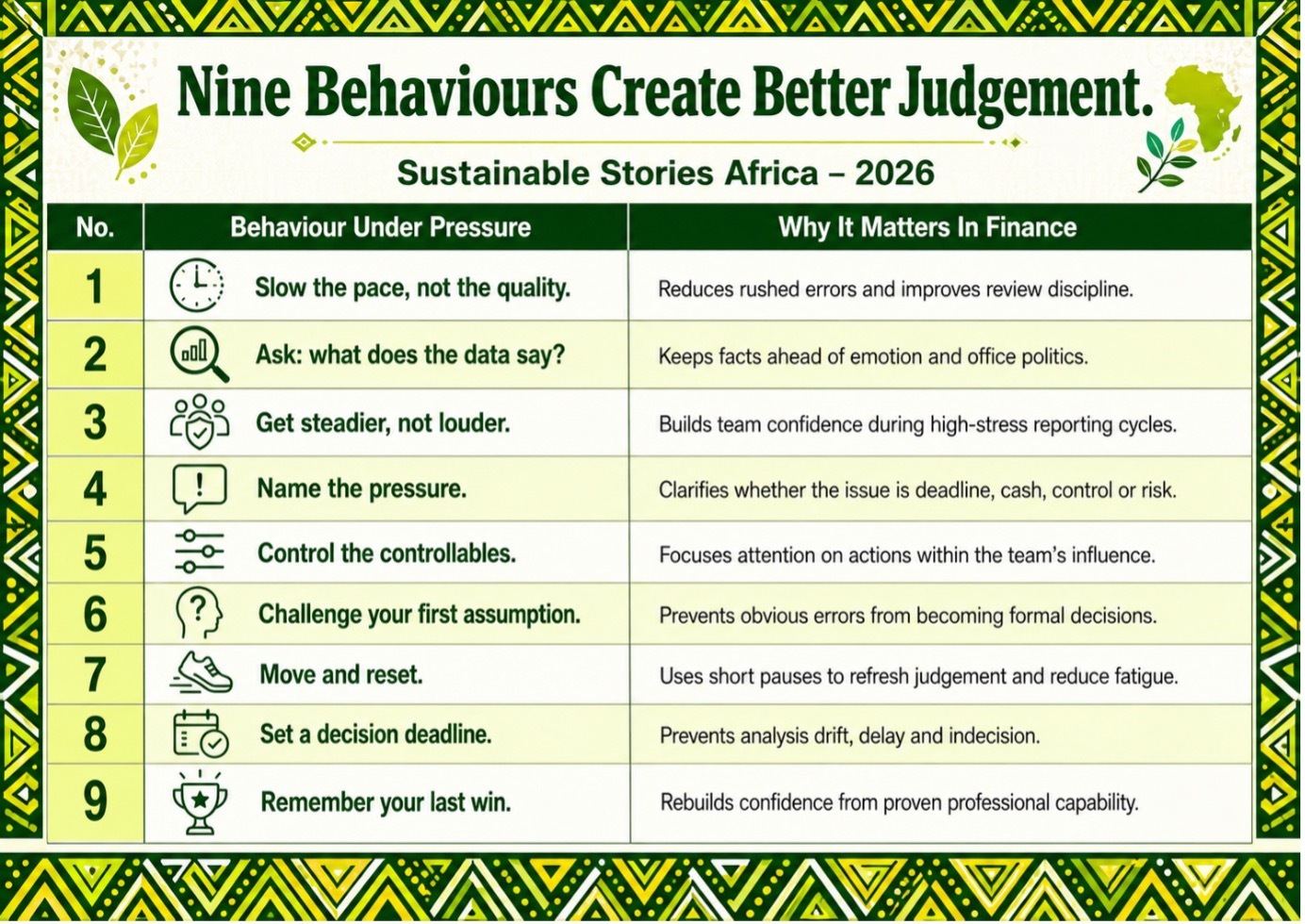
They reflect a broader shift in finance work. Today's finance professional must combine accounting precision with judgement, communication and emotional steadiness.
- "Slow the pace, not the quality" means resisting the urge to rush reconciliations or board packs under pressure.
- "Ask what the data says" means letting evidence lead before instinct or hierarchy does.
- "Name the pressure" is especially critical; a deadline problem is not a control failure.
Many organisations lose clarity here. FinPolNomics pushes finance professionals to diagnose the stress point before responding to it.
Data Discipline Strengthens Finance Culture
Finance teams are culture carriers. Their behaviour shapes how the rest of an organisation treats evidence, risk and accountability.
When the finance function panics, the organisation often follows. When finance stays calm, defines the problem and sets decision deadlines, it creates a more reliable management rhythm.
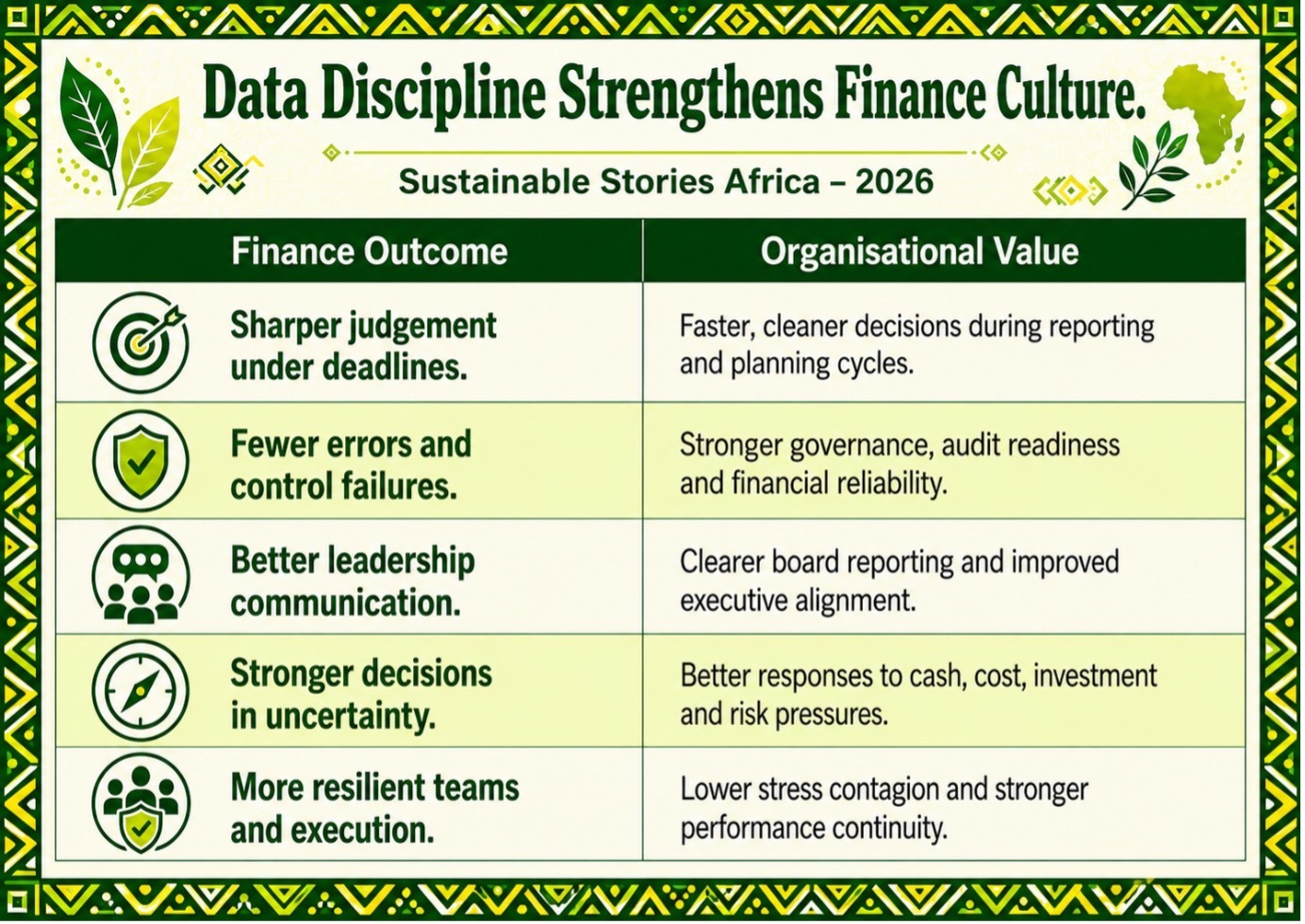
FinPolNomics identifies five outcomes that extend the framework beyond individual performance:
- Sharper judgment under deadlines
- Fewer errors
- Better leadership communication
- Stronger decisions in uncertainty
- More resilient teams.
For African businesses, this is especially urgent. Volatility is not occasional; it is structural.
Exchange-rate swings, delayed receivables, subsidy shifts and infrastructure constraints are operational realities.
Finance professionals cannot wait for certainty; they must decide with discipline.
That is why "control the controllables" carries real weight. Teams may not control inflation or policy shifts; however, they can control forecast quality, cash visibility, documentation, and review discipline.
Calm Finance Builds Better Institutions
The FinPolNomics opportunity extends well beyond individual performance. Adopted widely, the framework can fundamentally improve how organisations manage uncertainty.
- For employees, calm finance leadership reduces confusion, teams understand what is urgent, what is risky and what requires escalation.
- For executives, finance becomes a sharper advisory function.
- For boards, management reports grow more disciplined and less reactive.
- For investors and lenders, organisational stress-handling becomes visibly more credible.
The benefits are also deeply human. Where pressure becomes normalised, burnout, errors and team tension quietly embed themselves into culture.
A framework that encourages professionals to pause, reset and challenge assumptions protects both decision quality and team wellbeing.
Composure is not delay. Discipline is not indecision. “Set a decision deadline” is among the framework’s strongest instructions: create space to think clearly, then move decisively.
The cost of ignoring these behaviours is real.
- Rushed numbers mislead leadership.
- Weak assumptions distort forecasts.
- Loud managers erode confidence precisely when steadiness matters most.
In finance, small behavioural failures can become institutional failures.
Finance Teams Need Operating Discipline
Converting the FinPolNomics framework into operating practice requires intentional steps. Here is how organisations can begin.
- Build pressure reviews into reporting cycles. At the start of month-end close, audit season or board reporting, teams should map key pressure points, deadlines, cash positions, data gaps and leadership expectations.
- Make data questions standard. Before discussions become emotional, teams should ask: What does the data show? What assumptions are we using? What has changed? What remains uncertain?
- Create decision deadlines. Many financial decisions stall not from lack of intelligence, but from lack of closure. Decision deadlines prevent drift and keep accountability visible.
- Model steadiness. Under pressure, tone is a management tool. A calm leader focuses teams; a reactive leader transforms solvable problems into organisational crises.
- Treat recovery as performance. The instruction to "move and reset" is practical. A short reset sharpens judgment during long reporting cycles and audit queries.
- Recognise finance resilience as a governance capability. Teams that stay calm, communicate clearly and maintain control and discipline are better positioned to support sustainable growth.
This is especially relevant for ESG and sustainability reporting, where finance teams are increasingly responsible for assurance, data integrity and investor communication.
As sustainability data becomes more financially material, the behaviours that strengthen accounting discipline will equally strengthen ESG credibility.
Path Forward – Make Calm A Control System
Finance leaders should treat calm discipline as a formal operating capability, not a personality trait.
The priority is to build routines that improve evidence-led decisions, clearer escalation, stronger controls and healthier team execution.
For African markets, this is part of institutional resilience.
Better finance behaviour can support better governance, stronger investor confidence, improved ESG reporting and more sustainable business decisions under pressure.