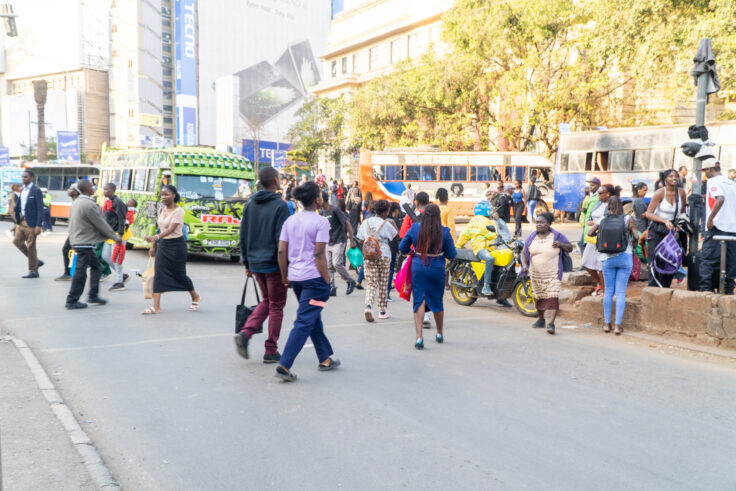
A field experiment in Addis Ababa shows that transport is not just about roads, buses and taxis. It is also about gender, safety, work, markets, dignity and access.
The Arbuzova et al. policy brief argues that African cities must treat women’s mobility as core urban infrastructure, rather than a social add-on, as rapid urbanisation reshapes development choices.
Transport Equity Now Shapes Urban Futures
African cities are expanding faster than many transport systems can adapt, and a policy brief on Ethiopia offers a clear warning: mobility gaps are development gaps. In Addis Ababa, women and men move through the same city, but not with the same freedom, safety or opportunity.
The October 2023 policy brief by Anastasiia Arbuzova, Tigabu Getahun, Ammar A. Malik and Mahesh Karra examines gendered differences in mobility and latent demand for transport in Ethiopia.
Its findings come from a field experiment involving 1,000 married couples in Addis Ababa, where participants received travel credit for private taxi trips over two months.
For African policymakers, investors and city planners, the lesson is direct.
- Transport systems that ignore gender risk reproduce inequality.
- Transport systems designed around real travel behaviour can expand access to jobs, markets, healthcare, education and public life.
The Mobility Gap Hiding In Plain Sight
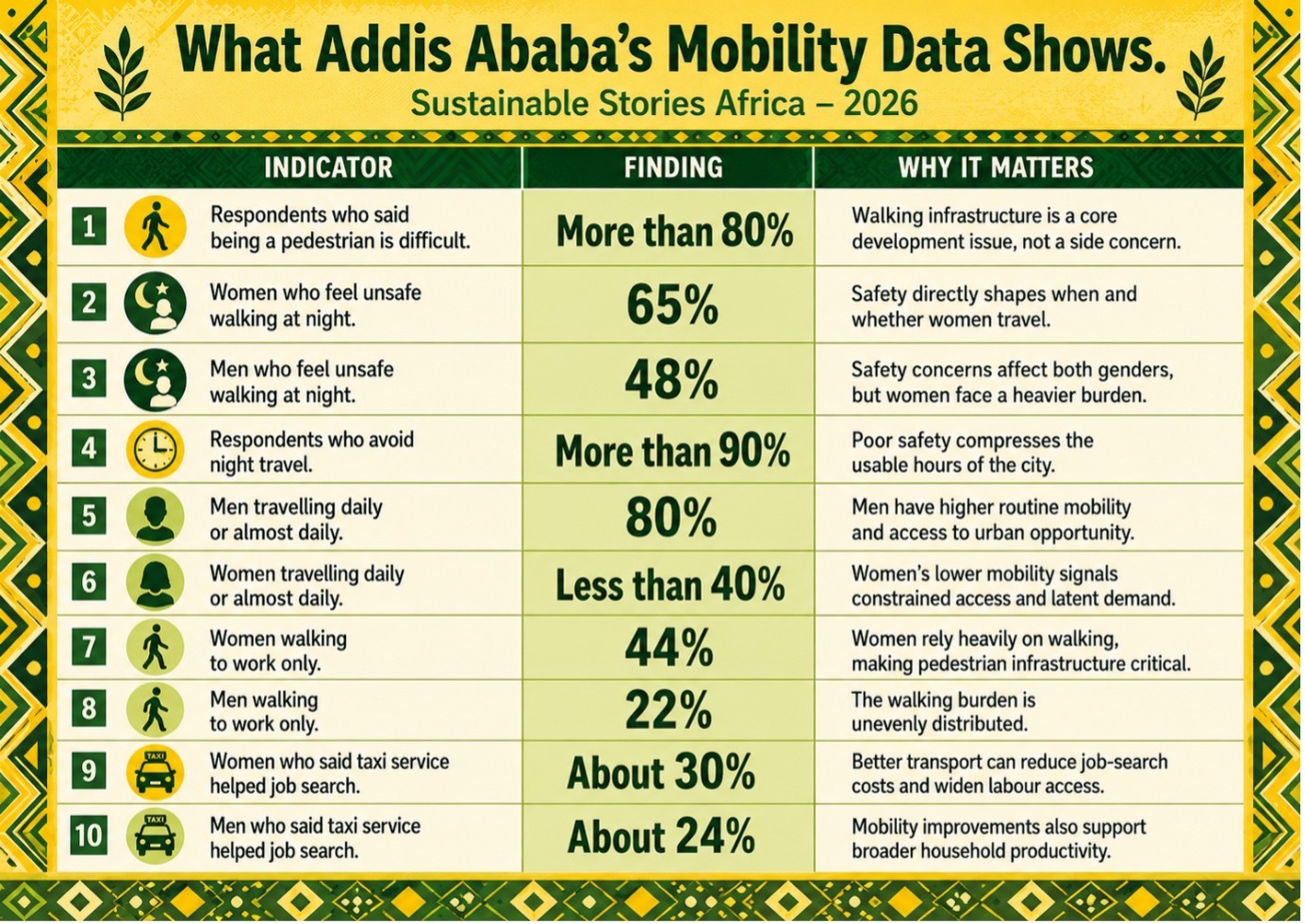
In Addis Ababa, more than 80% of residents say it is difficult to be a pedestrian. 50% report poor sidewalks and limited walkways.
In a city where walking remains central to daily life, that is not an inconvenience; it is a structural barrier.
The stakes are continental. By 2050, African cities will absorb 900 million additional inhabitants, housing over two-thirds of the continent's population.
Urbanisation can unlock growth and productivity; however, only if city systems genuinely connect people to opportunity.
That connection is not gender-neutral.
The mobility of Women is shaped by factors such as cost, safety, household responsibilities, travel time, and social expectations.
- A market may be reachable by road but unsafe at night.
- A job may exist across town but remain financially out of reach.
The data from Addis Ababa makes hidden inequality visible. While 80% of men travelled daily, fewer than 40% of women did. Around 30% of women worked from home, compared with 15% of men.
When women travel less, often not by choice, cities forfeit a measurable share of their economic potential.
What The Addis Experiment Revealed Clearly
A randomised study in Addis Ababa tested a direct question: what happens to women's mobility when cost and access barriers are reduced?
Couples were assigned to three groups:
- Women receiving travel credit
- Men receiving travel credit
- Both jointly, with vouchers reimbursing private taxi trips over two months.
Take-up reached 75% across all groups, with no significant differences in total trips taken.
Those findings matter: when access barriers fall, physical mobility gaps can close.
However, gender patterns persisted beneath the surface.
- Women spent an average of 13 Ethiopian birr more per trip than men, suggesting they travelled longer distances when given access.
- Women were also more likely to travel alone: 62% in the women, compared with 48% for men.
Care responsibilities travelled with women, too.
- Trips made with children were recorded in 34% of women's journeys, versus 21 percent for men.
The implication for transport design is clear. A woman's journey is rarely a simple commute; it combines school runs, market trips, healthcare visits and paid work.
Infrastructure that ignores this complexity will continue to underserve half the city.
Better Mobility Can Unlock Wider Opportunity
The core argument is not that women need transport because they are vulnerable. It is that cities become more productive, inclusive and resilient when women can move safely and affordably.
Improved mobility expands access to health services, education, markets, jobs and civic spaces.
The job-search data highlight this directly: approximately 30% of women and 24% of men reported that taxi access aided their job search, pointing to a critical spatial mismatch: opportunity exists, but distance and cost keep it out of reach.
For African markets, this is an ESG issue.
- Safe transport affects women's economic inclusion.
- Pedestrian infrastructure affects public safety. Data-driven planning affects governance. Urban mobility brings the "S" in ESG to life.
The risk of inaction is stark.
Without gender-responsive transport, fast-growing African cities risk deepening inequality while appearing to modernise, expanding road networks without making them safe, affordable or useful for the women who need them most.
What Governments And Investors Must Change
The policy agenda is practical and urgent.
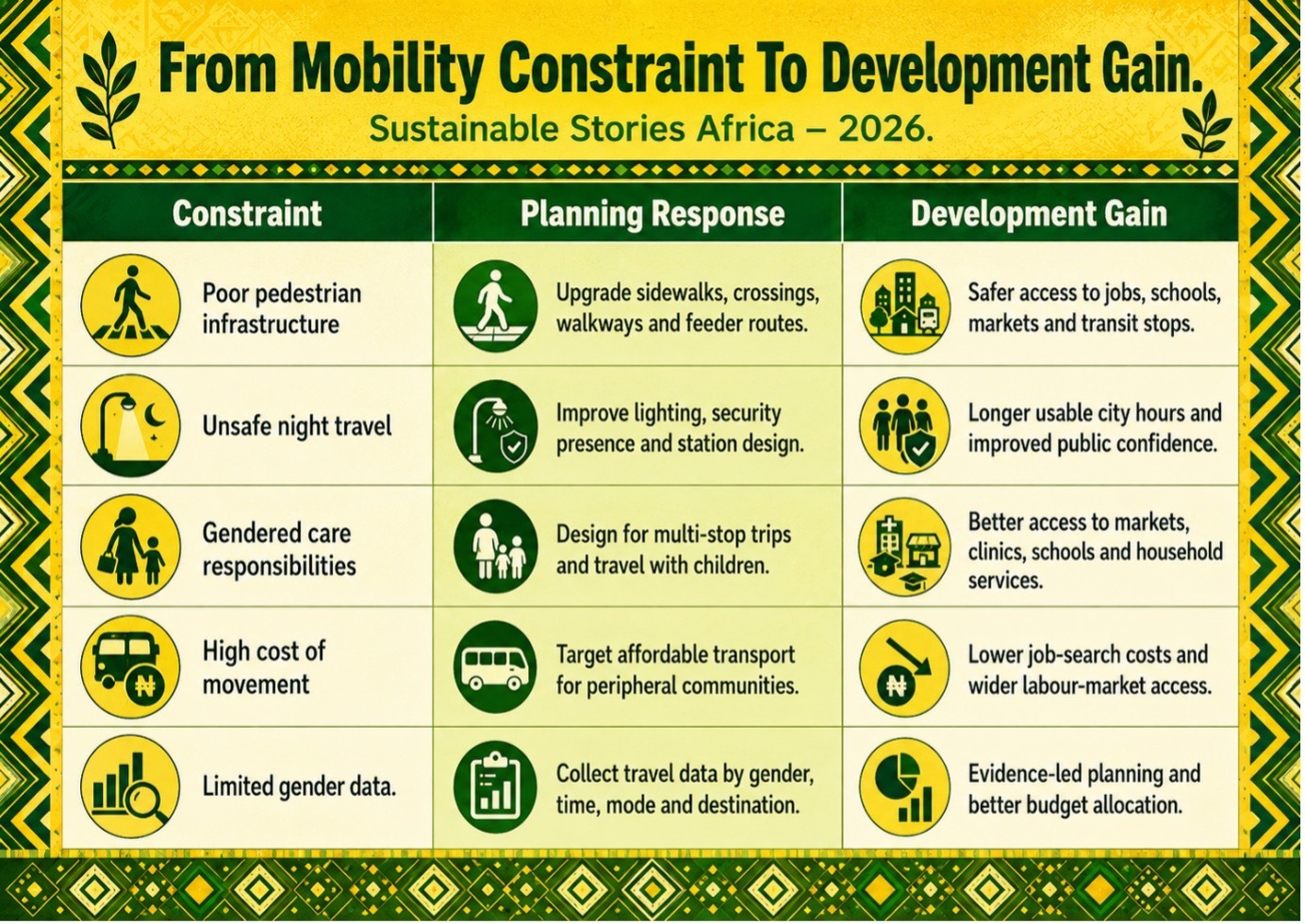
- African cities need better pedestrian infrastructure, upgraded roads, maintained sidewalks and improved access to transport stops, particularly in peripheral neighbourhoods where connectivity is weakest.
Safety must be designed in, rather than added later.
- In Addis Ababa, 65% of women and 48% of men felt unsafe walking at night.
- Over 90% avoided night travel entirely.
- Better lighting, visible security at transport nodes and targeted interventions during peak female travel hours are minimum requirements.
Gender-disaggregated transport data must become standard practice.
- Cities need to know not only how many people move, but who moves, when, why and at what cost.
- It should capture women's market trips, childcare journeys, walking patterns and job-search travel as core planning evidence.
Finally, women must shape transport systems from the start, rather than be consulted after routes, fares and station designs are already fixed.
- For financiers, the opportunity is to treat gender-smart transport as investable infrastructure.
- Development banks, climate finance institutions and private investors can support projects that integrate safety, accessibility and inclusion metrics into transport financing.
This could include bus rapid transit systems, non-motorised transport corridors, safer last-mile access, digital mobility platforms and station-area upgrades.
For regulators and city authorities, accountability matters.
- Transport plans should include measurable indicators: women’s ridership, reported safety, average travel cost, night-time accessibility, walking infrastructure quality and access to public services.
What gets measured is more likely to be funded and improved.
Pat Forward – Build Transport Around Real Travel Demand
African cities cannot afford transport systems that move vehicles but leave people behind.
The Addis Ababa evidence shows that when access barriers fall, latent demand emerges, including among women whose mobility has been constrained by cost, safety and household roles.
The path forward is gender-smart, data-led and people-centred: safer streets, affordable access, inclusive planning and transport investments that connect women and households to work, services and dignity.
That is how mobility becomes development infrastructure.