Most companies claim to have a risk register. Few can prove it changes anything. FinPolNomics' new framework argues that a real register links objectives, root causes, controls and owners into a single living decision tool.
For African firms navigating regulation, climate exposure and digital disruption, that distinction between a static document and a working early-warning system could determine which businesses survive the next shock.
A Spreadsheet Nobody Actually Reads
Across boardrooms in Lagos, Nairobi and Johannesburg, risk registers sit quietly in shared drives, updated once a year and rarely opened between audits.
FinPolNomics' latest explainer challenges that habit, arguing that a properly built register is not paperwork but a management system that connects strategy, exposure and accountability.
The stakes are immediate. African companies operate amid currency volatility, infrastructure gaps, evolving compliance regimes and fast-moving digital and AI adoption, all of which generate risks that static documents fail to capture in time.
When registers stay generic, leaders lose the early signals that would let them act before losses surface.
This explainer matters now because governance expectations are tightening.
Regulators, investors and boards increasingly want proof that risk management shapes real decisions, not just compliance checklists filed away until the next review.
Attention: The Comfort Trap Of Listing Risks
A striking admission anchors FinPolNomics' framework: organizations that "say they have a risk register" often cannot demonstrate it shapes any decision at all. That gap between claiming preparedness and proving it is where the real story begins.
What is happening is a shift in how governance experts define risk management itself. FinPolNomics distinguishes between a static register, which offers "false comfort," and a living register, which helps leaders "detect stress early, escalate issues and allocate resources before losses become visible". This distinction matters most for African firms in regulated sectors, infrastructure-heavy industries and fast-growing digital markets, where reputational and financial damage moves quickly once controls fail.
Seven Fields That Change Everything
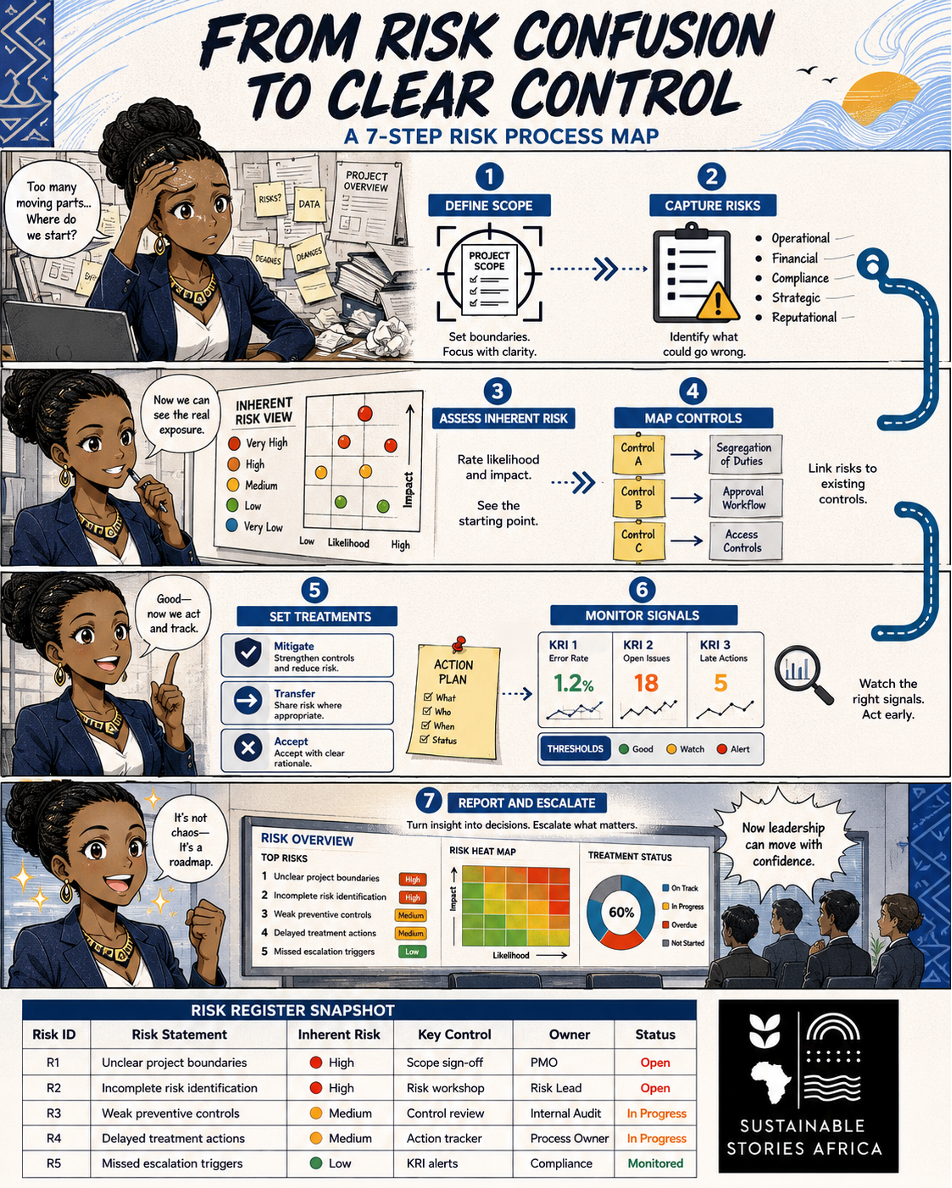
FinPolNomics builds its framework around a seven-step model:
- Define scope
- Capture risks
- Assess inherent risk
- Map controls.
- Set treatments
- Monitor signals.
- Report and escalate.
Each stage forces specificity that generic risk lists usually skip.
The first discipline is anchoring risk to objectives rather than abstractions.
Instead of writing "market risk," teams must state what could happen, why, and what impact it would create. This is tied directly to a business goal or compliance obligation.
FinPolNomics offers a concrete example: weak human review may allow AI-generated output to trigger compliance breaches, while single-cloud dependency may cause client access disruption if the platform fails.
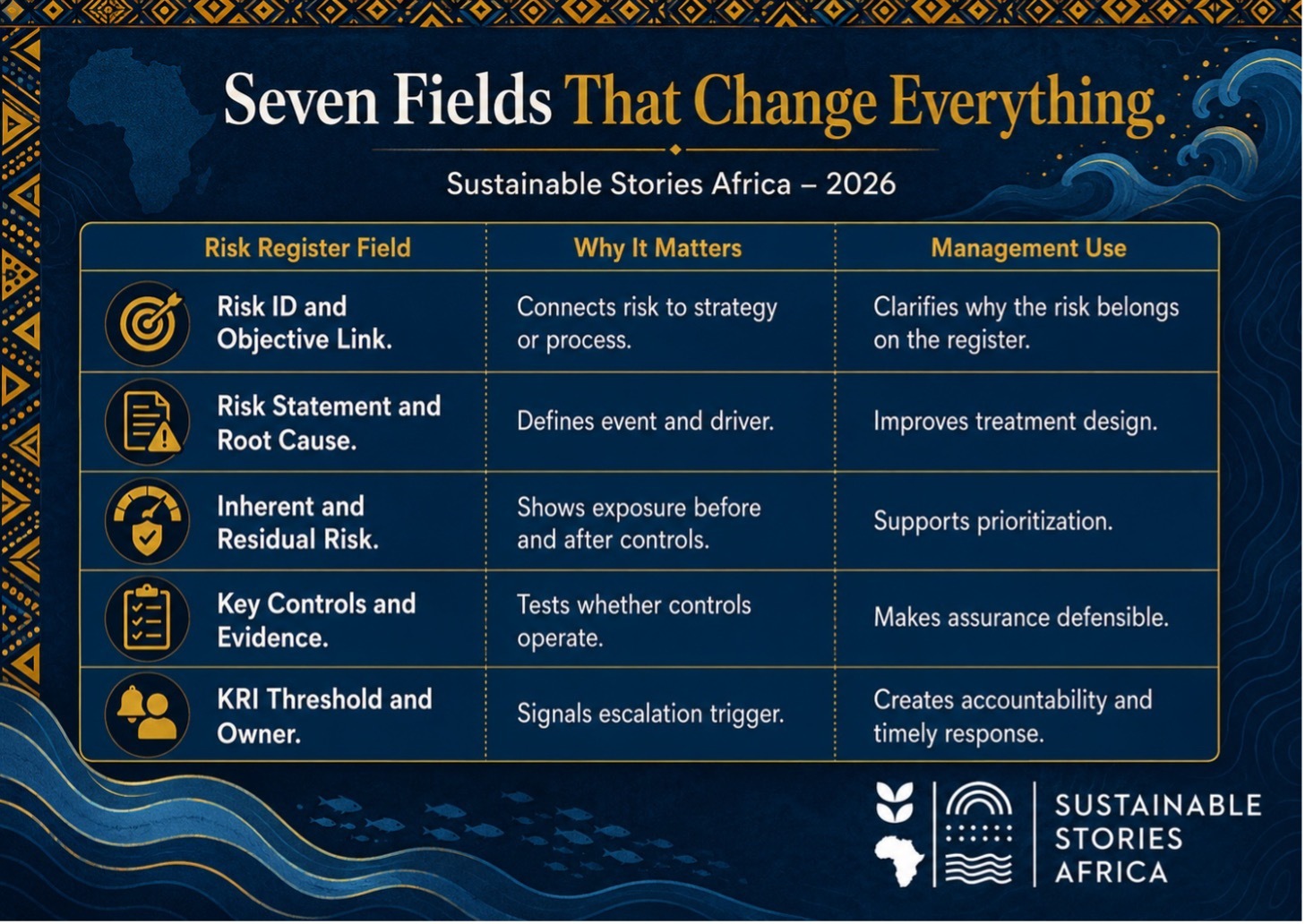
Controls only count if they are proven, not assumed.
FinPolNomics stresses that registers must record evidence that controls actually operate, because "without evidence, control claims become assumptions".
Residual risk then reveals what exposure survives after controls, while key risk indicators and thresholds tell leaders when conditions are deteriorating before a crisis becomes visible.
What Living Registers Unlock
Get this right, and the payoff is tangible. A functioning register becomes a governance tool that supports capital allocation, insurance decisions, technology investment, compliance planning and operational resilience.
For African markets balancing growth ambitions against volatility, this means faster escalation of problems, sharper resource allocation and steadier investor confidence.
The alternative is costly. Firms that treat registers as static filing exercises risk missing early warning signs, from AI-driven compliance breaches to single points of technology failure, until damage is already done.
In markets where infrastructure and regulatory shocks arrive with little notice, that lag between signal and response can determine whether a company absorbs a shock or is defined by it.
Who Must Move And How
FinPolNomics' seven-step model gives leaders a clear sequence rather than a vague mandate.
Boards, risk owners and management teams each have distinct responsibilities to make the register a decision tool rather than a document.
- Define scope by setting objectives, context, risk appetite and scoring criteria before capturing any risk
- Write risk statements that separate cause, event and consequence, not generic labels
- Map preventive, detective and corrective controls, and record evidence that they function
- Assign key risk indicators, thresholds and named owners so escalation triggers automatically
- Route breaches, overdue actions and high residual risks directly into management and board visibility
Regulators and investors, meanwhile, should press companies to demonstrate that registers inform actual capital, insurance and compliance decisions, rather than accepting registers as static evidence of good intentions.
Path Forward – Manage Risks, Not Lists
FinPolNomics' core advocacy is direct: redesign risk registers around objectives, root causes, controls, KRIs, owners and treatment actions, so documentation becomes decision infrastructure rather than an audit artefact.
The goal, as the framework states, is "not documentation for its own sake" but faster escalation, stronger accountability and more resilient performance.
For African companies facing regulatory tightening, climate exposure and digital disruption simultaneously, this shift advances broader ESG and governance objectives by making risk oversight demonstrably active rather than theoretical.
The proposed infographic, mapping the seven-step process alongside a live risk-register snapshot, is designed to make that transition visible to boards and investors alike.