The African Development Bank Group has approved €155.99 million to upgrade Uganda’s Arua Airport into an international-standard facility.
The project aims to strengthen regional trade, tourism, mobility and connectivity in northwestern Uganda.
For border communities, businesses and travellers, the airport could turn a historically underserved region into a stronger gateway for commerce and opportunity.
A Border City Gets A Bigger Gateway
The African Development Bank Group has approved €155.99 million to upgrade Arua Airport in northwestern Uganda, a major infrastructure investment designed to expand regional trade, tourism and connectivity.
The financing will support Phase 1 of the Uganda Airports Development Programme, to turn Arua Airport into an international-standard facility.
The upgrade is expected to improve aviation access for Uganda’s West Nile region, a strategic area near the borders with the Democratic Republic of Congo and South Sudan.
For Arua, this is not just an airport story. It is a market-access story. It is about traders moving faster, tourists travelling much more easily, businesses connecting better, and border communities gaining a stronger link to national and regional growth.
In a country where transport costs can determine whether agricultural produce reaches markets profitably, aviation infrastructure can become a quiet driver of competitiveness.
Why Arua Matters To Uganda
Arua sits in one of Uganda’s most commercially important frontier regions. Its location gives it direct relevance to cross-border trade, humanitarian logistics, tourism circuits and regional mobility.
Upgrading the airport could help reduce travel time, improve cargo handling, support access to tourism and strengthen economic links among Uganda, eastern DRC and South Sudan.
- For businesses, faster connectivity can mean better market reach.
- For visitors, it can make northern and northwestern Uganda more accessible.

The investment also fits into a wider African development challenge: transport infrastructure remains one of the biggest barriers to regional trade.
Roads carry most goods, but aviation can support high-value trade, emergency response, tourism and business travel.
For a hotel operator in Arua, an exporter moving fresh produce, or small trader sourcing goods across borders, improved air connectivity can shift business from slow and uncertain to faster and more predictable.
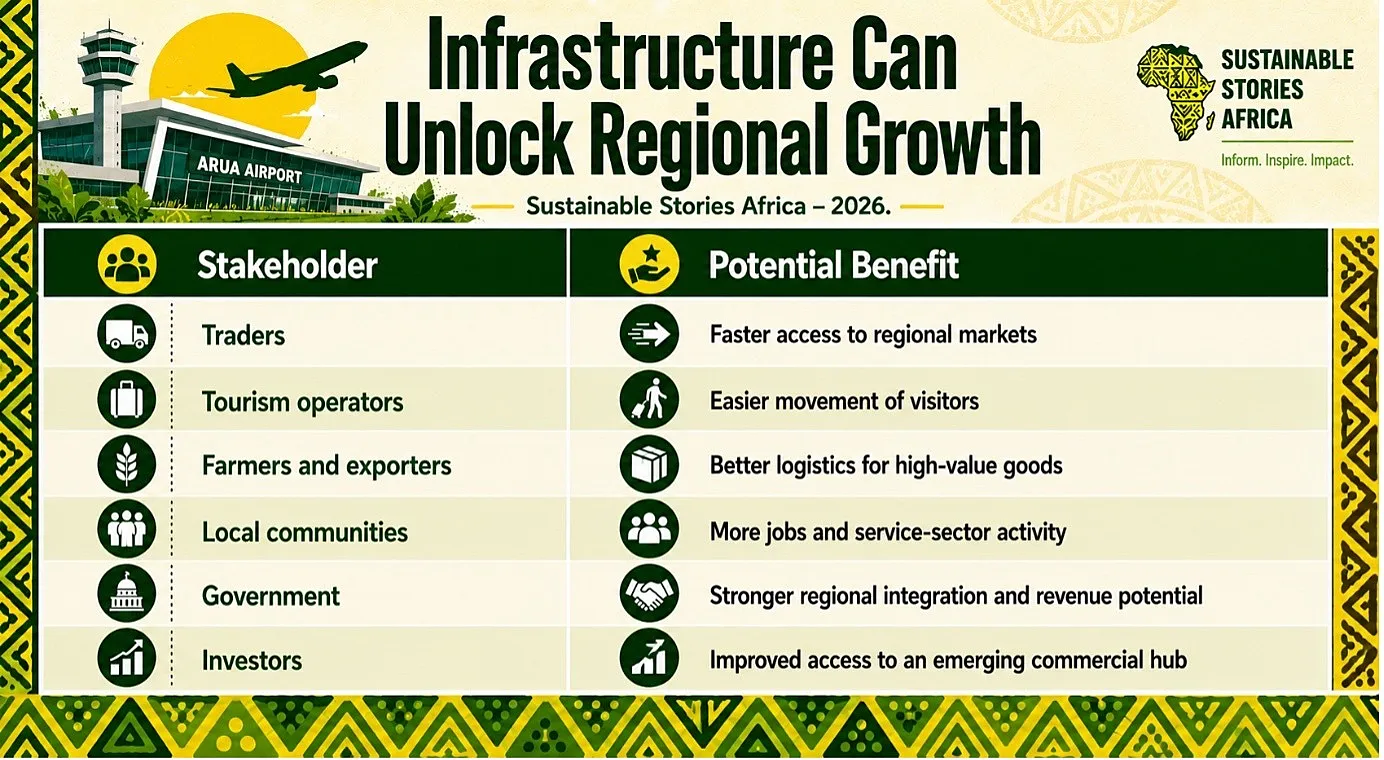
Infrastructure Can Unlock Regional Growth
The strongest case for the Arua Airport upgrade is its development multiplier effect.
Better transport infrastructure can support tourism, logistics, jobs, investment and service delivery.
Tourism could benefit as travellers gain easier access to northern Uganda’s attractions and wider regional circuits.
Trade could benefit as cargo systems improve. Public services could benefit from faster movement of personnel, equipment and emergency supplies.
The project also carries ESG relevance. Stronger regional connectivity can support inclusion by linking underserved communities to wider economic systems.
However, the benefits will depend on how the project is implemented.
If local jobs, environmental safeguards, fair compensation, accessibility and community engagement are prioritised, the airport can become a development asset.
If not, it risks becoming infrastructure without enough inclusive impact.
Build Connectivity That Serves People
Uganda’s next priority should be execution discipline. The airport upgrade must be delivered transparently, with strong procurement, environmental safeguards, local labour participation and clear timelines.
Government agencies and development partners should also ensure that the airport connects with roads, tourism strategies, border trade systems and local business development.
An airport alone cannot transform a region. It must be part of a wider economic corridor.
- For investors, the signal is important: Northwestern Uganda is being positioned for stronger participation in regional trade.
- For local businesses, this is the time to prepare for new demand in hospitality, logistics, retail, transport and agribusiness.
The Arua upgrade should therefore be seen not as a standalone aviation project, but as a platform for regional development.
Path Forward – For Inclusive Connectivity
Uganda must turn the Arua Airport upgrade into broader trade, tourism and job growth.
The priority is coordinated planning: airport works, road access, local enterprise support and environmental safeguards must move together.
Well done, Arua can become a stronger gateway for inclusive regional integration.