The African Development Bank Group has approved $140 million to support irrigation and agro-industrialisation in Uganda.
The programme targets climate-resilient farming, rural jobs, higher incomes and stronger food systems in the Bunyoro subregion.
For farming communities exposed to rainfall shocks, the investment could turn water access into productivity, enterprise growth and a more secure rural economy.
Water Becomes Uganda’s Next Growth Infrastructure
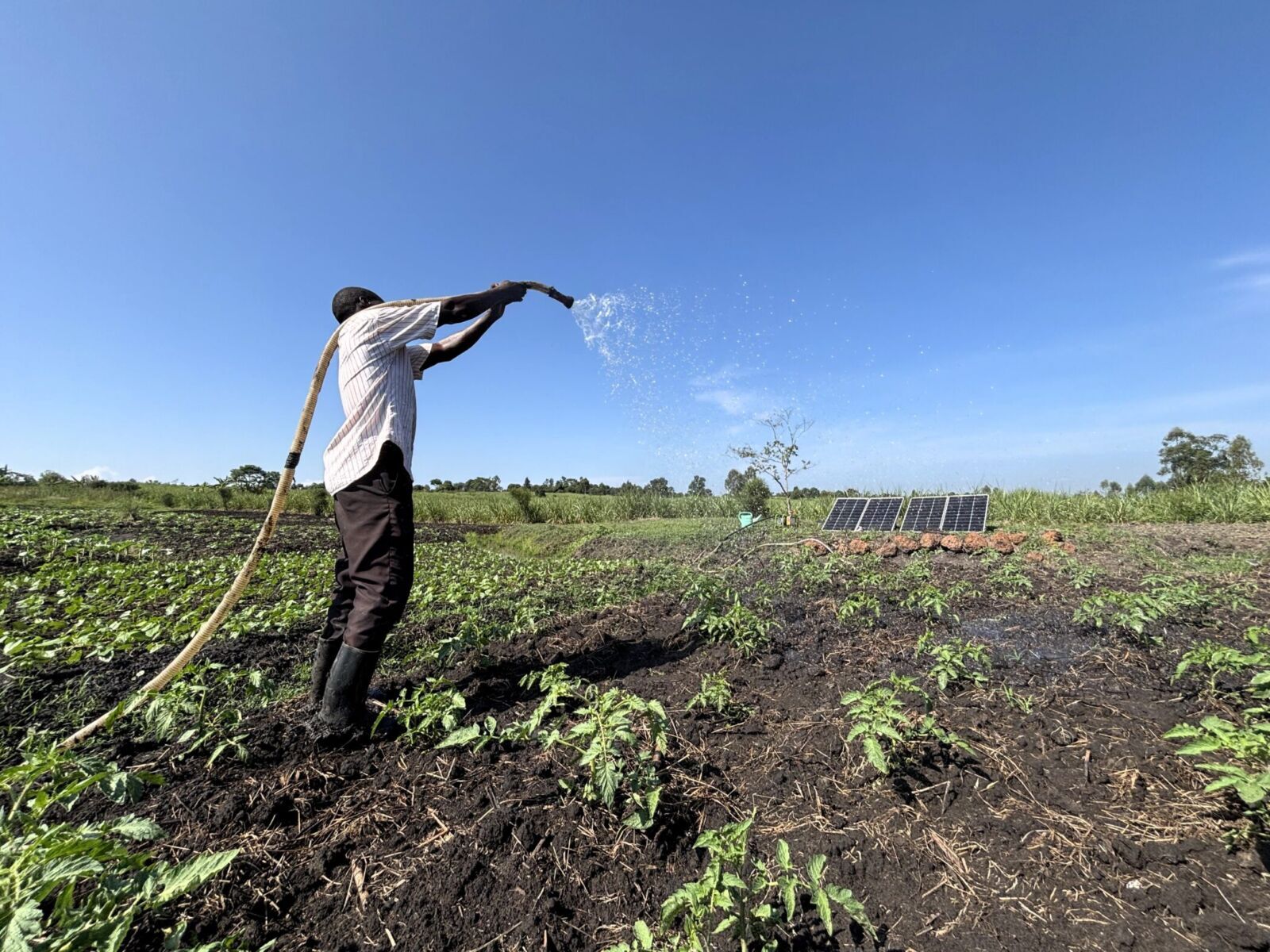
For many farmers in rural Uganda, the difference between a good season and a failed harvest is still written in the clouds.
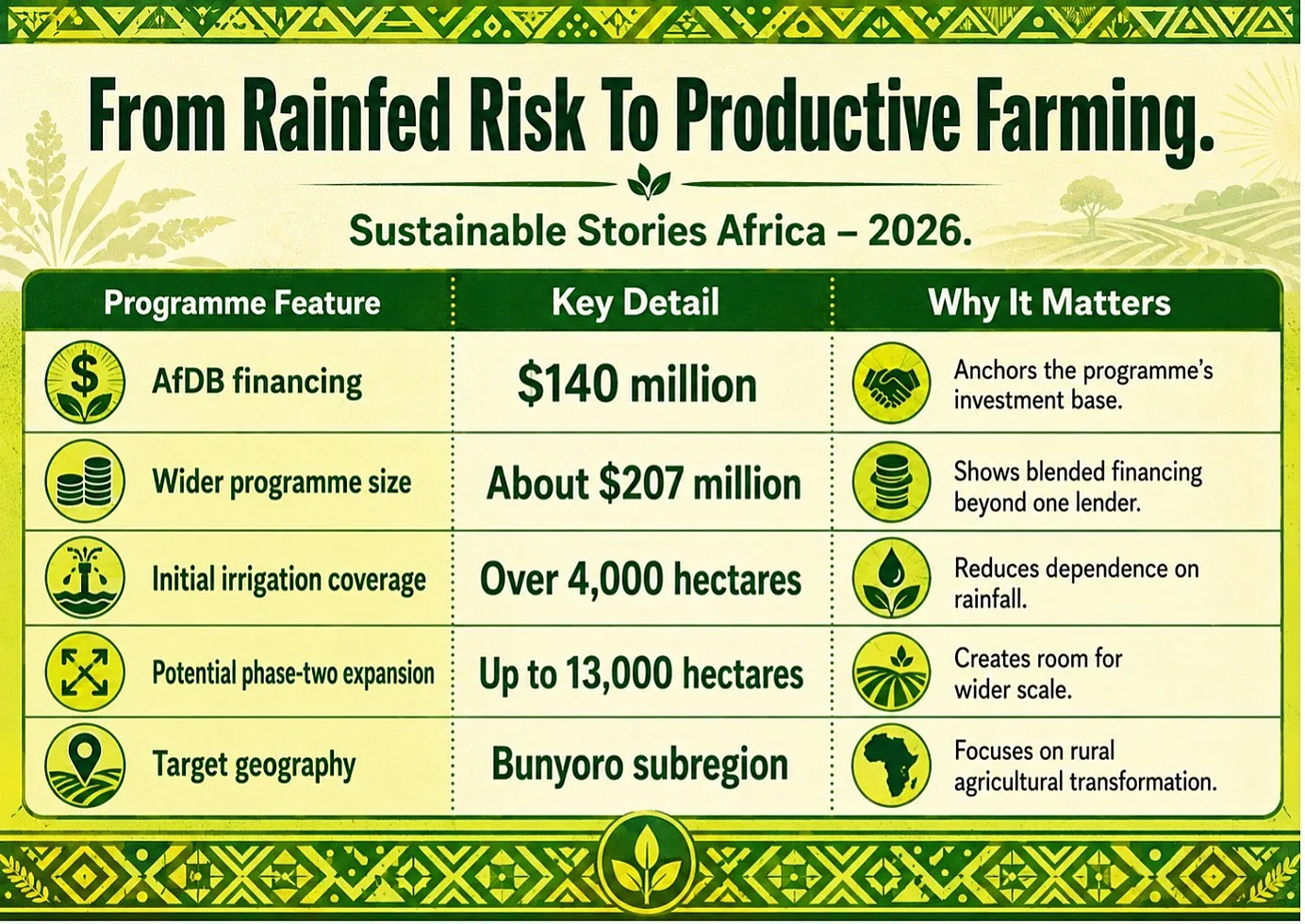
That is the development challenge behind the African Development Bank Group’s approval of a $140 million loan to support Uganda’s Multipurpose Water for Climate Resilient Irrigation Development and Agro-Industrialisation Programme.
The financing, provided through the African Development Fund, is part of a wider $207 million programme designed to expand irrigation, strengthen agro-industrialisation, create jobs and raise rural incomes.
The programme will focus on Uganda’s Bunyoro subregion, where many rural households depend heavily on rain-fed agriculture.
It will support the construction of a large-scale water conveyance system connected to irrigation networks, initially covering more than 4,000 hectares, and potentially expanding to 13,000 hectares in a second phase.
The core story is not only about water infrastructure. It is about reducing the uncertainty that keeps smallholder farmers vulnerable, processors under-supplied, and rural economies trapped below their productive potential.
From Rainfed Risk To Productive Farming
Uganda's agricultural economy holds enormous promise; however, climate volatility remains a persistent threat.
Late rains, early dry spells and erratic weather compress yields, destabilise incomes and push farming households into cycles of debt and food insecurity.
An AfDB-backed programme, co-financed by the OPEC Fund, the End School Age Hunger Fund and the Government of Uganda, seeks to rewrite that story.
Beyond irrigation, it deploys climate-smart technologies including certified seeds, soil restoration, livestock watering points and mobile veterinary services.
Critically, the programme extends to post-harvest systems, storage, aggregation and cold-chain infrastructure, recognising that higher yields without market access still leave farmers exposed to losses and weak bargaining power.
The financing model itself signals a wider shift: agriculture is increasingly treated not as a social sector, but as infrastructure, climate adaptation and enterprise policy combined, with measurable returns for farmers and economies alike.
Irrigation Can Build Rural Enterprise
Done well, Uganda's irrigation programme could shift rural economies from subsistence pressure to surplus-driven growth, delivering three interconnected gains.
- First, food security: reliable water access enables consistent production regardless of rainfall.
- Second, income stability: planning certainty allows farmers to negotiate, invest and expand.
- Third, agro-industrialisation: reliable supply is the foundation processors need, in volume, quality and timing, to operate efficiently and draw farmers into higher-value markets.
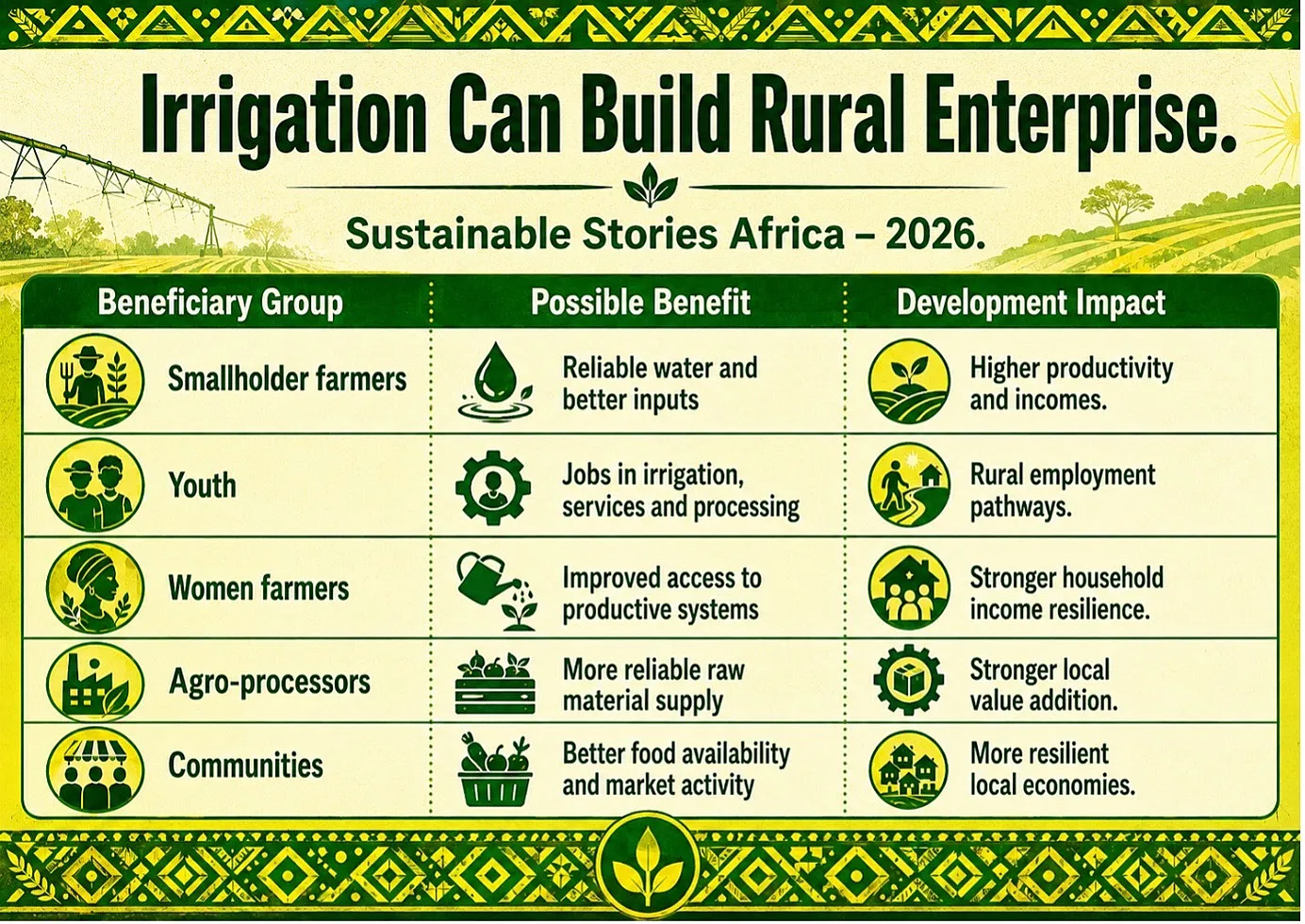
The programme's real value lies in the chain it builds, from irrigation to storage, cold-chain to processing, output to income.
However, execution will decide the outcome.
Infrastructure without maintenance, water without markets, or processing facilities hampered by weak roads and power supply can quietly erode even the most well-financed opportunity.
Delivery Must Reach Farmers First
Uganda’s next task is to ensure that the programme becomes visible in farmers’ lives, not only in project documents.
That means transparent procurement, strong community engagement, clear land and water-use arrangements, gender-sensitive access, reliable extension services and maintenance models that keep irrigation systems working after construction.
Financial institutions and private investors also have a role.
- Irrigation can de-risk lending to farmers and agribusinesses if paired with aggregation, insurance, offtake contracts and market information.
Development partners should measure success not only by hectares irrigated, but also by yields, incomes, jobs, reduced food losses, and women’s participation.
For African markets, the lesson is clear: climate adaptation must become productive infrastructure.
Water management, rural roads, storage, energy, extension and finance need to work together if agriculture is to create jobs at scale.
Uganda’s programme arrives as a strong example of how climate resilience and agro-industrialisation can open the way as an investment pipeline.
Path Forward – Make Irrigation Deliver Jobs And Resilience
The priority now is disciplined implementation: build the infrastructure, support farmers, protect water systems and connect production to markets.
If Uganda gets this right, the AfDB-backed programme can advance food security, climate adaptation, ESG-aligned investment and rural industrial growth.
The real question is whether access to water becomes a lasting income for communities.