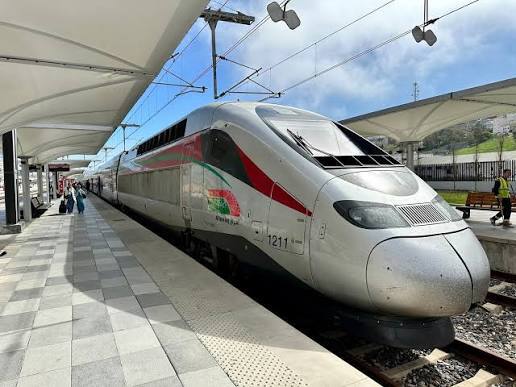
The African Development Bank has approved €205 million to expand Morocco’s high-speed rail network and modernise the Kenitra–Marrakech corridor.
The financing arrives as passenger demand, freight volumes and preparations for 2030 place greater pressure on the Kingdom’s transport system.
Beyond faster trains, the investment could shorten daily journeys, lower logistics costs and strengthen Morocco’s position between African and European markets.
A €205 Million Bet on Movement
Morocco’s next phase of rail modernisation has secured a major financial boost after the African Development Bank Group approved €205 million for the Rail Infrastructure Development Support Project, known by its French acronym, PADIF, on July 8, 2026.
The operation will extend the country’s high-speed rail line and upgrade conventional infrastructure along the Kenitra–Marrakech corridor, one of Morocco’s busiest passenger and freight routes.
It will also target capacity constraints around the Casablanca rail hub, where national mobility, commerce and urban growth increasingly converge.
A traveller moving between Casablanca and Marrakech, the institutional language translates into a straightforward promise: a journey that is faster, more reliable and less exposed to congestion.
For manufacturers, exporters and logistics operators, it means the ability to move goods with fewer delays and less friction.
Where Speed Meets Morocco’s Economic Spine
AfDB financing will fund new rails, switches, and track components for Morocco's conventional and high-speed networks, as well as engineering supervision and monitoring.
Country Manager Achraf Tarsim says the approach will "accommodate growing passenger and freight traffic, facilitate trade flows, and reduce travel times."
This fits a larger transformation: the 430-kilometre Kenitra–Marrakech high-speed programme, linking Kenitra, Rabat, Casablanca, and Marrakech with integrated airport connectivity, forms part of a broader $9.6 billion (MAD96 billion) railway investment plan.
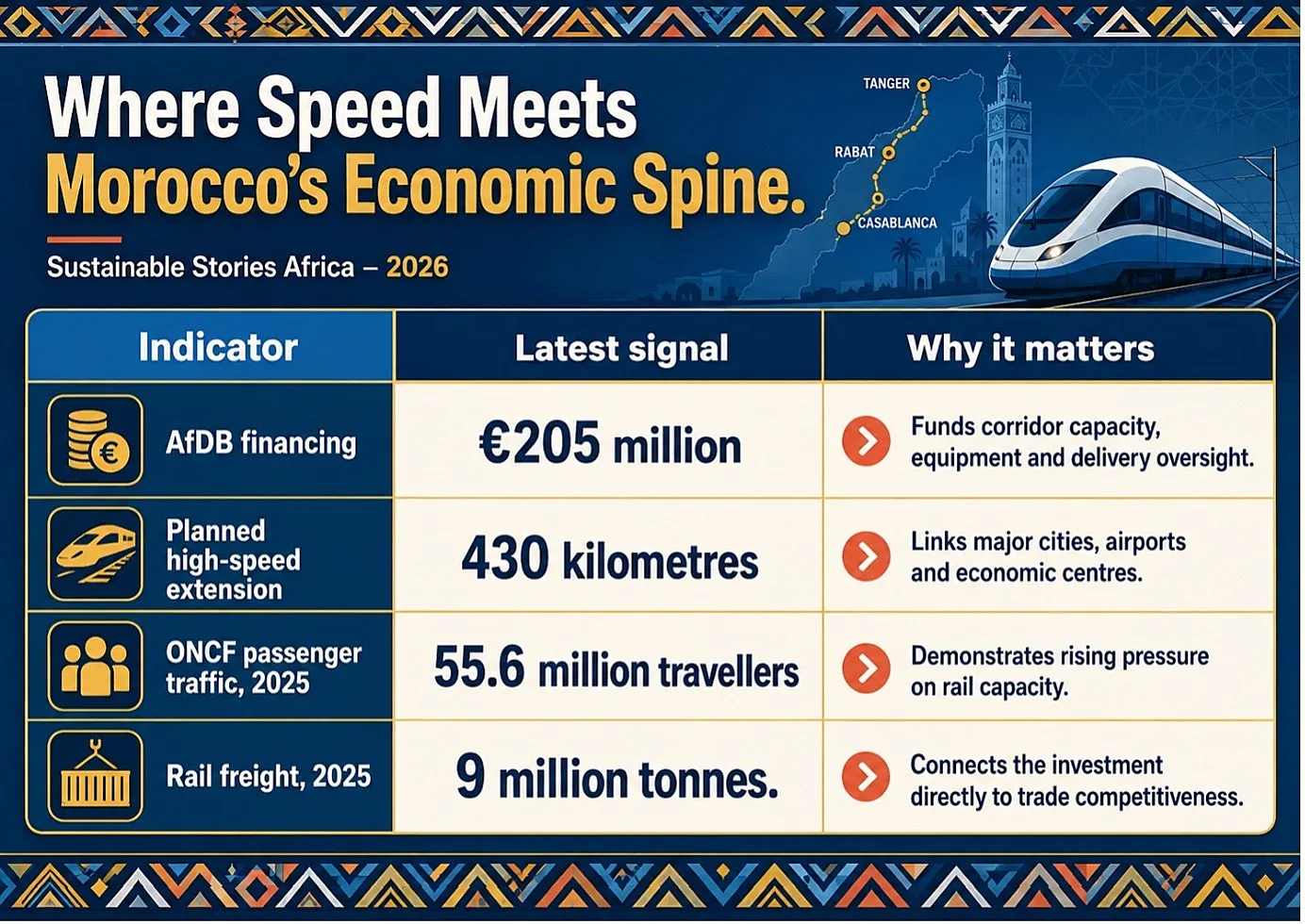
Demand underscores the urgency. ONCF carried 55.6 million passengers in 2025, including 5.6 million via Al Boraq, Africa's only high-speed rail service.
Freight rose 6% to nine million tonnes, while phosphate volumes climbed over 12% to 14.2 million tonnes, making this less a prestige project than a necessary response to surging network demand.
Faster Journeys, Stronger Trade, Lower Friction
The strongest case for investment lies not in speed alone, but in what speed enables: wider access to jobs and services, easier tourism circuits, and more predictable links between production centres, ports, airports, and consumer markets.
Rail also allows Morocco to absorb transport growth while cutting reliance on carbon-intensive mobility. ONCF's 2024 assessment recorded a 26% reduction in greenhouse-gas emissions, pairing expansion with measurable decarbonisation.
The programme carries a domestic dividend too: around 150 companies, nearly two-thirds Moroccan, were engaged by April 2026, converting infrastructure spending into local contracts, jobs, and lasting engineering capability.
The 2030 FIFA World Cup, co-hosted with Spain and Portugal, sets a visible deadline, but the real test comes after, whether the network keeps lowering costs and strengthening competitiveness.
Delivery discipline must match ambition. Morocco and the financing partners must protect timelines, control costs, publish progress, and shield communities from construction disruptions.
Procurement controls and outcome tracking should measure more than kilometres, covering journey times, reliability, freight shift, emissions, and access. With nearly €15 billion committed to over 150 Moroccan projects since 1978, AfDB's PADIF should now model mature development finance: not just funding assets, but building a transparent, resilient, inclusive mobility system.
Path Forward - Morocco's Rail Corridor: Benefits Must Travel
Morocco’s priority is to deliver the corridor with transparent governance, rigorous safeguards and measurable passenger, freight and emissions outcomes.
Coordinated planning must connect the new capacity with urban transit, airports, ports and regional development.
If PADIF is executed well, it can advance climate-aligned mobility, improve territorial inclusion and strengthen Morocco’s logistics position.
Its lasting success will be judged not by train speed alone, but by how widely the economic and social benefits travel.